


Quick Take:
- Milestone: India’s first FMCG brand to cross Rs 1 lakh crore (Rs 1 trillion) in turnover
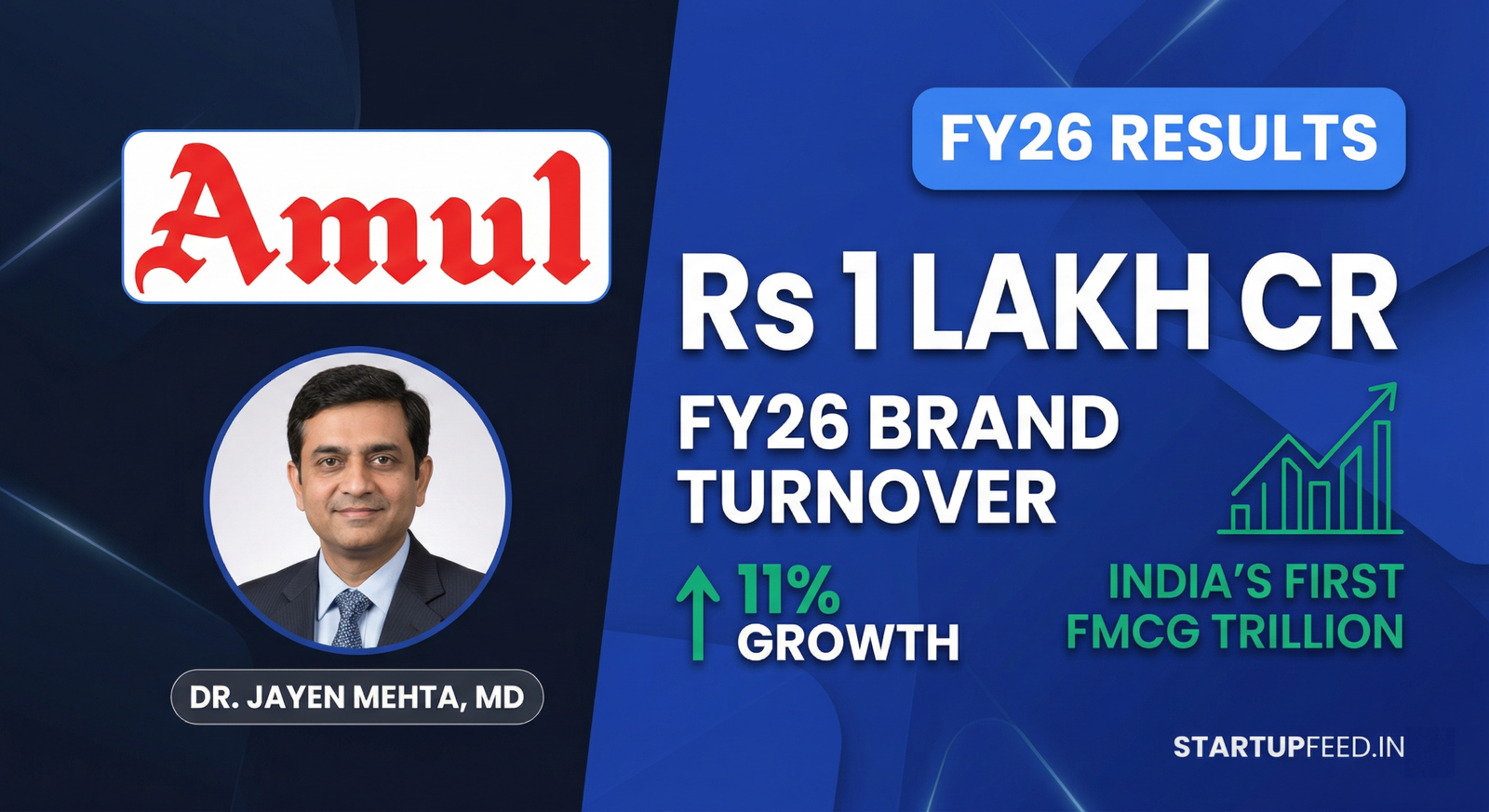
- Brand Turnover FY26: Rs 1,00,000+ Cr — up 11% from Rs 90,000 Cr in FY25
- GCMMF Turnover: Rs 73,450 Cr (+11.4% YoY) — India’s largest FMCG organisation
- Farmer Network: 3.6 million (36 lakh) dairy farmers across India
- Global Reach: 50+ countries | Fresh milk now in Europe and the US
- Next Target: 10 new international markets in next 12 months; Africa and Southeast Asia next
Amul, the Gujarat Cooperative Milk Marketing Federation’s flagship dairy brand, has become India’s first FMCG company to cross Rs 1 lakh crore (Rs 1 trillion) in brand turnover — registering 11% growth in FY26 over a Rs 90,000 Cr base in FY25. The milestone, announced on April 5, 2026, marks a landmark moment for Indian cooperatives, dairy, and consumer goods simultaneously.
GCMMF, which markets Amul products across India and 50+ countries, also reported its own sales turnover rising 11.4% to Rs 73,450 Cr in FY26, cementing its position as India’s largest FMCG organisation. The difference between the brand total and GCMMF’s own figure reflects sales by 18 member district cooperatives and cattle feed revenue — not double-counted, but additive.
StartupFeed Insight
What the numbers say: Amul’s Rs 1 lakh crore is not a vanity milestone — it is the outcome of India’s most efficient distribution architecture operating across 97% of the country, now being exported to the world. No listed FMCG company in India — not HUL, ITC, or Nestlé — has crossed this revenue threshold.
What this means for you —
If you’re a founder: Amul’s model proves that cooperative structures can scale to trillion-rupee revenue without external capital — the Rs 1 lakh crore was built on farmer ownership and compounding distribution. There is a lesson here for community-first business models in agritech, rural fintech, and food supply chains.
If you’re an investor: The dairy sector in India is at an inflection point. Amul’s scale and the premium category growth (protein, probiotic, cheese, organic) signal that Indian consumers are upgrading beyond commodity dairy — creating space for value-added dairy startups and D2C brands in categories Amul’s cooperative model cannot serve with speed.
If you’re an employee: Amul employs and sustains 36 lakh farmers directly. This is India’s most successful wealth distribution mechanism in the consumer economy — and it is accelerating, not plateauing.
Our prediction: Amul’s brand turnover will cross Rs 1.2 lakh crore in FY27 as the 10 new international markets contribute meaningfully. The fresh milk launch in Europe and the US — if sustained — positions Amul as the first Indian dairy brand with a genuine global-market presence by FY28.
Revenue Breakdown — What the Rs 1 Lakh Crore Consists Of
| Entity | FY25 | FY26 | Growth |
| Amul Brand Turnover (Total — unduplicated) | Rs 90,000 Cr | Rs 1,00,000+ Cr | +11% YoY |
| GCMMF Sales Turnover (marketing arm only) | Rs 65,911 Cr | Rs 73,450 Cr | +11.4% YoY |
| Gap (district union dairies + cattle feed) | Rs 24,089 Cr | Rs 26,550 Cr | Included in brand; excluded from GCMMF |
The GCMMF clarified that the Rs 1 lakh crore brand figure is unduplicated total revenue — meaning each rupee is counted only once. It includes GCMMF’s own Rs 73,450 Cr, plus the sales of 18 member district cooperative dairies in cities like Anand, Rajkot, Vadodara, Surat, Valsad, and Godhra — which sell milk and dairy under the Amul brand locally but report separately — as well as cattle feed sales in Gujarat.
Amul at a Glance — Operating Scale
| Operating Metric | Scale |
| Dairy Farmer Members | 3.6 million (36 lakh) across India |
| Milk Collected Daily | 31 million litres per day |
| Product Packs Sold Annually | Over 24 billion packs |
| SKUs / Product Packs | More than 1,200 product packs |
| Countries Served | 50+ countries |
| Member District Cooperatives | 18 district cooperative unions |
| New International Markets (FY27 Plan) | 10 additional markets in next 12 months |
| Domestic Penetration Focus | Towns with population of 5,000+ |
| Global Rank (ICA) | World’s #1 cooperative (International Cooperative Alliance ranking) |
What Drove the Rs 1 Lakh Crore
| Growth Driver | Action Taken | Why It Matters |
| Domestic Distribution | Penetrating towns with population 5,000+ | India’s semi-urban growth engine; low existing dairy brand penetration |
| Product Diversification | Protein, probiotic, organic products + value-added dairy (buttermilk, cheese) | Higher margin categories; health-conscious urban consumer growth |
| International Expansion | Fresh milk launched in Europe (Spain/EU) and United States | Indian diaspora + local market premium positioning; first fresh milk in these markets |
| H2 FY26 Momentum | High double-digit growth in the second half of FY26 | Seasonal demand, festive sales, and expanded distribution all accelerated in H2 |
| New Geographies | Africa and Southeast Asia expansion underway; 10 new markets in 12 months | Emerging market populations with rising dairy consumption and Indian community presence |
| House of Brands | Amul dominates dairy; now growing in cheese, ghee, ice cream, whey protein | Each category entering high-growth phase as Indian middle class upgrades consumption |
MD Jayen Mehta specifically called out the domestic distribution push — penetrating towns with populations above 5,000 — as the primary growth engine. These towns represent the largest underserved white space in India’s organised FMCG market. Amul’s cooperative model, with its merchant-owned last-mile distribution, is structurally better positioned to serve these markets than margin-dependent listed FMCG players.
The second half of FY26 delivered high double-digit growth — accelerating from the full-year 11% average. This suggests the distribution and product diversification investments made earlier in FY26 are compounding into the H2 numbers.
What the Leadership Said
“Crossing the Rs 1 lakh crore brand turnover is a testament to the trust of millions of consumers and the tireless hard work of our 36 lakh dairy farmers.”
— Ashokbhai Chaudhary, Chairman, GCMMF (Amul)
“Our journey to the Rs 1 lakh crore milestone is a definitive victory for the cooperative spirit. By scaling our model nationally, we are proving that the ‘Amul Model’ is a timeless blueprint for economic democracy.”
— Gordhanbhai Dhameliya, Vice Chairman, GCMMF (Amul)
“We are not just expanding our operations globally; we are expanding the very definition of what a farmer-owned institution can achieve in the modern world, ensuring that the fruits of technology and global trade reach the hands of the producers.”
— Dr. Jayen Mehta, Managing Director, GCMMF (Amul)
Mehta also added context on product strategy: “We have focused heavily on product diversification which includes protein, probiotic and organic products that are also seeing a strong growth rate. Even milk-related categories, which include value-added products like buttermilk and cheese, are growing very well.”
How Amul Compares — India’s FMCG Revenue Landscape
| Company | Revenue (Latest FY) | Approx. Growth | Key Differentiator |
| Amul (GCMMF + unions) | Rs 1,00,000+ Cr (FY26) | +11% YoY | First Rs 1L Cr FMCG brand; cooperative structure; 36L farmers |
| Hindustan Unilever (HUL) | ~Rs 62,000 Cr (FY25) | ~2–4% YoY | Multi-category FMCG leader; personal care, home care, foods |
| ITC (FMCG segment) | ~Rs 22,000 Cr (FY25) | ~9% YoY | Aashirvaad, Bingo, Sunfeast; agri-business integration |
| Nestlé India | ~Rs 19,000 Cr (FY25) | ~9% YoY | Maggi, Nescafé, Kit Kat; premium nutrition focus |
| Britannia Industries | ~Rs 16,500 Cr (FY25) | ~5% YoY | Biscuits, dairy, snacks; rural distribution |
The context is striking: HUL, ITC, and Nestlé combined — India’s three most widely tracked listed FMCG companies — have not individually crossed Rs 1 lakh crore in revenue. Amul has done it as a cooperative, without being listed on a stock exchange, and without any external equity capital in the traditional sense.
India’s overall FMCG market is projected to reach Rs 10.2 lakh crore (approximately $122 Bn) by 2026, growing at 9–11% CAGR. Amul’s Rs 1 lakh crore represents approximately 10% of that market — in a single brand.
The Global Push — From Anand to Europe and the US
Amul’s international strategy has shifted from exporting processed dairy to competing in fresh dairy — the highest-margin, highest-trust category in any grocery market. The launches of fresh Amul milk in Spain, the EU, and the United States are not just export plays — they are brand positioning plays in markets where Indian dairy brands have historically had no presence.
The target audiences are dual: the Indian diaspora (which brings immediate brand recognition and loyalty) and local consumers who are increasingly interested in natural, non-corporate, cooperative-origin dairy. Both are high-value, premium-willing segments.
The next wave: Mehta confirmed Amul is expanding into Africa and Southeast Asia and plans to enter 10 additional international markets in the next 12 months. These are dairy-deficit or dairy-transitioning economies with growing middle classes and established Indian diaspora communities — a near-perfect export profile.
The Amul Model — Why It Worked at Rs 1 Lakh Crore
Founded in 1946 from the cooperative dairy movement in Anand, Gujarat — inspired by Sardar Vallabhbhai Patel and built by Dr. Verghese Kurien — the Amul model functions on three principles: farmer ownership of surplus, cooperative aggregation of supply, and professional management of marketing.
The model creates structural advantages that listed FMCG companies cannot replicate:
- Cost of milk: Because farmers are owners, not suppliers, Amul’s procurement cost is structurally lower than any private dairy company’s sourcing cost — and farmers share in the surplus rather than seeing it flow to shareholders.
- Scale without margin pressure: Amul does not need to deliver quarterly earnings per share growth. It can invest in distribution, product development, and new markets with a 5–10 year horizon — something listed peers cannot do without analyst pressure.
- Brand trust at zero advertising cost per unit: Amul’s advertising (the iconic Amul girl has run since 1966) is one of India’s most efficient brand investments. At Rs 1 lakh crore turnover, the brand’s recognition is universal and self-reinforcing — each new product benefits from the halo instantly.
- Distribution density: 19 lakh+ retail outlets reaching 97% of India’s pin codes. No new-age D2C brand, startup, or listed FMCG company has built this from scratch — it took Amul 75+ years.
What’s Next
Mehta confirmed that Amul expects to continue growing in double digits — a target that, at Rs 1 lakh crore, means adding roughly Rs 10,000–12,000 Cr in absolute turnover each year. The next milestone is Rs 1.2 lakh crore in FY27.
Three things to watch: First, whether the fresh milk launch in Europe and the US gains enough scale to be disclosed as a meaningful revenue line in the next annual update. Second, whether Amul’s protein and probiotic category — positioned for India’s health-conscious urban segment — can grow faster than the core milk business and shift the mix toward higher-margin products. Third, whether the Sardar Patel Cooperative Dairy Federation Limited (SPCDF), launched in July 2025 to integrate village-level dairies outside Gujarat into a national network, starts contributing to the Amul brand’s overall scale.
The Rs 1 lakh crore milestone is not the end of the story — it is the beginning of Amul’s global chapter. A farmer-owned cooperative from Anand, Gujarat reaching Rs 1 trillion is one of independent India’s most remarkable economic achievements. The next chapter is whether the same model can build India’s first globally recognised dairy brand.
What do you think? Will Amul cross Rs 1.5 lakh crore by FY29? Share your view on X @StartupFeed_official

