


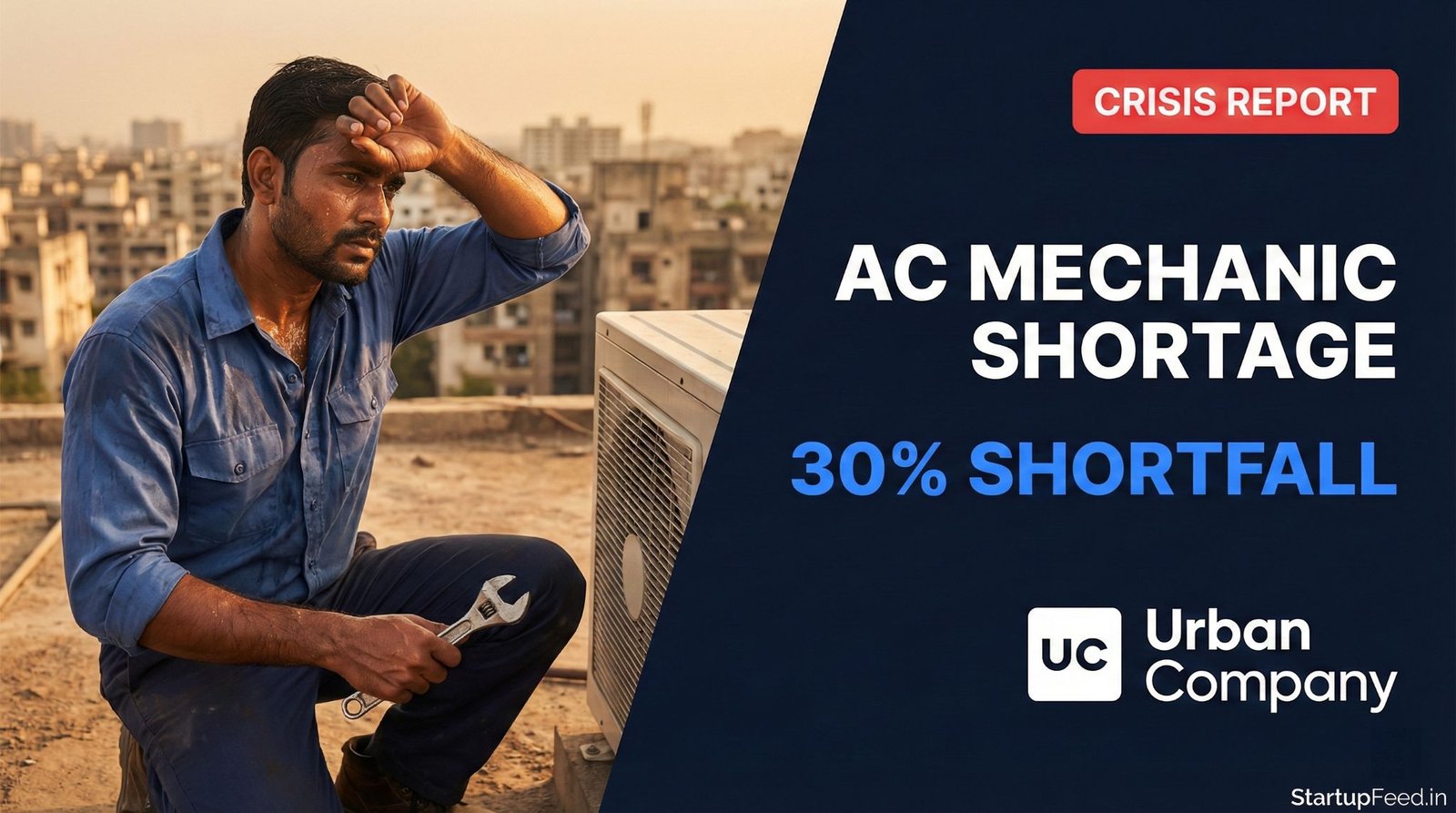

Quick Take:
- Growing Gap: While India’s AC market grows at 15–18% annually, the supply of trained technicians is only increasing by 4–5%.
- Impending Crisis: A leaked 2026 memo from Urban Company warns of a 30% technician shortfall, with wait times in Delhi-NCR expected to triple to 4–5 days.
- High Earnings: Top-performing technicians can earn ₹60,000 to ₹90,000 per month during peak season—often surpassing white-collar graduate salaries.
- New Solutions: Startups are using augmented reality (AR) and app-based modules to fast-track training for the 500,000 additional technicians needed by 2028.
- Consumer Advice: To avoid higher costs and long delays, homeowners are encouraged to book servicing in February or early March.
While the world obsesses over artificial intelligence and large language models, a far more urgent crisis is unfolding across urban India. The AC mechanic shortage in India has reached alarming levels, and it is set to affect millions of households this summer. According to a leaked internal memo from Urban Company, the country faces a staggering 30% shortfall in trained AC technicians as temperatures prepare to shatter records in March 2026.
Moreover, this is not merely a supply-chain hiccup. It is a structural failure that reveals deep cracks in India’s skilled labour ecosystem. In addition, it highlights a billion-dollar blue-collar startup opportunity that entrepreneurs and investors are only now beginning to understand. Consequently, the most in-demand job of 2026 is not in silicon—it is in servicing your split AC.
1. The Leaked Memo That Shook the Gig Economy
In early February 2026, an internal memo from Urban Company—India’s leading home services platform—was leaked to the media. The document painted a grim picture. It warned leadership that the platform would be unable to fulfil nearly one-third of incoming AC service requests during the peak summer months. Furthermore, the memo cited a critical gap between the demand surge projected for March through June and the available pool of certified AC technicians on the platform.
The implications were immediate. As a result, social media erupted with commentary. Homeowners worried about delayed repairs, while gig workers saw an opportunity to negotiate better wages. Meanwhile, investors began looking at the blue-collar services space with renewed interest. In essence, one leaked document managed to expose a problem that had been simmering for years.
2. Understanding the AC Mechanic Shortage in India
To understand why the AC mechanic shortage in India has become so severe, you need to look at the numbers. India’s room air conditioner market has been growing at a compounded annual rate of 15–18% over the last five years. However, the supply of trained HVAC technicians has grown at barely 4–5% annually during the same period. This widening gap has created a perfect storm.
Additionally, the problem is compounded by several structural issues. First, there is a significant social stigma attached to blue-collar technical work in India. Second, vocational training institutes (ITIs) remain underfunded and outdated in their curriculum. Third, the gig economy model—while providing flexibility—has not offered the wage stability needed to attract and retain skilled workers in the long term. As a consequence, many trained technicians migrate to Gulf countries for higher pay, further depleting the domestic workforce.
3. Why 2026 Is the Year Everything Breaks
Record Heatwave Projections Worsen the AC Mechanic Shortage
The India Meteorological Department (IMD) has issued early warnings that March 2026 could see temperatures exceeding 45°C across North India, parts of Rajasthan, and the Deccan Plateau weeks earlier than usual. Therefore, the demand for AC installations, servicing, and repairs will spike dramatically and much sooner than in previous years.
In addition, India’s AC penetration rate has crossed the 12% mark nationwide, up from just 7% in 2020. While this is still low compared to global averages, the absolute numbers are staggering—over 80 million installed AC units now require annual maintenance. Consequently, even a modest shortfall in technicians translates into millions of unserviced units and frustrated consumers.
4. The Blue-Collar Startup Opportunity Nobody Saw Coming
Here is where the narrative shifts from crisis to opportunity. The AC mechanic shortage in India is not just a problem—it is arguably the biggest untapped business opportunity in the Indian gig economy. Entrepreneurs and venture capitalists are beginning to take notice.
For instance, several early-stage startups have emerged with models focused specifically on HVAC technician training, certification, and placement. These companies are building “skilling academies” that can train a worker in AC repair within 8–12 weeks. Furthermore, some platforms are experimenting with micro-financing to help aspiring technicians purchase their own tool kits and become independent contractors.
Similarly, existing players like Urban Company, Housejoy, and regional service aggregators are investing heavily in upskilling programmes. However, the scale of the problem dwarfs current efforts. Industry analysts estimate that India needs an additional 500,000 trained AC technicians by 2028 to meet projected demand. As a result, the race to fill this gap is intensifying rapidly.
5. What Urban Company’s Internal Data Reveals
The leaked memo contained more than just a supply warning. It also revealed key operational data points that illustrate the depth of this crisis. According to the document, the average wait time for an AC servicing appointment in Delhi-NCR jumped from 1.5 days in March 2025 to a projected 4–5 days in March 2026. In Tier-2 cities like Jaipur, Lucknow, and Nagpur, the situation is expected to be even worse.
Key Statistics from the Leaked Memo:
| Metric | Data Point |
| Technician Shortfall | 30% gap vs. projected demand |
| Avg. Wait Time (Delhi-NCR) | 4–5 days (up from 1.5 days in 2025) |
| AC Units Needing Service (India) | 80 million+ installed base |
| Annual Technician Growth Rate | 4–5% (vs. 15–18% AC market growth) |
| Additional Technicians Needed by 2028 | 500,000+ |
| Peak Demand Period | March–June 2026 |
6. How the AC Mechanic Shortage Affects You Directly
This is not an abstract economic discussion. The AC mechanic shortage in India will hit consumers in very real, very uncomfortable ways. Specifically, you can expect longer wait times for AC servicing and repair, higher service charges as demand outstrips supply, an increase in unqualified or unlicensed technicians offering cut-rate services, greater risk of improper installations leading to safety hazards and warranty voidance, and a spike in electricity bills due to poorly maintained units running inefficiently.
Importantly, the impact will be disproportionately felt by middle-class households that rely on a single AC unit. Wealthier households with annual maintenance contracts from premium brands will be better insulated. However, the vast majority of Indian AC owners—who depend on on-demand platforms or local mechanics—will bear the brunt of this shortage.
7. Solutions: Can India Bridge the Technician Gap?
Government Initiatives to Address the AC Mechanic Shortage in India
The Government of India has been running the Skill India Mission since 2015, and HVAC training is technically part of the programme. Nevertheless, the results have been underwhelming. Placement rates from ITIs remain below 40%, and course curricula have not been updated to reflect modern inverter AC technology. Therefore, a significant overhaul is needed.
Private Sector and Startup Solutions
On the other hand, the private sector is moving faster. Companies like Daikin, Voltas, and Blue Star have launched their own technician certification programmes. In addition, edtech-meets-skillingtech startups are developing app-based training modules that allow aspiring technicians to learn on their smartphones. These programmes include augmented reality (AR) simulations for complex repair scenarios, which significantly reduce training time.
Furthermore, some states like Rajasthan and Gujarat have announced partnerships with industry bodies to fast-track HVAC certification. If these pilot programmes succeed, they could serve as a model for national scale-up. Ultimately, solving the AC mechanic shortage in India requires a coordinated effort between government, industry, and the gig platforms themselves.
8. The Bigger Picture: Gig Economy and Skilled Labour
The AC repair crisis is a symptom of a much larger disease. India’s gig economy, valued at over $60 billion, has largely focused on delivery and ride-hailing. Skilled services—plumbing, electrical work, HVAC repair—have been treated as secondary. As a result, there has been chronic underinvestment in training and worker welfare in these trades.
However, this is beginning to change. The AC mechanic shortage in India has served as a wake-up call. Investors are now asking: if AI engineers command $200K salaries in the West, why can’t India create a system where skilled AC technicians earn a stable, respectable income? In fact, the top-performing AC technicians on Urban Company already earn between ₹60,000 and ₹90,000 per month during peak season—more than many white-collar graduates.
This reframing of blue-collar work as a viable, even aspirational career path is perhaps the most significant cultural shift emerging from this crisis. Consequently, the long-term impact could reshape how India thinks about vocational education, labour dignity, and economic mobility.
9. FAQs About the AC Mechanic Shortage in India
Q1: Why is there an AC mechanic shortage in India in 2026?
India’s AC market has grown 15–18% annually, but the supply of trained technicians has only grown 4–5%. Combined with record heatwave projections and increasing AC penetration, the gap has become a crisis. Urban Company’s leaked memo confirmed a 30% shortfall in available technicians for the 2026 summer season.
Q2: How does the AC mechanic shortage affect consumers?
Consumers will face longer wait times for AC repairs, higher service charges due to demand-supply imbalance, and a greater risk of encountering unqualified technicians. In addition, poorly maintained ACs consume significantly more electricity, leading to inflated power bills.
Q3: Is AC repair a good career choice in India?
Absolutely. Top AC technicians on platforms like Urban Company earn between ₹60,000 and ₹90,000 per month during peak season. With training programmes becoming more accessible and the demand-supply gap widening, AC repair is arguably one of the most lucrative and in-demand skilled trades in India today.
Q4: What is being done to solve the technician shortage?
Multiple initiatives are underway. The government’s Skill India Mission includes HVAC training, though it needs modernisation. Private companies like Daikin and Voltas run certification programmes. Meanwhile, startups are developing app-based training with AR simulations to reduce learning time. Several states have also announced fast-track certification partnerships.
Q5: How can I get my AC serviced faster during the shortage?
Book your AC servicing well before peak season—ideally in February or early March. Consider signing up for an annual maintenance contract (AMC) with your AC brand or a reputed service platform. This ensures priority scheduling and typically guarantees a technician visit within 24–48 hours.
10. Final Thoughts
The AC mechanic shortage in India is more than a seasonal inconvenience. It is a structural crisis that exposes the fault lines in the country’s skill development infrastructure. At the same time, it represents a massive opportunity for entrepreneurs, investors, and young Indians willing to embrace skilled trades.
In conclusion, the most in-demand job of 2026 is not in artificial intelligence—it is in AC repair. And if India acts swiftly, this crisis could become the catalyst that finally gives blue-collar workers the recognition, training, and compensation they deserve.