Quick Take
| Event: | 15th Annual Convocation, IIM Raipur — April 4, 2026 |
| Speaker: | S. Jaishankar, External Affairs Minister of India |
| Key Message: | Ease of living improvements + startup ecosystem growth are core pillars of India’s top-5 economy rise |
| Global Context: | West Asia conflict, Russia-Ukraine war — India has navigated both successfully |
| Signal for Startups: | Government at highest level validates startup ecosystem as a national growth engine |
| Vision: | Viksit Bharat 2047 — graduating MBAs and startup founders are the vanguard |
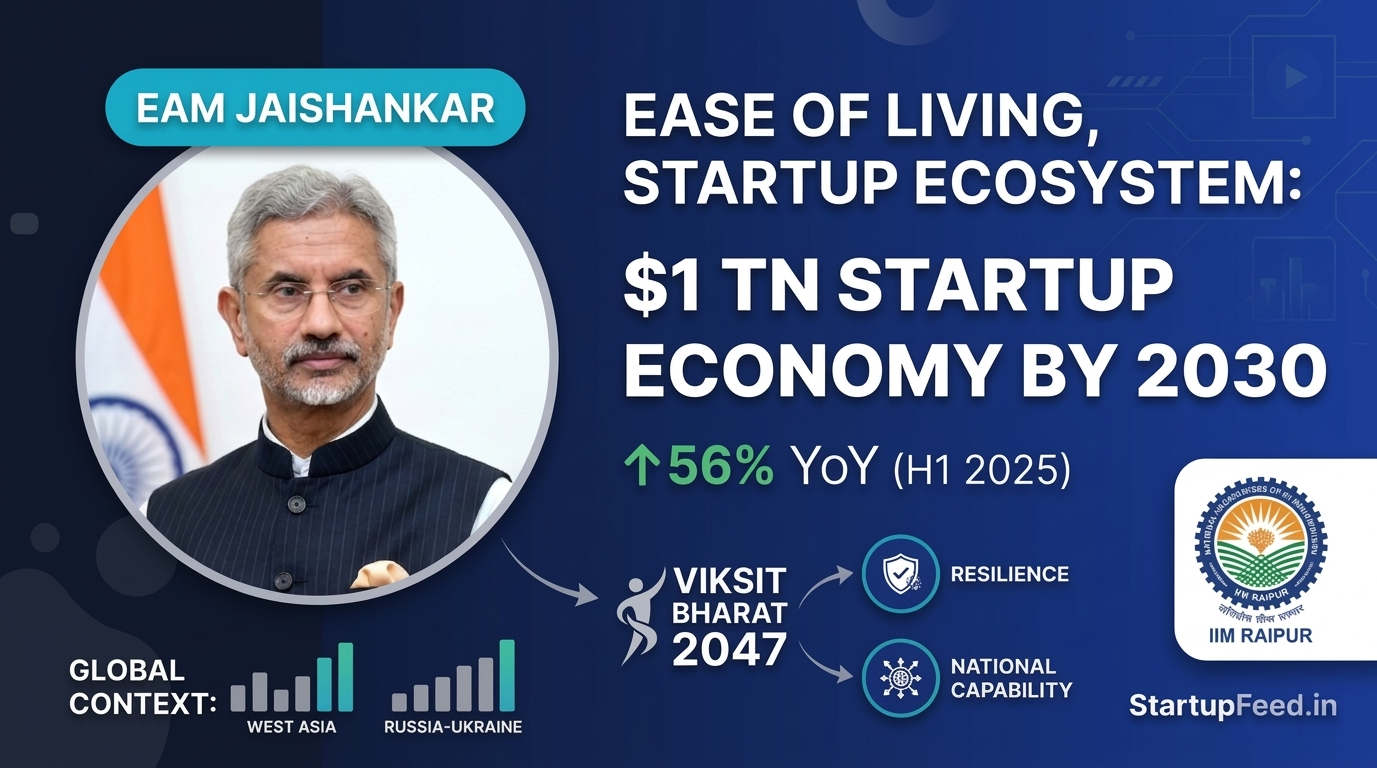
External Affairs Minister S. Jaishankar on Saturday credited India’s improved ease of living and the flourishing startup ecosystem as key contributors to the country’s emergence as a top-five global economy, while asserting that India has “solidly come through” multiple global shocks including the West Asia conflict and the Russia-Ukraine war. Addressing the 15th Annual Convocation Ceremony of IIM Raipur in Chhattisgarh, Jaishankar told the Class of 2026 that they are “beneficiaries of a solid decade of progress” and are “destined to achieve the goal of Viksit Bharat.”
StartupFeed Insight
| What this means: When the External Affairs Minister — not the Commerce or Industry Minister — speaks at a top B-school and cites the startup ecosystem as a pillar of India’s global positioning, it signals that entrepreneurship is now firmly embedded in India’s foreign policy and soft-power narrative. Winners:
Watch out for:
|
What Jaishankar Said: Key Quotes & Themes
1. India’s Top-5 Status and Resilience
We are now among the top five economies. No one can dispute that multiple global shocks have recently tested our resilience and India has come through that solidly. We have managed both domestic and external challenges fairly successfully.”
— S. Jaishankar, EAM, at IIM Raipur Convocation, April 4, 2026
Jaishankar’s remarks on India’s economic position come as the country cements its spot among the world’s five largest economies by nominal GDP, overtaking several advanced economies over the past decade. The backdrop: West Asia conflict (US-Israel strikes on Iran from February 28, 2026), the Russia-Ukraine war, COVID aftershocks, and global inflation — all of which impacted fuel supply chains and global capital flows. India navigated each, he said, through a combination of policy continuity, digital infrastructure, and decisive leadership.
2. Ease of Living and the Startup Ecosystem
The specific reference to ease of living — distinct from the better-known ‘ease of doing business’ metric — signals a broader government framing of economic progress. Jaishankar highlighted significant improvements in access to opportunities, particularly for entrepreneurs, startups and small businesses, alongside expansion of educational institutions and skill development as drivers of India’s human capital advantage.

The framing is deliberate: ease of living captures infrastructure (highways, railways, ports, airports), digital public infrastructure (UPI, Aadhaar, ONDC), healthcare access, and the reduced friction of daily economic life. All of these are direct input factors for startups — lower logistics costs, faster payments, deeper digital penetration, and a growing consumer base reaching Tier 2 and 3 cities.
3. Atmanirbhar Bharat and National Capability Building
Building national capabilities has become more critical in light of global trends. We must endeavour to build and secure within our control as many capacities as we can. Building robust national capabilities is the most effective way of de-risking and indeed even developing leverage.”
— S. Jaishankar, IIM Raipur Convocation, April 4, 2026
Jaishankar explicitly linked Atmanirbhar Bharat to food, health, energy security, and national security — four sectors where startup activity in India is intensifying. His call for “trusted partnerships” where full self-reliance is not feasible maps directly onto India’s approach to semiconductors, deeptech, and strategic manufacturing — areas where Indian startups are being actively encouraged through PLI schemes and DPIIT recognition.
4. Foreign Policy as a Startup Enabler
Our foreign policy is today focused on expanding market access for Indian producers. It promotes Brand India, essential to the perception of the country as a reliable and trusted partner.”
— S. Jaishankar, IIM Raipur Convocation, April 4, 2026
This is a direct signal for Indian SaaS companies, exporters, and startups with global ambitions. Market access through FTAs (India-UAE, India-UK negotiations, ASEAN), combined with Brand India promotion via diplomatic channels, creates soft infrastructure for Indian startup exports. The EAM’s emphasis on ‘reliable and trusted partner’ positioning is particularly relevant for Indian IT, fintech, and SaaS firms competing for global enterprise contracts.
The Startup Ecosystem Jaishankar Is Referring To: By the Numbers
| Metric | Data Point |
|---|---|
| DPIIT-recognised startups | 2 Lakh+ (as of mid-2025) | up from 500 in 2016 |
| Jobs created | 16.6 Lakh+ (DPIIT data, October 2024) |
| Unicorns | 125 (Tracxn, March 2026) | India: 3rd largest startup hub globally |
| Startup India initiative | 10 years (launched January 16, 2016) |
| H1 2025 funding | $5.7 Bn across 470 deals — India ranked 3rd globally |
| Q1 2026 funding | $2.3 Bn | 260+ startups funded | 1 new unicorn (Juspay) |
| Tier 2/3 share | ~50% of all recognised startups from Tier 2 & 3 cities |
| Women-led/co-led | 45%+ of recognised startups have women directors or partners |
| Long-term target | $1 Tn startup economy by 2030 (government projection) |
What This Means for India’s Startup Community
Validation at the highest level of government: When the EAM — one of India’s most influential ministers — explicitly names startups and small businesses as contributors to India’s top-5 economy status at an event covered by ANI and major wire services, the government’s commitment to the startup narrative gets reinforced for foreign investors, bilateral trade partners, and domestic capital allocators alike.
The ‘ease of living’ frame matters more than ‘ease of doing business’: Ease of doing business is about regulatory friction for companies. Ease of living is about the quality of life for the consumer base that startups serve. Jaishankar’s use of this framing signals that India’s startup opportunity is not just about removing business red tape — it’s about a rising, digitally connected consumer class creating demand. This is the real growth story for consumer-facing startups.
Hedging, de-risking, diversifying = opportunity for deeptech: Jaishankar’s call for national capability building in food, health, energy, and security is a direct demand signal for India’s deeptech startup community. Government-backed demand for indigenous solutions in these sectors will underpin a decade of deeptech startup formation and growth.
Brand India as a B2B sales tool: For Indian SaaS, IT, and fintech startups targeting global markets, the government’s active promotion of Brand India through FTAs and diplomatic channels creates commercial tailwinds. Indian startups should leverage India’s geopolitical stability and trusted-partner positioning as a differentiator in global enterprise sales.
What’s Next
- India’s 2026-27 Union Budget has already allocated Rs 1,000 Crore for India Semiconductor Mission 2.0 — part of the ‘national capability’ build Jaishankar referenced
- The Startup India programme, now 10 years old, is expected to announce its next phase of targets and support mechanisms in FY27
- DPIIT is expected to expand the CGSS (Credit Guarantee Scheme for Startups) coverage, addressing early-stage capital access gaps
- India’s ongoing FTA negotiations with the UK and EU, if concluded, will directly expand market access for Indian SaaS, fintech, and services startups
- With Jaishankar’s emphasis on ‘trusted partnerships’, expect more India-led bilateral tech partnerships in defence, space, semiconductors, and clean energy — all areas where startup opportunities are embedded
Liked this story? Follow StartupFeed on Google so our reporting reaches you first.