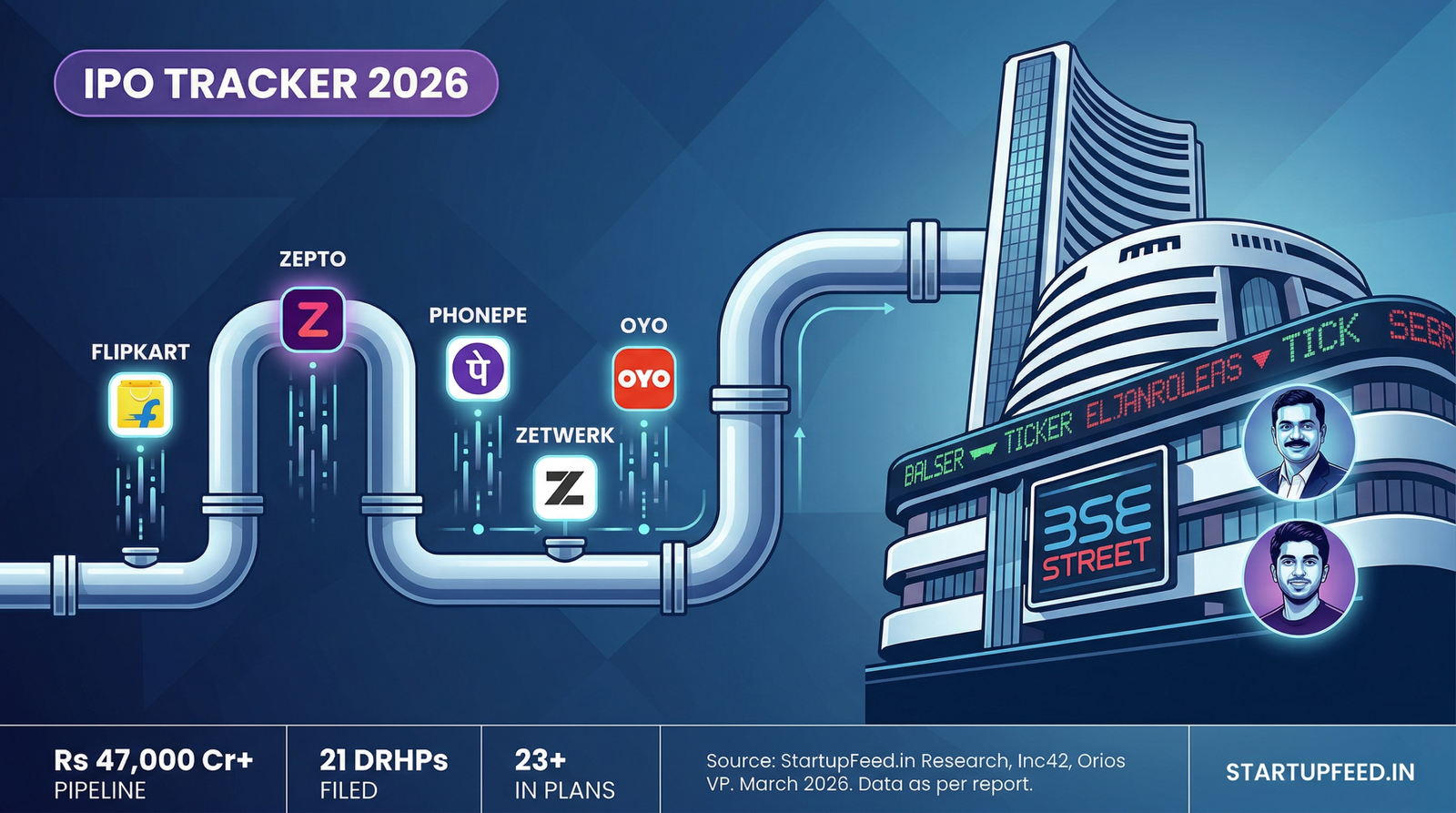
| QUICK TAKE 2025 in numbers: 18 startup IPOs | Rs 41,248 Cr raised | 371 total IPOs (mainboard + SME) | Rs 1.75 Lakh Cr ($21 Bn) total primary market capital 2026 pipeline: 21 DRHPs filed with SEBI | 23+ startups finalising plans | Rs 47,000+ Cr from top-5 unicorns alone | Recalibration defining investor expectations Investor shift: 48% of investors now cite profitability, strong fundamentals, and low cash burn as primary trigger for backing tech IPOs. |
2025: The Record-Breaking Year That Set The Stage
Dalal Street delivered a founder’s paradise in 2025. Eighteen Indian startups listed on the bourses and collectively raised a record Rs 41,248 Cr from Indian public markets. The surge was powered by a combination of macroeconomic tailwinds, regulatory reform under SEBI, and a domestic investor base that had matured significantly since the 2021–22 era.
SEBI’s simplified DRHP filing requirements reduced red tape, while more flexible ESOP rules allowed founders to retain meaningful ownership through the listing process. Robust GDP growth projections revived institutional appetite, and retail participation in mainboard IPOs hit new highs.
The total primary market raised over Rs 1.75 lakh crore ($21 billion) across 371 IPOs in 2025 — compared to 332 in 2024 and 240 in 2023. The largest deals included Tata Capital (Rs 15,511 Cr), HDB Financial Services (Rs 12,500 Cr), LG Electronics India (Rs 11,607 Cr), and ICICI Prudential AMC (Rs 10,602 Cr).
But beneath the headline numbers, a structural tension was building. A notable portion of large deals leaned heavily on OFS components — where existing shareholders sold stock rather than companies raising fresh growth capital. And nearly half of 2025’s listings are now trading below their issue prices, even after generating strong oversubscription numbers at launch. This disconnect between subscription enthusiasm and post-listing performance is the defining context for the 2026 market.
2025 Startup IPO Market — Top Listings by Issue Size

| Company | Sector | Issue Size | Listing | Post-Listing |
|---|---|---|---|---|
| Tata Capital | NBFC | Rs 15,511 Cr | Oct 2025 | Strong |
| HDB Financial Services | NBFC | Rs 12,500 Cr | 2025 | Positive |
| LG Electronics India | Consumer Electronics | Rs 11,607 Cr | 2025 | Mixed |
| ICICI Prudential AMC | Asset Management | Rs 10,602 Cr | 2025 | Positive |
| Hexaware Technologies | IT Services | TBD | 2025 | Mixed |
| 13 Other Startups | Various | Balance of Rs 41,248 Cr | 2025 | Mixed |
| Total 2025 Startup IPO Fundraise | Rs 41,248 Cr (RECORD) | |||
2026: Bigger Pipeline, Higher Bar
Building on 2025’s momentum, five new-age tech companies made their debut in the first three months of 2026. However, unlike 2025, most of these early listings have been either flat or outright lacklustre — a signal the market is sending clearly to founders and bankers preparing later-year filings.
Nevertheless, the pipeline itself is historic. Twenty-one startups have already filed their DRHPs with SEBI, while over 23 are in various stages of finalising their IPO plans. The concentration of high-value names in this cohort is unprecedented: Flipkart at a $60–70 billion valuation, Reliance Jio at a potential $170 billion valuation, PhonePe targeting a $15 billion listing, and Zepto eyeing Rs 11,000 Cr at a $7–8 billion valuation.
Unicorns like Flipkart, Zepto, OYO, InMobi and Zetwerk alone could raise over Rs 47,000 Cr in 2026, making it one of the most consequential years for startup listings in Indian capital market history. If Reliance Jio lists, that figure multiplies several times over.
| 2026 Metric | Number | 2025 Comparable | Change |
|---|---|---|---|
| DRHPs Filed (Startups) | 21+ | ~18 listed | More in pipeline |
| Startups Finalising Plans | 23+ | N/A | ↑ Strong |
| Q1 2026 Listings | 5 | Record FY in 2025 | Muted debuts |
| Top-5 Unicorn IPO Potential | Rs 47,000+ Cr | Rs 41,248 Cr (all 18) | ↑ Significantly |
| Investors Prioritising Profitability | 48% | Growth narrative era | Structural shift |
The Full 2026 Startup IPO Tracker
The following table tracks every significant new-age tech company in the 2026 IPO pipeline — from confidential DRHP filers to SEBI-approved listings and Q1 2026 debuts. Status is current as of March 30, 2026.
Status Key: Listed | SEBI Approved | DRHP Filed | Confidential | Planning | Paused
| Company | Sector | Valuation | Issue Size | IPO Type | Status | Notes |
|---|---|---|---|---|---|---|
| Flipkart | E-Commerce | $60–70 Bn | TBD | OFS + Fresh | Planning | Domicile shifted India (NCLT approval). Govt clearance pending. |
| Reliance Jio | Telecom / Digital | ~$170 Bn | TBD | Fresh + OFS | Planning | Awaiting SEBI large-cap DRHP regulations. H1 2026 target. |
| PhonePe | Fintech / Payments | ~$15 Bn | ~Rs 12,000 Cr | Pure OFS | Paused | SEBI approved. IPO paused due to West Asia conflict. June 2026 target. |
| Zepto | Quick Commerce | $7–8 Bn | ~Rs 11,000 Cr | Fresh + OFS | Confidential | Shareholder approval secured Dec 2025. July–Sep 2026 window. |
| OYO (Oravel) | Hospitality Tech | N/A | ~Rs 6,650 Cr | Fresh + OFS | Confidential | Filed confidential DRHP. Shareholder approval sought. Third IPO attempt. |
| InMobi | AdTech / SaaS | ~$13 Bn | Part of Rs 47,000+ Cr combined | TBD | Planning | Unicorn cohort. Finalising IPO plans alongside Flipkart, Zepto, OYO, Zetwerk. |
| Zetwerk | B2B Manufacturing | ~$4 Bn | ~$550 Mn | Fresh + OFS | DRHP Filed | DRHP filed March 2026. One of India’s largest B2B manufacturing IPOs. |
| NSE | Capital Markets | ~Rs 4.75 Lakh Cr | ~Rs 47,500 Cr (10% equity) | OFS | Planning | Governance/compliance issues resolved. Long-anticipated listing. |
| Fractal Analytics | AI / SaaS | N/A | ~Rs 4,900 Cr | Fresh + OFS | SEBI Approved | SEBI approved. SaaS unicorn. Founded 2000. Global enterprise analytics. |
| boAt (Imagine Mktg) | Consumer Tech | N/A | Rs 1,500 Cr | Fresh + OFS | DRHP Filed | Updated DRHP filed. Fresh issue Rs 500 Cr + OFS Rs 1,000 Cr. |
| Hero FinCorp | NBFC / Fintech | N/A | Rs 3,668 Cr | Fresh + OFS | DRHP Filed | Hero Group-backed NBFC. Major MSME and retail lending play. |
| Infra.Market | B2B Commerce | N/A | TBD | TBD | Planning | B2B construction materials unicorn. Finalising IPO plans in 2026. |
| Shadowfax | Logistics Tech | N/A | TBD | TBD | DRHP Filed | Last-mile delivery unicorn. Filed DRHP 2026. Strong FMCG/ecomm exposure. |
| Cashify | Consumer Tech | N/A | TBD | Fresh + OFS | Planning | Device buyback/refurb platform. Aiming for new shares + OFS IPO. |
| Razorpay | Fintech / Payments | N/A | TBD | TBD | Planning | Payments + agentic AI platform. Mulling 2026 IPO post redomicile. |
| SBI Mutual Fund | Asset Management | N/A | TBD (10% equity) | OFS | Planning | SBI MF hopes to launch IPO in 2026. Largest AMC in India by AUM. |
| Clean Max Enviro | Clean Energy | N/A | Rs 5,200 Cr | Fresh + OFS | SEBI Approved | Renewable energy. SEBI approved. Strong ESG investor appetite. |
| Manipal Payment | Fintech | N/A | TBD | TBD | DRHP Filed | Payment solutions platform. Part of Manipal Group. |
| Amagi | SaaS / Media Tech | Rs 7,966 Cr (~$885 Mn) | Rs 816 Cr fresh + 2.69 Cr OFS | Fresh + OFS | Listed | Listed Jan 2026 at -12.2% discount. 30.2x oversubscribed. Profitable H1 FY26. |
| Aye Finance | NBFC / Fintech | N/A | Rs 1,010 Cr | Fresh + OFS | Listed | Listed Feb 2026 at flat (issue price Rs 129). Undersubscribed 97%. Flat debut. |
| Ace Vector | Consumer / D2C | N/A | TBD | TBD | DRHP Filed | In IPO queue for 2026. |
Q1 2026 In Focus: Oversubscribed But Underperforming
The first three months of 2026 offered a revealing preview of the year ahead. Five new-age companies listed, generating solid subscription numbers but delivering disappointing post-listing returns — a pattern that is reshaping how investment banks and founders approach pricing.
Amagi — The Profitable SaaS That Still Listed At A Discount
Amagi, the cloud SaaS platform for broadcast and streaming, filed its DRHP with SEBI in July 2025 and received approval in November 2025. Its January 2026 listing was oversubscribed 30.2 times — strong institutional and HNI demand. But the stock listed at Rs 317 on BSE, a 12.2% discount to the issue price of Rs 361, and Rs 318 on NSE — 11.9% below issue price.
The irony is significant: Amagi had actually turned profitable in H1 FY26, reporting net profit of Rs 6.5 Cr against a net loss of Rs 66 Cr in H1 FY25. Yet even demonstrable profitability did not protect against a first-day discount. The market is repricing SaaS multiples globally, and Indian public investors are applying that discipline locally.
Aye Finance — The Undersubscription Warning
Aye Finance, an NBFC focused on small business lending, filed its DRHP in December 2024 and received SEBI approval in April 2025. When it finally launched its Rs 1,010 Cr IPO in February 2026, the market delivered a stark verdict: the issue closed with 97% undersubscription, with investors bidding for only 4.42 Cr shares against 4.55 Cr on offer. The stock listed flat at Rs 129 on both BSE and NSE.
Financially, Aye Finance’s net profit had declined 40% YoY to Rs 64.6 Cr in H1 FY26, even as operating revenue rose 21.8% YoY. This illustrates the specific risk profile that 2026 investors are refusing to reward: revenue growth with deteriorating profitability metrics is no longer a viable IPO story.
The Big Names: What Every Investor Is Watching
Flipkart — The Reverse-Flip Moment
Flipkart’s domestic IPO — which would be India’s largest e-commerce listing — is arguably the most consequential ‘reverse-flip’ since Walmart acquired a majority stake in 2018. The Walmart-owned platform has secured NCLT approval to shift its domicile from Singapore to India, a prerequisite for listing on Indian exchanges. Government clearance for minority shareholder protections is pending.
At a targeted valuation of $60–70 billion, Flipkart’s listing would instantly become one of the largest in Indian capital market history. Former Meta executive Dan Neary joining the board signals active IPO readiness. But the timing depends on regulatory clearances and market conditions — the company has not formally filed its DRHP.
Reliance Jio — India’s Largest IPO Ever
Reliance Jio Platforms, the digital and telecom arm of Reliance Industries, could become India’s largest-ever IPO with a valuation of up to $170 billion. Mukesh Ambani confirmed a first-half 2026 target, pending government notifications on SEBI’s recommendations for large-cap IPO regulations. Under revised norms, companies with market capitalisation above Rs 5 lakh crore may dilute only 2.5% equity, shaping Jio’s offering structure.
A Jio IPO would dwarf everything else in the 2026 pipeline combined, and its reception by domestic and global institutional investors will be read as a referendum on India’s capital market ambitions.
PhonePe — Paused, Not Cancelled
PhonePe received SEBI approval for its IPO — structured as a pure offer-for-sale by Walmart, Tiger Global, Microsoft, and General Atlantic — and filed an updated DRHP in January 2026. But in March 2026, the company temporarily paused its IPO plans citing geopolitical tensions in West Asia and volatility in global equity markets. Sources indicate the IPO has been pushed to at least June 2026.
Financially, PhonePe commands approximately 45% of India’s UPI transactions, reported FY25 revenue of Rs 7,115 Cr (up 40% YoY), and turned free cash flow positive with Rs 1,202 Cr in operating cash flow. Its adjusted net profit (excluding ESOP costs) more than tripled to Rs 630 Cr. The OFS-only structure means no fresh growth capital; all proceeds go to existing shareholders. Net loss on a GAAP basis remains at Rs 1,444 Cr in H1 FY26.
Zepto — India’s Youngest Mega IPO
Quick-commerce startup Zepto secured shareholder approval in December 2025 to raise up to Rs 11,000 Cr through its IPO, targeting a $7–8 billion valuation. The company has filed a confidential DRHP with SEBI and is targeting a July–September 2026 listing window. If successful, Zepto would be one of India’s youngest startups to launch a mega IPO and a bellwether for investor appetite in new-age retail models.
OYO — The Third Attempt
Budget hotel chain OYO — operating through parent Oravel Stays — has filed a confidential DRHP with SEBI for a Rs 6,650 Cr IPO, marking its third attempt at a public listing. The company first filed in September 2021, shelved the plans, refiled via confidential route for $600 Mn in 2023, withdrew again in May 2024, and is now back. OYO’s FY25 results provide the strongest financial case yet: net profit soared 172% to Rs 623 Cr from Rs 229 Cr in FY24, while operating revenue grew 20% to Rs 6,463 Cr.
Zetwerk — B2B Manufacturing Goes Public
B2B manufacturing platform Zetwerk filed its DRHP with SEBI in March 2026 for a $550 million IPO at a likely valuation of approximately $4 billion. This would make Zetwerk one of India’s first major B2B manufacturing unicorns to list publicly — a significant milestone for the industrial tech sector, which has long been dominated by traditional manufacturers in India’s public markets.
The Recalibration: What 2026 Investors Actually Want
The most important structural shift in the 2026 IPO market is not in the pipeline — it is in the investor mindset. The era of backing growth narratives and future profit potential is definitively over. A new, more demanding standard has taken hold.
What IPO Investors Are Prioritising In 2026
| Investor Priority | % of Investors Citing | What This Means For IPO-Bound Startups |
|---|---|---|
| Strong fundamentals, profitability, low cash burn | 48% | Must show path to profit or existing profitability. Growth alone rejected. |
| Retail participation and brand recognition | 18% | Consumer-facing brands with high retail awareness command IPO premiums. |
| Expanding domestic investor base (DIIs/SIPs) | 13% | Domestic institutional money provides floor; SIP inflows remain strong. |
| Governance, transparency, capital efficiency | Key criteria | Post-Paytm, GoMechanic era: governance failures directly affect listing premium. |
| OFS vs Fresh Issue ratio | Closely tracked | High OFS = founder/investor exits. Market rewards fresh capital for growth. |
As Rehan Yar Khan, Managing Partner at Orios Venture Partners, put it: “IPO-bound startups in 2026 will be increasingly defined by their ability to demonstrate predictable cash flows, sustainable unit economics, and operational discipline rather than headline growth alone. Public market investors will place greater emphasis on governance, capital efficiency and long-term value creation, favouring companies that balance scale with financial prudence.”
This represents a stark departure from the pre-2022 era. Today, the public market increasingly demands proof that a business can survive and scale without constant capital infusion. Startups approaching IPOs in 2026 will look fundamentally different from their 2021 incarnations: leaner, operationally disciplined, and far more measured in their expansion and discounting strategies.
Risks That Could Reshape The 2026 Calendar
- Geopolitical volatility: PhonePe’s pause demonstrates that global events can halt even SEBI-approved IPOs overnight. West Asia tensions and broader emerging market volatility remain live risks throughout 2026.
- OFS-heavy structures: Market pressure against pure OFS IPOs (where no fresh capital enters the company) will force promoters and bankers to renegotiate deal structures that were agreed upon at higher market valuations.
- Post-listing underperformance overhang: With nearly half of 2025 listings trading below issue price, retail investors are growing wary. A continuation of this trend could dampen subscription numbers for later 2026 filers.
- Regulatory timing risk: Flipkart and Reliance Jio are both awaiting government/regulatory notifications before filing DRHPs. Delays here cascade into later-year listing windows with compressed marketing periods.
- Global rate environment: While India’s domestic liquidity remains strong via SIP inflows, foreign institutional investor appetite for Indian tech IPOs is sensitive to US Federal Reserve rate decisions and dollar strength.
| STARTUPFEED INSIGHT 2026 is not a bigger version of 2025. It is a different market asking different questions. In 2025, the question was: will this company grow fast enough to justify the valuation? In 2026, the question is: does this company deserve to be public? That means real profitability or a credible near-term path to it, governance structures that survive scrutiny, OFS ratios that do not look like founder exits, and unit economics that can survive without the next funding round. The startups that answer those questions convincingly — OYO with its 172% profit turnaround, Zetwerk with its B2B manufacturing discipline, Fractal Analytics with its enterprise SaaS recurring revenue — will be rewarded. Those that show up with growth narratives and incomplete fundamentals will face the same market that sent Amagi to a 12% discount on debut despite being profitable and 30x oversubscribed. The Rs 47,000 Cr pipeline is real. Whether it all reaches Dalal Street in 2026 depends on discipline — from founders, bankers, and a market that has clearly learned from 2021. |
Liked this story? Follow StartupFeed on Google so our reporting reaches you first.