Quick Take : | |
|---|---|
| When & Who | PM Narendra Modi · March 8, 2026 (Sunday) · Delhi · Alongside Delhi CM Rekha Gupta |
| Pink Line Inaugurated | Majlis Park–Maujpur Babarpur · 12.3 km · 8 elevated stations · Completes India’s first Ring Metro · Pink Line total: 71.56 km |
| Magenta Line Inaugurated | Deepali Chowk–Majlis Park · 9.9 km · 7 elevated stations · Highest elevated point: 28.36 m · Magenta Line total: ~49 km |
| Project Value | Two metro corridors: Rs 18,300+ Cr · Total Delhi projects inaugurated + foundation stone: Rs 33,500 Cr · GPRA redevelopment: Rs 15,200 Cr |
| Phase V-A Foundation Stone | 3 new corridors · 16.1 km · 13 stations (10 underground) · Rs 12,014.91 Cr · Target completion 2028 · Union Cabinet approval: December 24, 2025 |
| What’s Next | Central Vista underground corridor (RK Ashram–Indraprastha) · Airport connector (Aerocity–IGI Terminal 1) · Delhi Metro total network to reach ~400 km |
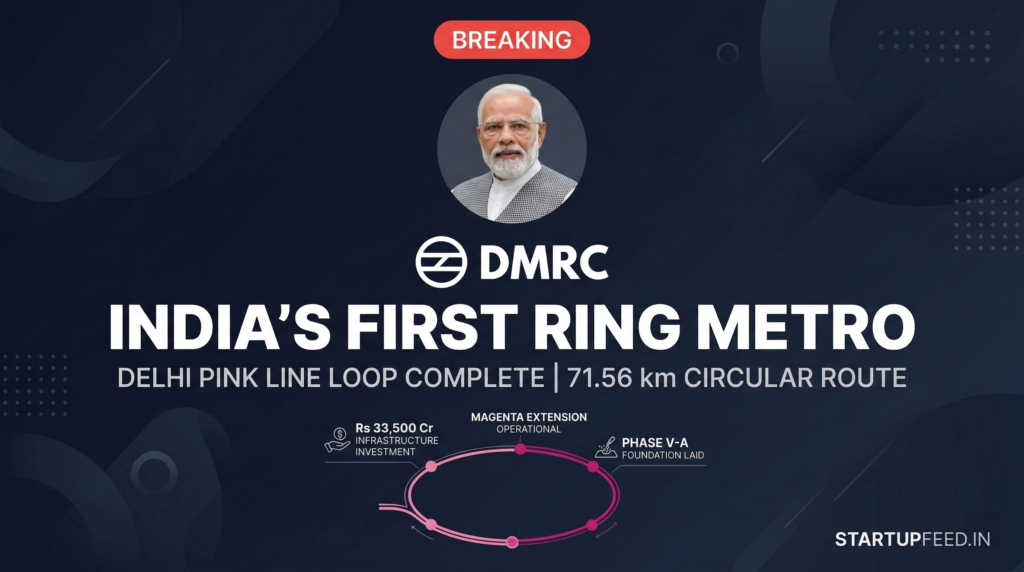
Prime Minister Narendra Modi on March 8, 2026 inaugurated two new corridors of the Delhi Metro — completing India’s first fully operational Ring Metro and setting in motion the largest single-day metro infrastructure event in Delhi’s history. The inauguration of the Majlis Park–Maujpur Babarpur corridor on the Pink Line and the Deepali Chowk–Majlis Park corridor on the Magenta Line was the centrepiece of a broader Rs 33,500 crore project programme that also included the laying of foundation stones for Phase V-A’s three underground and elevated corridors.
With the 12.3 km Pink Line addition, India now has its first Ring Metro — a continuous circular rail loop of 71.56 kilometres that circles large parts of the national capital, enabling commuters to travel around the city without passing through the congested central interchange stations that have defined Delhi Metro commuting for two decades.
Train services on both new corridors commenced at 3 PM IST on the same day as the inauguration — a zero-delay deployment on a 22.2-kilometre combined addition to the network.
What Was Inaugurated: The Two New Corridors
| Corridor | Line | Length | Stations | Key Areas Served |
|---|---|---|---|---|
| Majlis Park–Maujpur Babarpur | Pink Line | 12.3 km | 8 elevated | Burari, Jharoda Majra, Jagatpur-Wazirabad, Soorghat, Nanaksar-Sonia Vihar, Khajuri Khas, Bhajanpura, Yamuna Vihar, Maujpur-Babarpur — NE Delhi connectivity |
| Deepali Chowk–Majlis Park | Magenta Line | 9.9 km | 7 elevated | Deepali Chowk, Madhuban Chowk, Uttar Pitampura-Prashant Vihar, Haiderpur Village, Haiderpur Badli Mor, Bhalswa, Majlis Park — NW Delhi residential |
The Pink Line corridor is the structurally more significant of the two — it closes the final gap in a loop that was conceptualised in the earliest Delhi Metro master plans and has been under construction in stages since Phase III. With Majlis Park now connected to Maujpur-Babarpur, the Pink Line forms a complete ring around Northeast and North Delhi, integrating the Yamuna floodplain corridor and the high-density residential belt of Burari, Khajuri Khas, and Bhajanpura into the metro network for the first time.



The Magenta Line corridor — Deepali Chowk to Majlis Park — serves a different purpose: it extends the existing Botanical Garden–Krishna Park Extension Magenta Line deeper into Northwest Delhi’s residential and commercial belt, connecting Uttar Pitampura, Haiderpur, and Bhalswa to the south Delhi–Noida corridor for the first time. The Majlis Park terminal serves as the critical interchange between the two newly extended lines, creating a network node that did not previously exist.
“These projects will play a crucial role in transforming Delhi into a Viksit Delhi. The Delhi government has placed a high priority on transit in the 2025-26 budget to ensure seamless connectivity for the national capital.”
— Rekha Gupta, Chief Minister of Delhi
Station-by-Station: Both New Corridors
| # | Pink Line (Majlis Park–Maujpur Babarpur) | Magenta Line (Deepali Chowk–Majlis Park) |
|---|---|---|
| 1 | Majlis Park (interchange with Magenta Line) | Deepali Chowk |
| 2 | Burari | Madhuban Chowk |
| 3 | Jharoda Majra | Uttar Pitampura–Prashant Vihar |
| 4 | Jagatpur–Wazirabad | Haiderpur Village |
| 5 | Soorghat | Haiderpur Badli Mor |
| 6 | Nanaksar–Sonia Vihar | Bhalswa |
| 7 | Khajuri Khas | Majlis Park (interchange with Pink Line) |
| 8 | Bhajanpura | — |
| 9 | Yamuna Vihar | — |
| 10 | Maujpur–Babarpur | — |
Engineering Milestones
| Engineering Parameter | Detail |
|---|---|
| Double-decker viaduct at Bhajanpura | Single structure carrying both Delhi Metro Pink Line tracks and a road flyover — co-location model maximising right-of-way in urban-constrained zone · First of its kind on Pink Line |
| New Yamuna bridge | Fresh bridge over River Yamuna on the Majlis Park–Maujpur Babarpur Pink Line corridor — first new Yamuna metro crossing since Phase III |
| Record elevated height | 28.36 metres — maximum height of Deepali Chowk–Majlis Park Magenta Line corridor · Among the highest elevated metro sections in India’s national metro network |
| Train services commencement | Public train operations on both new corridors commenced from 3 PM IST on March 8, 2026 — same day as inauguration · Zero-delay deployment |
| Gauge and technology | Broad-gauge and standard-gauge mix across Delhi Metro network · CBTC (Communication-Based Train Control) enables 90-second headway capability on new lines |
| Phase V-A construction type | 10 of 13 Phase V-A stations will be underground · RK Ashram–Indraprastha tunnel will pass under active Central Vista redevelopment zone — highest technical complexity in Delhi Metro history |
The double-decker viaduct at Bhajanpura deserves particular attention. In a city where every metre of right-of-way is contested, a structure that simultaneously carries a metro line and a road flyover represents the most efficient possible use of the vertical urban space. It is the infrastructure equivalent of a mixed-use development — and DMRC’s deployment of this model at Bhajanpura signals its likely recurrence in Phase V-A, where the Central Vista underground corridor will face even more extreme right-of-way constraints.
The Phase V-A Foundation Stone: What’s Being Built Next
| Phase V-A Corridor | Length | Stations | Type | Key Purpose |
|---|---|---|---|---|
| RK Ashram Marg–Indraprastha (Magenta Line extension) | 9.913 km | ~8 | Underground | Central Vista area · India Gate · Kartavya Path · 60,000 daily office-goers + 2 lakh visitors |
| Aerocity–IGI Airport Terminal 1 (Golden Line extension) | 2.263 km | ~2 | Underground | Closes airport metro gap · Domestic terminal connectivity for south Delhi commuters |
| Tughlakabad–Kalindi Kunj (Golden Line extension) | 3.9 km | ~3 | Elevated | South Delhi residential + commercial · Noida and Faridabad exchange connection |
The three Phase V-A corridors collectively represent a fundamental shift in Delhi Metro’s strategic purpose. Phases I through IV were primarily connectivity investments — linking residential catchments to commercial centres. Phase V-A is a destination investment: every corridor connects either to a national landmark (Central Vista, India Gate), a mobility hub (IGI Airport Terminal 1), or a major commercial spine (Kalindi Kunj, South Delhi).
The RK Ashram Marg–Indraprastha underground corridor passes through the most complex urban geology in Delhi — below active road traffic, below the Central Vista redevelopment works, and below the historical floodplain zone near the Yamuna. DMRC has already begun the tender process for the civil contract EC-03 for this corridor (initiated February 10, 2026), suggesting an aggressive project timeline to meet the 2028 target.
“Once completed, the Magenta Line will become the longest corridor in the entire Delhi Metro network, spanning roughly 89 km — connecting Botanical Garden to Indraprastha via Deepali Chowk, Majlis Park, and RK Ashram Marg.”
— HelloRail / DMRC Phase V-A project brief
Delhi Metro: Full Network Context
| Network Parameter | Data |
|---|---|
| Total operational network (before March 8, 2026) | 352.2 km · 257 stations · 10 colour-coded lines · Largest metro network in India |
| New corridors added (March 8, 2026) | 12.3 km (Pink) + 9.9 km (Magenta) = 22.2 km additional · 15 new stations |
| Pink Line total post-inauguration | 71.56 km — India’s longest circular/ring metro line · India’s first Ring Metro |
| Magenta Line total post-inauguration | ~49 km · Botanical Garden to Majlis Park via Deepali Chowk · Extension of Botanical Garden–Krishna Park Extension line |
| Phase V-A target network length | ~400 km total (upon Phase V-A completion by 2028) · 13 new stations (10 underground) |
| Daily ridership (peak, all-time) | 7.86 Mn passenger journeys — November 18, 2024 (record) |
| Annual ridership | 203.23 Cr (2.03 billion) in calendar year 2023 |
| Daily trips | 4,300+ trips daily across all lines |
| NCR coverage | Delhi · Faridabad · Gurugram · Ghaziabad · Noida · Bahadurgarh · Ballabhgarh |
| Construction began | October 1, 1998 · First line (Red Line, Shahdara–Tis Hazari) opened December 25, 2002 · 24 years of phased expansion |
Project Investment
| Financial Parameter | Data |
|---|---|
| Two metro corridors (Pink + Magenta) | Rs 18,300+ Cr — infrastructure value of both inaugurated corridors combined |
| Total Delhi projects (inaugurated + foundation stone) | Rs 33,500 Cr — all projects across metro, GPRA redevelopment, and related infrastructure |
| GPRA Residential Redevelopment (Sarojini Nagar) | Rs 15,200 Cr — Type-5 GPRA quarters; PM Modi handed keys to women allottees on inauguration day |
| Phase V-A total project cost | Rs 12,014.91 Cr · Union Cabinet approval: December 24, 2025 · Delhi Cabinet approval: February 11, 2026 |
| Delhi Government contribution to Phase V-A | Rs 2,940.46 Cr · Remaining from Central Government and international funding agencies |
| Phase V-A completion target | 2028 — DMRC has already initiated tender for RK Ashram–Indraprastha civil contract (EC-03) from February 10, 2026 |
StartupFeed Insight | |
|---|---|
| Why the Ring matters | A ring metro does for urban transport what a ring road does for vehicular traffic — it breaks the hub-and-spoke dependency that forces every journey through a single congested interchange. Before March 8, every Pink Line commuter who wanted to reach the northeastern corridor had to route through Shiv Vihar or Majlis Park and then backtrack. The 12.3 km loop eliminates that entirely. For urban planners, this is the architectural breakthrough that allows Delhi’s Phase V corridors to stop converging on Central Secretariat and start distributing load across the ring. |
| The engineering firsts | Three engineering milestones distinguish this inauguration from routine corridor additions. First: the double-decker viaduct at Bhajanpura — a single structure carrying both the metro line and a road flyover, a co-location model that maximises right-of-way utilisation in Delhi’s land-constrained urban core. Second: a new bridge over the Yamuna on the Pink Line extension — the first new Yamuna metro crossing since Phase III. Third: the Deepali Chowk–Majlis Park Magenta corridor rising to 28.36 metres — one of the highest elevated metro sections in India, requiring special structural design for wind loading and seismic compliance. |
| The real estate signal | Every new DMRC corridor creates a 500-metre property premium bubble along its route within 18 months of inauguration. The Burari–Jagatpur–Wazirabad–Khajuri Khas Pink Line corridor opens North Delhi neighbourhoods that were previously 40+ minutes from the nearest metro station. The Uttar Pitampura–Haiderpur stretch on the Magenta Line connects established residential clusters that had been metro-dark since Phase II. Property developers and institutional real estate investors should be monitoring land parcels within 400m of Jagatpur-Wazirabad, Soorghat, and Uttar Pitampura-Prashant Vihar stations — all of which will see appreciation pressure within FY26–FY27. |
| The Phase V-A business play | The Central Vista underground corridor — RK Ashram Marg to Indraprastha — is not just a commuter convenience. It is a commercial infrastructure investment: the corridor will pass under India Gate, Kartavya Path, and the Central Secretariat redevelopment zone, servicing an estimated 60,000 office-goers and 2 lakh visitors daily. For hospitality, retail, food and beverage, and co-working businesses operating in or planning to enter Lutyens’ Delhi, Phase V-A completion by 2028 is the development signal to build around. The Aerocity–IGI Terminal 1 link closes the airport metro gap that has frustrated airline passengers for over a decade — and unlocks Aerocity’s Rs 10,000+ Cr commercial real estate at its maximum connectivity value. |
| Our prediction | Delhi Metro will cross 400 km of operational network by late 2028 following Phase V-A completion. Daily ridership — which peaked at 7.86 Mn on November 18, 2024 — will cross 10 Mn daily passenger journeys by FY29, driven by the Ring Metro’s load redistribution, Phase V-A’s Central Vista corridor, and the Airport Terminal 1 link. The Ring Metro’s property premium effect will materialise in Burari, Khajuri Khas, and Haiderpur Badli Mor by Q4 FY26. For the Indian urban mobility startup ecosystem — EV last-mile, micro-mobility, integrated ticketing, and transit-adjacent retail — the Ring Metro’s 71.56 km loop is the infrastructure backbone to build upon. |
What This Means for Urban Mobility Startups and Investors
Every Delhi Metro expansion creates a downstream market for India’s urban mobility startup ecosystem. The Ring Metro’s 15 new stations across Burari, Khajuri Khas, Jagatpur-Wazirabad, Haiderpur Badli Mor, and Bhalswa open last-mile connectivity gaps that are the addressable market for electric two-wheeler services (Yulu, Rapido), shared mobility apps (BluSmart, InDrive), and micro-mobility startups operating in Delhi-NCR.
The Phase V-A business opportunity is larger. The Aerocity–IGI Terminal 1 connector creates seamless metro-to-airport access for south Delhi’s 5 Mn+ resident population — expanding the premium transport corridor that BluSmart and Uber have been building ground-side airport transfer businesses on. The Central Vista corridor will add 60,000 daily office-goers to a zone that currently has minimal food and beverage, co-working, and retail metro catchment. Operators who build in this catchment zone in 2026–2027 will have 18 months before the corridor opens and residential + commercial demand accelerates.
For real estate investors: the most underpriced assets in Delhi are within 500 metres of Jagatpur-Wazirabad, Soorghat, and Uttar Pitampura-Prashant Vihar stations. These stations connected neighbourhoods that were metro-dark for 20+ years to a network serving 7.86 Mn daily commuters. The property premium cycle will begin from Q3 FY26.


Working on a story about Delhi Metro’s Phase V-A, last-mile mobility, or urban real estate near new stations? Write to tips@startupfeed.offiicial
Liked this story? Follow StartupFeed on Google so our reporting reaches you first.