

Quick Take: | |
|---|---|
| The Infusion | Rs 1,999.88 crore (~$218 Mn) — Jio Financial Services → Jio Credit Ltd (wholly-owned NBFC); 3,35,71,923 equity shares at Rs 10 face value + Rs 585.70 premium = Rs 595.70/share |
| Why Now | Jio Credit AUM surged 4.5x YoY to Rs 19,049 crore in Q3 FY26; gross disbursements doubled to Rs 8,615 crore — the loan book needs fresh capital to keep growing |
| The Catch | Borrowings at Jio Credit ballooned from Rs 1,350 crore to Rs 16,192 crore YoY; JFSL consolidated net profit FELL 9% to Rs 269 crore despite 101% income growth — finance costs rising fast |
| Prior Infusion | Rs 1,000.24 crore pumped into Jio Credit in March 2025 — the Feb 2026 infusion is 2x the previous top-up, signalling accelerating ambition |
| The Platform | JFSL: digital lending · Jio Payments Bank (100% owned) · Jio BlackRock AMC (Rs 14,972 Cr AUM) · Jio BlackRock Advisory · Allianz Jio Reinsurance — 20 Mn digital users |
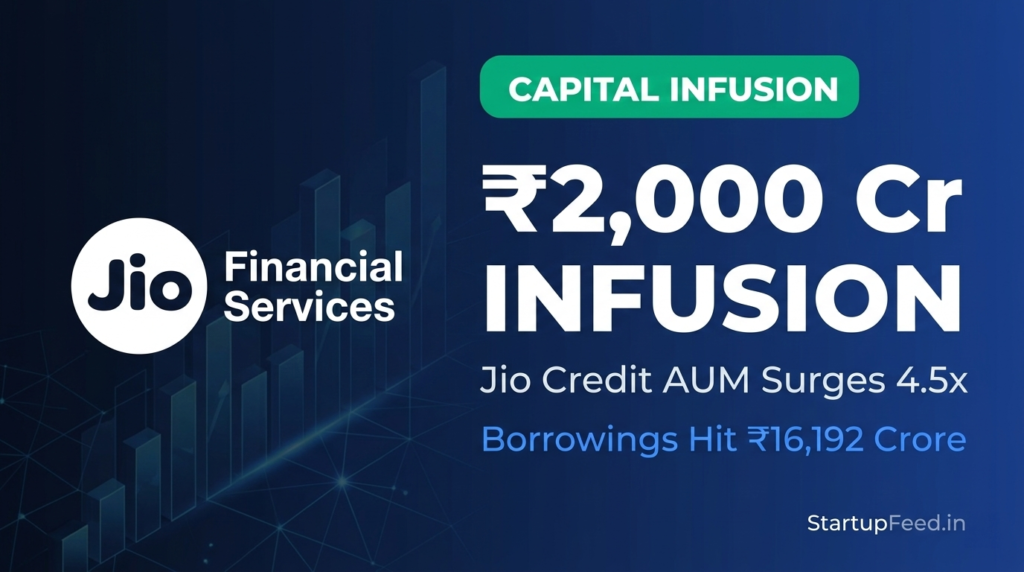
Jio Financial Services Ltd has pumped Rs 1,999.88 crore — effectively Rs 2,000 crore (~$218 million) — into its wholly-owned lending subsidiary Jio Credit Ltd. The capital infusion, announced on February 26, 2026, is structured as an equity subscription: JFSL subscribed to 3,35,71,923 shares at Rs 10 face value and Rs 585.70 premium each.
The number looks large in isolation. In context, it is almost unavoidable. Jio Credit’s loan book is growing at a pace that requires constant equity reinforcement. In the quarter ending December 2025, the NBFC’s assets under management hit Rs 19,049 crore — a 4.5x jump year on year. Gross disbursements doubled to Rs 8,615 crore. Net interest income surged 166%. At that velocity, the parent has no choice but to keep the capital adequacy ratio healthy by injecting equity.
There is, however, a number on the other side of the ledger. Jio Credit’s borrowings have rocketed from Rs 1,350 crore a year ago to Rs 16,192 crore. And at the consolidated level, JFSL’s net profit in Q3 FY26 fell 9% to Rs 269 crore — even as total income more than doubled to Rs 901 crore. The loan book is compounding. So are the costs.
| StartupFeed Insight | |
|---|---|
| Key Angle | The borrowings number — Rs 16,192 crore at Jio Credit, up from Rs 1,350 crore a year ago — is the real story inside the Rs 2,000 crore infusion. Jio Credit is funding its loan book with borrowed money at enormous speed. The parent is now injecting equity to keep the capital adequacy ratio healthy. This is not a warning sign yet, but it is a number worth watching every quarter. |
| For Investors | JFSL’s market cap is ~Rs 1.67 trillion (as of early Feb 2026) on Q3 FY26 PAT of Rs 269 crore. The implied P/E is in triple-digit territory. MarketsMojo currently rates the stock as ‘Sell’ citing expensive valuations and flat financial trends. Long-term bull case depends on whether Jio Credit’s AUM compounding continues without credit quality deterioration. |
| For Competitors | This is Reliance activating its most powerful moat: 466 million Jio subscribers as a captive credit distribution channel. Bajaj Finance took 20 years to build what Jio is trying to shortcut with data and distribution. The 4.5x YoY AUM growth shows the shortcut may be working — but the quality of that growth (NPAs, default rates) is not yet public. |
| For Bankers / VCs | The ‘Chasing Growth 2026’ investor event (Feb 25, 2026, Mumbai, organised by Kotak Securities) is the roadmap presentation: digital lending + insurance + payments + wealth management — all cross-sold to 466 million Jio users. If asset quality holds, this is the most powerful distribution-driven fintech story in Asia right now. |
| Prediction | Jio Credit will cross Rs 50,000 crore AUM by FY28 if current trajectory holds (Q3 FY26: Rs 19,049 crore, +4.5x YoY, +29% QoQ). However, the next 4–6 quarters of NPA data will determine whether the Rs 2,000 crore infusion was a growth catalyst or a capital adequacy patch. |
The Transaction: How Rs 1,999.88 Crore Was Structured
| Transaction Parameter | Detail |
|---|---|
| Announcement date | February 26, 2026 |
| Total infusion | Rs 1,999.88 crore (~$218 Mn) |
| Shares subscribed | 3,35,71,923 equity shares of Jio Credit Ltd |
| Share face value | Rs 10 per share |
| Premium per share | Rs 585.70 |
| Effective price | Rs 595.70 per share (face value + premium) |
| Recipient entity | Jio Credit Ltd — wholly-owned NBFC subsidiary of JFSL |
| Formerly known as | Jio Finance Ltd (name recently changed to Jio Credit Ltd) |
| Transaction type | Related-party transaction — arm’s length basis; no regulatory/government approvals required |
| Use of proceeds | Fund business operations and future expansion of Jio Credit’s lending book |
| Prior infusion | Rs 1,000.24 crore — March 2025 (previous equity top-up into Jio Credit) |
| Total equity invested in Jio Credit (cumulative) | Rs ~3,000 crore (March 2025 + Feb 2026 combined) |
The deal is classified as a related-party transaction — JFSL is both the infuser and the ultimate beneficial owner of Jio Credit — but was conducted on arm’s length terms. No regulatory or government approvals were required because the investment stays within the consolidated Reliance financial ecosystem. The transaction is the second equity capital injection into Jio Credit in under a year, doubling the March 2025 infusion of Rs 1,000.24 crore.
At Rs 595.70 per share (face value plus premium), JFSL is valuing Jio Credit’s equity at a premium that reflects significant confidence in the NBFC’s earnings potential. The premium is not set by the market — it is set by a parent injecting capital into a subsidiary it wholly owns — but it still signals the internal valuation JFSL’s board has put on the lending business it is building.


Jio Credit: Loan Book That Is Scaling Faster Than Almost Any NBFC in India
| Metric | Q3 FY26 | YoY Change |
|---|---|---|
| Gross disbursement | Rs 8,615 crore | ↑ ~2x (doubled) |
| AUM (Assets Under Mgmt) | Rs 19,049 crore | ↑ 4.5x YoY; +29% QoQ |
| Net Interest Income (NII) | Rs 165 crore | ↑ 166% YoY |
| Net profit | Rs 59 crore | ↑ 157% YoY |
| Borrowings | Rs 16,192 crore | ↑ from Rs 1,350 crore — +11.9x YoY |
| AUM (March 2025) | Rs 10,094 crore | Base — 29 weeks before Q3 FY26 close |
| Loan products | Home loans · LAP · Corporate financing | — NBFC secured lending focus |
“The NBFC’s AUM grew 4.5 times year-on-year to Rs 19,049 crore during Q3 FY26, while net profit rose 157% to Rs 59 crore. Gross disbursements doubled to Rs 8,615 crore.”
— JFSL Q3 FY26 Earnings Disclosure
The performance numbers are, by any objective measure, exceptional for an NBFC that barely existed three years ago. What makes them possible is architecture: Jio Credit sits inside an ecosystem where 466 million people already have a relationship with the parent group. Every Jio mobile subscriber, every Reliance Smart customer, every JioFinance app user is a pre-qualified distribution channel. The cost of customer acquisition that takes other NBFCs years and hundreds of crores to build is, for Jio Credit, effectively subsidised by the Jio telecom subscription.
The borrowings picture tells the other half of the story. Jio Credit grew its borrowings 11.9x year-on-year to fund the loan book. That is how NBFC economics work: raise equity, borrow against it, lend the borrowed money out, earn the spread. But 12x growth in borrowings in one year is an extraordinary acceleration. The Rs 2,000 crore equity infusion is, in large part, the capital required to backstop that Rs 16,192 crore borrowing programme.
JFSL Consolidated: The Numbers Behind the Fintech Empire
| Metric | Value | Context |
|---|---|---|
| Q3 FY26 total income | Rs 901 crore | ↑ 101% YoY from Rs 449 crore |
| Q3 FY26 net profit | Rs 269 crore | ↓ 9% YoY from Rs 295 crore — finance costs rising |
| Q2 FY26 net profit | Rs 695 crore | Sequential drop in Q3 due to expense scaling |
| Pre-provisioning op. profit | Rs 354 crore | ↑ 7% YoY — core operations improving |
| Operating revenue (net of dividends) | Rs 386 crore | ↑ 4% YoY |
| Digital users (unique, Q3 FY26) | 20 million | Across all JFSL digital properties |
| Monthly Active Users (MAU) | 9.2 million | Average during Q3 FY26 |
| Revenue FY25 | Rs 2,042 crore | From Rs 41.63 crore at listing (Mar 2023) — hypergrowth |
| Net profit FY25 (stabilised) | ~Rs 1,612 crore | Flat YoY — heavy reinvestment phase |
| Stock price (Feb 27, 2026) | Rs 258.80 | Range Rs 255.25–258.85; prev close Rs 256.15 |
| Market cap | ~Rs 1.67 trillion | Feb 2026; P/E in triple digits |
The headline tension in JFSL’s Q3 FY26 results is simple: total income doubled while net profit fell. The explanation is equally simple — finance costs at the operating subsidiary level (Jio Credit’s Rs 16,192 crore borrowings carry interest charges) and headcount and technology investment at the parent level are together absorbing what would otherwise be profit.
This is not unusual for a company in the scale-before-profit phase of building a financial services empire. JFSL is spending on Jio Payments Bank operations, on the BlackRock AMC buildout, on insurance broking, on technology infrastructure. The question investors are asking — and the reason the stock has drifted from its highs near Rs 338 to around Rs 256 — is how long the scale-first phase lasts before it translates into sustained profit growth.
Capital Deployment: A Rs 3,400 Crore Year of Building
| Date / Entity | Amount & Context |
|---|---|
| Mar 2025 — Jio Credit | Rs 1,000.24 Cr equity infusion — first major capital top-up after NBFC commenced scaling |
| Jun 2025 — Jio Payments Bank | Rs 190 Cr injection — post SBI 17.8% stake acquisition; triggered 3% stock rally |
| Dec 2025 — Jio BlackRock AMC | Rs 136 Cr rights issue — both JFSL + BlackRock subscribed for mutual fund operations |
| Dec 2025 — Jio BlackRock Advisers | Rs 93.5 Cr rights issue — wealth management and advisory buildout |
| Feb 2026 — Jio Credit (this deal) | Rs 1,999.88 Cr — 2x the March 2025 infusion; signals accelerating loan book ambitions |
| Total deployed (selected rounds) | ~Rs 3,419 Cr in subsidiaries and JVs in 12 months — systematic capital deployment |
The Jio Financial Ecosystem: Eight Subsidiaries, One Stack
| Subsidiary / JV | Description |
|---|---|
| Jio Credit Ltd | NBFC; secured lending — home loans, loans against property, corporate finance; AUM Rs 19,049 Cr (Q3 FY26) |
| Jio Payments Bank | 100%-owned payments bank (acquired SBI’s 17.8% in 2025); UPI + digital banking; toll management via MLFF/Fastag ANPR |
| Jio Payment Solutions | Payment gateway, merchant acquiring, payment infrastructure |
| Jio Insurance Broking | Multi-line insurance distribution — life + general + health |
| Jio BlackRock AMC (50:50) | Mutual fund JV with BlackRock; Rs 14,972 Cr AUM; 10 schemes; 1 million investors; Aladdin® analytics platform deployed |
| Jio BlackRock Advisers (50:50) | Wealth management; JioBlackRock Personalised Investment Advice launched Feb 2026 — Rs 10,000 entry, 0.35% fee |
| Jio BlackRock Broking | SEBI-registered brokerage (subsidiary of Jio BlackRock Investment Advisers) |
| Allianz Jio Reinsurance (50:50) | Reinsurance JV with Allianz Group; exploring general + life insurance |
| JioFinance App | Unified digital storefront — payments, lending, insurance, investments; 20 Mn unique users/quarter |
| Sandeep Khaitan hire | Recently appointed Group Chief Risk Officer — signals professionalisation ahead of potential credit quality scrutiny |
The Rs 2,000 crore infusion into Jio Credit is the largest single capital movement in a twelve-month period that has seen JFSL systematically deploy equity into every vertical of its intended full-stack financial services platform. The logic is consistent across all five capital deployment decisions: build the subsidiary to a level of operational credibility, then scale it with fresh equity.
The most strategically interesting deployment is the BlackRock JV pair. The Jio BlackRock AMC has Rs 14,972 crore AUM across 10 mutual fund schemes and one million retail investors — including a growing proportion from beyond India’s top-30 cities. The JioBlackRock Personalised Investment Advice platform, launched in February 2026, brings institutional-grade Aladdin® analytics to retail investors at Rs 10,000 minimum and 0.35% annual fee. That product is not a feature — it is a direct assault on Zerodha, Groww, and the entire Indian wealth-tech sector.
Competitive Landscape: Who Jio Credit Is Racing Against
| Player | Segment | Approx. Mkt Cap | Edge vs Jio Credit |
|---|---|---|---|
| Bajaj Finance | Diversified NBFC | Rs ~2.3 trillion | 20+ yrs of credit data, risk models, loyalty; ~42x P/E |
| HDFC Bank | Full-service bank | Rs ~11.5 trillion | Branch network, corporate relationships, ~19x P/E — cheaper valuation |
| Paytm / One97 | Digital lending + payments | — | UPI moat; lending via NBFC partners; recovering from RBI action |
| DMI Finance | Digital personal + MSME loans | — | Niche focus; no telecom distribution advantage |
| Lendingkart | SME lending | — | B2B MSME niche; not consumer-facing |
| Jio Credit | Digital NBFC — home, LAP, corporate | — | 466 Mn Jio subscribers + Reliance Retail cross-sell; growing fastest |
Bajaj Finance is the most-cited comparison — the NBFC that transformed from a consumer durables loan company into India’s most valuable non-bank financial company. It took Bajaj Finance two decades of credit cycles, of building proprietary risk models on millions of customer histories, to get to a Rs 2.3 trillion market cap. JFSL at Rs 1.67 trillion is already two-thirds of the way there — having been listed for less than three years.


The difference is credit quality data. Bajaj Finance’s underwriting edge is its 80+ million customer credit histories. Jio Credit is building the same asset at 4.5x AUM growth per year, which means the customer history is short, and the loans being made now are the first-cycle test. The 157% net profit growth at Jio Credit in Q3 FY26 is encouraging. The NPA data from those same loans — which will surface in 2026 and 2027 — is what matters.
Key Risks
| Risk | Why It Matters |
|---|---|
| Borrowings explosion at Jio Credit | Rs 16,192 crore in borrowings vs Rs 1,350 crore a year ago — 12x YoY growth. This is how NBFCs build loan books, but it creates duration mismatch and refinancing risk. If credit markets tighten or interest rates rise, Jio Credit’s cost of funds increases, squeezing margins. |
| Profit fell despite income doubling | Q3 FY26 consolidated PAT: Rs 269 crore (−9% YoY). Total income: Rs 901 crore (+101%). The gap is absorbed by finance costs and scaling expenses. If the income-to-profit compression continues, the valuation narrative — currently priced for a fully realised fintech empire — faces pressure. |
| Asset quality not yet transparent | Jio Credit is growing its loan book at speed. Home loans and LAP are secured, but NPA data for newly disbursed loans has not been prominently disclosed. The next 2–4 quarters will reveal whether rapid disbursement came with disciplined underwriting. |
| Bihar MFI Bill and NBFC sector risk | Bihar Microfinance Bill 2026 triggered 11% share price drops in L&T Finance, Utkarsh SFB, and Fusion Finance on passage. Regulatory actions targeting lending practices — even in adjacent NBFC segments — signal a volatile policy environment for the sector Jio Credit operates in. |
| Valuation demands perfection | At ~Rs 1.67 trillion market cap with Q3 FY26 PAT of Rs 269 crore and a P/E in triple digits, there is no room for execution stumbles. Flat profit, rising borrowing costs, or any regulatory friction will be punished disproportionately by markets. |
| Competition from Airtel Money | Bharti Airtel’s NBFC licence and Airtel Money expansion are direct competitive moves against JFSL’s distribution-led playbook. Airtel has 380+ million subscribers. The Jio distribution advantage is real but not unchallenged. |
Who Should Be Watching
| Stakeholder | Why This Matters |
|---|---|
| Existing JFSL shareholders | Watch the Jio Credit NPA data closely in Q4 FY26 and Q1 FY27 results. The Rs 2,000 Cr infusion is priced on confidence, not track record. Jio Credit’s first credit cycle under stress — when it comes — is the real test of whether JFSL deserves its premium valuation. |
| Bajaj Finance & legacy NBFCs | Jio Credit grew AUM 4.5x in one year on the back of the most powerful consumer database in India. Bajaj Finance built its equivalent over two decades. The Jio distribution shortcut is now working — competitors need to re-examine their home loan and LAP product economics in any geography where Jio Payments Bank is active. |
| Fintech and insurance investors | The JioBlackRock AMC has Rs 14,972 Cr AUM and 1 million retail investors after a very short runway. The Allianz Jio Reinsurance JV is awaiting regulatory approval. JFSL is assembling the most diversified licensed fintech stack in India — with Reliance as the sole shareholder. Watch for a proposed insurance licence in general or life. |
| RBI and SEBI watchers | JFSL is simultaneously an RBI-registered Core Investment Company, NBFC operator, payments bank operator, and SEBI-supervised AMC and brokerage. The Rs 1,999.88 Cr infusion into an NBFC at 12x YoY borrowings growth will be on RBI’s radar. Any regulatory direction on capital adequacy or provisioning for fast-growing NBFCs lands directly on Jio Credit. |
| Startup founders in fintech | The JioFinance app already serves 20 million unique quarterly users at effectively zero acquisition cost — because 466 million people use Jio SIM cards. The cost per credit customer for Jio Credit is structurally lower than any standalone fintech can achieve. Building a competing consumer lending app in India without a telecom distribution layer is now a fundamentally harder pitch to investors. |
What’s Next
The next reporting event is Q4 FY26 results, expected April 2026. Investors and analysts will focus on three numbers: Jio Credit’s NPA ratio (first public credit quality signal after a year of rapid disbursement); JFSL’s consolidated net profit trajectory (can it recover from the Q3 FY26 drop?); and borrowings growth at Jio Credit (did the Rs 2,000 crore infusion enable further borrowing-led expansion or does it stabilise the balance sheet?).
The ‘Chasing Growth 2026’ investor event held on February 25 — the day before this infusion was announced — was a deliberate sequencing. Show the strategy, then show the capital commitment behind it. The Rs 2,000 crore is Jio Financial’s answer to the question every institutional investor in that room would have asked: is the lending ambition backed by real capital? The answer is now on record.
India’s fintech market is expected to reach $420 billion by 2029 (TGNNS/multiple estimates). The Indian wealthtech sector alone is projected at $109 billion by 2031. JFSL, through its combination of Jio Credit, Jio Payments Bank, and the BlackRock and Allianz JVs, is positioned to participate in all of it — if the asset quality holds.
Questions or tips on JFSL and India’s NBFC sector? Write to tips@startupfeed.official