| Quick Take: | ||||||||||||||||||||||||||||||||||||||||||||||||||||||||||||||||||||||||||||||||||||||||||||||||||
| The Startup | Oncare — Gurugram-based distributed oncology care platform. Founded 2023 by Amar Sneh and Deepak Kumar | |||||||||||||||||||||||||||||||||||||||||||||||||||||||||||||||||||||||||||||||||||||||||||||||||
| The Round | ₹27 Crore (~$3.2 Mn) Series A · Lead: Sky Impact Capital · Also: Huddle Ventures, Lotus Herbal Group, SteerX, Tremis Capital | |||||||||||||||||||||||||||||||||||||||||||||||||||||||||||||||||||||||||||||||||||||||||||||||||
| Current Scale | 4 operational centres across Delhi-NCR · 30,000+ patients engaged · ~3,000 oncologist consultations · ~1,000 patients treated · 4,000+ procedures | |||||||||||||||||||||||||||||||||||||||||||||||||||||||||||||||||||||||||||||||||||||||||||||||||
| The Price Edge | Chemotherapy: ₹24,000–25,000/session vs ₹40,000 at corporate hospitals (40% cheaper) · Surgeries: 30–40% lower cost | |||||||||||||||||||||||||||||||||||||||||||||||||||||||||||||||||||||||||||||||||||||||||||||||||
| Expansion Plan | Bengaluru entry · New centres in Uttar Pradesh, Bihar, West Bengal · Metro + Tier-2/3 markets · Tech investment in clinical ops + patient experience | |||||||||||||||||||||||||||||||||||||||||||||||||||||||||||||||||||||||||||||||||||||||||||||||||
In India, a cancer diagnosis is often followed by a second crisis: the bill. A single course of chemotherapy at a corporate hospital can cost ₹40,000 per session. Surgery can push a family past ₹10 lakh. For the 1.57 million Indians projected to receive a cancer diagnosis this year, the treatment that could save their life is, for many, financially impossible.
That is the market Oncare is targeting. Not the premium patient at Apollo or Fortis. The middle-income family in Delhi NCR, Lucknow, Patna, or Kolkata who needs oncology services — standardised, coordinated, transparent — at a price that does not require selling a home to afford.
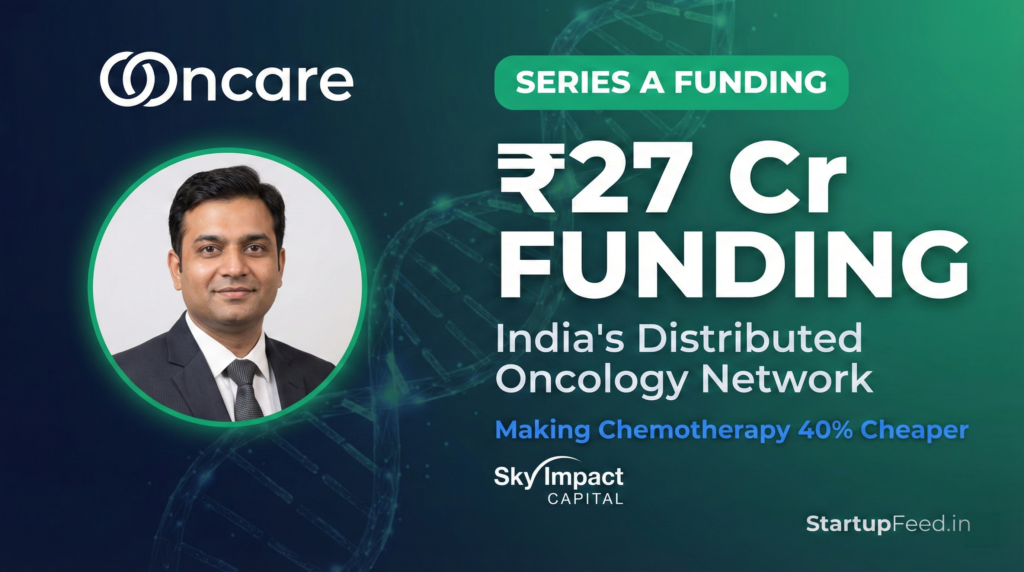
On February 24, 2026, Oncare announced it had raised ₹27 Crore (~$3.2 Mn) in a Series A funding round led by Sky Impact Capital, with participation from Huddle Ventures, Lotus Herbal Group, SteerX, and Tremis Capital. The capital will fund its expansion from 4 Delhi-NCR centres to Bengaluru and into UP, Bihar, and West Bengal — some of India’s most medically underserved large states.
| StartupFeed Insight | ||||||||||||||||||||||||||||||||||||||||||||||||||||||||||||||||||||||||||||||||||||||||||||||||||
| Key Angle | Oncare does not build hospitals. It occupies unused clinical space inside mid-size hospitals and deploys oncology services under its own brand and protocols. That capital-light model means ₹27 Cr can open multiple centres, not just one. The unit economics, not the round size, is the thesis. | |||||||||||||||||||||||||||||||||||||||||||||||||||||||||||||||||||||||||||||||||||||||||||||||||
| For Investors | India healthtech raised ~$700 Mn in 2025. The oncology segment is seeing accelerating deal flow — 4baseCare (₹90 Cr), MOC Cancer Care ($18 Mn, Elevation Capital), Everhope ($10 Mn seed). Oncare’s differentiation is delivery infrastructure, not diagnostics or therapeutics. That is an underfunded wedge in a crowded segment. | |||||||||||||||||||||||||||||||||||||||||||||||||||||||||||||||||||||||||||||||||||||||||||||||||
| For Founders | Oncare’s model — partner-hospital integrations at ₹0 capex for beds/equipment, standardised protocols, shared clinical staff — is a playbook applicable to any chronic, high-cost specialty: nephrology, cardiology, neurology. The template is as important as the company. | |||||||||||||||||||||||||||||||||||||||||||||||||||||||||||||||||||||||||||||||||||||||||||||||||
| For Patients | 75% of public-sector cancer patients in India cannot access timely radiotherapy. 60-75% are treated in private hospitals with high out-of-pocket costs. Oncare’s 40% price reduction is not just a business edge — it is the difference between treatment and financial catastrophe for middle-income households. | |||||||||||||||||||||||||||||||||||||||||||||||||||||||||||||||||||||||||||||||||||||||||||||||||
| Prediction | By Q1 2028, Oncare will operate 20+ centres across 6 states and announce a Series B of ₹80–100 Cr. The Bengaluru entry and performance in UP/Bihar markets will determine whether the distributed model holds outside Delhi-NCR’s health-literacy advantage. | |||||||||||||||||||||||||||||||||||||||||||||||||||||||||||||||||||||||||||||||||||||||||||||||||
Company at a Glance
| Detail | Information |
|---|---|
| Company | Oncare (registered: Gurugram, Haryana) |
| Founded | 2023 |
| Founders | Amar Sneh (Co-founder) & Deepak Kumar (Co-founder) — previously worked at leading healthcare organisations |
| Business Model | Distributed oncology care: builds and runs oncology departments inside accredited mid-size hospitals (50–100 bed non-branded facilities) |
| Services | Medical oncology · Surgical oncology · Radiation oncology · Care coordination · On-call nursing support |
| Current Footprint | 4 operational centres across Delhi-NCR |
| Patient Traction | ~30,000 patients engaged · ~3,000 oncologist consultations · ~1,000 patients treated · 4,000+ procedures completed |
| Price Positioning | Chemotherapy: ₹24,000–25,000/session vs ₹40,000 at corporate hospitals · Surgeries: 30–40% cheaper than corporate peers |
| Series A Round | ₹27 Crore (~$3.2 Mn) — February 2026 |
| Lead Investor | Sky Impact Capital |
| Co-Investors | Huddle Ventures · Lotus Herbal Group · SteerX · Tremis Capital |
| Seed Round | ~$1 Mn (~₹8.3 Cr) — October 2024 · Led by Huddle Ventures + TRTL Ventures, Cloud Capital, DeVC |
| Total Raised | ~₹35.3 Crore (~$4.2 Mn) across seed + Series A |
| Use of Funds | Expand to Bengaluru · New centres in UP, Bihar, West Bengal · Tech investment in clinical ops + care coordination + patient experience |
Oncare’s founding in 2023 put it into one of India’s hardest operating environments: multi-speciality oncology delivery inside non-Oncare-owned hospitals, in a market dominated by vertically integrated hospital chains with deep brand trust. The co-founders — Amar Sneh and Deepak Kumar — had previously worked inside India’s healthcare sector and designed the model specifically to avoid the two biggest barriers to oncology access: the capital cost of building hospitals, and the price premium of the corporate chains that do.
The Model: Why ‘Distributed’ Changes the Economics
| Model Element | How It Works |
|---|---|
| Capital-Light Entry | No greenfield hospital construction. Oncare identifies accredited mid-size hospitals (50–100 beds) with under-utilised clinical space and embeds an oncology wing under the Oncare brand and protocols. |
| Full Service Integration | Medical oncology (chemo, immunotherapy, targeted therapy) + Surgical oncology + Radiation oncology delivered on a single platform within the partner hospital. |
| Standardised Protocols | Oncare applies its own clinical protocols across all centres — ensuring consistent diagnostic and treatment standards regardless of which partner hospital is hosting the wing. |
| Transparent Pricing | Clearly published per-session pricing. No hidden charges. Chemotherapy: ₹24,000–25,000/session. Goal: make cancer treatment costs predictable for middle-income families. |
| On-Call Nursing Support | Dedicated nurses available remotely to help patients manage treatment side effects and anxiety — reducing unnecessary hospital visits and improving adherence. |
| Care Coordination | Single-platform integration of medical, surgical and radiation oncology means patients are not referred between disconnected specialists — all care is coordinated under one Oncare umbrella. |
| Technology Layer | Investment from Series A funds will go into clinical operations tech, care coordination software, and patient experience improvements — building the data infrastructure for a national network. |
The core insight behind Oncare is simple and powerful. India has thousands of mid-size hospitals — 50 to 100 beds — with clinical infrastructure, diagnostic equipment, and physical space that sits under-utilised because they lack oncology specialisation. Oncare does not build a hospital. It occupies one. It brings the oncologists, the treatment protocols, the care coordination software, and the Oncare brand into spaces that already exist.
The result is a cancer care centre that costs a fraction of what a greenfield build would require, opens faster, and can be replicated across any city where the partner hospital model works. With ₹27 Crore, Oncare can open multiple centres. With the same capital, a conventional oncology hospital company might open one.
The Price Advantage: What 40% Cheaper Actually Means
| Treatment / Service | Corporate Hospital (est.) | Oncare | Saving |
|---|---|---|---|
| Chemotherapy (per session) | ₹40,000 | ₹24,000–25,000 | ~₹15,000–16,000 (38–40%) |
| Cancer Surgery | Varies — high | 30–40% lower | 30–40% vs corporate rates |
| Full treatment course | Can exceed ₹10 lakh | Substantially lower | Model designed for middle-income access |
| Oncologist consultation | High OOP cost | Integrated pricing | Within partner-hospital model |
“We’ll use this fund to expand into Bangalore and open a few tertiary-city centres. The demand in underserved markets is clear.”
— Deepak Kumar, Co-founder, Oncare
The price comparison is not a marketing claim. It is a structural consequence of the model. When Oncare does not pay for hospital construction, land acquisition, or equipment procurement — costs that corporate hospital chains amortise across every patient — those savings flow directly into the pricing. ₹24,000 per chemotherapy session vs. ₹40,000 is not a subsidy. It is the arithmetic of a lower cost base.
For a patient requiring eight chemotherapy sessions — a common course for breast or colorectal cancer — the total difference is ₹1.2–1.28 lakh. In a country where 60–75% of cancer patients are treated privately and the median household income in UP or Bihar is under ₹3 lakh annually, that difference is not marginal. It is the difference between completing treatment and stopping it midway.
The Market: India’s Oncology Crisis in Numbers
| Data Point | Figure | Source / Context |
|---|---|---|
| India cancer cases (annual) | 1.39 Mn (2020) → 1.57 Mn (2025) | Apollo Hospitals Health of Nation Report — 6.8% annual increase |
| India oncology market growth | CAGR 19.8% (2025–2029) | Technavio — growing by $2+ Bn from 2025 to 2029 |
| Global oncology market | $521.6 Bn by 2033 (8.9% CAGR) | StartUs Insights / industry research |
| India patients in private hospitals | 60–75% of all cancer patients | High out-of-pocket costs; 60–75% treated privately |
| Radiotherapy access (public sector) | 75% cannot access timely care | MedBound Times — rural India radiotherapy gap |
| India healthtech funding (2025) | ~$700 Mn raised | Inc42 Annual Indian Startup Trends Report 2025 |
| India healthtech market forecast | $37 Bn by 2030 (39% CAGR) | Inc42 Annual Indian Startup Trends Report 2025 |
| 4baseCare raise (recent, oncology) | ₹90 Crore | Led by Ashish Kacholia & Lashit Sanghvi — genomics/precision oncology |
| MOC Cancer Care raise (recent) | $18 Mn | Elevation Capital led — full-stack cancer care operator |
| Everhope Oncology raise (recent) | $10 Mn (seed) | Seed stage — oncology care delivery |
India’s cancer burden is not a coming crisis. It is a present one. The country is expected to record 1.57 million new cancer cases in 2025 — up from 1.39 million in 2020. Experts warn the actual figure may be 1.5 to 3 times higher due to chronic underdiagnosis, particularly in rural areas and lower-income states. 75% of public-sector patients cannot access timely radiotherapy. In a country of 1.4 billion people, the specialist oncology infrastructure simply does not exist at the scale the disease burden demands.
The investor response is accelerating. Indian healthtech raised nearly $700 Mn in 2025. The oncology segment specifically saw landmark rounds: MOC Cancer Care ($18 Mn, Elevation Capital), Everhope Oncology ($10 Mn seed), 4baseCare (₹90 Cr). Oncare’s Series A adds to a wave of institutional confidence that cancer care delivery — not just diagnostics or pharma — is a fundable, scalable business in India.
Competitive Landscape: Where Oncare Sits
| Startup | Focus Area | Funding | Vs. Oncare |
|---|---|---|---|
| Oncare | Distributed oncology (delivery infrastructure) | ₹35 Cr total (seed + Series A) | This article’s subject — capital-light partner-hospital model |
| MOC Cancer Care | Full-stack cancer care & research | $18 Mn (Elevation Capital) | Greenfield hospital model — higher capex, more control |
| Everhope Oncology | Cancer care delivery (early stage) | $10 Mn seed | Seed stage; direct competitor in care delivery space |
| 4baseCare | Precision oncology — genomic profiling | ₹90 Cr (Ashish Kacholia) | Diagnostics/genomics — complements rather than competes |
| ErlySign | Cancer screening / early detection | Funded | Diagnostics focus — upstream of Oncare’s treatment stage |
| OneCell Diagnostics | Liquid biopsy / diagnostics | Funded | Diagnostic layer — not treatment delivery |
| HCG (hospital) | Dedicated cancer hospital chain | Listed | Established incumbent; high-capex; Tier-1 city focused |
Oncare’s most important competitive distinction is what it is not competing on. It is not building a cancer hospital to rival HCG or AIIMS. It is not a genomics platform competing with 4baseCare. It is not a diagnostics company. It is a care delivery infrastructure company — filling the gap between diagnosis and the nearest affordable, integrated treatment pathway. That wedge is real, underfunded relative to the problem size, and structurally defensible through network scale and clinical protocol standardisation.
Expansion Roadmap
| Phase | Markets / Actions | Strategic Logic |
|---|---|---|
| Current (Feb 2026) | 4 centres · Delhi-NCR · 10,000+ daily patients engaged | Proof of concept: price, quality, care coordination — proven in one of India’s most competitive health markets |
| Near-term (2026) | Bengaluru entry (confirmed by co-founder) · New centres in Uttar Pradesh, Bihar, West Bengal | Bengaluru = tech-savvy, health-aware patient base; UP/Bihar/WB = massive underserved patient population with acute access gap |
| Tech Build | Clinical operations software · Care coordination platform · Patient experience infrastructure | Build the data layer that makes the distributed model scalable — clinical consistency without physical control of the hospital |
| Medium-term (2027+) | Additional metros + Tier-2/3 cities nationwide | Tier-2/3 markets are where affordability is the sharpest pain point and corporate hospital penetration is lowest — highest impact per rupee deployed |
Key Risks to Watch
| Risk Factor | Why It Matters |
|---|---|
| Partner hospital dependency | Oncare does not own the clinical infrastructure it operates in. If a partner hospital exits the arrangement, changes leadership, or degrades quality, Oncare’s brand takes the reputational hit. Exclusivity agreements and governance protocols are critical. |
| Clinical quality consistency | Delivering standardised oncology protocols across multiple partner hospitals with different staff, equipment, and cultures is an ongoing governance challenge. One adverse patient outcome in any centre affects the entire network’s trust. |
| Tier-2/3 market readiness | Cancer diagnosis rates are lower in smaller cities — not because cancer is less prevalent but because screening infrastructure is weaker. Oncare needs patients to arrive for treatment; without upstream diagnostic density, the treatment centres underperform. |
| Competition from funded incumbents | MOC Cancer Care and Everhope are direct competitors in care delivery. HCG and AIIMS-affiliated hospitals command deep trust. Oncare’s cost moat is real but not unassailable — incumbents can selectively discount to defend market share. |
| Tech execution at scale | The Series A tech investment is a bet that software can enforce clinical consistency at scale. Healthcare SaaS for oncology care coordination in India is nascent. Build-vs-buy decisions and integration complexity will affect the network’s expansion speed. |
| Fundraising pace vs. expansion | ₹27 Cr funds Bengaluru + a few Tier-2 centres. A 20-centre national footprint likely needs ₹80–120 Cr. The Series B story depends entirely on unit economics demonstrated in non-Delhi-NCR markets — execution risk is high in the next 18 months. |
Who Should Be Watching
| Who Should Be Watching | Why This Matters |
|---|---|
| Mid-size hospitals (50–100 beds) | These are Oncare’s natural partners. A hospital with under-utilised bed capacity and no oncology department can embed Oncare and generate incremental revenue without capex. The partnership model solves a real problem on both sides. |
| Health insurance companies | If Oncare’s 40% cost reduction holds at scale, it dramatically changes the maths on oncology coverage underwriting. Insurers who partner early to list Oncare centres as in-network providers gain a cost-control lever in the fastest-growing claims category. |
| Cancer diagnostics startups | Oncare is a treatment platform. It needs a steady pipeline of diagnosed patients. Partnerships with 4baseCare (genomics), ErlySign (screening), OneCell (liquid biopsy), and Metropolis’s AI cancer screen are natural referral channel alliances. |
| Impact investors & DFIs | Oncare’s pricing and geographic expansion into UP, Bihar, and West Bengal is explicitly impact-oriented. Development Finance Institutions and impact-first funds that have struggled to find oncology vehicles with viable unit economics now have a credible candidate. |
| State health departments (Ayushman) | If Oncare’s partner hospitals are Ayushman Bharat empanelled, Oncare can access government-funded oncology patients — a enormous patient acquisition channel. Formalising this integration is the highest-leverage policy move the company can make. |
hat’s Next
The ₹27 Crore round gives Oncare 18–24 months of focused expansion capital. The Bengaluru entry is the immediate proof test: can the partner-hospital model work in a market that already has stronger oncology infrastructure than Delhi-NCR, and where patients are more likely to know their options? If Bengaluru works, the national thesis becomes much easier to fund.
The Tier-2/3 expansion into UP, Bihar, and West Bengal is the higher-impact, higher-risk bet. These states have the highest cancer burden relative to specialist access, the most financially constrained patient populations, and the least developed private hospital networks. They also represent the majority of India’s population. Getting the model to work here is not just Oncare’s growth story — it is India’s cancer care story.
Deepak Kumar and Amar Sneh built Oncare on a simple premise: that cancer care does not need to be expensive to be good. Three years and ₹35 crore in raised capital later, with 30,000 patients engaged and four operating centres, the premise is becoming a track record. Whether that track record can scale from Delhi-NCR to a national network is the question that a Series B will eventually answer.
Are you a hospital administrator, oncologist, or patient with experience of India’s cancer care system? Write to us at tips@startupfeed.in
Liked this story? Follow StartupFeed on Google so our reporting reaches you first.