


QUICK TAKE
| Funding | ₹12 Crore ($1.4M) Seed round led by Transition VC |
| The Tech | Microalgae-based biorefinery converts industrial CO2 (flue gas + wastewater) into high-value biochemicals (food, pharma, cosmetics, nutrition) |
| The Problem It Solves | Carbon Capture, Utilisation & Storage (CCUS) has broken economics. Intrinsic flips the model: capture carbon, sell the output = revenue-positive decarbonization |
| Innovation | 3D-printed hollow tubular photobioreactors (address self-shading) + Factory 4.0 automation + real-time process controls = scalable biomanufacturing |
| Stage & Timeline | Proof of concept completed at thermal power plant (2025). Target: 1-ton/day commercial facility operationalized in 12-24 months |
| Founders | Shreyansh Jain (BITS/Cornell, process engineer), Sanjay Jain (ops), Umang Jain (tech strategy) |
| Why This Matters | India committed ₹20,000 Cr to CCUS over 5 years. Intrinsic positioned to capture share of $2.4B market. Hard-to-abate sectors (steel, cement, refining) are customers. |
| Next Moves | Scale team, industrial pilots, US entity, patent portfolio. Goal: carbon-to-value biomanufacturing as core decarbonization infrastructure. |
The $1.4M Funding That Signals CCUS Economics Are Flipping
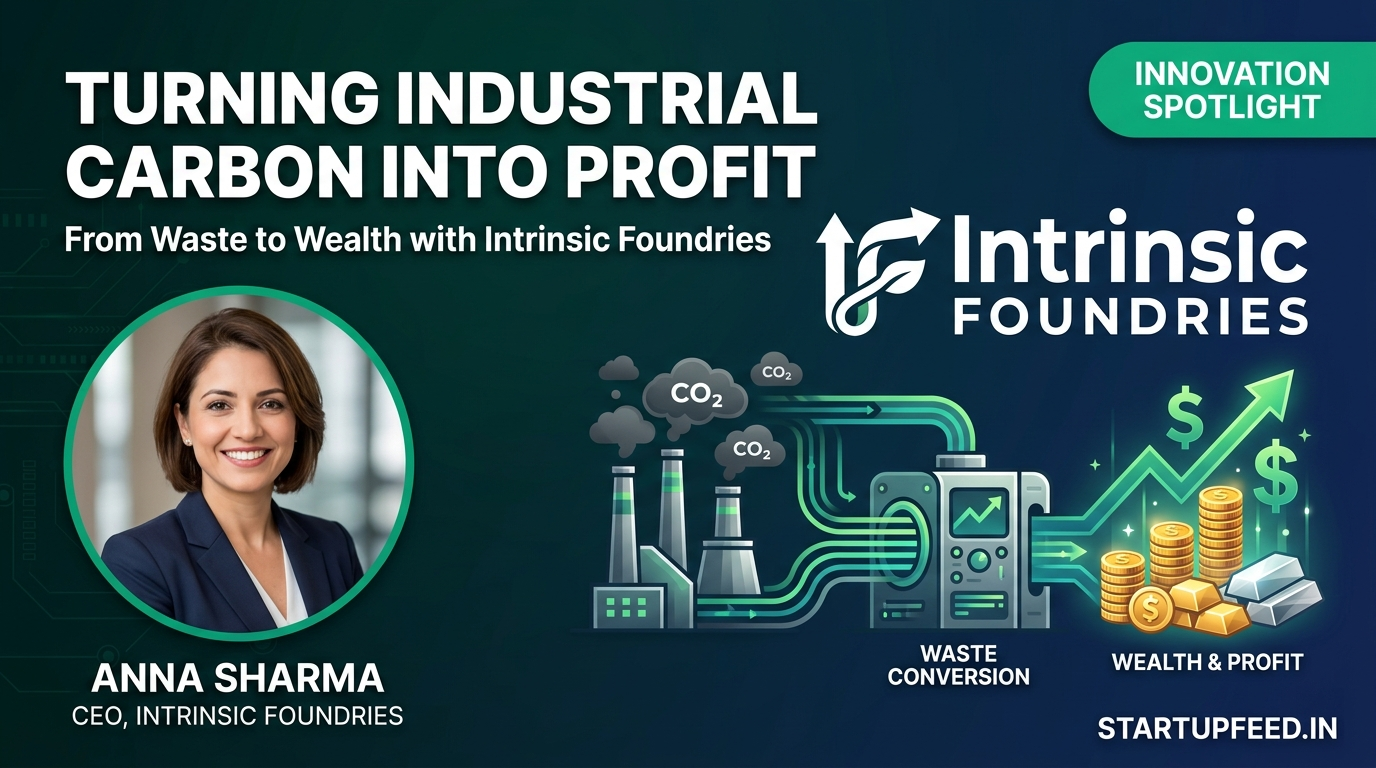
Intrinsic Foundries, a microalgae-based carbon capture and biochemical production platform founded in 2023, has raised ₹12 crore ($1.4 million) in Seed funding led by Transition VC. The Hazaribagh-based startup converts industrial carbon emissions directly into commercially valuable biochemicals used in pharmaceuticals, nutraceuticals, and cosmetics—a departure from traditional carbon capture models that treat emissions as waste. The funding signals growing investor confidence in a specific thesis: the economics of carbon capture just flipped. Revenue-generating CCUS is now viable.
Why This Deal Matters: The CCUS Broken Economics Problem Solved
For decades, carbon capture has been an economic dead-end. Companies capture CO2 at huge capital expenditure, then bury it underground with zero financial return—or worse, negative returns after operating costs. The model only works with massive government subsidies. Intrinsic flips this entirely. Instead of burying carbon, it feeds CO2 from industrial flue gas and wastewater streams into microalgae bioreactors. The algae grows, absorbs the carbon, and produces biomass containing high-value biochemicals (astaxanthin, beta-carotene, algal proteins, omega-3s) that sell for $10,000-$50,000+ per kilogram into food, pharma, and cosmetic supply chains. One input (waste CO2) = two outputs (carbon removed + revenue from sales). This is the first time CCUS has unit economics that make sense without subsidies. That’s why Transition VC led the round.
StartupFeed Insight
| What the round reveals: | India’s ₹20,000 Cr CCUS commitment (2026 budget) is reshaping the decarbonization playbook. No longer carbon storage, but carbon-to-value. Intrinsic captured early momentum by proving microalgae-based biorefinery at thermal power plant (2025). Transition VC’s investment signals confidence in biorefinery-scale-up timelines (1-ton/day facility in 24 months). |
| For industrial customers: | Steel plants, cement, refineries, chemicals = hard-to-abate sectors with no decarbonization path. Intrinsic offers: (1) comply with carbon regulations, (2) reduce Scope 1/2 emissions, (3) sell high-value biochemical byproducts. This is capex they can eventually profit from, unlike traditional carbon storage. |
| Founder playbook: | Shreyansh Jain (Cornell bioprocess engineer + BITS background) designed the tech. Sanjay Jain (industrial ops experience) handles manufacturing readiness. Umang Jain (enterprise tech) runs strategy. The three-person founding team blends deep domain expertise (not just greentech hype). This is critical for biorefinery scaling. |
| Our prediction: | By 2028, Intrinsic will have 3-5 one-ton/day facilities operational across India’s industrial belt. Series A will likely arrive in late 2026 or early 2027 when proof-of-concept revenue from biochemical sales becomes visible. US market entry by 2027 could unlock 5-10x scale (US industrial CO2 sources = larger TAM). |
The Engineering Innovation: 3D-Printed Tubular Photobioreactors + Factory 4.0
The Core Problem with Algae Cultivation: Traditional algae cultivation uses either open ponds (cheap but contamination-prone, no temperature control) or conventional photobioreactors (sealed tubes made of glass or plastic). Both have a critical flaw: self-shading. As algae cells grow and densify, they block light from reaching cells deeper in the reactor. The result: productive cells at the surface, starving cells in the center. Growth plateaus. Yields suffer. Economics break.
Intrinsic’s Solution: 3D-Printed Hollow Tubular Design. The platform is built on modular photobioreactor systems with 3D-printed hollow tubular structures and integrated Factory 4.0 automation. The hollow design isn’t decorative—it’s a light distribution strategy. By creating specific geometric patterns in the 3D-printed tubes, light scatters more evenly throughout the culture medium, reaching cells that would normally be in shadow. This is inspired by coral reef biology, where coral skeletons scatter light to support dense algae colonies.
Factory 4.0 Integration: Parallel development is underway on additional microbial systems, including yeast-based platforms, with advanced automation architecture managing real-time process controls. This means sensors continuously monitor pH, dissolved oxygen, CO2 concentration, light intensity, temperature, and nutrient levels. AI-driven automation adjusts inputs in real-time. No manual intervention needed for sustained 24/7 operation. The system learns optimal conditions for each algae species and industrial input stream (flue gas, wastewater, etc.).
Two Parallel Platforms:
(1) Flue Gas Platform: Direct capture of CO2 from thermal power plants, cement plants, refineries. The industrial exhaust stream feeds directly into the photobioreactors. Algae absorbs CO2, removes pollutants, creates biomass.
(2) Wastewater Stream Platform: Treatment of industrial wastewater. Algae absorbs dissolved nutrients (nitrogen, phosphorus) that would otherwise contaminate waterways. Produces algal biomass as a byproduct.
Proof of Concept: Real-World Thermal Power Plant Test (2025)
In 2025, Intrinsic completed a successful proof of concept at a thermal power plant, demonstrating sustained carbon capture and stable operational performance under real-world conditions. This is not a laboratory achievement—this is a thermal power plant producing industrial CO2 24/7, with Intrinsic’s bioreactors capturing it continuously, and the system delivering consistent biomass yields.
What this proves:
• The tech works at scale (not just in flasks)
• Real industrial exhaust streams don’t destroy the system
• Continuous operation is feasible (no contamination breakdowns)
• Biomass quality is production-grade (can be refined into biochemicals)
This is the single most important validation for any deep-tech startup. Intrinsic cleared it.
How Intrinsic Will Use ₹12 Crore: A Deliberate, Staged Approach
| Use of Capital | Timeline | Why It Matters |
| Industrial Pilot Facilities | Months 3-12 | Prove economics at 100-500kg/day scale. Validate unit economics with real customers (steel, cement plants). Generate first revenue from biochemical sales. |
| R&D & Patent Filings | Ongoing (Months 1-24) | File 5-10 patents on photobioreactor design, process IP, algae strains. IP = moat against competitors. Critical for Series A valuations. |
| Team & Engineering | Months 1-24 | Hire manufacturing engineers, bioprocess specialists, automation experts. Shreyensh Jain (BITS/Cornell) will lead process scaling. Scale from 3 to 15+ person team. |
| US Entity & Market Access | Months 6-18 | US is 10x larger CCUS market than India. East Coast refineries, Texas chemical plants = huge CO2 sources. US presence = 5-10x valuation jump. |
| Commercial 1-Ton/Day Facility | Months 12-24 | Build first permanent 1-ton/day plant. Operationalize as proof for Series A. Establish revenue base from biochemical sales. |
| KEY INSIGHT | All capital = revenue-generating milestones | Unlike many cleantech startups that burn capital on R&D, Intrinsic’s capital goes to profit-generating facilities. By end of 24 months, startup could be generating ₹50-100 Cr annual revenue from biochemical sales. |
Market Opportunity: India’s ₹20,000 Crore CCUS Bet + Global TAM
India’s Policy Tailwind: To achieve net-zero goals by 2070, focus needs to be on reducing carbon emissions from hard-to-abate sectors—steel, cement, refineries, and chemicals. The only feasible option is Carbon Capture, Utilisation, and Storage (CCUS). In the recent budget, India has committed ₹20,000 crore (~$2.4 billion) over five years to scale up CCUS.
This is not just talk—these are funds allocated. Steel companies (Tata Steel, JSW, Jindal), cement players (Ultratech, Ambuja, ACC), refineries (IOCL, BPCL) are actively seeking CCUS solutions. Carbon tariffs are coming. Carbon credits are becoming valuable. Intrinsic’s revenue-generating model fits perfectly into this policy landscape.
| Competitor | Tech Approach | Maturity | Intrinsic’s Advantage |
| LanzaTech | Gas fermentation (bacteria, not algae); converts CO2 to ethanol | Late-stage; demos with airlines | Lower value products ($2-5/kg). Intrinsic: $10-50K/kg biochemicals. Faster scaling in India. |
| OCO (Oxy) | Direct Air Capture (DAC); high energy input | Pilot stage | DAC is capital-intensive, energy-intensive. Intrinsic leverages algae photosynthesis (free solar energy). Biorefinery = higher-value output. |
| CarbonFree (Local) | CO2 utilization, various approaches | Varies | Intrinsic: Proprietary 3D-printed photobioreactor design. Factory 4.0 automation. Strong founder + investor backing (Transition VC = climate-focused fund). |
| Intrinsic Foundries | Microalgae biorefinery; 3D-printed modular photobioreactors + Factory 4.0 | POC complete; Series A ready by late 2026 | Revenue-positive model, India-focused, proven tech at power plant, strong founding team, policy tailwinds |
| Market Position | — | — | Early leader in India’s biorefinery-based CCUS space. Positioned for 10x scale-up to Series A (late 2026/early 2027) |
The Founding Team: Why This Execution Will Happen
Shreyansh Jain (CEO, Process Engineering): BITS Pilani and Cornell University alumnus leads process engineering and global development efforts. Cornell’s bioprocess engineering program is one of the top 3 globally. Shreyansh has deep expertise in bioreactor design, fermentation, and scaling biotech from lab to pilot to commercial. This is the critical skillset for Intrinsic’s 1-ton/day facility timeline.
Sanjay Jain (Operations & Industrial Strategy): Brings industrial operations experience (implied by founding team composition). This is crucial—thermal power plants, cement plants, refineries = brutally operational environments. Sanjay understands how to integrate Intrinsic’s bioreactors into existing industrial facilities without disrupting production. Most biotech startups fail here.
Umang Jain (Enterprise Tech & Strategy): Covers technology strategy and enterprise deployment. This is the person who understands how to package the tech for B2B enterprise sales (vs just having better science).
Why This Team Executes: Unlike many deeptech founders who are brilliant scientists with zero commercial sense, Intrinsic’s three-person founding team blends process engineering (Shreyansh), industrial operations (Sanjay), and enterprise strategy (Umang). This is the exact team profile for a biotech-scale-up that actually ships.
Intrinsic’s 24-Month Timeline: What to Watch For
| Timeframe | Key Milestone | Signal for Series A |
| Q2-Q3 2026 (Now) | Launch 2-3 industrial pilots with major steel/cement/refinery customers | Customer contracts signed. First revenue from biochemical byproducts flowing. Validates willingness-to-pay. |
| Q4 2026 – Q1 2027 | Operationalize 1-ton/day commercial facility. Patent portfolio expanded (5-10 filings). US entity established. | Proof that tech works at scale. IP protection visible. International expansion begun. |
| Q2-Q3 2027 | Series A fundraise (₹50-100 Cr likely). Multiple pilots generating consistent revenue. | Valuation jump from $15-20M (current seed) to $50-100M+ (post-Series A). Trajectory proves. |
| 2027-2028 | Scale to 3-5 one-ton/day facilities. US market launch. Yeast-based platform commercialization. | Multi-facility operation = proof of replicability. Biochemical revenue base = $50-100 Cr+/year. |
Why This Matters for India’s Deeptech Ecosystem
Intrinsic Foundries represents a shift in Indian deeptech: from laboratory science to revenue-generating biomanufacturing. The company isn’t just capturing CO2—it’s proving that the economics of decarbonization can flip. Instead of treating emissions as a problem with negative ROI, Intrinsic converts them into assets. This model works in India’s industrial heartland (Jharkhand, Odisha, Tamil Nadu) where steel, cement, and refining capacity is concentrated and carbon regulations are tightening. It’s also fundable: investors (Transition VC, others) will keep backing this because the unit economics are real, not speculative. Over the next 3 years, expect Intrinsic to become a template for how India builds deeptech companies: strong technical founding team, proprietary engineering, real customer demand, revenue-generating first product.
What Investors & Industry Say
Intrinsic Foundries Technology helps capture CO2 from Industrial sources using microalgae in the upstream and convert it into high-value biochemicals. By utilising the captured carbon, Intrinsic generates high-value biochemicals for the Pharmaceutical, Nutraceutical, and cosmetic Industries. India has committed Rs 20,000 crore to scale up CCUS, and we believe Intrinsic is well-positioned to capture a significant share of the market.”
— Shantanu Chaturvedi, Partner, Transition VC
Carbon is not waste. It is a resource waiting to be transformed. The economics of carbon capture have been broken for decades because the industry has been trying to bury the problem underground. At Intrinsic, we are using nature-based biological systems to convert industrial emissions into the ingredients that go into your supplements, your food, and your skincare.”
— Shreyansh Jain, Founder, Intrinsic Foundries
Risks to Watch: The Scaling Challenge Ahead
Bioreactor Contamination: At small scale (laboratory), contamination is manageable. At industrial scale (1-ton/day facility), a single contamination event = total production loss. Intrinsic’s Factory 4.0 automation helps, but biological systems are inherently unpredictable. Success = flawless operational protocols.
Industrial Customer Adoption: Thermal power plants and cement facilities are conservative. They prefer proven suppliers. Intrinsic is new. Getting pilot contracts is easy; getting long-term commercial contracts at scale = hard. Customer risk mitigation will be critical.
Biochemical Market Volatility: Intrinsic’s economics depend on selling captured algal biomass as high-value biochemicals. If prices for astaxanthin, beta-carotene drop (commodity pricing), unit economics break. Intrinsic must focus on highest-value molecules (pharmaceutical-grade) to avoid commoditization.
Capital Requirements: Scaling from pilot to 1-ton/day to 10-ton/day = significant capex. Each facility = ₹5-10 Cr. Series A (and B) capital availability = key constraint. Biotech scaling is capital-intensive.

