

Quick Take
|
India’s startup ecosystem crossed a $354 billion total valuation in 2025, cementing the country’s position as the world’s third-largest startup hub with 125+ unicorns and 1.64 lakh+ DPIIT-recognised companies. Behind these numbers are a new generation of founders — some still in their twenties, some bootstrapped billionaires, some pivoting from ride-hailing to AI chips — who are rewriting what Indian entrepreneurship looks like in 2026.
The defining shift of 2026 is that India’s top founders are no longer just building for Bharat — they are building for the world. Zerodha’s Nithin Kamath has $7 billion bootstrapped without a single rupee of VC money. Falguni Nayar took a beauty startup public at $7 billion. Aadit Palicha became a billionaire at 23. And Deepinder Goyal, having built India’s largest food delivery platform, has now stepped down to bet $54 million on brain-monitoring wearables. This is not a startup ecosystem in its infancy — it is one in full stride.
| StartupFeed Insight
Ecosystem inflection point: 2026 marks the first year where India’s top founders are being measured not just by fundraising but by profitability, IP creation, and global ambition. Three categories to watch:
Watch for: Whether India’s AI unicorns can break the pattern of 90% intra-group revenue dependency (see: Krutrim, Rs 101.7 Cr revenue, 90% from Ola group entities) and build truly independent revenue bases. |
India’s Startup Ecosystem — 2026 Snapshot
| Metric | Figure | Source |
| Total startups (DPIIT recognised) | 1.64 lakh+ | DPIIT, 2026 |
| Total unicorns | 125+ | Inc42 / Tracxn |
| Total ecosystem valuation | $354 Billion | DPIIT Startup Mahakumbh 2025 |
| Funding raised in 2025 | ~Rs 94,500 Cr | StartupTalky |
| Bengaluru unicorns | 52 | Inc42 |
| Delhi-NCR unicorns | 20+ | Inc42 |
| New unicorns in 2025-26 (select) | Netradyne, Porter, Sarvam AI, Fireflies AI | GrowthList |
| Minimum valuation: Top 200 list | Rs 4,300 Cr (up 26% YoY) | Hurun India 2025 |
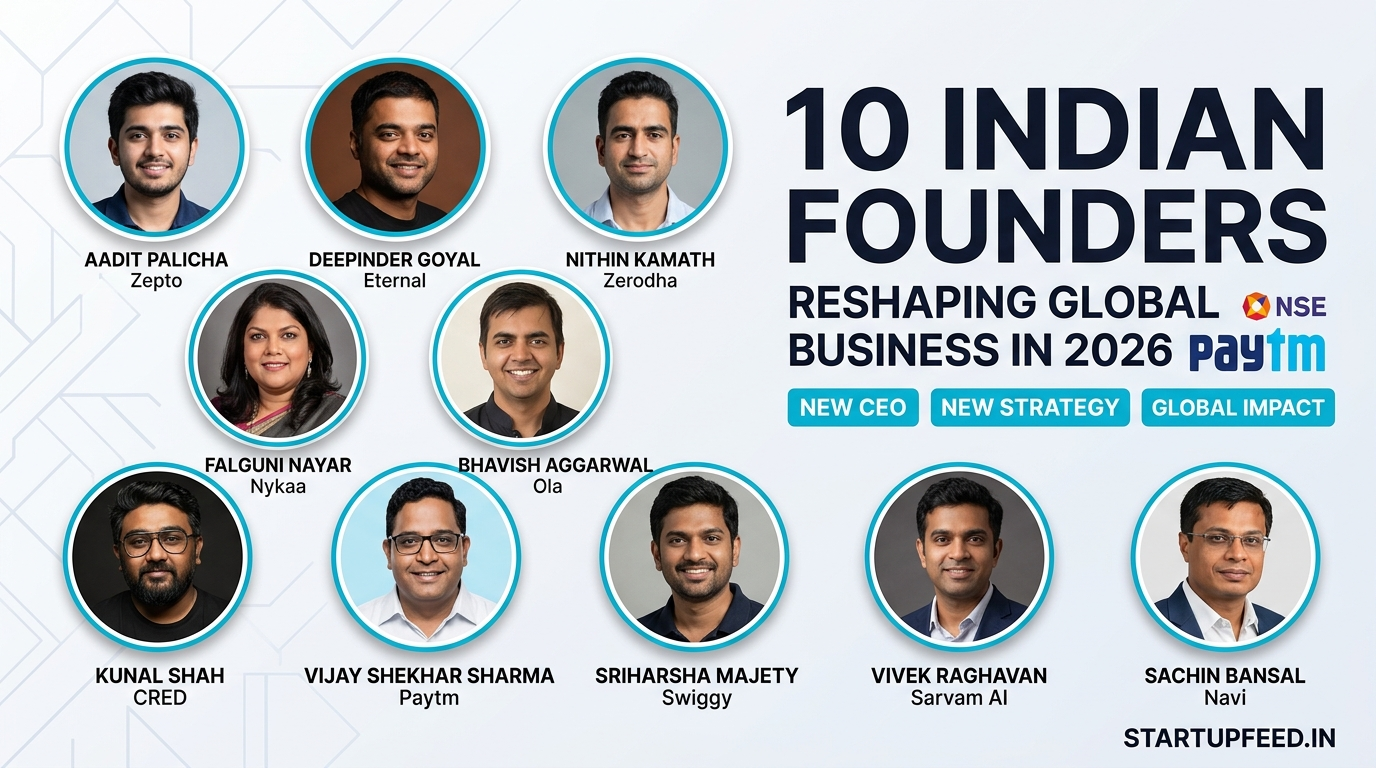
The Founders: 10 Profiles That Define India’s Startup Story in 2026
| 1. Aadit Palicha & Kaivalya Vohra — Zepto
Co-founders (CEO & CTO) | Sector: Quick Commerce | Valuation: $5.9B (Rs 52,400 Cr) | HQ: Mumbai | Est. 2021 Two Stanford dropouts who flew back to India in 2020, failed with KiranaKart, then pivoted to build Zepto — India’s fastest-growing quick-commerce company. Their dark-store model (1.5 km radius, 10-minute delivery) turned a logistics problem into a defensible moat. Zepto raised $450–500 million in 2025 and operates across 50+ cities. As of early 2026, Palicha (23) and Vohra (22) are the youngest founders on India’s Self-Made Billionaire list, with a combined net worth placing them firmly among India’s newest wealth creators. Palicha responded to government criticism of startup innovation by pledging all capital generated would be invested into long-term value creation in India.
— Aadit Palicha, Co-founder & CEO, Zepto |
| 2. Deepinder Goyal — Eternal (Zomato) → Temple
Founder (stepped down as Group CEO, 2026) | Sector: Food Delivery / Deep Tech | Valuation: Rs 15,300 Cr+ net worth | HQ: Gurugram | Est. 2008 Deepinder Goyal co-founded Zomato in 2008 with Pankaj Chaddah and spent nearly two decades building it into India’s largest food delivery and quick-commerce platform (via Blinkit, acquired for $568 million in 2022). He topped India’s Self-Made Billionaire list in 2025. In early 2026, Goyal stepped down as Group CEO of Eternal (Zomato’s parent) and immediately pivoted to deep-tech: raising $54 million at a $190 million valuation for Temple, a brain-monitoring wearable startup. He has also committed $25 million of personal capital to Continue Research, a longevity biotech venture, and co-founded LAT Aerospace, expanding into defence tech. Investors in Temple include Vijay Shekhar Sharma, Kunal Shah, and the Kamath brothers — underscoring Goyal’s position as India’s most influential founder-angel.
— Deepinder Goyal, Founder, Temple |
| 3. Nithin Kamath — Zerodha
Co-founder & CEO | Sector: Fintech (Discount Brokerage) | Valuation: $7B (bootstrapped) | HQ: Bengaluru | Est. 2010 Nithin Kamath and brother Nikhil Kamath built Zerodha into India’s largest stockbroker by active users — entirely without external funding. The discount brokerage model they pioneered (flat Rs 20 per trade) disrupted full-service brokers and democratised equity investing for retail India. As of 2025, Zerodha’s profit surged 62% to Rs 4,700 crore, with Nithin’s personal net worth estimated at $5.1 billion. Zerodha’s bootstrapped journey stands as a proof point that category leadership does not require VC capital — a message Nithin actively advocates through public commentary and investments in 100+ startups (Rs 700 crore deployed). Both Kamath brothers collectively earned Rs 160 crore in FY2024-25 salary from Zerodha.
— Nithin Kamath, Co-founder & CEO, Zerodha |
| 4. Kunal Shah — CRED
Founder & CEO | Sector: Fintech (Credit & Rewards) | Valuation: $6.4B | HQ: Bengaluru | Est. 2018 Kunal Shah dropped out of his MBA to pursue entrepreneurship — a decision that led first to FreeCharge (sold to Snapdeal, then Axis Bank) and then to CRED, launched in 2018. CRED began as a credit card bill payment platform that rewards on-time payments, but has since evolved into a full-stack financial platform spanning P2P lending (CRED Mint), wealth management, and premium commerce. Valued at $6.4 billion, CRED’s strategy of targeting India’s ‘creditworthy premium’ consumer segment — and monetising through brand partnerships and financial products — has become a case study in vertical fintech. Shah is also one of India’s most prominent angel investors, backing Deepinder Goyal’s Temple in early 2026.
— Kunal Shah, Founder & CEO, CRED |
| 5. Falguni Nayar — Nykaa
Founder, MD & CEO | Sector: Beauty / D2C Commerce | Valuation: Rs 67,500 Cr (company value) | HQ: Mumbai | Est. 2012 Falguni Nayar left a 19-year investment banking career at Kotak Mahindra to found Nykaa at age 49 — making her one of India’s most compelling late-bloomer success stories. Nykaa went public in 2021 at a $7 billion market cap, making Nayar one of India’s wealthiest self-made women with a net worth of approximately $3.6 billion. She ranks 31st on Forbes’ 2025 list of World’s Richest Self-Made Women. In 2026, Nykaa continues to expand its offline footprint (550 stores across 100 cities, up from 250) while scaling its fashion vertical. Nayar and daughter Adwaita Nayar (Co-founder, Nykaa Fashion) together lead the top women-founder pairing on India’s self-made billionaire list, with 20 women entrepreneurs featured collectively accounting for Rs 3.3 lakh crore in combined company value.
— Falguni Nayar, Founder & CEO, Nykaa |
| 6. Bhavish Aggarwal — Ola / Krutrim
Co-founder & CEO (Ola); Founder (Krutrim) | Sector: EV Mobility / AI | Valuation: $4.8B (Ola Electric, NSE listed) | HQ: Bengaluru | Est. 2010 / 2023 Bhavish Aggarwal co-founded Ola Cabs in 2010 after a frustrating taxi experience — and built it into India’s dominant ride-hailing platform. He then pivoted aggressively into EVs with Ola Electric (IPO’d 2024, NSE: OLAELEC), which holds 99 of Ola group’s 118 total patents and plans Rs 1,600 crore in R&D between FY25-27. His most audacious bet: Krutrim, India’s first AI unicorn, which hit a $1 billion+ valuation in under seven months. Krutrim is building India’s own LLMs, AI chips (Bodhi series), and cloud infrastructure — with targets of 1 GW data centre capacity by 2028. A note of caution: Krutrim reported Rs 101.7 crore revenue for FY25, with 90% sourced from Ola group entities, drawing governance scrutiny.
— Bhavish Aggarwal, Founder, Krutrim |
| 7. Vijay Shekhar Sharma — Paytm
Founder & CEO | Sector: Fintech / Digital Payments | Valuation: NSE listed (PAYTM) | HQ: Noida | Est. 2010 Vijay Shekhar Sharma built Paytm into India’s largest digital payments platform, serving 300 million+ users and processing billions of transactions annually. The Paytm Payments Bank crisis in 2024 (RBI restrictions) tested Sharma’s resilience — and his response, restructuring the platform and refocusing on its core payment gateway and financial services business, has been closely watched across the ecosystem. Despite the regulatory headwinds, Sharma remains one of India’s most prominent founders. His net worth places him in the top tier of India’s technology founders, and he continues to be an active angel investor — backing Deepinder Goyal’s Temple in early 2026.
— Vijay Shekhar Sharma, Founder & CEO, Paytm |
| 8. Sriharsha Majety — Swiggy
Co-founder & CEO | Sector: Food Delivery / Quick Commerce | Valuation: $13B (NSE: SWIGGY, IPO 2024) | HQ: Bengaluru | Est. 2014 Sriharsha Majety co-founded Swiggy in 2014 and built it into India’s second-largest food delivery platform, before IPO-ing on NSE in 2024 at a $13 billion valuation — one of the largest tech IPOs in Indian history. Swiggy’s Instamart quick-commerce vertical directly competes with Blinkit (Zomato/Eternal) and Zepto. Majety has overseen Swiggy’s expansion beyond food into grocery, pharmacy, and gig-economy financial services. The post-IPO period in 2025-26 has been about proving that delivery platforms can improve unit economics and march toward sustained profitability — a test all three quick-commerce players face simultaneously. |
| 9. Vivek Raghavan — Sarvam AI
Co-founder & CEO | Sector: AI (Sovereign LLM) | Valuation: $1.5B (Series B, April 2026) | HQ: Bengaluru | Est. 2023 Vivek Raghavan is the face of India’s sovereign AI movement. Co-founded with IIT alumni in 2023, Sarvam AI is building India’s own large language models trained on Indian languages, contexts, and data — positioning itself as an alternative to OpenAI and Google for Indian enterprise and government use cases. In April 2026, Sarvam closed a $300–350 million funding round at a $1.5 billion valuation, making it one of the fastest Indian AI startups to achieve unicorn status. With India generating 41.06 zettabytes of data in 2024 (per the National Data Administration), Sarvam’s bet on Indian-language AI has strong tailwinds from both the government’s AI Mission and enterprise demand. |
| 10. Sachin Bansal — Flipkart → Navi Technologies
Co-founder (Flipkart); Founder & CEO (Navi) | Sector: E-Commerce / Fintech | Valuation: $37.6B (Flipkart, Walmart-owned) | HQ: Bengaluru | Est. 2007 / 2018 Sachin Bansal (along with Binny Bansal) co-founded Flipkart in 2007 as two former Amazon engineers — and built India’s largest e-commerce marketplace before Walmart acquired it for $16 billion in 2018 (the largest e-commerce acquisition in India’s history). Post-Flipkart, Sachin founded Navi Technologies in 2018, a full-stack financial services company spanning home loans, personal loans, health insurance, and mutual funds. Navi serves 50+ million customers and is preparing for an IPO. Sachin’s journey — from e-commerce pioneer to fintech builder — is emblematic of how India’s first generation of startup exits is funding the next generation of category creation. |
India’s Top Founder-Led Companies: Sector Overview 2026
| Founder(s) | Company | Sector | Valuation / Status | Key 2026 Milestone |
| Aadit Palicha, Kaivalya Vohra | Zepto | Quick Commerce | $5.9B | $450-500M raised in 2025; 50+ cities |
| Deepinder Goyal | Eternal (Zomato) | Food / QComm | Listed (NSE: ETERNAL) | Stepped down as CEO; launched Temple ($54M) |
| Nithin Kamath | Zerodha | Fintech | $7B (bootstrapped) | Profit Rs 4,700 Cr; zero VC funding |
| Kunal Shah | CRED | Fintech | $6.4B | Expanding into P2P lending & wealth |
| Falguni Nayar | Nykaa | Beauty / D2C | Listed (NSE: NYKAA) | 550 offline stores; 100 cities |
| Bhavish Aggarwal | Ola Electric / Krutrim | EV / AI | $4.8B (Ola Electric) | Krutrim: $1B+ AI unicorn; chip by 2026 |
| Vijay Shekhar Sharma | Paytm | Fintech / Payments | Listed (NSE: PAYTM) | Post-RBI restructuring & recovery |
| Sriharsha Majety | Swiggy | Food / QComm | $13B | IPO 2024; Instamart scaling |
| Vivek Raghavan | Sarvam AI | AI (Sovereign LLM) | $1.5B | $300-350M raised April 2026 |
| Sachin Bansal | Flipkart / Navi | E-commerce / Fintech | $37.6B (Flipkart) | Navi IPO preparations underway |
What’s Next for India’s Startup Ecosystem in 2026
India’s startup story in 2026 is defined by three macro forces: the shift from growth-at-all-costs to profitability-first investing, the rise of sovereign AI as a national priority, and the first wave of founder-led ‘second acts’ — serial entrepreneurs who have exited billion-dollar companies and are now placing deep-tech bets that older venture models would have rejected.
The minimum valuation to appear on India’s Top 200 self-made billionaire list rose 26% to Rs 4,300 crore in 2025 — one of the steepest single-year jumps in the list’s history. The message to founders is clear: the bar for entry into India’s wealth-creation narrative has never been higher. And yet, the Zepto founders — 22 and 23 years old — are already on it.
Sector outlook: Where India’s next founders will emerge
|

