
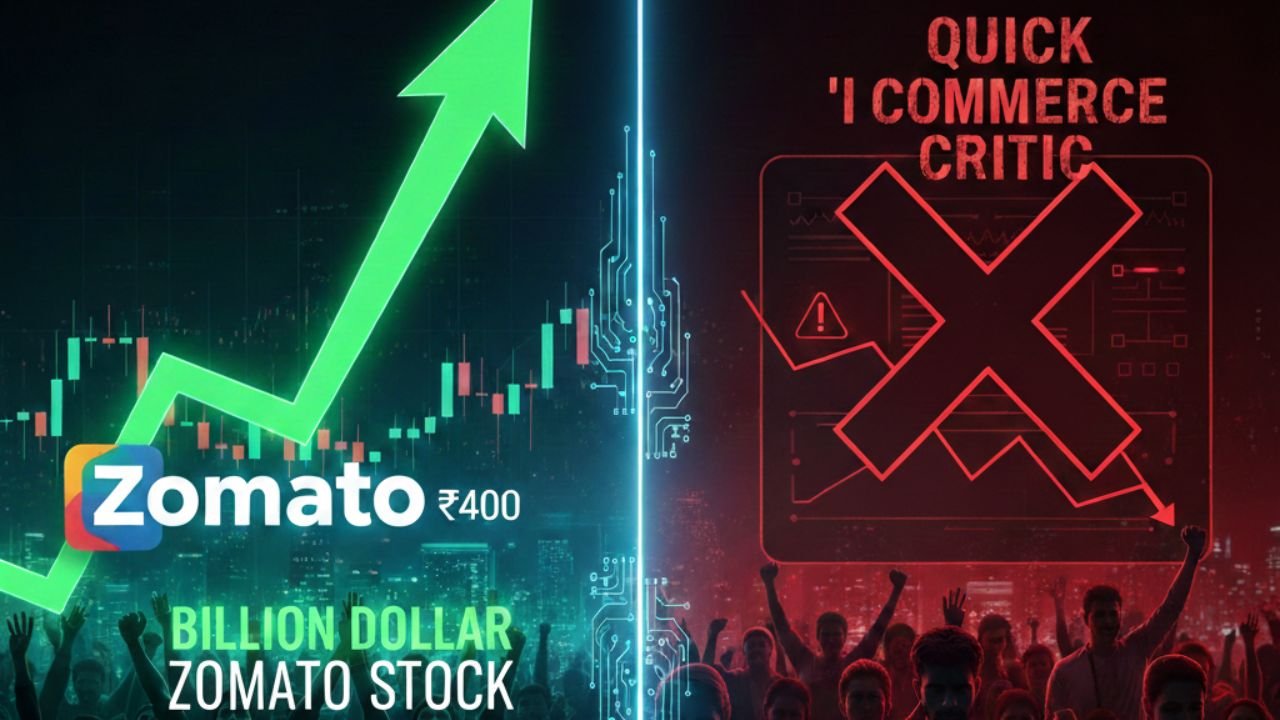

Zomato stock ₹400—three numbers that represent more than just a price milestone. They represent vindication. For every analyst who called quick commerce “unsustainable,” every investor who panic-sold during the ₹200 dip, and every skeptic who claimed Blinkit would “burn infinite cash forever,” the Zomato stock ₹400 breakthrough is the market’s loudest possible response: you were wrong.
The Blinkit Profitability Shocker That Changed Everything for Zomato Stock ₹400
Following Eternal Ltd.’s (formerly Zomato) Q3 FY26 results announcement on January 21, 2026, the market witnessed something many thought impossible: Blinkit, the quick commerce arm that critics dismissed as a bottomless money pit, turned adjusted EBITDA-positive.
The numbers tell a story of operational excellence: ₹30 contribution per order, 121% year-on-year net order value growth to ₹13,300 crores, and 2,027 dark stores operational across India. This wasn’t a fluke—it was execution.
“Blinkit delivered positive EBITDA at a time when competitive intensity appears near its peak,” noted Jefferies in its post-results analysis, maintaining a ‘buy’ rating with a target price of ₹480—well above the Zomato stock ₹400 psychological barrier.
CLSA went further, reiterating its ‘high-conviction outperform’ call with a ₹503 target, citing Blinkit’s contribution per order beating estimates alongside higher-than-expected monthly transacting users.
The stock, which traded around ₹282.8 immediately post-results, surged nearly 5% that day alone—and hasn’t looked back since. For investors who held through the noise, the Zomato stock ₹400 milestone represents not just profits but validation of their thesis.
The ₹250 Regret: Retail Investors Who Sold Too Soon on Zomato Stock ₹400 Run
Social media and investment forums are filled with a particular brand of regret this week: investors who dumped Zomato stock at ₹250 during the October 2025 sell-off, convinced the company would never achieve quick commerce profitability.
“I sold at ₹252 because ‘everyone said’ Blinkit would keep bleeding cash for years,” confessed one Reddit user on r/IndianStockMarket. “Now watching it approach ₹400 feels like watching an ex thrive after you said they’d never make it.”
The psychology is painfully familiar to anyone who’s invested long enough. During Q3 FY25 (October-December 2024), when Blinkit losses widened due to aggressive store expansion, Zomato stock cratered from its ₹368 highs to ₹207—a 44% drawdown that shook out weak hands by the thousands.
Headlines screamed, “Zomato’s 6-Month Low Amid Blinkit Expansion Plans.” Analysts questioned whether the quick commerce bet would ever pay off. The narrative was uniform: Zomato was sacrificing profitability for unproven market share in an overcrowded sector facing Zepto, Swiggy Instamart, BigBasket, and Flipkart Quick.
But something fundamental was misunderstood by those who sold: Blinkit wasn’t burning cash recklessly. It was investing in a moat.
Why Zomato Stock ₹400 Represents More Than Just Numbers
The Zomato stock ₹400 milestone isn’t about hitting a round number. It’s about the market repricing a business model that was systematically undervalued by investors who couldn’t see past quarterly losses to underlying unit economics.
Consider the strategic playbook Eternal (Zomato) executed:
Dark store density: By reaching 2,027 stores, Blinkit achieved geographic coverage that makes 10-minute delivery economically viable—not just a marketing gimmick. Competitors with fewer stores can’t match this service level without matching this infrastructure.
Contribution margin expansion: The ₹30 per order contribution represents years of supply chain optimization, vendor negotiations, and route efficiency improvements. This isn’t easily replicated.
Customer quality over quantity: Monthly transacting users grew 21% YoY to 24.9 million, but average order values declined—meaning Blinkit is successfully converting low-frequency, high-value customers into high-frequency, moderate-value customers. That’s the sign of a habit, not a novelty.
Food delivery cash cow: While everyone obsessed over Blinkit, Zomato’s core food delivery business quietly grew 17% YoY to ₹9,846 crore in NOV with adjusted EBITDA margins improving to 4.5%. This profitable core funded the quick commerce experiments that have now turned profitable themselves.
“The organisational transition from founder Deepinder Goyal to Blinkit CEO Albinder Dhindsa as MD & CEO does not alter the near-term outlook,” noted Jefferies, addressing another source of investor anxiety.
In fact, Dhindsa—who led Blinkit from acquisition to breakeven—taking over operational leadership while Goyal transitions to vice chairman might accelerate the Zomato stock ₹400+ trajectory rather than hinder it.
EXPERT TAKE:
“The Zomato stock ₹400 move isn’t FOMO or irrational exuberance—it’s fundamental repricing,” explains Karan Mehta, equity analyst at a leading domestic brokerage. “When Blinkit was losing money, the market treated it as a liability dragging down Zomato’s food delivery business. Now that it’s EBITDA-positive with 121% growth, the market is adding Blinkit’s enterprise value to Zomato’s valuation rather than subtracting it. That’s a multi-hundred crore swing in how investors model the business. The bears who said ‘quick commerce will never be profitable’ weren’t just wrong—they fundamentally misunderstood the economics of density-based delivery networks. Every new store increases coverage and reduces per-order delivery costs for existing stores. Blinkit crossed the inflection point where network effects kick in. Investors who sold at ₹250 didn’t just miss the rally—they missed understanding the business model itself.”
The Long-Term Bull Case Beyond Zomato Stock ₹400
If ₹400 feels like validation for existing shareholders, consider what the next 12-18 months could bring:
Store expansion to 3,000+: Management targets 3,000 stores by March 2027—roughly 200 net additions per quarter. Each mature store contributes positive EBITDA, meaning scale actually improves profitability, not erodes it.
Category expansion: Blinkit is already testing pharmaceuticals, electronics, and even ambulance services. The 10-minute delivery infrastructure can monetize far beyond groceries.
International opportunity: India’s quick commerce success provides a playbook for similar density markets across Southeast Asia and the Middle East.
Improved capital efficiency: With Blinkit now self-funding through positive cash flow, Zomato can allocate capital to other ventures (District, Hyperpure, Feeding India) without diluting shareholders or burning food delivery profits.
Analysts at CLSA raised FY26-28 estimates by 5-15% post-Q3 results, citing sustained pricing power and better customer quality. Nomura, while more cautious, acknowledged that quick commerce growth exceeded expectations despite the competitive environment.
The Zomato stock ₹400 level, in this context, isn’t a destination—it’s a waypoint on a longer journey.
The Bottom Line: Was Selling at ₹250 the Right Call?
For every investor who sold Zomato stock at ₹250, convinced it was overvalued, the ₹400 level poses an uncomfortable question: what else did you get wrong?
Markets aren’t efficient in the short term—they’re emotional. During the October 2025 panic, when Blinkit losses widened due to accelerated store expansion, the narrative dominated the numbers. “Unsustainable business model” became conventional wisdom, repeated in brokerage notes, financial media, and investor group chats.
But businesses aren’t built on quarterly narratives. They’re built on unit economics, competitive moats, management execution, and patience. Eternal (Zomato) had all four—if you were willing to look past the temporary losses to see the permanent infrastructure being built.
The Zomato stock ₹400 milestone won’t erase the regret for those who sold at ₹250. But it should teach a valuable lesson about distinguishing between a broken business (which deserves to be sold) and a growth business enduring short-term pain to build long-term competitive advantages.
For the critics who said quick commerce would never work? The market just delivered a billion-dollar “I told you so.”
SUMMARY POINTS:
!. Blinkit EBITDA positive: Q3 FY26 marked inflection point with ₹30 per order contribution, defying critics’ “infinite cash burn” narrative
2. 122% YoY NOV growth: Quick commerce revenues exploded while maintaining path to sustainable unit economics
3. Brokerages bullish: Target prices of ₹480-503 suggest Zomato stock ₹400 is just the beginning, not the ceiling

