


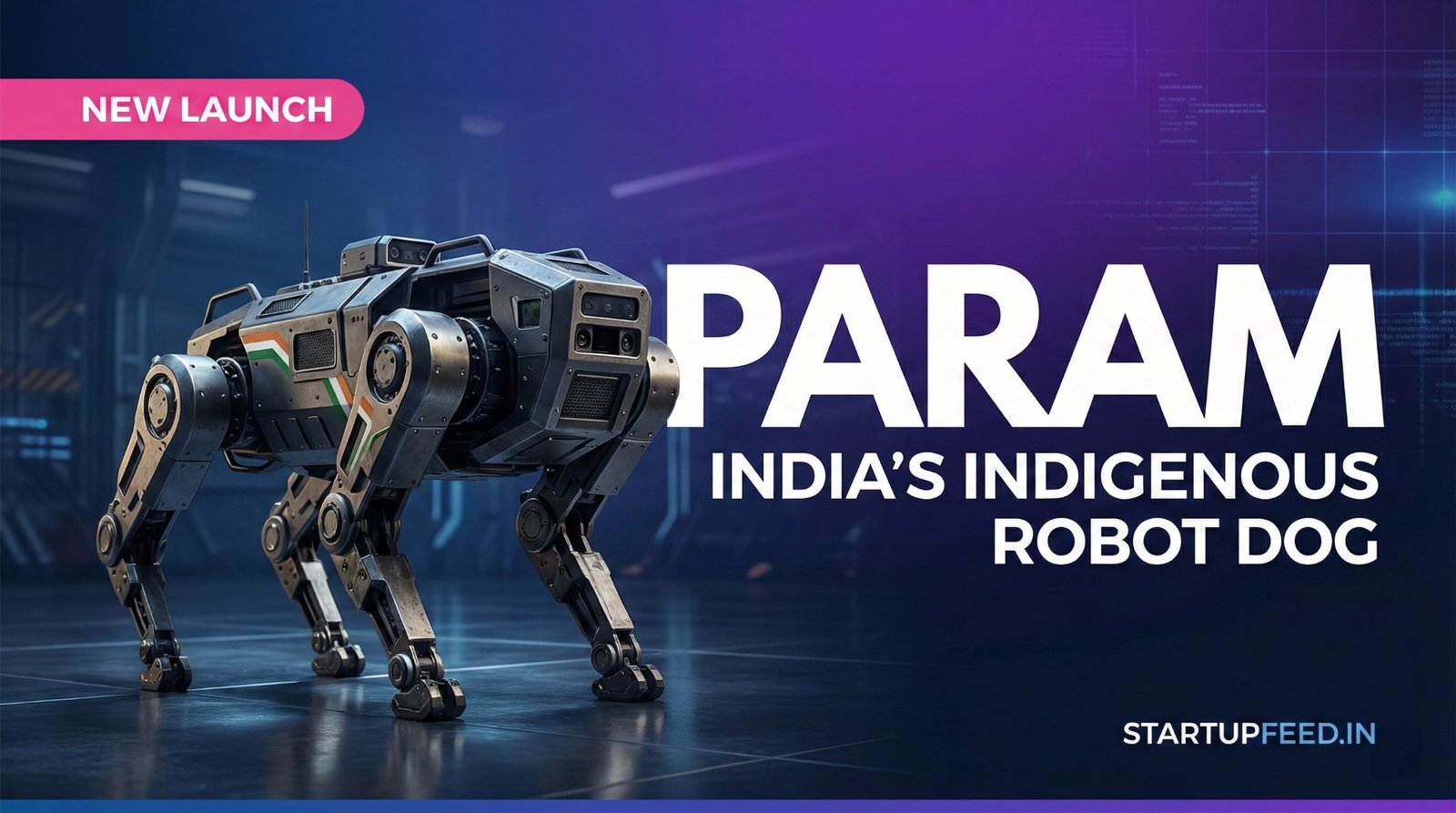

Quick Take (30-second read)
- Product: PARAM — India’s most powerful indigenous quadruped robot dog
- Developer: General Autonomy (Team of 5 engineers, HSR Layout, Bengaluru)
- Weight: 35 kg | Top Speed: 3 m/s | Jump Height: 1 metre
- Battery Life: 8 hours (hot-swappable) — industry-leading
- Indigenisation: 90% Made-in-India (chassis, software, perception, planning)
- Target Markets: Defence (DRDO) & Industrial Inspection (Oil & Gas)
- Viral Context: Trending #1 on Tech Twitter after the Galgotias ‘Orion’ scandal
General Autonomy, a bootstrapped Bengaluru startup run by a team of five engineers, has launched PARAM — India’s most powerful indigenous robot dog — catapulting the startup into the national spotlight after the viral ‘Orion’ controversy exposed a culture of rebranding Chinese hardware as homegrown innovation at the India AI Impact Summit, held at Bharat Mandapam.
The timing positions General Autonomy as the authentic counter-narrative to India’s ‘sticker engineering’ problem. With PARAM built from scratch in HSR Layout — custom chassis, proprietary Agile-Locomotion software stack, in-house perception and planning modules — the startup demonstrates that real deep-tech is happening in Indian garages, not just on university press releases.
StartupFeed Insight
The key signal: India’s most credible robot dog wasn’t built by IIT, DRDO, or a funded startup.
What’s building confidence:
- 90% indigenous BOM — the highest in any Indian quadruped robot on record
- 8-hour battery life with hot-swap capability — critical differentiator for defence use
- Custom locomotion stack, not an SDK download — genuine IP ownership
What to watch:
- Actuators are imported — India’s precision actuator gap remains a challenge sector-wide
- No disclosed revenue or contracts yet — seed raise rumoured but unconfirmed
Our prediction: General Autonomy will close a Seed round of $1–2 Mn by Q3 2026, led by a defence-focused deep-tech VC, riding the post-Orion backlash that has made PARAM a cause.
The Scandal That Started It All
At the India AI Impact Summit on February 18, 2026, Galgotias University drew sharp backlash after netizens identified their showcase robot dog — branded as “Orion”, an ‘indigenous’ product — as an off-the-shelf Chinese Unitree Go2 with a university sticker on it. The institution was reportedly asked to vacate their stall.
Social media amplified the story rapidly. Within hours, the incident became a referendum on India’s tendency to rebrand imported hardware as domestic innovation — a practice critics call “sticker engineering.” The backlash created a vacuum that General Autonomy filled decisively.
Enter PARAM: The Real Beast from Bengaluru
General Autonomy’s response was swift and surgical. The startup dropped a video on Tech Twitter within hours of the Orion story breaking, captioned: “Enough of this nonsense! Presenting PARAM: India’s most powerful indigenous robot dog. Not assembled, not bought, BUILT IN INDIA.” The post is now trending #1 on Tech Twitter in the robotics category.
Unlike Orion, PARAM required no stickers. Built over several years by a five-person engineering team in HSR Layout, Bengaluru, the robot reflects genuine systems-level engineering — from mechanical design to sensor fusion, motion planning, and real-time locomotion control.
PARAM Robot Dog India — Full Technical Specifications
| Specification | PARAM — General Autonomy |
| Developer | General Autonomy (5-person team, Bengaluru) |
| Weight | 35 kg (heavy-duty frame) |
| Top Speed | 3 m/s — among fastest in Indian-built quadrupeds |
| Jump Height | 1 metre |
| Battery Life | 8 hours (hot-swappable) — industry-leading |
| Locomotion Stack | Proprietary Agile-Locomotion (not an SDK download) |
| AI / Compute | NVIDIA Jetson GPU (imported) |
| Actuators | Imported (only non-indigenous component) |
| Indigenous Content | 90% — chassis, software, perception, planning built in India |
| Origin | HSR Layout, Bengaluru — bootstrapped, no external funding announced |
PARAM’s 8-hour battery life with hot-swap capability is the specification that defence observers are flagging most. Indian military and paramilitary deployments in border terrains or pipeline inspection assignments require robots that can stay operational across shifts — a constraint that renders most imported quadrupeds with 2–3-hour batteries impractical.
PARAM vs. Unitree Go2 — Why the Comparison Matters
| Feature | PARAM (General Autonomy) | Unitree Go2 (China) |
| Origin | 🇮🇳 Built in Bengaluru | 🇨🇳 Manufactured in China |
| Battery Life | 8 hours (hot-swap) | ~2–3 hours |
| Locomotion Software | Custom Agile-Locomotion stack | Vendor SDK |
| Weight | 35 kg (heavy-duty) | ~15 kg (lighter frame) |
| Indigenous IP | 90% — genuine IP ownership | None (off-the-shelf) |
| Defence Readiness | Yes — built for Indian conditions | Not positioned for Indian defence |
The Market Opportunity — This Isn’t a Toy
General Autonomy is positioning PARAM for two high-value markets that demand exactly what the robot delivers: long battery life, rugged mobility, and fully auditable Indian software.
| Sector | Application | Why PARAM Fits |
| Defence (DRDO) | Border surveillance, mine detection, hazardous-area reconnaissance | Hot-swap battery, indigenous software for classified deployments |
| Industrial Inspection | Oil & Gas pipeline inspection, power plant walkdowns | 8-hour runtime covers full inspection shifts without recharge downtime |
The global quadruped robot market is projected to grow from $200 Mn in 2024 to over $1.5 Bn by 2030, driven by defence and industrial automation demand. India’s DRDO has been actively scouting indigenous alternatives to imported robot platforms following government directives on Atmanirbhar Bharat procurement — a policy tailwind that could give PARAM a decisive edge in public-sector deals.
Investor Note: Seed Round in the Pipeline
General Autonomy is rumoured to be raising a Seed round, sources familiar with the startup’s plans told StartupFeed. No terms or lead investor have been disclosed. The PARAM launch and the resulting viral moment significantly raise the startup’s profile ahead of any formal fundraise — compressing the discovery phase that typically precedes deep-tech seed conversations.
For investors, the thesis is straightforward: a bootstrapped team of five has built a 90%-indigenous quadruped robot that outperforms imported alternatives on the metrics that matter for Indian defence and industrial buyers. The intellectual property sits entirely within India. The viral moment provides organic brand recognition that most deep-tech startups spend years and capital to achieve.
Who Should Be Watching
| Player | Strategic Implication |
| DRDO / Indian Army | PARAM’s 90% indigenous content directly aligns with defence procurement mandates — evaluation trials could follow the viral moment |
| Unitree Robotics (China) | PARAM’s launch creates a credible domestic alternative for Indian buyers who were previously dependent on Chinese quadrupeds |
| Boston Dynamics (US) | At a fraction of Spot’s price point, PARAM targets the cost-sensitive tier of the industrial inspection market Boston Dynamics cannot serve |
| IIT / Research Labs | A five-person bootstrapped startup has outpaced years of academic robotics research in indigenisation — a credibility challenge for institutions |
| Deep-Tech VCs (India) | The Seed window is open now; the viral narrative lowers risk perception for investors previously sceptical of Indian hardware startups |
What’s Next
Our prediction: General Autonomy closes a Seed round of $1–2 Mn by Q3 2026, with defence deep-tech fund participation. PARAM enters DRDO evaluation trials before the end of FY26, and the startup expands its team from 5 to 20 engineers within 12 months of closing the round.
The more consequential question is whether Indian deep-tech investors will fund hardware at seed — a category they have historically avoided in favour of software plays. PARAM’s moment tests whether India’s VC community has matured enough to back a robot company before it has revenue, betting on IP, talent density, and a viral proof of concept
General Autonomy is a bootstrapped robotics startup headquartered in HSR Layout, Bengaluru, founded by a team of five engineers. The startup builds India’s most powerful indigenous quadruped robot, PARAM, targeting defence surveillance and industrial inspection markets. Total external funding raised: undisclosed (bootstrapped). The company is rumoured to be pursuing its first institutional Seed round.

