
QUICK TAKE:
| MoU Parties: | Export Promotion Bureau (EPB), MSME & Export Promotion Department, Govt of UP × Ideas to Impact Foundation (Walmart Vriddhi Supplier Development Programme) |
| Duration: | 3 years, non-financial in nature. Extendable by mutual consent. |
| Primary Goal: | Integrate UP’s MSMEs into national and global value chains. Boost exports and generate employment. |
| Who Benefits: | 9 million+ MSME units across 75 districts in Uttar Pradesh — the largest state MSME ecosystem in India by unit count |
| What MSMEs Get: | Free training + mentorship in: digital enablement, e-commerce preparedness, packaging, quality standards, certifications, and market access strategies |
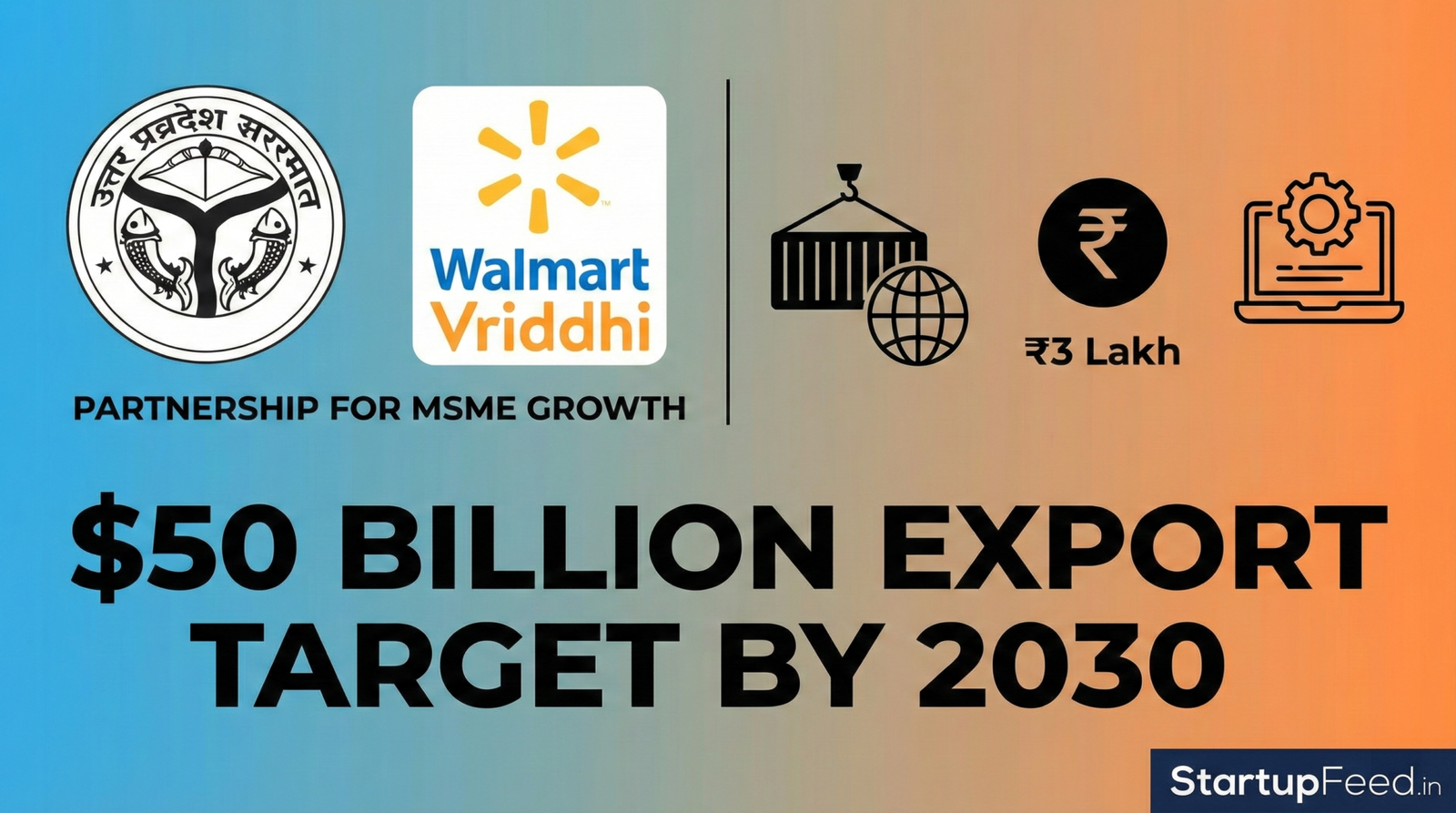
| Exporter Incentive: | First-time exporters: 75% of e-commerce platform listing fee covered, capped at ₹3 lakh (UP Export Promotion Policy 2025–30) |
| UP Export Target: | $50 billion in goods and services exports by 2030 — up from $21 billion in 2024 (138% growth target in 6 years) |
| MSME’s Role in UP Economy: | 60% contribution to UP’s annual industrial output. Backbone of ‘Make in UP’ vision. |
| Flipkart +ODOP: | Flipkart separately partnered with UP to promote One District One Product (ODOP) items: Khadi, leather, carpets, agri-products, pottery — via digital marketplaces, supporting women SHGs, artisans, micro-entrepreneurs |
| Official Quote: | Alok Kumar, Additional Chief Secretary, MSME & Export Promotion: ‘MSMEs form the backbone of the state’s economy, and this partnership would unlock new opportunities, expand market access and create fresh avenues for growth.’ |
THE DEAL, EXPLAINED
Uttar Pradesh has a problem that is also an opportunity: it hosts more than 9 million MSME units spread across 75 districts — the largest state-level MSME base in India — yet the vast majority of these businesses sell only locally or domestically. The products exist. The craftsmanship exists. The demand exists globally. The gap is market access, digital readiness, and export know-how — exactly what the average Uttar Pradesh small business owner has never had structured support to develop.
On January 9, 2026, the Yogi Adityanath government took a concrete step to close that gap. The Export Promotion Bureau (EPB) under UP’s MSME and Export Promotion Department signed a strategic, non-financial Memorandum of Understanding (MoU) with the Ideas to Impact Foundation — the implementation arm of Walmart’s Vriddhi Supplier Development Programme. The signing was attended by Additional Chief Secretary Alok Kumar, along with senior officials from Walmart, Flipkart, and the Export Promotion Bureau.
“MSMEs form the backbone of the state’s economy, and this partnership would unlock new opportunities, expand market access and create fresh avenues for growth.” — Alok Kumar, Additional Chief Secretary, Infrastructure & Industrial Development, MSME & Export Promotion, Govt of UP
The MoU will remain in force for three years, with the option to extend by mutual consent. It is non-financial — meaning there is no government money changing hands — but the value it delivers is structural: Walmart’s global supply chain expertise and e-commerce infrastructure made freely available to UP’s smallest businesses.
What Is Walmart Vriddhi — And Why Does It Matter for UP’s MSMEs
Walmart Vriddhi is Walmart Inc.’s flagship MSME supplier development initiative in India, implemented through the Ideas to Impact Foundation. The programme’s core thesis is that small businesses in India are not failing because of lack of effort or product quality — they are failing to reach global markets because of structural knowledge gaps: how to list on international e-commerce platforms, how to meet international packaging and quality standards, how to navigate export certifications, how to price and market for overseas buyers. Vriddhi closes these gaps through free, structured capacity building.
| Training Module | What UP’s MSMEs Will Learn — and Why It Matters |
|---|---|
| Digital Enablement | End-to-end onboarding onto digital commerce platforms — how to create a seller account, manage inventory digitally, process orders, and integrate payment systems. For the average MSME in Lucknow or Varanasi that has never sold online, this is the foundational layer without which everything else is inaccessible. |
| E-Commerce Preparedness | Specific training for cross-border e-commerce — understanding international marketplace requirements, pricing in foreign currency, managing international returns, understanding customs documentation. This is the bridge between domestic digital readiness and actual export capability. |
| Packaging Standards | International packaging requirements for different categories of products — from food and agricultural items to handicrafts and leather goods. Poor packaging is one of the most common reasons Indian MSME exports are rejected or returned at international ports. This training directly addresses that failure point. |
| Quality Standards & Certifications | Guidance on international quality certifications (ISO, BIS, FSSAI for food exports, etc.) that are mandatory prerequisites for global marketplace listing or direct trade buyer relationships. Most UP MSMEs have excellent product quality but lack the certification paperwork that formal international trade requires. |
| Market Access Strategies | Understanding which international markets have demand for UP’s specific product categories — e.g., Middle East and Southeast Asia for Lucknow chikankari, US and Europe for Agra leather, GCC countries for Varanasi Banarasi silk. Market targeting is as important as product quality for export success. |
| Free Mentorship | Individual and group mentorship from Walmart’s supplier development experts — not generic advice but specific guidance calibrated to each entrepreneur’s product, market, and current capability level. This is the element that separates Vriddhi from a one-time workshop: it is structured, ongoing, and personalised. |
UP Export Promotion Policy 2025–30 — The Full Incentive Architecture
The Walmart Vriddhi MoU does not exist in isolation. It is the private sector layer on top of a comprehensive government policy framework: the Uttar Pradesh Export Promotion Policy 2025–30, which the Yogi Adityanath government enacted as a dedicated roadmap for transforming UP into a top-tier export hub. The policy’s specific focus on e-commerce-led exports is what makes the Walmart Vriddhi partnership a strategic fit rather than a generic MoU.
| Policy Element | Detail | Impact |
|---|---|---|
| First-Time Exporter Incentive | 75% of e-commerce platform listing fee covered, up to ₹3 lakh (one-time) | Removes the single biggest financial barrier for a new UP MSME trying to list on Amazon Global, Walmart.com, or Etsy for the first time. The listing fee is often what prevents first attempts. |
| Focus on E-Commerce Exports | Policy specifically prioritises digital channel exports over traditional B2B trade | Ensures UP’s MSMEs enter global markets through the lowest-friction pathway available: online marketplaces, which have lower minimum order requirements, no need for trade intermediaries, and direct access to end consumers worldwide. |
| UP Export Target | $50 billion by 2030 (from $21 billion in 2024) | 138% growth in 6 years — ambitious but achievable if even 0.5% of UP’s 9 million+ MSMEs begin exporting meaningfully. The Walmart Vriddhi partnership is the activation mechanism for this target. |
| ODOP + E-Commerce Integration | One District One Product items promoted through Flipkart and other platforms | Ensures UP’s most distinctive products — Lucknow chikankari, Agra leather, Varanasi silk, Moradabad brassware, Firozabad glassware — have dedicated digital shelf space. ODOP is UP’s product diversity moat. |
| Women SHG + Artisan Inclusion | Specific support for women’s self-help groups, micro-entrepreneurs, artisans through digital platform training | 70% of India’s online sellers are small businesses — including women entrepreneurs and artisans (Business Standard). The policy targets this segment explicitly, ensuring export growth is inclusive, not just corporate. |
Understanding the Scale — What 9 Million MSMEs in 75 Districts Actually Means
UP’s MSME Ecosystem — Context That Makes This MoU Significant:
|
Central Government Parallel: Export Promotion Mission 2026
The UP-Walmart Vriddhi partnership lands at the same moment the Union Government is significantly doubling down on MSME export infrastructure. On February 20, 2026, Union Commerce Minister Piyush Goyal launched seven new interventions under the Export Promotion Mission (EPM) — a flagship scheme of the Department of Commerce that supports MSMEs in reaching global markets. The timing is not coincidental: both the state and central government are moving simultaneously on the same strategic imperative.
Central Government EPM Interventions (Feb 20, 2026) — Relevant to UP MSMEs:
|
The convergence of UP’s Walmart Vriddhi MoU with the Central EPM’s seven new interventions creates a double-layered support system for UP’s export-ready MSMEs: Vriddhi provides the training and market access knowledge; EPM provides the financial infrastructure (credit, warehousing subsidy, freight support) to actually execute on that knowledge. An MSME that graduates from Vriddhi’s programme and is ready to export now also has access to EPM’s credit facilities and overseas warehousing support. This is end-to-end MSME export infrastructure at state-plus-central scale.
STARTUPFEED INSIGHT
| Why This MoU Is More Significant Than It Looks: A non-financial MoU gets underreported precisely because there is no money headline. But the Walmart Vriddhi partnership delivers something potentially more valuable than a grant: it delivers Walmart’s global supply chain and e-commerce intelligence — built through decades of operating the world’s largest retail network — directly to 9 million+ MSME owners in UP. Free. For three years. The knowledge transfer embedded in this MoU is not replicable by any government scheme alone, because it comes from a private entity that has skin in the game: Walmart wants more Indian suppliers because it needs to diversify its global sourcing. The interests are genuinely aligned. | |
| For UP MSMEs: | The ₹3 lakh first-exporter incentive covering 75% of platform listing fees is the most actionable element of this announcement for individual business owners. If you make anything in UP — leather, textiles, handicrafts, food products, pottery — and have never listed on an international marketplace, apply for this incentive immediately. It removes the single biggest financial barrier to your first export transaction. Combine this with Vriddhi’s free training, and there has genuinely never been a lower-cost pathway to international markets for a small UP business. |
| For Startups Building for Exporters: | The UP MSME export push creates a significant opportunity for B2B startups building tools for exporters: export documentation software, quality compliance SaaS, packaging design platforms, international marketplace management tools, multilingual listing optimisation, logistics aggregators for last-mile export from tier-2 cities. The Walmart-UP MoU creates a guaranteed pipeline of newly export-ready MSMEs who will need these tools within 12-18 months. StartUP policy + Vriddhi training = a qualified, ready market. |
| For Investors: | Logistics and export-tech startups serving India’s MSME base are significantly undervalued relative to the market size the UP-Walmart MoU signals. UP alone has 9M+ MSMEs contributing 60% of state industrial output, targeting $50B exports by 2030. The infrastructure to support this transition — last-mile logistics, digital customs compliance, quality certification services, multilingual e-commerce enablement — is still fragmented. Watch for consolidation plays in this space over the next 24 months. |
| Our Prediction: Within the 3-year term of this MoU, UP will report its first major milestone: 10,000+ MSMEs onboarded to international e-commerce platforms with Vriddhi support, and a measurable increase in UP’s export figures attributable to the programme. The $50 billion 2030 export target is achievable — but only if Vriddhi’s training reaches district-level penetration beyond Lucknow and Noida into interior UP districts like Gorakhpur, Jhansi, and Allahabad. That last-mile training penetration will be the real test of whether this MoU is transformational or symbolic. We’re watching for the year-one progress report. | |