

QUICK TAKE:
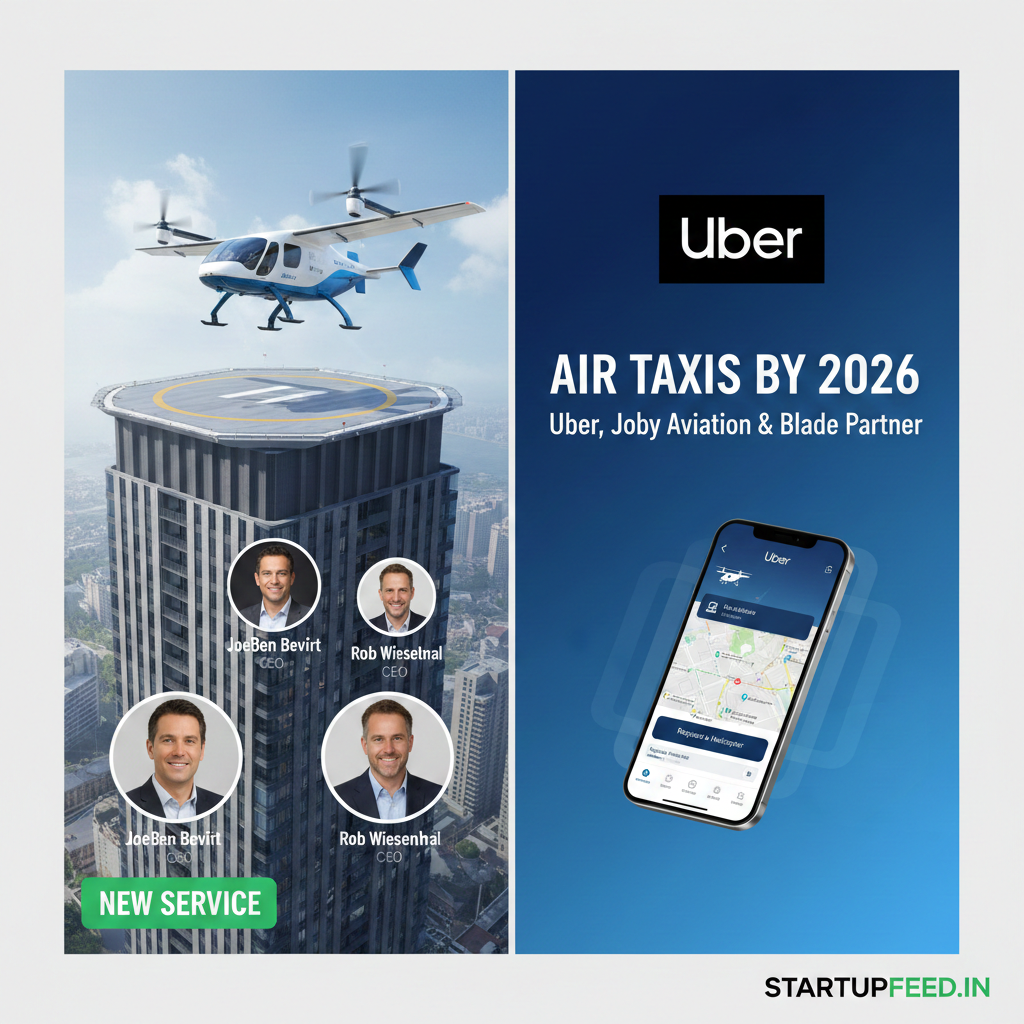
| What’s Happening: | Uber will add helicopter and seaplane booking directly inside its app in 2026 through an expanded partnership with Joby Aviation, which acquired helicopter company Blade Air Mobility for $125 million in August 2025. |
| Who’s Involved: | Uber (ride-hail platform, owns ~2.5% of Joby) + Joby Aviation (eVTOL manufacturer, previously acquired Uber Elevate in 2020) + Blade Air Mobility (helicopter + seaplane operator, now owned by Joby). |
| First Launch Market: | New York City — the world’s most congested major city. Routes confirmed: Manhattan helipad → JFK International, Newark Liberty, and the Hamptons. Southern Europe (French Riviera: Nice, Monaco, Cannes, Saint-Tropez) launching in parallel. |
| Pricing (Phase 1): | “$195 per person” for airport helicopter hops. Group charters: $2,000 for the full 8-passenger helicopter. Uber has not confirmed final in-app pricing — details expected closer to launch. |
| Time Saved: | Manhattan to JFK: car = 60+ minutes (traffic), helicopter = 5–7 minutes. Airport transfers that take over an hour by road can take under 10 minutes by air. For frequent business travellers, that is not a luxury — it is arithmetic. |
| Phase 2 — eVTOL: | Once Joby’s electric air taxi receives FAA certification, Blade’s jet-turbine helicopters will be replaced by Joby’s eVTOL aircraft: 200 mph top speed, 100-mile range, 4 passengers + pilot, 100x quieter than helicopters, zero emissions. Joby’s first commercial eVTOL service launches in Dubai in 2026. |
| Global Rollout Road Map: | Phase 1 (2026): New York + Southern Europe. Future cities confirmed: Los Angeles, Dubai, London, Tokyo. Uber’s long-term vision: a single app where you choose between a car, minibus, helicopter, or eVTOL for any journey. |
| Blade’s Existing Scale: | 50,000+ passengers flown last year · 12 urban terminals · New York + Southern Europe operations · Private helipad lounges. Blade’s medical organ transport division was NOT included in Joby’s acquisition — that remains a separate business. |
| Key Quotes: | Joby CEO JoeBen Bevirt: ‘Integrating Blade into the Uber app is the natural next step in our global partnership.’ Uber President Andrew Macdonald: ‘We’ve believed in the power of advanced air mobility since our earliest days.’ |
| India Angle: | Uber operates in 70+ Indian cities. The helicopter-in-app framework could eventually extend to Indian routes — think Mumbai to Pune bypass, Delhi airport transfers, or Bengaluru’s notoriously congested IT corridor. Phase 1 is US + Europe, but the architecture being built now is global. |
THE STORY — HOW UBER WENT FROM CARS TO HELICOPTERS
In 2016, Uber had a wild idea: what if we built Uber Elevate — a flying car division that would someday let you hail an air taxi from your phone the same way you hail a Toyota on the ground? The idea was visionary, the timelines were aggressive, the competition was fierce, and the regulatory hurdles were enormous. By 2020, Uber had sold Uber Elevate to Joby Aviation, a California startup that had quietly been building the world’s most advanced electric vertical take-off and landing (eVTOL) aircraft since 2009. The Uber dream didn’t die. It just got handed to a company better equipped to make it real.
Fast-forward to August 2025: Joby made a $125 million acquisition that changed everything. It bought Blade Air Mobility’s passenger business — a company that had been quietly operating helicopter and seaplane services in New York and Southern Europe for years, carrying 50,000+ passengers annually across 12 urban terminals. Blade had already proven the concept: affluent, time-pressed passengers in congested cities will happily pay $195 to shave 55 minutes off a trip to the airport. The Joby acquisition didn’t just bring routes and revenue. It brought something more valuable: infrastructure, regulatory relationships, and operational credibility that Joby’s pure-eVTOL team did not yet have.
One month later, on September 10, 2025, Joby and Uber made the announcement: Blade’s helicopter flights will come to the Uber app as soon as 2026. Not as a separate app. Not as a partnership link. Directly inside the same Uber interface that 170 million users globally already use to book a car, rent a scooter, or order food. And behind this near-term helicopter launch is a longer-term ambition: the moment Joby’s eVTOL gets FAA certification, those electric air taxis will replace the helicopters in the same app — quieter, cleaner, and eventually cheaper.
“Can we take the massive demand funnel, the massive customer base that Uber has, and make short-haul aviation available to that group? We get to get started now with helicopters, and that sets us up well to make eVTOL service available just as soon as we’re ready.” — Paul Sciarra, Executive Chairman, Joby Aviation
“Since Uber’s earliest days, we’ve believed in the power of advanced air mobility to deliver safe, quiet and sustainable transportation to cities around the world.” — Andrew Macdonald, President & COO, Uber
The Two-Phase Architecture — Helicopters Now, eVTOLs When Ready
The Uber × Joby × Blade partnership is not a single product launch. It is a two-phase strategy designed to prove demand now and then upgrade the vehicle technology once regulatory approvals are secured. Understanding this distinction is essential to understanding why this announcement matters far beyond the New York helicopter market it is initially targeting.
| Phase | Vehicle | Status in 2026 | What This Phase Achieves |
|---|---|---|---|
| Phase 1(NOW) | Blade helicopters — jet turbine powered, existing fleet. The same helicopters Blade has been flying since 2015. | Booking integrated into Uber app. Launching in New York and Southern Europe. $195/seat starting price. Confirmed 2026. | Proves that Uber’s customer base will actually book air rides. Builds helipad infrastructure. Trains operations teams. Creates demand data that justifies Phase 2 investment. Carries 50,000+ existing Blade passengers + Uber’s 170M user demand funnel. |
| Phase 2(NEXT) | Joby eVTOL — purpose-built electric air taxi. 200 mph. 100-mile range. 4 passengers + pilot. 100x quieter than helicopter. Zero emissions. | FAA certification pending (one of the most advanced applications in eVTOL sector). First commercial service: Dubai 2026. US cities: post-FAA certification, later this decade. | Replaces helicopters with aircraft that are dramatically cheaper to operate (electric vs. jet fuel), quieter for urban deployment, and scalable to mainstream pricing. The long-term vision: eVTOL rides at 2–3x car prices, not 10x. |
| The Bridge | Why start with helicopters at all? | “Helicopters are the biggest impediment to scaling Blade” (Paul Sciarra, Joby). They are loud, expensive to operate, and fossil-fuel-powered. They are the Phase 1 vehicle because they exist today and can prove demand now. | The helicopter phase is not the destination. It is the on-ramp. Joby is using Blade’s existing operations to build the customer habits, helipad infrastructure, regulatory relationships, and demand data that will make eVTOL commercially viable when the aircraft is certified. |
Routes, Pricing, and the “Is It Worth It?” Calculation
| Route | Car Time | Helicopter Time | Price · Why It Makes Sense |
|---|---|---|---|
| Manhattan → JFK Airport | 60–90 min (heavy traffic, especially peak hours) | 5–7 minutes | $195/person. Time value: for a business traveller billing $300+/hour, the $195 ticket saves $200–300 in billable time. Net financial benefit: positive. |
| Manhattan → Newark Airport | 45–75 min (George Washington Bridge / Holland Tunnel congestion) | Under 10 minutes | ~$195/person. Avoids the most congested tunnel crossings in the US. Also eliminates Uber surge pricing during peak airport hours. |
| Manhattan → The Hamptons | 2–3 hours (Friday traffic is legendary) | 25–35 minutes | $195–500/person (seaplane option also available). The Hamptons is Blade’s highest-margin leisure route and has proven repeat customers who specifically plan trips around Blade access. |
| Nice → Monaco (Riviera) | 45–60 min (coastal road, summer gridlock) | 7–10 minutes | €150–300/person (existing Blade Riviera pricing). Monaco Grand Prix, Cannes Film Festival, summer yacht season = peak demand windows where helicopter access is a genuine competitive advantage. |
| Nice → Saint-Tropez | 90–120 min (notorious summer coastal traffic) | 15–20 minutes | €200–400/person. Blade’s Southern Europe operation carried significant passenger volume before Joby acquisition. Uber integration makes it bookable for any Uber user — not just Blade app users. |
| Group Charter(Any Route) | N/A — charter your own helicopter | Your schedule | $2,000 for full helicopter, up to 8 passengers. Per-person cost: $250 for 8 passengers — cheaper than individual seats for large groups, with full schedule flexibility. |
The Real Prize — Joby’s eVTOL: What It Is and Why It Changes Everything
Joby S4 eVTOL — The Aircraft That Replaces the Helicopter:
|
What This Means for India — and Why You Should Be Watching Closely
Phase 1 of Uber’s helicopter launch is US + European. India is not on the 2026 launch road map. But the architecture being built right now is exactly what India needs — and the country’s urban congestion problem is arguably more severe than New York’s.
The Indian Urban Congestion Case for Air Mobility:
|
STARTUPFEED INSIGHT
| Why This Is the Most Important Mobility Story of 2026: Uber putting helicopter booking inside its consumer app is not a feature update. It is a category redefinition. For the first time in aviation history, helicopter travel — historically accessible only through specialised operators with separate apps, websites, and booking processes — will be available to 170 million Uber users with zero friction. The demand signal this unlocks will be unlike anything the helicopter industry has seen. Blade carried 50,000 passengers last year. Inside the Uber app, the addressable pool in New York alone is tens of millions. | |
| For Indian Startup Founders: | The Uber × Joby × Blade model is a textbook case study in platform leverage. Joby needed demand. Uber had demand but not the aircraft. Blade had the aircraft and routes but not the distribution. Three companies each brought one piece of an unsolvable problem and solved it together. This is the partnership architecture that Indian mobility startups should be studying. UrbanAero, Sarla Aviation, and the growing Indian eVTOL ecosystem will need exactly this kind of platform-infrastructure-operator triangle to make urban air mobility viable in India. |
| For Investors Watching This Space: | Joby’s Blade acquisition at $125M — and the subsequent Uber app integration that unlocks Uber’s 170M user base as a distribution channel — is a masterclass in how to de-risk an eVTOL business model before the primary aircraft is certified. The genius is Phase 1: use existing helicopters to prove demand while Phase 2 (eVTOL) completes regulatory approval. Indian investors evaluating urban air mobility plays should ask which startups have equivalent Phase 1 strategies that generate real revenue before the futuristic aircraft arrives. |
| For the Indian Policy Ecosystem: | DGCA’s urban air mobility framework, combined with India’s existing helicopter ecosystem (Pawan Hans, private operators, offshore + tourist routes), creates a foundation for what Uber is building in New York. The missing piece in India is not demand — it is vertiport infrastructure and regulatory clarity on eVTOL certification pathways. The 2026 Uber launch in New York and Dubai will generate the safety data, operational playbooks, and public trust evidence that Indian regulators will need to move from framework to approval. |
| Our Prediction: Uber’s helicopter launch will reach India within 4–6 years, with the Bengaluru–Mysuru or Mumbai–Pune corridor as the first viable Indian route at scale. The trigger event will be Joby’s eVTOL receiving DGCA certification — likely following FAA certification by 2–3 years. The more interesting near-term opportunity is for Indian startups: the first Indian company to build the ‘Blade equivalent’ — a helicopter and eVTOL booking and operations business that positions itself for exactly the kind of acquisition or Uber partnership that Blade achieved — will create enormous value. Watch UrbanAero, Sarla Aviation, and the 2025–2026 Indian eVTOL startup cohort. | |

