


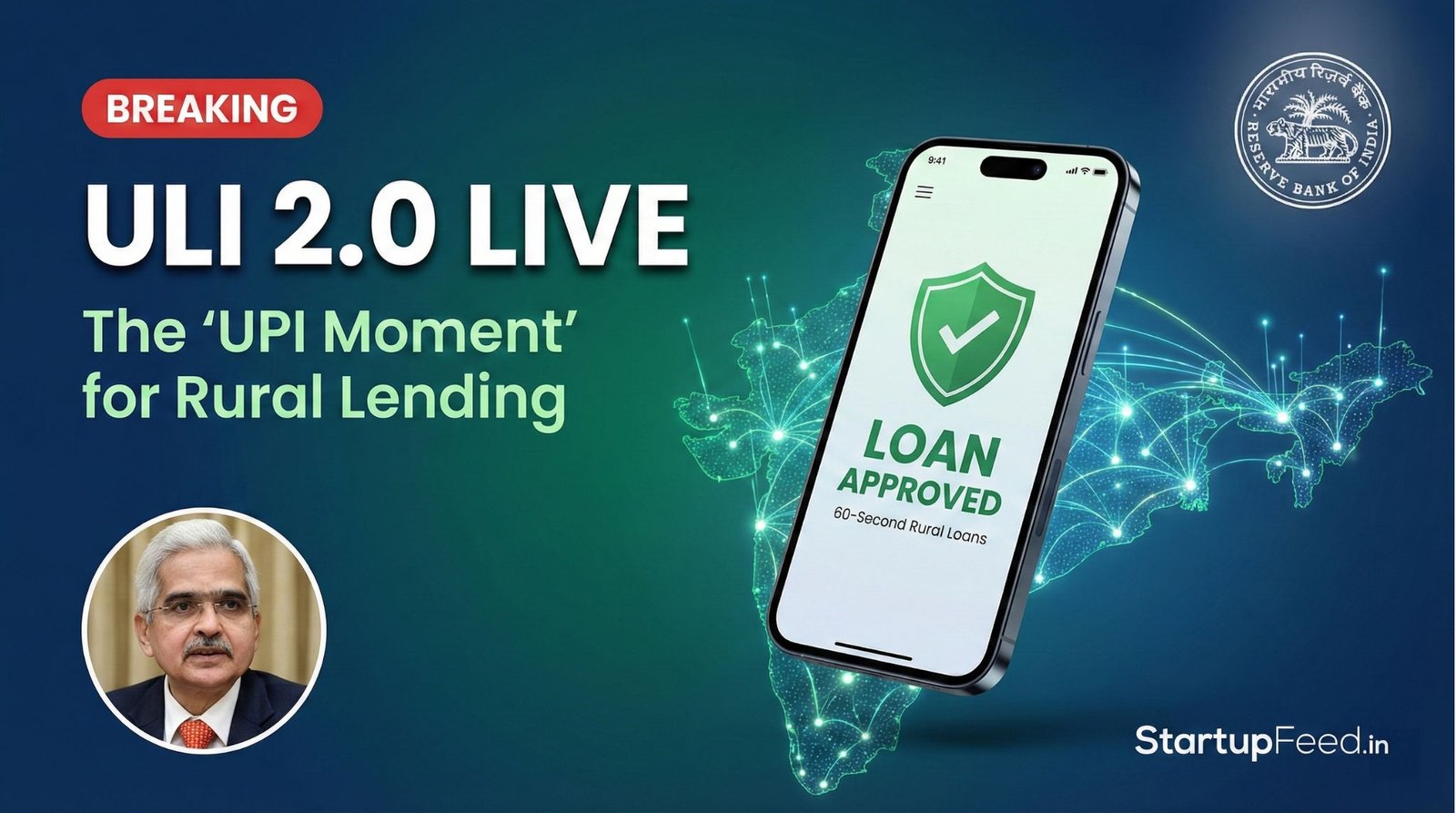

India’s digital lending landscape just witnessed its most transformative upgrade since UPI went mainstream. The Reserve Bank of India’s ULI 2.0 Unified Lending Interface has officially gone live with full land record integration across Uttar Pradesh, Bihar, and Karnataka as of February 18, 2026. This historic rollout means that millions of farmers, small business owners, and rural borrowers in Tier-3 India can now access instant digital loans approved in as little as 60 seconds — all without stepping into a bank branch or filing a single sheet of paper.
The implications are staggering. What UPI did for payments, ULI 2.0 Unified Lending Interface is now poised to do for credit delivery. Fintech companies, banks, and NBFCs building on the platform are staring at exponential growth, and the first signs of a lending revolution are already visible on the ground.
What Is ULI 2.0 Unified Lending Interface? A Quick Primer
The Unified Lending Interface, originally launched as a pilot by the RBI in 2023 and branded as the Public Tech Platform for Frictionless Credit, is a digital public infrastructure designed to connect lenders with verified borrower data from multiple government and private sources through standardised APIs.
In its first phase, ULI allowed lenders to pull digitised data — such as Aadhaar verification, PAN details, and credit bureau scores — through a single integration point. However, what held back its transformative potential was the absence of real-time land record integration, especially from agrarian states where the demand for rural credit is highest.
The ULI 2.0 upgrade changes everything. With the integration of digitised land records from Uttar Pradesh, Bihar, and Karnataka now fully operational, lenders can verify land ownership, assess collateral value, and disburse crop loans or MSME credit within seconds. The platform now supports over 136 data services across 12 distinct loan journeys, with 64 lenders — including 41 banks and 23 NBFCs — already onboarded.
Why ULI 2.0 Land Record Integration Is a Game-Changer for Tier-3 India
Consider this scenario: a farmer in Begusarai, Bihar, needs a crop loan before the sowing season. Traditionally, this would require multiple trips to the bank, manual submission of land documents, physical verification by a bank officer, and weeks of waiting. More often than not, the farmer would turn to informal money lenders charging predatory interest rates.
With ULI 2.0 Unified Lending Interface, that same farmer can now apply through a fintech app, grant consent for the platform to pull verified land records from the Bihar state database, and receive a loan approval in approximately 60 seconds. The entire process is paperless, digital, and consent-driven.
This is not just incremental improvement; it is a structural transformation in how credit reaches the last mile. According to government estimates, land disputes account for nearly 66% of civil cases in India. By plugging verified, digitised land records directly into the lending pipeline, ULI 2.0 eliminates a massive bottleneck that has historically excluded rural borrowers from formal credit.
Three States, Three Unique Opportunities: UP, Bihar, and Karnataka
Uttar Pradesh: India’s Largest Agricultural Economy Goes Digital
Uttar Pradesh, with its massive farming population and widespread landholding patterns, stands to benefit enormously from the ULI 2.0 rollout. The state’s Bhulekh portal has been progressively digitising land records under the Digital India Land Records Modernisation Programme (DILRMP), and this integration allows lenders to access verified khasra, khatauni, and land map data in real time. For the first time, millions of UP farmers can leverage their landholdings as verifiable digital collateral.
Bihar: Bridging the Credit Gap in One of India’s Most Underserved States
Bihar has historically suffered from low formal credit penetration, particularly in rural areas. The integration of Bihar Bhumi land records with ULI 2.0 Unified Lending Interface is expected to unlock a massive unmet demand for agricultural and MSME loans. Small and marginal farmers who previously lacked the documentation to access bank credit can now be assessed and approved digitally. District Central Cooperative Banks and Regional Rural Banks are also connecting through NABARD’s e-Kisan Credit Card platform, extending ULI’s reach deeper into the rural ecosystem.
Karnataka: Fintech Hub Meets Rural Innovation
Karnataka offers a unique dual advantage. As India’s fintech capital (Bengaluru alone hosts hundreds of lending startups), the state has a thriving ecosystem of digital lenders ready to build on ULI 2.0. Simultaneously, its large agrarian hinterland in North Karnataka has significant unmet credit needs. The Bhoomi land records system, one of India’s earliest land digitisation projects, now feeds directly into the Unified Lending Interface, creating a seamless bridge between fintech innovation and rural demand.
The Fintech Opportunity: Why Startups Are Calling ULI 2.0 the ‘UPI for Lending’
The comparison to UPI is not hyperbole. When UPI launched in 2016, it created a universal payments rail that spawned an entire ecosystem of fintech companies — from PhonePe and Google Pay to countless smaller players. ULI 2.0 Unified Lending Interface has the potential to replicate that effect in the lending space.
Here is why fintech founders are excited. ULI operates on a plug-and-play model that eliminates the need for complex one-to-one integrations between lenders and data providers. A startup can connect once and access a broad array of verified data — from Aadhaar authentication to satellite imagery to land records — through a single API gateway. This dramatically lowers the barrier to entry for new lending platforms.
Moreover, with the RBI positioning ULI as a universal API gateway covering the entire loan lifecycle — from identity verification and eligibility checks to application processing and disbursement — startups can build end-to-end lending products without stitching together dozens of disparate integrations. The cost savings are significant, and the time-to-market advantage is enormous.
Industry analysts expect that the next wave of fintech unicorns in India will emerge from companies that build innovative lending products on the ULI infrastructure, particularly those focused on rural and semi-urban markets that remain vastly underserved.
How ULI 2.0 Unified Lending Interface Achieves 60-Second Loan Approvals
The speed of ULI 2.0 is rooted in its architecture. The platform aggregates data in real time and automates verification as part of a standardised lending workflow. When a borrower initiates a loan application, the following happens almost simultaneously: identity verification through Aadhaar, credit history check through bureau data, land ownership verification through state records, collateral assessment through satellite and geospatial data, and eligibility determination through the lender’s algorithm.
Because all of this data flows through a single, standardised interface with consent-based access, the entire credit appraisal process that once took days or weeks now completes in under a minute. For rural borrowers, this is nothing short of revolutionary.
What the Numbers Tell Us: ULI’s Rapid Growth Trajectory
The growth metrics for the Unified Lending Interface are impressive. According to the RBI’s Trends and Progress of Banking in India report released in December 2025, ULI has nearly doubled its lender base in a single year. The platform now hosts 64 lenders (up from 36 in December 2024), supports over 136 data services (up from approximately 50), and enables 12 different loan journeys.
A high-level meeting convened by the Department of Financial Services in June 2025, co-chaired by DFS Secretary M. Nagaraju and RBI Deputy Governor T. Rabi Sankar, described ULI as a technology initiative poised to make frictionless credit available to every Indian. The officials explicitly drew parallels with UPI’s transformative impact on payments.
With additional data services and data sources being continually onboarded, and with the RBI’s Annual Report 2024–25 flagging ULI expansion as a priority for FY26, the trajectory points firmly upward.
Challenges and Concerns: What Could Slow Down the ULI 2.0 Revolution?
Despite the optimism, several challenges remain. Data quality is a primary concern. A study by the Centre for Policy Research found that land disputes account for 66% of civil cases in India. Many digitised records still carry errors, legacy inaccuracies, or gaps in historical documentation. If flawed land data feeds into automated lending decisions, it could lead to wrongful loan denials or biased borrower profiling at scale.
Privacy and consent governance is another area where the framework needs to mature. While the RBI has stated that ULI operates on a consent-based model, detailed consent mechanisms — similar to the Account Aggregator framework — have not yet been fully codified. As the platform scales and more alternative data sources are onboarded, robust privacy guardrails become essential.
Additionally, the grievance redress mechanism for borrowers affected by ULI-linked credit decisions remains unclear. The RBI has clarified that individual lenders bear responsibility for consent management and dispute resolution, but a centralised ombudsman or escalation pathway may be necessary as transaction volumes grow.
What’s Next: ULI 2.0 Roadmap and Future States
The RBI has signalled that the current three-state land record integration is just the beginning. The Department of Financial Services has urged all state governments to digitise and connect their land records with ULI. With the Unique Land Parcel Identification Number (ULPIN) initiative already rolled out across 29 states, the infrastructure for a pan-India ULI land integration is rapidly falling into place.
Future enhancements to the ULI 2.0 Unified Lending Interface are expected to include broader business-to-consumer (B2C) use cases, integration with dairy and agricultural supply chain data, enhanced satellite and geospatial analytics for crop insurance and climate risk assessment, and deeper interoperability with the Account Aggregator ecosystem.
For fintech entrepreneurs, the message is clear: ULI 2.0 is the platform to build on. For rural India, the promise is equally powerful — access to formal credit, delivered instantly, on the strength of verified digital assets.
The Bottom Line: India’s Lending Revolution Has Officially Begun
The launch of ULI 2.0 with live land record integration in Uttar Pradesh, Bihar, and Karnataka marks a watershed moment for India’s financial inclusion story. The Unified Lending Interface is no longer a pilot project or a policy aspiration — it is live, operational, and already transforming how credit reaches the most underserved segments of the population.
If UPI taught us anything, it is that well-designed digital public infrastructure, when combined with a vibrant private sector ecosystem, can leapfrog decades of incremental progress. ULI 2.0 Unified Lending Interface carries the same DNA. The ‘UPI Moment’ for lending is here, and Tier-3 India is where the action begins.