

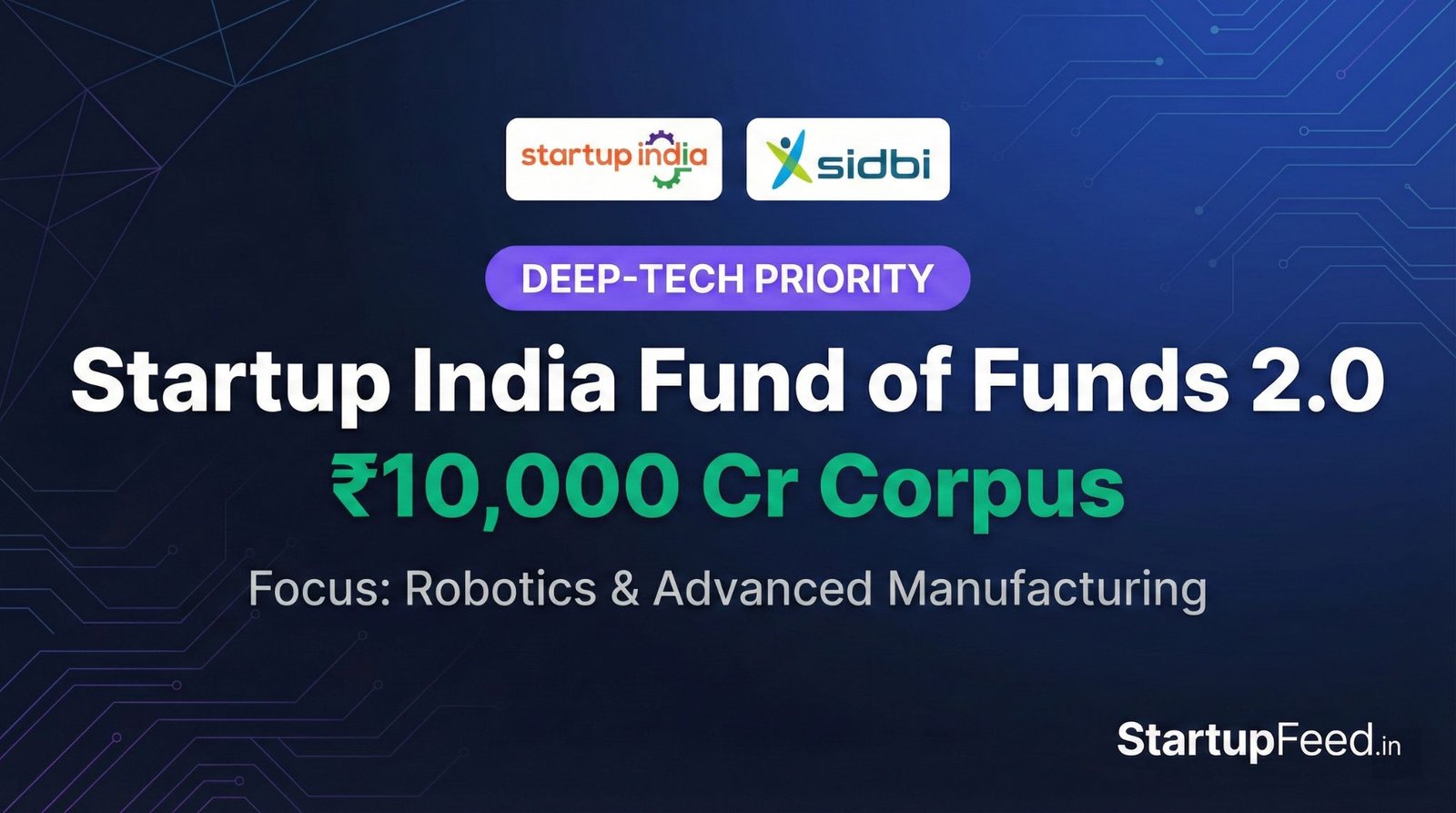

The Union Cabinet has approved the Startup India Fund of Funds 2.0 with a ₹10,000 crore corpus — and this time, the money is heavily ring-fenced for deep-tech, robotics, and advanced manufacturing. Here’s the full breakdown every founder, incubator, and investor needs to read.
Introduction: The Funding Gap India’s Deep-Tech Always Needed to Fix
India’s Startup India Fund of Funds 2.0 (FoF 2.0) is not just another government scheme — it is a ₹10,000 crore structural intervention designed to solve one of the most chronic problems in the Indian startup ecosystem: the scarcity of patient, early-stage capital for deep-tech ventures. The Union Cabinet has granted its final approval, and the implications for founders, incubators, venture capitalists, and policymakers are enormous.
For years, India’s startup narrative was dominated by consumer internet plays — food delivery, e-commerce, fintech. Deep-tech segments like robotics, space tech, semiconductor design, and advanced manufacturing were left waiting at the door, largely because private VCs demanded shorter return horizons than these capital-intensive sectors could offer. The Startup India Fund of Funds 2.0 is the government’s direct answer to that structural gap.
In this article, we break down exactly what the Startup India FoF 2.0 means, who qualifies, how the money flows, and why this could be the most consequential startup policy announcement of 2025.
| Quick Fact — Focus Keyphrase in Action
The Startup India Fund of Funds 2.0 has a ₹10,000 crore corpus approved by the Union Cabinet, with a strategic ring-fence for deep-tech, robotics, and advanced manufacturing sectors. |
What Is the Startup India Fund of Funds 2.0?
The Startup India Fund of Funds 2.0 is a government-backed vehicle that does not invest directly in startups. Instead, it invests in SEBI-registered Alternative Investment Funds (AIFs) — i.e., private VC funds — who then deploy that capital into early-stage startups. Think of it as the government becoming a Limited Partner (LP) in carefully selected VC funds, using SIDBI (Small Industries Development Bank of India) as the nodal agency to manage the corpus.
The original Startup India FoF, launched in 2016, had a corpus of ₹10,000 crore but was broadly sector-agnostic and took many years to deploy effectively. FoF 2.0 learns from that experience and makes a crucial pivot: it is explicitly designed to prioritize deep-tech sectors where private capital has been historically thin.
Key Features of Startup India Fund of Funds 2.0
- Total Corpus: ₹10,000 Crore — approved by the Union Cabinet
- Nodal Agency: SIDBI (Small Industries Development Bank of India)
- Structure: Fund-of-Funds — invests in SEBI-registered AIFs, not directly in startups
- Priority Sectors: Deep-tech, robotics, advanced manufacturing, quantum computing, AI/ML infrastructure
- Stage Focus: Early-stage and seed-stage startups — where patient capital is most scarce
- Multiplier Effect: Every ₹1 from FoF 2.0 is designed to crowd in ₹4–5 of private VC capital
- Eligibility: Startups recognized under DPIIT’s Startup India program
Why Deep-Tech? Understanding the ‘Patient Capital’ Problem
The phrase that appears in policy documents and investor conversations alike is ‘patient capital’ — and understanding it is key to grasping why the Startup India Fund of Funds 2.0 is structured the way it is.
Deep-tech startups — those building hardware, robotics, advanced semiconductors, or biotech — have fundamentally different economics than software startups. They require:
- 3–7 years to reach commercial viability (vs. 2–3 for SaaS)
- Significant upfront capital expenditure (CapEx) for R&D and prototyping
- Multiple rounds of funding before any revenue is generated
- Specialized technical due diligence that most generalist VCs lack
Private VCs, driven by fund lifecycles of 7–10 years and LP pressure for returns, have historically underweighted deep-tech in India. The result: India has world-class IIT and IISc talent generating breakthrough research, but that research rarely makes it to commercial products because funding dries up at the prototype stage.
The Startup India FoF 2.0 directly addresses this by deploying government capital into VC funds that commit to investing in deep-tech. By acting as an anchor LP, the government effectively de-risks the deep-tech AIF for other private LPs, encouraging more private capital to flow in alongside.
| Why This Matters for Founders
If you are a deep-tech founder in robotics, AI hardware, quantum tech, or advanced manufacturing — the Startup India Fund of Funds 2.0 means more VC funds will be actively looking to deploy capital in your sector in 2025 and beyond. This is a structural shift, not a one-time grant. |
Priority Sectors Under Startup India FoF 2.0: Who Qualifies?
The government has been deliberate about which sectors get priority. While the final list of eligible sectors will be governed by DPIIT and SIDBI guidelines, the cabinet approval signals heavy emphasis on:
1. Deep-Tech & Frontier Technologies
This is the broadest and most significant bucket. It includes startups working on artificial intelligence infrastructure, machine learning chips, quantum computing, photonics, and next-generation semiconductors. India’s ambition to build a domestic semiconductor ecosystem — reinforced by the India Semiconductor Mission — makes this a strategic pillar.
2. Robotics & Automation
India’s manufacturing sector is undergoing rapid automation, and the government wants India-built robots, not just imported ones. Startups building collaborative robots (cobots), industrial automation systems, agricultural robotics, and medical robotics are expected to be strong beneficiaries of VCs funded under the Startup India Fund of Funds 2.0.
3. Advanced Manufacturing & Industry 4.0
Startups building solutions for smart factories, precision manufacturing, additive manufacturing (3D printing at industrial scale), and industrial IoT fall squarely within this bucket. The government’s Production Linked Incentive (PLI) schemes have already accelerated demand in these areas, and FoF 2.0 capital is expected to fund the startups building the enabling technology layer.
4. Climate Tech & Clean Energy
Though not the primary headline, green hydrogen, solid-state batteries, carbon capture technology, and climate analytics are also likely to benefit. India’s Net Zero commitments make climate deep-tech a long-term priority.
5. Space Tech
With ISRO commercialization and IN-SPACe opening India’s space sector to private players, startups in satellite manufacturing, launch vehicles, earth observation, and geospatial analytics are increasingly attracting policy attention. FoF 2.0 may catalyze the first large cohort of VC-backed Indian space tech companies.
How Does the Startup India Fund of Funds 2.0 Actually Work?
Understanding the mechanics is important for founders to know where their touchpoint is in this ecosystem.
| Step | Actor | Action |
| 1 | Union Cabinet | Approves ₹10,000 Crore FoF 2.0 corpus |
| 2 | DPIIT / MoCI | Sets eligibility criteria for AIFs (deep-tech focus mandate) |
| 3 | SIDBI | Acts as nodal agency; evaluates and onboards qualifying AIFs as investee funds |
| 4 | SEBI-Registered AIFs | Receive FoF 2.0 capital; deploy into early-stage startups in priority sectors |
| 5 | Deep-Tech Startups | Access capital from these VCs; must be DPIIT-recognized Startup India entities |
| 6 | Returns | Flow back up: Startup → AIF → SIDBI → Government (as LP returns) |
Expected Economic Impact: The ₹10,000 Crore Multiplier
Government FoF models are designed on the principle of capital multiplication. The logic: every rupee the government commits as an LP in an AIF signals credibility and reduces risk for other private LPs, enabling the AIF to raise a much larger total fund.
If the Startup India Fund of Funds 2.0 achieves even a 4x multiplier — conservative by global FoF standards — the effective capital mobilized for Indian deep-tech startups could exceed ₹40,000 crore. Given India currently has fewer than 500 deep-tech startups with institutional VC backing, this represents a potential 10x expansion of the funded deep-tech ecosystem over the next 5–7 years.
Beyond raw capital, the policy signal matters enormously. When the Union Cabinet approves a ₹10,000 crore ring-fenced fund for deep-tech, it tells global LPs — sovereign wealth funds, pension funds, family offices — that India is serious about deep-tech as a national priority. This can trigger inbound international co-investment at a scale that no individual VC fund announcement could.
| Key Stat
India currently ranks 3rd globally in total startup count but barely enters the top 15 in deep-tech startup density. The Startup India Fund of Funds 2.0 is a direct attempt to close that gap with structured government capital. |
Startup India FoF 1.0 vs FoF 2.0: What Changed?
FoF 1.0 (launched 2016, ₹10,000 crore corpus) was largely sector-agnostic. It helped build several successful AIFs and funded hundreds of startups across consumer internet, fintech, and edtech. But critics noted: the capital took years to deploy, the deep-tech bias was absent, and the multiplier effect was lower than expected because SIDBI’s AIF evaluation criteria were too conservative.
FoF 2.0 addresses these issues directly:
- Explicit deep-tech sector ring-fencing — no more broad deployment to consumer internet plays
- Faster deployment mandate — SIDBI is expected to commit to AIFs within a defined timeline
- Stronger AIF eligibility criteria — focus on track record in deep-tech, not just AUM
- Outcome monitoring — startups funded through FoF 2.0 AIFs will be tracked for jobs created, IP filed, and export revenue
How Can Startups Access Funding Through Startup India FoF 2.0?
Startups do not apply directly to the FoF. The pathway is:
- Step 1: Get recognized under DPIIT’s Startup India program (mandatory eligibility baseline)
- Step 2: Build relationships with SEBI-registered AIFs that focus on deep-tech (these will be the VCs that receive FoF 2.0 capital from SIDBI)
- Step 3: Apply to incubators and accelerators linked to those AIFs — many top-tier VCs prefer to see startups graduate from recognized incubation programs
- Step 4: Track SIDBI’s public announcements on which AIFs have been empaneled under FoF 2.0 — this is public information and helps founders know which VCs have government-backed capital to deploy
The official portal for tracking Startup India-related funding is startupindia.gov.in, and SIDBI’s official channels will publish the list of empaneled AIFs once the operational guidelines are notified.
What This Means for India’s Startup Ecosystem in 2025
The approval of the Startup India Fund of Funds 2.0 lands at a critical inflection point. Global VC funding has been cautious across 2023–2024, and Indian deep-tech founders have felt the chill acutely. A government-backed ₹10,000 crore corpus signals counter-cyclical confidence — the government is stepping in precisely when private capital is most hesitant.
For the VC ecosystem, this creates a new class of LPs: government-backed fund capital that private VCs can leverage to raise larger funds than they could from purely private sources. Expect a wave of new AIF launches in the deep-tech space in the next 12–18 months, as fund managers position themselves to qualify for FoF 2.0 capital from SIDBI.
For incubators and accelerators — particularly those attached to IITs, IISc, and NITs — this creates a stronger pipeline: more VC capital downstream means incubators can credibly tell deep-tech founders that the funding environment has improved. This may trigger a virtuous cycle of more researchers choosing the startup path over academia or corporate R&D.
Conclusion: A Generational Bet on India’s Deep-Tech Future
The Startup India Fund of Funds 2.0 is one of the most significant structural interventions in India’s startup policy history. A ₹10,000 crore corpus, ring-fenced for deep-tech, robotics, and advanced manufacturing, with SIDBI as the disciplined nodal agency — this is not a token gesture. It is a multi-year, multi-billion-rupee bet on India’s ability to build a globally competitive deep-tech ecosystem.
For founders, this changes the funding calculus. For VCs, it opens a new capital source. For India Inc., it signals that the government sees deep-tech — not just consumer apps — as the next engine of economic growth, job creation, and export revenue.
The Startup India FoF 2.0 is the ₹10,000 crore lifeline India’s deep-tech sector has been waiting for. Now, it’s up to founders to build, and VCs to deploy — wisely, and fast.

