

Summary Points:
- India’s startup incubation landscape is expanding across urban and rural areas, but faces challenges of uneven access, funding gaps, and infrastructure limitations.
- Incubators must adapt to regional diversity in language, economic priorities, and startup maturity levels.
- Institutional, private, and government-led incubators play different but complementary roles.
- Navigating legal, cultural, and operational complexities is key to inclusive startup growth.
- Local mentorship, sector specialization, and state support are essential to successful incubation models.
- Incubators in Tier-2 and Tier-3 cities require targeted strategies to ensure sustainability and scalability.
India is now the third-largest startup ecosystem in the world, with over 100,000 registered startups.
While metro cities like Bengaluru, Delhi NCR, and Mumbai continue to dominate, Tier-2 and Tier-3 cities are emerging as innovation hotspots.
This expansion brings new opportunities—but also significant challenges for incubators.
How can incubators effectively support startups in such a complex, fragmented landscape?
Understanding the Diversity of India’s Startup Landscape
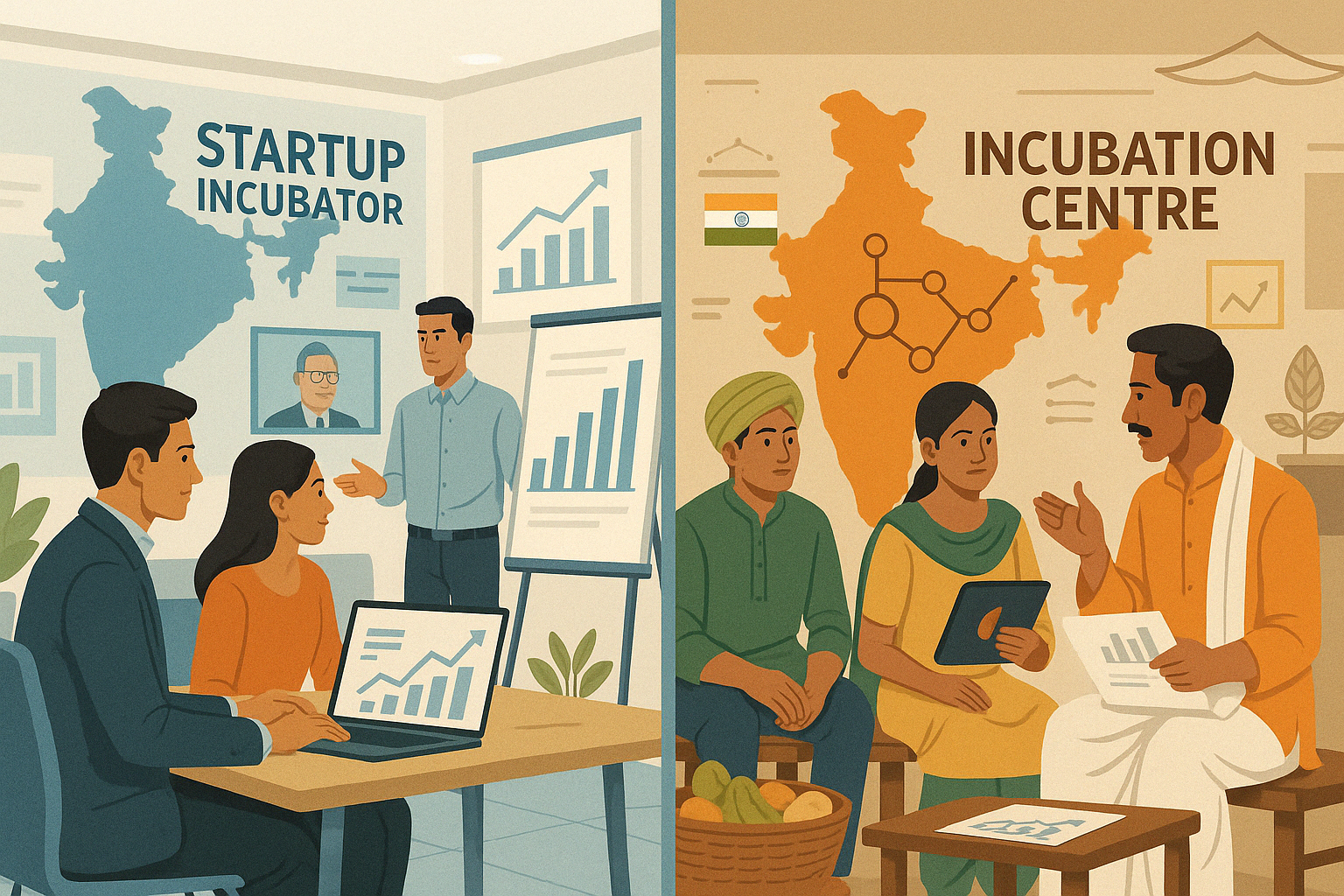
India’s geography, culture, and economy vary region by region. So do its startup needs.
Key variations include:
- Language and digital literacy levels
- Access to infrastructure like labs, coworking space, and internet
- Funding access—urban incubators often have better VC networks
- Sectoral focus—agritech and manufacturing dominate rural areas, while SaaS and fintech thrive in cities
- Regulatory awareness and compliance—often low in early-stage rural ventures
Incubators must tailor their approach based on these realities.
ALSO READ: The Rise of Global Indian Startups, and the Incubators Powering Them
Types of Incubators Operating in India
1. Institutional Incubators
- Run by colleges, universities, or government bodies
- Supported by DST, AICTE, MSME, and state innovation councils
- Focused on student entrepreneurship, research commercialization
2. Private Incubators
- Operated by companies, VCs, or accelerators
- Offer faster, outcome-driven incubation
- Often take equity and focus on scaling
3. Hybrid/PPP Models
- Combine public funding with private execution
- Seen in models like T-Hub, AICs, and Startup Villages
Each type has distinct strengths, but they must collaborate more effectively to build a unified ecosystem.
Challenges Faced by Incubators Across India
1. Infrastructure Gaps
Many incubators in smaller towns lack:
- Prototyping labs
- Reliable internet
- Meeting and pitching spaces
- Modern coworking infrastructure
2. Limited Mentorship Pools
Startups need mentors in:
- Tech development
- Business strategy
- Legal/IP
- Export and compliance
But these experts are scarce outside top cities.
3. Funding Disparities
Urban startups often attract:
- Angel investors
- VC funds
- CSR-based grants
Meanwhile, rural or semi-urban startups struggle to raise even Rs 5–10 lakh in early funding.
ALSO READ:
4. Regulatory Awareness
Many first-time founders are unaware of:
- Startup India registration
- GST, company formation laws
- IP rights and licensing
Incubators are filling this gap, but awareness remains uneven.
Strategies for Navigating These Complexities
1. Localization of Programs
Incubators must:
- Offer workshops in regional languages
- Promote local success stories
- Use WhatsApp, local media, and community networks to reach founders
2. Mentor Pool Diversification
Partner with:
- Local industry leaders
- Alumni entrepreneurs
- Regional chambers of commerce
- Online mentoring platforms (hybrid format)
This ensures guidance is relevant and accessible.
3. Stronger State-Level Policy Support
States like Karnataka, Uttar Pradesh, and Kerala are leading with:
- Monthly seed grant disbursements
- Matching funds for private incubators
- Land and tax subsidies for innovation parks
Other states must adopt similar frameworks.
4. Customized Incubation Models
One-size doesn’t fit all. Incubators should offer:
- Pre-incubation for ideation-stage founders
- Virtual incubation for remote regions
- Sector-focused incubation (e.g., cleantech, cyber forensics, agritech)
Examples of Adaptation and Innovation
- Startup Village (Kerala) incubates rural youth in digital platforms and micro-entrepreneurship with local mentors.
- Atal Incubation Centres (AICs) are deploying pan-India models focused on underserved regions with sector specificity.