


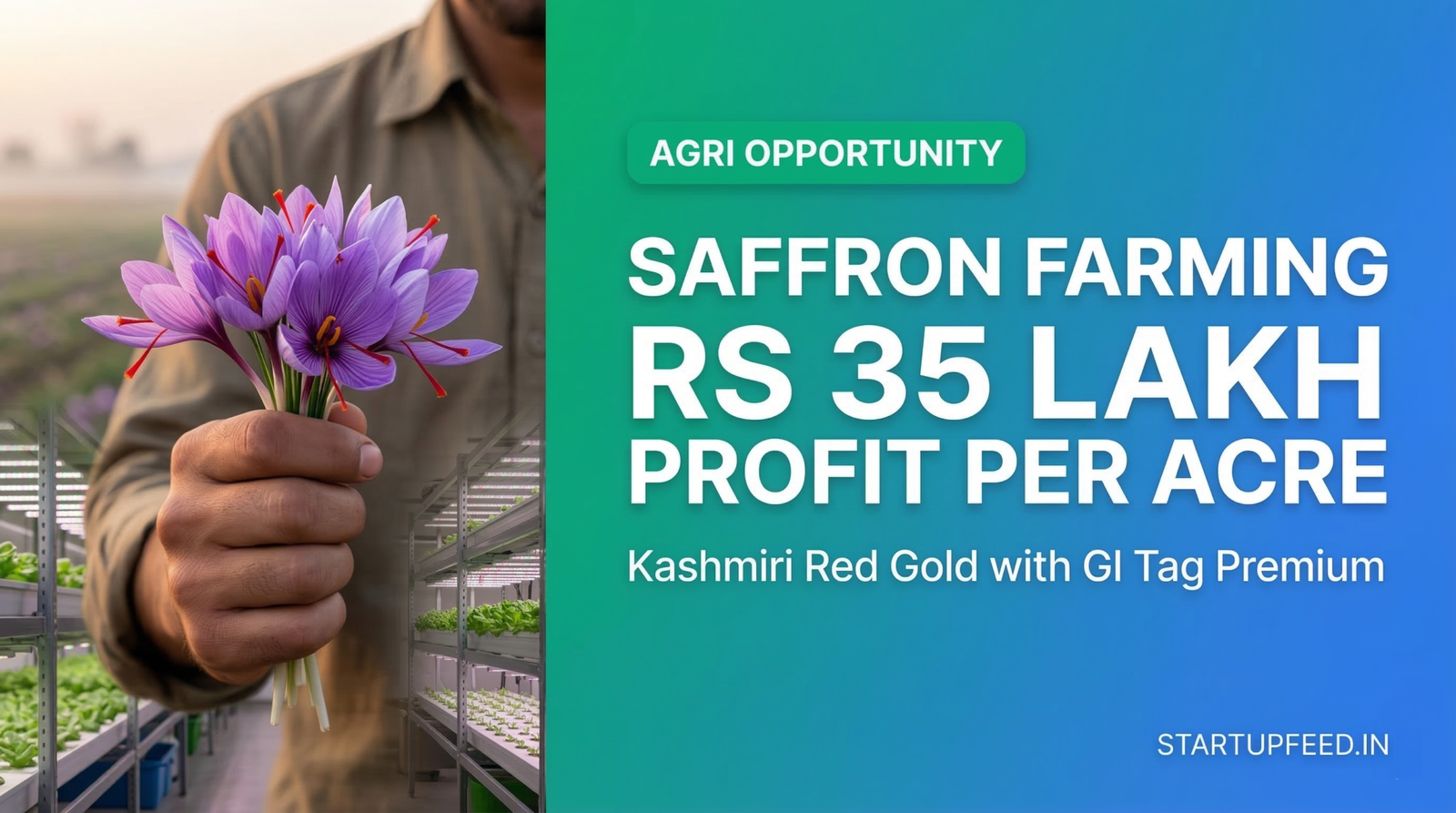

QUICK TAKE;
- What it is: Saffron (Crocus sativus) – the dried stigmas of the saffron crocus flower – is the world’s most expensive spice by weight, priced at Rs 2,50,000 to Rs 6,00,000 per kilogram (Rs 2.5-6 lakh/kg) depending on grade and channel
- Why so expensive: Each flower produces only 3 stigmas (the saffron threads). It takes approximately 150,000 flowers to produce 1 kilogram of dry saffron. All harvesting must be done by hand at dawn during a 2-3 week window per year. There is no mechanisation possible.
- India’s supply gap: India produces less than 3 metric tonnes of saffron per year (2023-24 data). Global demand is 60-65 metric tonnes annually. India meets less than 5% of global saffron demand despite having the world’s second-best quality saffron after GI tagging.
- Profit per acre: Rs 15-35 lakh per acre annual profit (outdoor traditional farming, Karnataka/Kashmir). Indoor aeroponic farming in non-traditional states projects even higher returns per square foot.
- Price after GI tag: Kashmiri saffron received its GI tag in 2020. Retail price jumped from Rs 60,000/kg (pre-GI) to Rs 2,50,000/kg+ (post-GI). Export price: up to Rs 6,00,000/kg for certified organic premium grade.
- Where it grows (traditional): Pampore, Pulwama, Budgam, Srinagar, Kishtwar (J&K) – 90%+ of India’s production. Also Kinnaur and Lahaul-Spiti (HP). J&K is the only state with outdoor traditional cultivation.
- Where it can grow (new): Indoor/aeroponic/greenhouse farming is now being successfully piloted in Rajasthan, Maharashtra, Gujarat, Madhya Pradesh, Uttar Pradesh (including a Noida engineer earning Rs 3.5 lakh/month from 100 sq ft), and Punjab
- Global market: Global saffron market valued at USD 1.16 billion (2023); projected to reach USD 1.66 billion by 2032 at ~4% CAGR (GMInsights). India projected as fastest-growing region 2025-2032 (Data Bridge)
- India’s export opportunity: India is only the 13th largest saffron exporter globally (US$1.44 million in 2022) despite having the GI-tagged world-premium variety. Top importers: USA, UAE, Australia. J&K government export policy targets 60+ countries.
- Government schemes: National Saffron Mission (NSM); MIDH (Mission for Integrated Development of Horticulture); APEDA export certification support; One District One Product (ODOP) scheme; National Horticulture Mission (NHM) subsidies
In the hierarchy of agricultural commodities, saffron occupies an entirely separate category. At Rs 2.5 to Rs 6 lakh per kilogram – depending on quality and sales channel – it is not merely the world’s most expensive spice. It is one of the most expensive agricultural products on Earth, period, sitting alongside truffles and vanilla in the rarefied tier of crops where a single kilogram can cost more than a mid-range motorcycle.
And yet, India – which holds the world’s second-largest saffron-producing region in Kashmir, whose GI-tagged Kashmiri saffron commands higher crocin content and richer aroma than even Iranian saffron according to multiple comparative studies – produces less than 3 metric tonnes per year. Global annual demand stands at 60-65 metric tonnes. India’s contribution: less than 5%. The gap between India’s quality advantage and its production share is one of the most structurally underexploited agricultural opportunities in the country.
This article builds the complete business case for saffron farming in India in 2026: the economics of outdoor and indoor cultivation, the per-acre investment and profit analysis, the government support landscape, the emerging non-Kashmir indoor cultivation revolution, and five non-obvious insights for agri-entrepreneurs, investors, and founders looking at saffron as a high-value agri-business opportunity.
Why Saffron Commands Rs 3-6 Lakh Per Kilogram – The Economics of Scarcity
Saffron’s price is not manufactured scarcity – it is structural scarcity built into every step of the production process. Understanding why saffron is expensive is essential to understanding why it is genuinely worth growing.
| Factor | Detail | Why It Creates Price |
|---|---|---|
| Flower-to-spice ratio | Each Crocus sativus flower has 3 red stigmas (the saffron threads). Those 3 stigmas, when dried, weigh approximately 0.006-0.007 grams. It takes ~150,000 flowers to yield 1 kg of dry saffron. | No crop in agriculture has a lower flower-to-product ratio. The biological constraint cannot be engineered away – each flower produces exactly 3 stigmas. |
| Harvest window | Saffron flowers bloom for 2-3 weeks per year, typically October-November in Kashmir. The flowers open at dawn and must be hand-picked within hours – they wilt by afternoon. | Entire annual crop must be harvested in 15-20 days, by hand, before sunrise. No mechanisation is viable due to flower fragility. Pure labour intensity. |
| Drying process | Fresh stigmas must be dried immediately after harvest to preserve crocin (color), safranal (aroma), and picrocrocin (taste). Improper drying destroys value – even 30% yield loss from incorrect drying is common among beginners. | Post-harvest processing is as skill-intensive as cultivation. Quality differences between Rs 1.5 lakh/kg and Rs 6 lakh/kg saffron are almost entirely determined by drying technique. |
| Low yield per acre | Traditional outdoor farming in Kashmir yields 1-2 kg of dry saffron per acre. Even with advanced scientific practices, premium outdoor yield reaches 4-5 kg per acre. For perspective: wheat yields 1,500-2,000 kg per acre. | A farmer harvesting 2 kg/acre of saffron at Rs 2.5 lakh/kg earns Rs 5 lakh from the same land that would yield Rs 45,000 worth of wheat. The yield is 1,000x lower but the price is 5,000x higher. |
| Corm (bulb) propagation | Unlike most crops, saffron cannot be grown from seed. It reproduces only through corms (underground bulbs) that multiply slowly – each corm produces 2-5 daughter corms per year. Large healthy corms (8-10 grams) are essential for first-year flowers. | Supply of planting material is itself constrained – quality corms from Kashmir are limited and cannot be mass-produced rapidly. This prevents sudden supply surges. |
| Climate specificity (traditional) | Traditional outdoor saffron requires specific elevation (1,200-2,000 metres), cool winters (15-20 deg C at planting), dry summers, low humidity during flowering, and well-drained sandy loam or calcareous clay soil. | Geographic limitation historically concentrated supply in Iran, Kashmir, and small areas of Spain and Morocco. Indoor cultivation is now partially breaking this constraint. |
| Adulteration risk | Saffron is the world’s most adulterated spice – safflower petals, turmeric-dyed silk fibres, and synthetic colourants are commonly sold as saffron. Authentic GI-tagged Kashmiri saffron certified by testing labs commands a 300-400% premium over suspect product. | GI certification and lab testing (ISO 3632 standard for crocin, safranal, picrocrocin content) are now the primary quality differentiation tools for premium pricing. |
It takes 150,000 hand-picked flowers, all harvested before sunrise in a 2-3 week window, to produce 1 kilogram of dry saffron. India produces less than 3 tonnes a year. Global demand is 20x that. This is not a niche crop. It is a structurally undersupplied premium commodity with a GI tag and a Rs 6 lakh/kg export ceiling.
The Complete Financial Model: Investment, Yield, Revenue and Profit
Outdoor Traditional Farming (Kashmir / Himachal Pradesh)
| Cost Item | Cost per Acre (Rs) | Notes |
|---|---|---|
| Land preparation (deep ploughing x 3, raised bed creation) | Rs 8,000 – 12,000 | 3-4 deep ploughings; raised beds 15-20 cm height for drainage; one-time in first year |
| Farmyard manure / vermicompost (8-10 tonnes/acre) | Rs 12,000 – 18,000 | Organic manure essential; chemical fertilisers used judiciously (NPK 36:24:24 kg/acre) |
| Saffron corms (planting material) – 400-500 kg/acre | Rs 2,00,000 – 3,00,000 | Largest cost component; quality corms 8-10 grams each from Pampore/Pulwama; corm cost is the primary investment barrier |
| Labour (land prep, planting, irrigation management) | Rs 10,000 – 15,000 | Year 1 labour intensive for land preparation and planting in July-August |
| Harvest labour (hand-picking at dawn x 15-20 days) | Rs 20,000 – 35,000 | Most labour-intensive phase; 8-12 workers needed during 15-20 day harvest window |
| Drying and post-harvest processing | Rs 5,000 – 8,000 | Traditional sun drying (free but quality-variable) vs electric/vacuum oven drying (cost Rs 3,000-5,000 investment) |
| Irrigation infrastructure | Rs 8,000 – 12,000 | Saffron requires limited but precise irrigation; 3 irrigations at sprouting, 3 at post-flowering; drip irrigation reduces waste |
| Pest and disease management | Rs 5,000 – 8,000 | Fusarium, Violet Root Rot, Rhizoctonia are key fungal threats; corms must be dug and replanted in new sites every 3-4 years to break disease cycle |
| Packaging and certification (APEDA, organic) | Rs 8,000 – 15,000 | GI certification, ISO 3632 testing, APEDA registration for export; significant one-time investment with multi-year benefit |
| TOTAL INVESTMENT (YEAR 1) | Rs 2,76,000 – 4,23,000 | Corm cost dominates; Year 2+ investment drops significantly as existing corms multiply (daughter corm yield is 2-5x per corm per year) |
Year 2 investment drops dramatically: corms from the first crop multiply underground and can be partially replanted, reducing corm purchase cost by 40-60%. Infrastructure and land prep costs are sunk. Ongoing annual investment from Year 2 is approximately Rs 60,000-1,20,000 per acre (primarily labour and maintenance).
| Revenue Scenario | Yield/Acre | Price/Kg | Gross Revenue/Acre | Net Profit/Acre | Profit Margin |
|---|---|---|---|---|---|
| Conservative (Year 1, traditional outdoor) | 1-2 kg dry saffron | Rs 1,50,000/kg (wholesale, low grade) | Rs 1,50,000 – Rs 3,00,000 | Rs (-1,00,000) to Rs 0 | Break-even / slight loss in Year 1 at wholesale |
| Moderate (Year 2+, traditional outdoor, wholesale) | 2-3 kg dry saffron | Rs 2,00,000/kg (wholesale) | Rs 4,00,000 – Rs 6,00,000 | Rs 2,80,000 – Rs 4,80,000 | 70-80% |
| Good (Year 2+, scientific management, D2C/retail) | 3-4 kg dry saffron | Rs 2,50,000/kg (retail/D2C) | Rs 7,50,000 – Rs 10,00,000 | Rs 5,50,000 – Rs 8,80,000 | 73-88% |
| Premium (Year 3+, certified organic, direct export) | 4-5 kg dry saffron | Rs 4,00,000 – Rs 6,00,000/kg (export grade, organic certified) | Rs 16,00,000 – Rs 30,00,000 | Rs 13,00,000 – Rs 27,00,000 | 80-90% |
| Indoor/aeroponic (any state, controlled environment) | 6-12 kg/100 sq ft (extrapolated for scale) | Rs 3,00,000 – Rs 3,50,000/kg (retail, Noida benchmark) | Variable – see indoor section below | Rs 3.5 lakh/month reported at 100 sq ft scale | High but infrastructure-dependent |
The Kashmir Production Crisis: Why India’s Biggest Opportunity Is Also Its Biggest Problem
Kashmir – specifically Pampore in Pulwama district, known as the ‘Saffron Capital of India’ – has accounted for over 90% of India’s saffron production for centuries. But the production story in Kashmir is one of sustained decline, and understanding this decline is critical for understanding why the saffron opportunity has never been larger.
| Metric | 1990s (Peak) | 2018-19 | 2023-24 | Change / Implication |
|---|---|---|---|---|
| Area under cultivation | 5,707 hectares | 2,387.71 hectares | ~3,700-4,000 hectares (partial recovery) | 58% decline in cultivation area from peak; partial recovery after GI tag and government support |
| Annual production | 15.95 metric tonnes | ~3-4 metric tonnes (declining) | Less than 3 metric tonnes | 81% production collapse from 1990s peak; structural supply crisis |
| Global demand | ~30-40 metric tonnes (1990s est.) | ~55-60 metric tonnes | 60-65 metric tonnes | Demand has grown while Indian supply has collapsed – widening the structural gap |
| India’s global market share | ~8-10% (1990s est.) | ~5% | Less than 5% | India’s share of the market it dominated historically has collapsed to negligible levels |
| Average price (Kashmiri saffron) | Rs 30,000-60,000/kg (pre-GI, pre-2020) | Rs 1,00,000-1,50,000/kg | Rs 2,50,000-3,00,000/kg (domestic retail) | Price has increased 4-8x from 1990s levels – rewarding the declining number of farmers still producing |
| Number of active saffron farmers | ~tens of thousands in Pampore/Pulwama | Declining – many switched to higher-yielding crops (apple) or construction jobs | Estimated 10,000-15,000 active saffron growers remaining in J&K | Farmer exodus accelerated by low and unpredictable traditional yields before GI tag revival |
The causes of decline are multiple: urbanisation eating into Pampore’s karewas (the elevated plateaus with ideal drainage where saffron historically grew); cement factories causing pollution near cultivation zones; erratic weather (saffron needs specific seasonal temperature patterns that climate change is disrupting); low and unpredictable yields pushing farmers toward higher-certainty crops; and decades of inadequate government investment in saffron-specific agricultural extension services.
The GI tag (2020) and subsequent price surge have reversed some of this decline – cultivation area has recovered from 2,387 hectares to approximately 4,000 hectares, and the marginal 4% production increase noted since February 2024 suggests the revival is underway. But the structural production gap remains vast.
The Indoor Saffron Revolution: Growing Red Gold Without Kashmir
Perhaps the most significant development in India’s saffron story is happening not in the Kashmir Valley, but in apartment rooms in Noida, greenhouse plots in Rajasthan, and aeroponic towers in Maharashtra. Indoor saffron cultivation – using controlled temperature, humidity, artificial lighting, and soilless growing systems – is now a validated, commercially successful alternative to traditional field farming, and it is breaking saffron’s geographic constraint.
The Noida Proof of Concept: Ramesh Gera’s 100 Sq Ft Farm
Ramesh Gera, a retired electrical engineer in Sector 63, Noida, Uttar Pradesh, started growing Kashmiri saffron indoors in 2017 in a 100 square foot room. Initial investment: Rs 4 lakh for greenhouse construction + Rs 2 lakh for Kashmir corms. By 2024, his operation was generating Rs 3.5 lakh per month, and he had trained 370+ individuals through online courses in indoor saffron cultivation. His reported selling prices: Rs 2.5 lakh/kg (wholesale), Rs 3.5 lakh/kg (retail), Rs 6 lakh/kg (direct export). Monthly electricity cost: Rs 4,500. Annual labour: Rs 8,000. The economics are stark: at Rs 3.5 lakh/kg retail on even 100 grams of monthly yield, the business generates Rs 35,000/month from 100 sq ft of space – and scales linearly with rack space.
SKUAST-Kashmir’s Indoor Farming Research: The Science Backing
The research arm validating this approach is SKUAST-Kashmir (Sher-e-Kashmir University of Agricultural Sciences and Technology). In comparative trials documented by farmer Abdul Majeed Wani, traditional field cultivation of 5 quintals of corms on 1.25 acres yielded 1.2 kg of saffron. The same quantity of corms in a 400 sq ft indoor setup with 40 racks produced 600 grams – roughly half the yield, but from a fraction of the land area. Indoor saffron uses less water (no irrigation waste), no pesticides (controlled environment), produces up to 5 flowers per corm vs 1-2 in field conditions, and is completely weather-independent.
| Method | Space Required | Corms Required | Yield | Advantages | Challenges |
|---|---|---|---|---|---|
| Traditional outdoor (J&K only) | 1 acre (4,047 sq m) | 400-500 kg corms | 1-4 kg dry saffron/acre/year | Low infrastructure cost; established supply chain; GI-tagged; natural microclimate | Weather-dependent; pest/disease risk; 2-3 week harvest window only; geographic limitation to J&K/HP |
| Indoor rack/tray system | 100-400 sq ft (any state) | 2 quintals per 400 sq ft (SKUAST data) | 600 grams per 400 sq ft (Year 1); improving with experience | Weather-independent; year-round potential; 5 flowers/corm vs 1-2 outdoors; low water; no pesticides | Higher infrastructure cost (Rs 4-6 lakh setup); electricity cost (~Rs 4,500/month); corm sourcing; technical learning curve |
| Aeroponic/hydroponic towers | 50-200 sq ft | Higher density planting vs tray system | Experimental – higher yield density projections; more flowers per corm | Maximum space efficiency; precise nutrient control; fastest growing segment | Highest setup cost; most technical; limited large-scale data available in India yet |
| Greenhouse polyhouse (outdoor warm climates) | Quarter acre to 1 acre | Standard outdoor quantities | Similar to outdoor Kashmir yields but achievable in warm states | Expands cultivation to Rajasthan, Maharashtra, Gujarat, MP; semi-controlled environment | Polyhouse construction cost Rs 4-8 lakh/acre; temperature control required for flowering trigger |
Government Support: Every Scheme Available to Saffron Farmers
| Scheme/Programme | What It Provides | Who Can Apply | How to Access |
|---|---|---|---|
| National Saffron Mission (NSM) | Dedicated central government mission for saffron revival in J&K; provides corm distribution, training, technical guidance, and infrastructure support specifically for Kashmir saffron farmers | Registered farmers in J&K with land in saffron cultivation zones | State Department of Agriculture, J&K; Agriculture Technology Management Agency (ATMA) |
| Mission for Integrated Development of Horticulture (MIDH) | Subsidy and support for high-value horticultural crops including saffron; covers infrastructure, post-harvest, cold chain, marketing | Farmers and agri-entrepreneurs across India growing horticultural crops | State Horticulture Department; MIDH online portal; district-level implementation |
| National Horticulture Mission (NHM) | Financial assistance for horticulture crop development including exotic and high-value spices; training and capacity building | Individual farmers and Farmer Producer Organisations (FPOs) | District Horticulture Department; NHM district project implementation cells |
| APEDA (Agricultural and Processed Food Products Export Development Authority) | Export registration; quality certification support; market linkage for overseas buyers; APEDA certification required for saffron export from India | Any registered farmer or agri-business entity looking to export saffron | APEDA online registration portal; APEDA regional offices in major cities |
| One District One Product (ODOP) scheme | Promotes signature products of each district; J&K’s Pampore district benefits from ODOP for saffron promotion; branding and marketing support | Farmers and businesses in districts with designated ODOP products | District Industries Centre; J&K government ODOP programme offices |
| GI Tag (Geographical Indication) – Kashmiri Saffron | GI tag issued 2020; allows certified Kashmiri saffron to command significant price premium in domestic and export markets; legal protection against adulteration/fake labelling | Farmers producing saffron in designated J&K geographies (Pampore, Pulwama, Budgam, Kishtwar, Srinagar) | J&K GI Authority; state agriculture department for GI certification and documentation |
| PM-KISAN and Kisan Credit Card (KCC) | Direct income support (PM-KISAN Rs 6,000/year) and crop credit at low interest rates for farmers; applicable to saffron farmers as an agricultural activity | All registered farmers with cultivated land including saffron growers | Common Service Centres (CSC); local bank branches; PM-KISAN portal |
| Saffron Park, Pampore | Government-established dedicated saffron processing and marketing park in Pampore; provides processing infrastructure, packaging facilities, testing labs, and direct buyer-seller linkage | J&K-based saffron farmers and traders using the park’s facilities | J&K government Department of Agriculture; Saffron Park management authority |
Export Markets and Pricing Tiers: Where the Real Money Is
| Sales Channel | Price Range (Rs/kg) | Volume Potential | Requirements | India’s Current Status |
|---|---|---|---|---|
| Local wholesale markets (mandis, traders) | Rs 1,00,000 – Rs 1,50,000/kg | High volume, easy access | No certification required; quick cash realisation | Primary channel for most Kashmir farmers; lowest value realisation |
| Domestic retail (direct to consumer, gift packaging) | Rs 2,00,000 – Rs 3,00,000/kg | Medium volume; growing fast via e-commerce | Quality packaging; consumer marketing; Flipkart/Amazon listing | Growing rapidly; D2C saffron brands emerging (Taj Mahal Saffron, Baby Saffron, Rasayanam) |
| Premium D2C / gourmet online (subscription boxes, luxury gifting) | Rs 3,00,000 – Rs 4,00,000/kg | Lower volume but highest margin | Brand storytelling; origin certification; premium packaging; social media presence | Early stage; significant opportunity for farmer-branded D2C plays |
| Ayurveda / nutraceutical companies (B2B) | Rs 2,00,000 – Rs 3,50,000/kg | Large and growing volumes; Dabur, Himalaya, Patanjali, Marico sourcing saffron for products | Consistent quality; ISO 3632 testing; regular supply contract | Under-exploited; most nutraceutical companies source through traders rather than directly from farmers |
| UAE / Gulf export (Indian diaspora market) | Rs 3,00,000 – Rs 5,00,000/kg | Significant; Gulf has large Indian diaspora and strong saffron cultural demand | APEDA registration; phytosanitary certificate; packing standards | J&K government targeting Gulf in new export policy; major growth opportunity |
| US / UK / EU export (gourmet food market) | Rs 4,00,000 – Rs 6,00,000/kg (USD equivalent $5,000-7,500/kg) | Large but requires market entry investment | APEDA; food safety standards (FDA/EU); GI certification; brand recognition | India is currently 13th largest exporter globally; massive gap vs market position |
| Pharmaceutical / cosmetics (B2B global) | Rs 3,50,000 – Rs 6,00,000/kg (high crocin content premium) | Growing fastest; global pharma using saffron for depression, Alzheimer’s research | ISO 3632 Grade I certification; high crocin content testing (>250 per ISO standard); consistent supply chain | Emerging opportunity; India’s high crocin Kashmiri saffron is specifically suited for pharmaceutical grade |
StartupFeed Insight – Five Non-Obvious Reads on India’s Saffron Opportunity
- India’s saffron supply gap is actually a startup opportunity, not just a farming story.
India produces less than 5% of global saffron demand while holding the GI-tagged world-premium variety. The gap between India’s quality and its market share is not a farming problem – it is a supply chain, branding, certification, and go-to-market problem. Iranian saffron dominates global trade (90%+ of world supply) not because it is better quality – multiple studies show Kashmiri saffron has higher crocin content and superior aroma – but because Iran has built better trade infrastructure, export logistics, and international distribution. An Indian startup that builds a GI-certified Kashmiri saffron D2C brand with APEDA certification, ISO 3632 testing, and direct export to the UAE, UK, and US would be creating value not by growing saffron but by being the distribution and certification layer between Kashmir’s farmers and global premium buyers. The gap that needs filling is not in a field in Pampore. It is in a logistics warehouse and a brand strategy document.
- The indoor farming revolution is the most important structural shift in Indian saffron in a century – and it is completely under-reported.
Traditional saffron cultivation has been geographically locked to Kashmir and small parts of Himachal Pradesh for approximately 2,500 years. Indoor aeroponic and rack-based cultivation is breaking that lock for the first time. A retired engineer in Noida growing Rs 3.5 lakh/month from 100 sq ft is not an anomaly – it is the proof of concept for an entirely new category: urban saffron farming that can happen in any Indian city with a controlled indoor space. The implications are significant. First, it democratises access to saffron cultivation revenue beyond J&K farmers. Second, it dramatically expands India’s potential production capacity without requiring traditional karewa land or Kashmir-specific climate. Third, it enables year-round harvesting cycles vs the single annual October-November window, potentially multiplying annual yields per square foot. The primary bottleneck is corm supply from Kashmir – if aeroponic indoor farming scales significantly, demand for corms will outpace Kashmir’s corm production capacity, creating a secondary high-value business in corm multiplication.
- Saffron’s medicinal and pharmaceutical demand is the next wave – and it is larger than the culinary market.
The culinary demand for saffron is well-understood: biryani, kheer, kesar milk, European paellas and risottos. The pharmaceutical and nutraceutical demand is less visible but growing faster. Published clinical research has identified saffron extract as showing significant efficacy in depression treatment (comparable to certain SSRIs in mild-to-moderate depression in multiple randomised controlled trials), anxiety reduction, Alzheimer’s symptom management (crocin and safranal cross the blood-brain barrier), and anti-cancer applications (antioxidant properties). The global nutraceutical use of saffron is projected to grow at 13.6% CAGR from 2024 to 2032 (Krishi Jagran). Pharmaceutical-grade saffron (ISO 3632 Grade I; crocin content above 250 per ISO standard) commands the highest prices because it requires the highest quality control. Indian saffron – with the world’s highest natural crocin content – is structurally best positioned for the pharmaceutical grade segment. No Indian agri-entrepreneur has yet built a dedicated pharmaceutical-grade saffron supply chain from Kashmir to global pharma buyers. That is a Rs 50-200 crore B2B business waiting to be built.
- The Year 1 loss is the biggest psychological barrier and the biggest reason most potential saffron farmers never start.
At conservative outdoor farming economics, Year 1 can break even or generate a modest loss at wholesale prices. This is because the corm investment (Rs 2-3 lakh/acre) is front-loaded and corms take their first full season to establish before flowering vigorously. Farmers who calculate saffron profitability solely on Year 1 numbers – and conclude it is not viable – are making a fundamental mistake. From Year 2 onward, corms multiply 2-5x per corm per year, dramatically reducing the effective cost of planting material. From Year 3 onward, established corm beds can sustain 3-4 years of declining reinvestment before needing relocation to break disease cycles. The real payoff horizon for saffron farming is a 3-4 year view, at which point the compounding effect of corm multiplication and growing yield maturity makes the economics dramatically positive. Farmers and agri-entrepreneurs evaluating saffron must model a 3-year P&L, not a first-year break-even analysis.
- India imports 95% of its saffron consumption – from Iran – while exporting its own premium variety at a fraction of its potential value.
India’s saffron paradox is extraordinary. India is the world’s second-largest saffron-producing region with the world’s highest-quality saffron. And yet India imports approximately 95% of its own domestic saffron consumption – most of it from Iran, often re-labelled or blended and sold as ‘premium’ at Rs 400-800/gram in pharmacies and grocery stores. Meanwhile, genuine GI-tagged Kashmiri saffron is exported at only US$1.44 million annually – making India the 13th largest saffron exporter in the world. The business opportunity is therefore not just in growing more saffron. It is in building the quality assurance, branding, and consumer education infrastructure that can (a) reduce India’s dependence on Iranian saffron imports by demonstrating the superiority of domestic production, (b) capture the domestic premium consumer market currently paying Rs 800-1,000/gram for inferior imported product, and (c) build export channels that position India as the premium saffron source globally rather than a minor exporter. The market is already priced for this. Indian consumers are already paying Rs 3-6 lakh/kg equivalent for saffron – most of it Iranian. The captured value needs to flow to Indian farmers instead.
Practical Steps: How to Start Saffron Farming in 2026
- Identify your cultivation method: Outdoor traditional farming is viable only in J&K and HP hill areas. For all other states, indoor rack/tray or aeroponic is the starting point. Choose based on available space, budget (indoor Rs 4-6 lakh setup cost vs outdoor Rs 2.5-4 lakh/acre investment) and risk tolerance.
- Source authentic quality corms: The single most important decision. High-quality, large (8-10 gram) corms from Pampore or Pulwama farmers are essential. Avoid intermediary traders who supply undersized or diseased corms. Ramesh Gera’s network in Noida and SKUAST-Kashmir are validated sourcing contacts. Expect to pay Rs 500-800 per kg for good corms in 2026.
- Get your certifications early: Register with APEDA before your first harvest if you intend to export. Apply for organic certification (preferably NPOP – National Programme for Organic Production) during the cultivation period – it takes 2-3 years to achieve certified organic status but commands 2-3x price premium. Get ISO 3632 testing done on your dried product to know your crocin/safranal levels.
- Build direct buyer relationships before you harvest: Connect with D2C platforms (Amazon, Flipkart, specialty health sites), Ayurveda and nutraceutical companies (Dabur, Himalaya, Patanjali, small supplement brands), and UAE/Gulf-based Indian grocery importers BEFORE harvest. Saffron sold through trader intermediaries realises 40-50% less value than direct-to-buyer sales.
- Study the drying process in depth: Up to 30% of saffron’s value is determined by the drying technique. Vacuum oven drying at 40-45 deg C preserves maximum crocin and safranal. Traditional sun drying can cause quality inconsistency but has no equipment cost. Learn to test dried saffron using the ISO 3632 standard (water dissolution test – genuine saffron turns golden-yellow slowly, not immediately).
- Apply for government schemes: National Saffron Mission, NHM, MIDH, and ODOP are all available and actively disbursing. The J&K Agriculture Department provides direct technical support and subsidised corms to registered farmers. APEDA certification is free for registered exporters. Do not start without mapping available subsidies.

