


Quick Take:
- The Trigger: West Asia conflict (US-Iran) disrupts Strait of Hormuz — India’s source for ~90% of LPG imports.
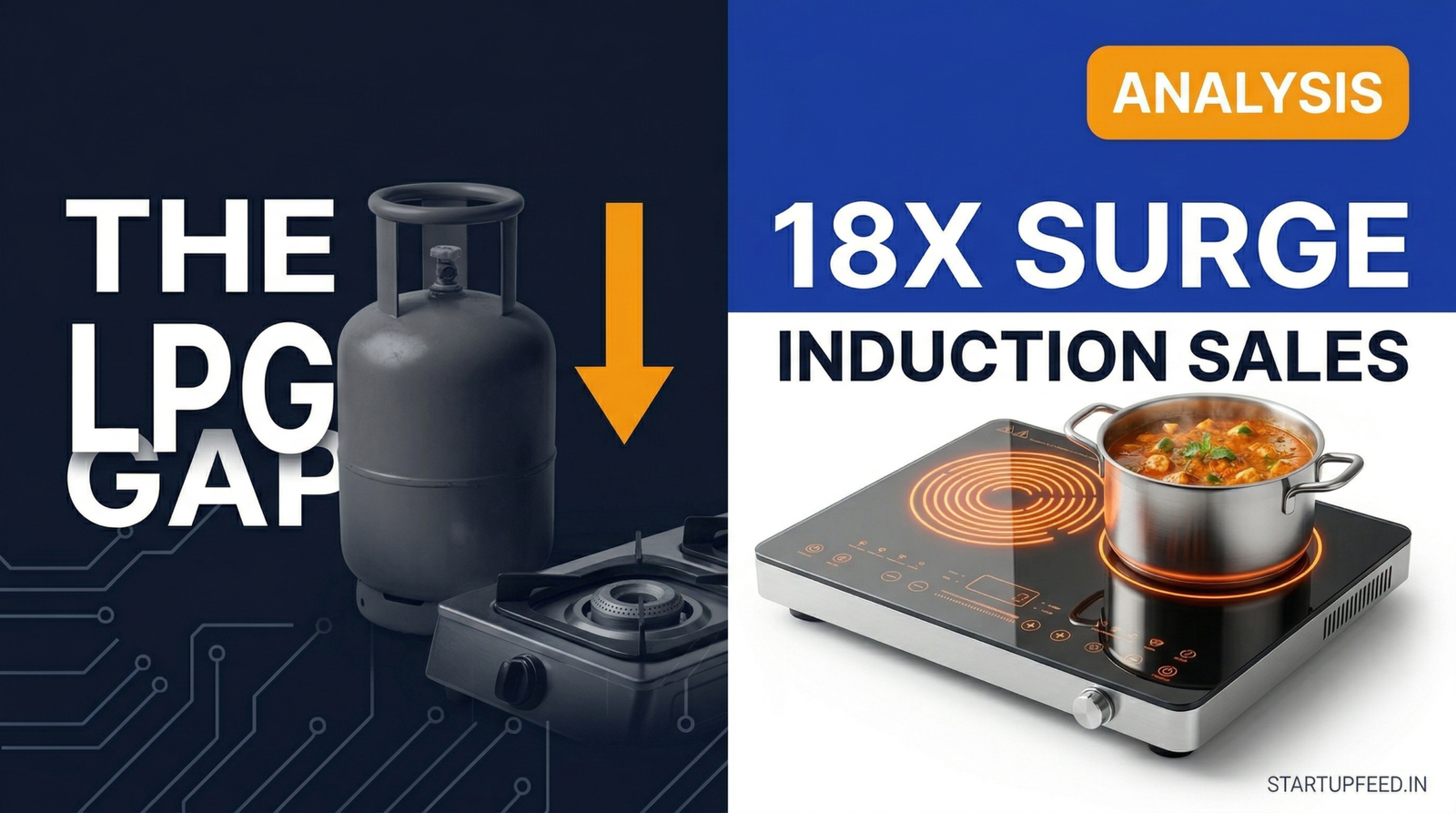
- The Numbers: Amazon India induction cooktop sales up 18X; Flipkart up 4X; Croma’s highest single-day induction sale ever.
- Scale: Daily demand jumped from ~1,000–2,000 units/month to 1–2 lakh units/day nationwide.
- Supply Crunch: Delhi NCR manufacturers running factories on overtime; quick-commerce shelves emptied within hours.
- Market Movers: TTK Prestige +36% in 3 trading sessions; Stove Kraft +36%; Butterfly Gandhimathi and Jaipan up 20%.
- The Bigger Picture: India’s induction cooktop market, valued at $798 Mn in 2025, is now set for a permanent demand reset.
When geopolitical tremors rattled the Strait of Hormuz in early March 2026, the shockwave reached not oil refineries first — but Indian kitchens. A disruption in LPG supply from West Asia, where India sources approximately 90% of its cooking gas imports, triggered an overnight behavioural reset among urban households across the country. In the days that followed, Amazon India recorded an 18X surge in induction cooktop sales, Flipkart reported 4X growth, and Croma’s highest-ever single-day induction cooktop sale shattered every benchmark in its history — surpassing what the chain previously sold in an entire month. The Indian kitchen is changing, and it is changing faster than anyone predicted.
This isn’t just a supply disruption story. A geopolitical crisis has done what years of clean-energy campaigns and government incentive programs could not: it forced millions of Indian households to reconsider their cooking infrastructure overnight. The startups, D2C brands, and legacy manufacturers who had been quietly building India’s electric kitchen segment for a decade are now staring at an order backlog they never planned for. The LPG crisis has handed India’s kitchen tech sector a structural demand inflection point — and the supply chain is scrambling to keep up.
StartupFeed Insight
What the numbers say: Going from 1,000–2,000 units/month to 1–2 lakh units/day is not a demand spike — it is a category reset. The induction cooktop market effectively compressed a decade of projected adoption into a 72-hour window. Some of that demand will revert when LPG stabilises. But a meaningful portion — the households that have now used induction, liked it, and bought induction-compatible cookware — will not go back.
What this means for you:
- If you’re a founder: The LPG crisis is proof that energy disruption is a massive category unlock — build kitchen tech products with an ’emergency backup’ use case baked into the pitch.
- If you’re an investor: D2C kitchen tech brands (iBell, Wonderchef, Candes, Atomberg) are under-covered in VC portfolios relative to their revenue quality — watch for Series B/C rounds in this cohort through FY27.
- If you’re an employee: Engineering, supply chain, and D2C marketing roles at kitchen appliance brands are in acute demand right now — this is an unusual hiring window.
Our prediction: By Q2 FY28, India’s induction cooktop market will have permanently structurally shifted — with annual unit sales at 2–3X pre-crisis baselines. At least 2 D2C kitchen tech brands will raise Series B rounds above Rs 100 Cr citing LPG-shock-driven customer acquisition data. Wonderchef and Atomberg will emerge as the clear winners in the premium segment.
The Crisis: How a Gulf Conflict Shut Down Indian Kitchens
India is the world’s third-largest LPG consumer, importing roughly 90% of its cooking gas supply through West Asian routes — primarily via the Strait of Hormuz. The Iran-US conflict of early 2026 disrupted these supply chains severely. The Union Petroleum Ministry acknowledged on March 11 that supply remains “a matter of concern,” even as it insisted no dry-out had occurred. The government invoked the Essential Commodities Act to restrict commercial LPG distribution and prioritise household supply, widened the LPG booking interval to 25 days, and urged Reliance Industries to increase domestic LPG output.
LPG cylinder prices moved sharply: household cylinders rose approximately Rs 60, while commercial cylinders (used by restaurants and hotels) saw a steeper Rs 115 increase. The Federation of Hotel and Restaurant Associations of India (FHRAI) warned that restaurants in Mumbai would be forced to shut operations within 48 hours without supply. In Kolkata, the Indane Distributors Association described conditions as “catastrophic” for the commercial sector. Some city restaurants cut production by half; others closed entirely.
The Numbers: India’s 72-Hour Kitchen Revolution
The household response was instantaneous. Across ecommerce platforms, physical retail, and quick commerce, the same pattern repeated: consumers searched, found, bought — and cleared shelves within hours.
| Platform / Retailer | Normal Sales Baseline | Crisis Peak Sales | Surge Multiple | Key Detail |
|---|---|---|---|---|
| Amazon India | ~500–600 units/day | ~15,000–18,000/day | 18X–30X | Rice cookers +4X; Air fryers +2X |
| Flipkart | Indexed baseline | 4X baseline volume | 4X | Surge prominent in Delhi, Kolkata, UP |
| Croma (Tata) | ~40–45 units/day | ~120–130+ units/day | 3X daily run rate | Highest EVER single-day sale; multiple units/customer |
| Quick Commerce (Blinkit/Zepto/Instamart) | Normal stock rotation | Sold out within hours | N/A — stockout | Zero stock: Bengaluru, Mumbai, Chennai, Delhi, Kolkata |
| Physical retail (street market) | 1–2 units/store/day | 50–70 units/store/day | 25X–35X | Prestige Chandigarh: 30+ units/day vs 1–2 before |
| Kerala appliance chains | 35–40 units/day | ~150 units/day | 4X | Stock depleted; reorder lead times stretched 10–14 days |
| Nationwide (all channels) | ~1,000–2,000 units/month | ~1–2 lakh units/DAY | 1,500X+ monthly rate | Delhi NCR factories moved to overtime immediately |
The Ripple: More Than Just Induction Cooktops
The demand surge was not limited to induction cooktops. The LPG crisis triggered a full kitchen electrification wave. Consumers who had never previously considered electric cooking were now buying entire electric kitchen setups in a single session.
| Product Category | Surge vs Normal | Channel | Driver |
|---|---|---|---|
| Induction cooktops | 18X–30X (Amazon) | Ecommerce + physical | Primary LPG replacement |
| Rice cookers & electric pressure cookers | +4X | Ecommerce | Induction-incompatible cookware workaround |
| Electric kettles | ~2X at Croma | Retail (Croma confirmed) | Household water boiling, hot beverages |
| Air fryers | +2X | Ecommerce (Amazon) | General heat-cooking alternative |
| Microwave ovens & OTG | Elevated (unquantified) | Retail | Reheating & baking alternatives |
| Induction-compatible cookware | Sharp spike | Physical retail (Pune wholesale) | Mandatory upgrade for induction use |
| Ready-to-eat / packaged meals | Significant uptick | Quick commerce + kiranas | Short-term cooking avoidance |
The parallel surge in induction-compatible cookware — stainless steel and cast-iron flat-bottom pans — reveals a nuance: the transition from LPG to induction is not just an appliance replacement. It is an entire kitchen infrastructure upgrade, creating a secondary market estimated at roughly 30–40% of the primary appliance spend.
Who’s Winning: The Kitchen Tech Ecosystem in Focus
The crisis exposed two distinct cohorts of winners: the listed incumbents who saw immediate stock market re-rating, and the D2C kitchen tech startups that were best positioned on ecommerce channels to capture demand.
| Company / Brand | Type | Stock / Market Reaction | Position & Advantage | Key Products |
|---|---|---|---|---|
| TTK Prestige | Listed — NSE: TTKPRESTIG | +36% in 3 sessions (intraday high Rs 613.5); Mkt Cap Rs 7,851 Cr | Q3 FY26 revenue Rs 801 Cr (+10% YoY); 40–45 → 120–130 units/day at Prestige showrooms | Induction cooktops, non-stick, pressure cookers |
| Stove Kraft (Pigeon brand) | Listed — NSE: STOVEKRAFT | +36% in 3 sessions; Mkt Cap Rs 1,739 Cr | Mass market Pigeon brand dominant in value segment; wide distribution | Cooktops, pressure cookers, non-stick cookware |
| Butterfly Gandhimathi | Listed | Up ~20% in crisis week | Strong South India presence; positioned well in Chennai/Kerala surge markets | Induction cooktops, LPG stoves, mixer-grinders |
| Jaipan Industries | Listed | Up ~20% | Value-segment induction cooktops; benefited from stockouts of premium brands | Budget induction cooktops |
| Wonderchef | D2C Startup | Private — no listed data | Founded 2009 with Sanjeev Kapoor; aspirational brand with Indian menu presets; premium positioning | Induction, air fryers, non-stick, OTG |
| Atomberg Technologies | D2C Startup (funded) | Private — Series D funded | BLDC motor tech from IIT Bombay; expanding kitchen range with energy efficiency pitch; now perfectly positioned | Mixer-grinders, chimneys, kitchen appliances |
| iBell | D2C Startup | Private — bootstrapped | Bengaluru-based; ecommerce-first; highly rated on Amazon/Flipkart; value-tech positioning | Induction cooktops, kettles, blenders |
| Candes | D2C Startup | Private | Delhi-based; D2C + ecommerce; strong Tier II/III reach; mass-market price points | Induction cooktops, OTG, kettles, mixer-grinders |
The Market: India’s Induction Cooktop Opportunity Pre- and Post-Crisis
| Metric | Pre-Crisis (2025) | Post-Crisis Projection (2026) | Long-Term (2034) |
|---|---|---|---|
| India induction cooktop market size | $798 Mn | $900 Mn–$1 Bn est. | $1,628 Mn (IMARC, 8% CAGR) |
| Normal daily unit demand (all channels) | ~1,000–2,000 units/month | 1–2 lakh units/day (peak) | Sustained 2–3X pre-crisis baseline |
| E-commerce share of sales | ~40–45% | Dominant channel in crisis | Growing to 55–60% by 2030 |
| Average selling price | Rs 1,500–3,500 (mass) | Premium models clearing faster | ASP rising as consumers upgrade |
| Top cities by sales volume | Delhi, Mumbai, Bengaluru, Pune | All metros + Kolkata, Chennai acutely | Tier II cities growing fastest |
| Primary customer type | Urban, upper-middle class | Panic-driven cross-segment | Mass-market + Tier II mainstream |
India’s induction cooktop market was already on an 8% CAGR trajectory through 2034. The LPG crisis has effectively pulled forward 2–3 years of adoption in a single quarter, permanently raising the baseline. Critically, induction efficiency (85–90%) versus LPG efficiency (40–55%) makes the economics of switching compelling even after the immediate crisis passes — a fact that manufacturers and startups are now aggressively communicating.
The Bottleneck: Supply Chains Under Unprecedented Pressure
Meeting demand has proved harder than capturing it. Delhi NCR, India’s largest manufacturing and distribution hub for induction cooktops, scrambled to respond. The Central Radio and Electronic Merchant Association (CREMA), led by President Sanjay Nagpal, convened an emergency meeting with manufacturers within 48 hours of the crisis breaking. Factories moved to overtime shifts, and the association activated coordination channels to ensure balanced distribution across markets — specifically to prevent hoarding and price gouging.
The challenges are structural, not just logistical. Induction cooktops require specific components — electromagnetic coil assemblies, ceramic glass panels, and IGBT chips — that cannot be sourced or manufactured at will overnight. Lead times from component suppliers in China and Taiwan, already stretched by 10–14 days under normal conditions, have extended further. This creates a gap between the crisis-driven demand surge and the supply chain’s ability to fulfil it — a gap that D2C brands with leaner inventory models are navigating more nimbly than traditional distributors.
Who Should Be Watching?
| Stakeholder | Why This Matters |
|---|---|
| Zomato & Swiggy (Q-commerce) | Induction cooktops sold out on Blinkit, Zepto, Instamart — proving Q-commerce is now a primary channel for durables in an emergency; both platforms will need dedicated appliance inventory strategies. |
| Government / MeitY / MNRE | The LPG crisis is the single strongest argument for India’s electric cooking mission (ECM) — expect accelerated PM Surya Ghar Yojana linkages and subsidy top-ups for induction adoption. |
| IRCTC | Already shifting station kitchens to induction cooking in response to the commercial LPG shortage — a signal that institutional adoption will sustain demand beyond the panic-buying phase. |
| Amazon & Flipkart | The 18X and 4X surges prove that durables can be crisis-demand categories; both platforms are likely to build ’emergency appliance’ inventory buffers and surge-pricing guardrails. |
| Restaurant / F&B sector | Hotels and restaurants hit by commercial LPG hikes (Rs 115/cylinder) face structural cost pressure to electrify kitchens — a Rs 5,000–25,000 capex per commercial induction unit that pays back in 12–18 months. |
| ONDC sellers | The crisis validated ecommerce as the first port of call for emergency appliance purchases — ONDC-listed kitchen appliance sellers stand to benefit from growing network adoption. |
What’s Next
The Strait of Hormuz will not remain disrupted indefinitely. India’s domestic LPG production is being ramped up, and alternative import routes are being activated. But the kitchen will not return to its pre-March 2026 configuration — not entirely.
Three forces will sustain the electric kitchen shift beyond the immediate crisis: first, a cohort of newly converted induction users who have now experienced the technology’s advantages (speed, safety, energy efficiency) and invested in compatible cookware; second, a supply chain ramp-up that will leave India with significantly greater induction cooktop manufacturing capacity by H2 FY27; and third, an institutional shift as IRCTC, hospital chains, and hospitality groups accelerate their commercial LPG-to-induction transitions.
Our prediction: by Q2 FY28, at least 2 D2C kitchen tech startups will raise growth rounds above Rs 100 Cr citing LPG-shock-driven user acquisition as proof of category elasticity. The smart kitchen segment — app-connected induction cooktops, IoT pressure cookers, AI-driven cooking assistants — will receive its first significant VC attention in India. The LPG crisis didn’t disrupt India’s kitchen industry. It unlocked it.
What do you think? Will India permanently shift to electric cooking, or will the habit revert when LPG normalises? Tell us @StartupFeed_official

