


Quick Take:
|
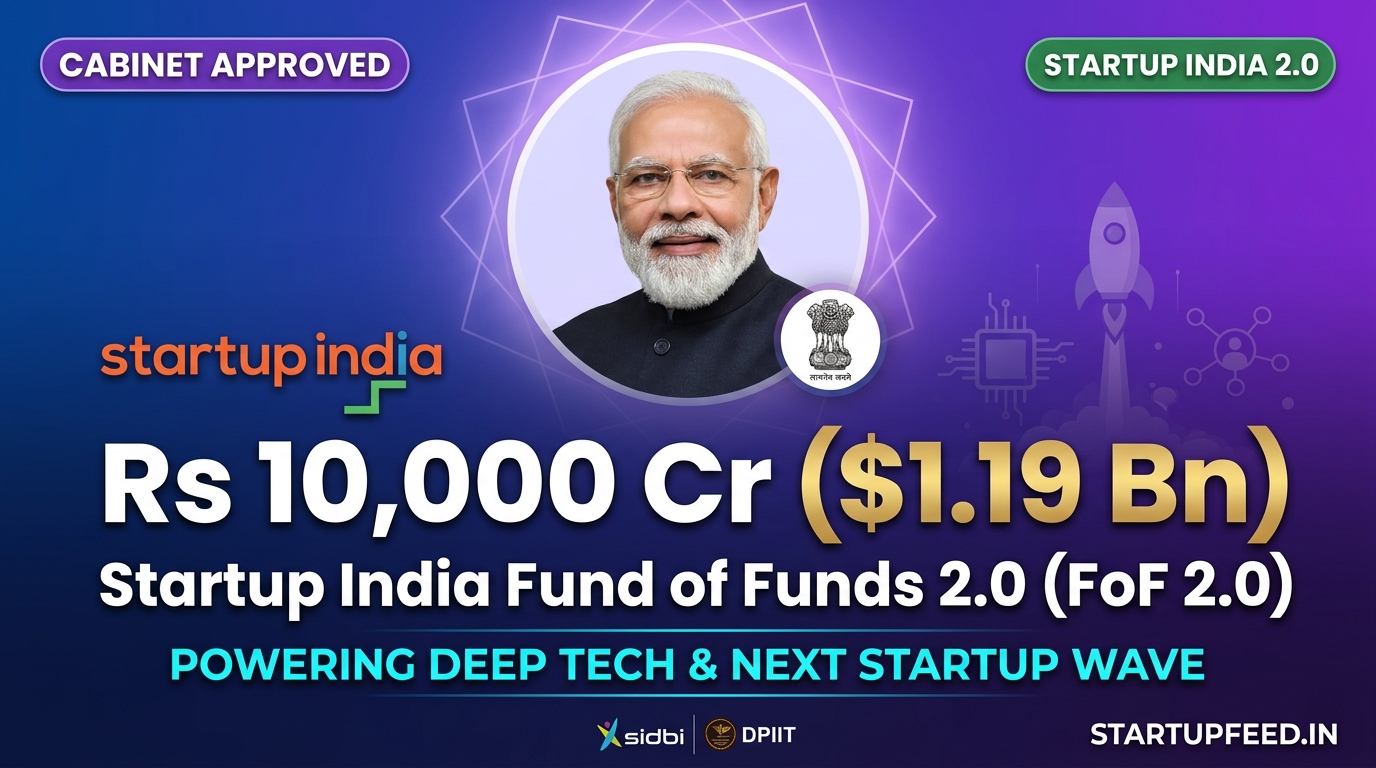
The Union Cabinet, chaired by Prime Minister Narendra Modi, has approved the establishment of Startup India Fund of Funds 2.0 (FoF 2.0) with a corpus of Rs 10,000 Cr ($1.19 Bn) — India’s largest single government commitment to venture capital mobilization since the original FoF was launched a decade ago. Announced on February 14, 2026, the scheme prioritizes deep tech, tech-driven manufacturing, and early-growth startups in Tier-2 and Tier-3 cities, targeting precisely the segments where India’s private capital has consistently underinvested.
This is not a supplemental budget line — it is a strategic course correction. FoF 1.0 built India’s VC infrastructure. FoF 2.0 is designed to direct that infrastructure at harder problems: semiconductor stacks, advanced manufacturing, climate tech, and defence technology — areas where patient, long-term government-anchored capital is the only viable catalyst. Every founder, fund manager, and investor in India’s ecosystem needs to understand what changes and what doesn’t.
StartupFeed Insight
| The key number: Rs 25,500 Cr mobilized from Rs 10,000 Cr in FoF 1.0 — a 2.55x multiplier. FoF 2.0, with a mandatory 2:1 AIF co-investment requirement, is designed to generate Rs 30,000 Cr+ in total ecosystem capital deployment over its lifecycle, unlocking Rs 40,000 Cr in total startup investment if private capital follows at historical ratios.
Winners:
Losers:
Action required for founders: Secure or renew DPIIT recognition now — it is the non-negotiable gateway to any FoF 2.0-backed AIF investment. Founders without DPIIT recognition are categorically ineligible. Our prediction: SIDBI will select the first tranche of FoF 2.0 AIFs by Q2 FY27 (Sep 2026), with initial commitments of Rs 2,000–2,500 Cr. By FY28, FoF 2.0 will generate India’s first cohort of deep tech unicorns — 3 to 5 companies in space tech, defence AI, and advanced manufacturing — directly funded by FoF-backed AIFs. |
What’s New: FoF 2.0 vs FoF 1.0
| Parameter | FoF 1.0 (2016) | FoF 2.0 (2026) |
|---|---|---|
| Corpus | Rs 10,000 Cr | Rs 10,000 Cr (+ Rs 10,000 Cr from Union Budget 2025 = Rs 20,000 Cr total FoF envelope) |
| Sector Focus | Broad-based (14+ sectors) | Targeted: Deep tech, advanced manufacturing, early-growth |
| Geographic Mandate | Metro-heavy in practice | Explicit push: investment beyond major metros |
| AIF Co-Investment | 2:1 match required | 2:1 match retained; smaller AIF preference added |
| Capital Type | General VC funding | Patient, long-term capital (deep tech gestation) |
| Fund Manager | SIDBI | SIDBI (Fund Manager) + DPIIT (Monitoring Agency) |
| Startup Eligibility | DPIIT-recognised | DPIIT-recognised (mandatory) |
| Alignment | Startup India 2016 | Viksit Bharat @ 2047 + Make in India + Atmanirbhar Bharat |
| Outcomes (1.0) | 145 AIFs, 1,370+ startups, Rs 25,500 Cr deployed | Targeted Rs 30,000+ Cr in pipeline (est.) |
Key Provisions Explained Simply
| Provision | What It Means | Impact |
|---|---|---|
| Fund of Funds (FoF) Structure | Govt invests in SEBI-registered AIFs, not directly in startups; AIFs do the startup due diligence | Leverages professional VC expertise; govt anchors risk without picking winners |
| 2:1 AIF Match Mandate | AIFs must invest at least twice what they receive from FoF 2.0 | Every Rs 1 of government money catalyses Rs 2+ of private capital |
| Deep Tech Prioritization | Focus on AI, robotics, space, biotech, advanced manufacturing, semiconductors | Fills gap that private VC won’t touch due to 8-12 year return horizons |
| Smaller AIF Preference | Specifically supports smaller/emerging domestic fund managers | Breaks concentration where 10-15 large VCs previously captured most FoF capital |
| National Reach Mandate | AIFs must invest beyond Bengaluru/Delhi/Mumbai metro cluster | Democratizes VC access to Jaipur, Indore, Coimbatore, Visakhapatnam, Lucknow founders |
| Break Fee Clause (FoF) | N/A (this is a state disbursement scheme) | SIDBI reviews AIF applications via VCIC (Venture Capital Investment Committee) |
Who’s Affected and How
| Stakeholder | Impact | Why |
|---|---|---|
| Deep Tech Founders | Positive | Long-term capital with no short-term return pressure — matches gestation periods of 7-12 years in semiconductors, biotech, and space |
| Advanced Manufacturing Startups | Positive | FoF 2.0 aligns with Make in India; startups building PLI-adjacent tech in electronics, EV components, and defence get government-backed VC access |
| Early-Stage Startups | Positive | Explicit ‘safety net’ for seed-to-Series A gap; reduces early-stage failure due to capital starvation, particularly outside top metros |
| Tier-2/3 City Founders | Positive | Geographic diversity mandate forces AIFs to deploy capital in non-metro India for the first time under a structured government framework |
| Domestic VC Funds (smaller) | Positive | FoF 2.0 explicitly supports smaller domestic funds, giving new and emerging managers access to Rs 10,000 Cr government anchor capital |
| Foreign / Global VC Funds | Neutral | FoF 2.0 does not restrict foreign capital — but the scheme specifically strengthens domestic VC base, reducing India’s dependency on foreign risk capital |
| Consumer Internet / D2C Startups | Neutral/Caution | Not a FoF 2.0 priority sector — AIFs that receive government capital may shift focus to deep tech over consumer plays to qualify |
| DPIIT-Unrecognised Startups | Negative | Categorically ineligible for FoF 2.0 portfolio investment; DPIIT recognition is the hard gateway with no exceptions |
Action Items for Founders — FoF 2.0 Readiness Checklist
Action Items for Startups:
|
FoF 1.0 Performance: The Track Record FoF 2.0 Builds On
| Metric | FoF 1.0 Outcome | Benchmark / Context |
|---|---|---|
| Government Corpus Committed | Rs 10,000 Cr (100% deployed) | Full commitment to 145 AIFs |
| AIFs Supported | 145 SEBI-registered AIFs | Includes both established and emerging managers |
| Startups Funded (via AIFs) | 1,370+ startups | Across 14+ sectors |
| Total Capital Mobilized (downstream) | Rs 25,500 Cr+ | 2.55x multiplier on Rs 10,000 Cr corpus |
| Ecosystem Growth (2016-2026) | 500 startups → 2 lakh+ DPIIT startups | 400x growth in recognised startups |
| Unicorns (2014-2026) | 4 unicorns → ~125 active unicorns | ~31x growth in decade |
| Direct Jobs Created | 17.28 lakh+ direct jobs | IT services leads at 2.10 lakh jobs |
| Known Challenge | Disbursement lag (40-50% of committed capital reached AIFs efficiently) | FoF 2.0 expected to streamline; VCIC process to be faster |
Industry Reaction
| “Building on the transformational success of Startup India since 2016 and the strong outcomes of FFS 1.0, this Fund will mobilise long-term domestic capital for deep tech, capital-intensive manufacturing and early-growth startups. This move will strengthen India’s venture capital ecosystem, crowd in private investment and accelerate high-quality job creation across the country, advancing our Government’s ambition to make India a global innovation hub.”
— Piyush Goyal, Union Minister of Commerce & Industry Analysis: Goyal’s emphasis on ‘crowd in private investment’ is the key phrase — FoF 2.0’s primary KPI will be its multiplier effect on private capital, not just the government corpus deployed. The benchmark is FoF 1.0’s 2.55x return; FoF 2.0 targets even higher leverage through the 2:1 mandatory AIF match. |
What’s Next
The Cabinet approval triggers a multi-step execution sequence. SIDBI will issue an expression of interest (EOI) for SEBI-registered AIFs, evaluate applications through the VCIC (Venture Capital Investment Committee), and begin first-tranche commitments. DPIIT will monitor scheme outcomes against targets including sector distribution, geographic spread, and total capital mobilized.
FoF 2.0’s success will be measured against three hard milestones over the next 5 years: total downstream capital mobilized (target: Rs 30,000 Cr+), number of deep tech startups funded (target: 500+), and geographic diversity (target: 40%+ investment in non-metro India). Watch for SIDBI’s first AIF selection list — it will reveal which sectors and regions the government is actually prioritizing vs. what the policy document promises.
For founders: This is the most significant domestic policy tailwind for Indian startups since the 2016 Startup India launch. Those who position their ventures at the intersection of deep tech, advanced manufacturing, and geographic diversity will find the next 24 months exceptionally well-capitalised by the domestic VC funds FoF 2.0 empowers.
Does India’s deep tech finally have the patient capital it needs to compete with China’s state-backed tech giants? Tag us @StartupFeed_official