
QUICK TAKE:
| What: | PM Modi’s keynote at India AI Impact Summit 2026 featured live AI-powered sign language translation on a large screen at Bharat Mandapam |
| Languages: | Speech dubbed live into 11 regional languages and simultaneous sign language—all AI-powered, no human interpreters |
| On Screen: | An AI-animated sign language avatar translated the PM’s Hindi speech in real-time, displayed on the main stage screen |
| Who Benefits: | India’s ~18 million persons with hearing impairments (National Association of the Deaf estimate) |
| The Tech: | AI sign language translation + 11-language live dubbing via platforms aligned with India’s Bhashini AI initiative |
| PM’s Signal: | ‘We will always work to ensure technology and public discourse are accessible to persons with disabilities.’ — PM Modi on X |
THE STORY
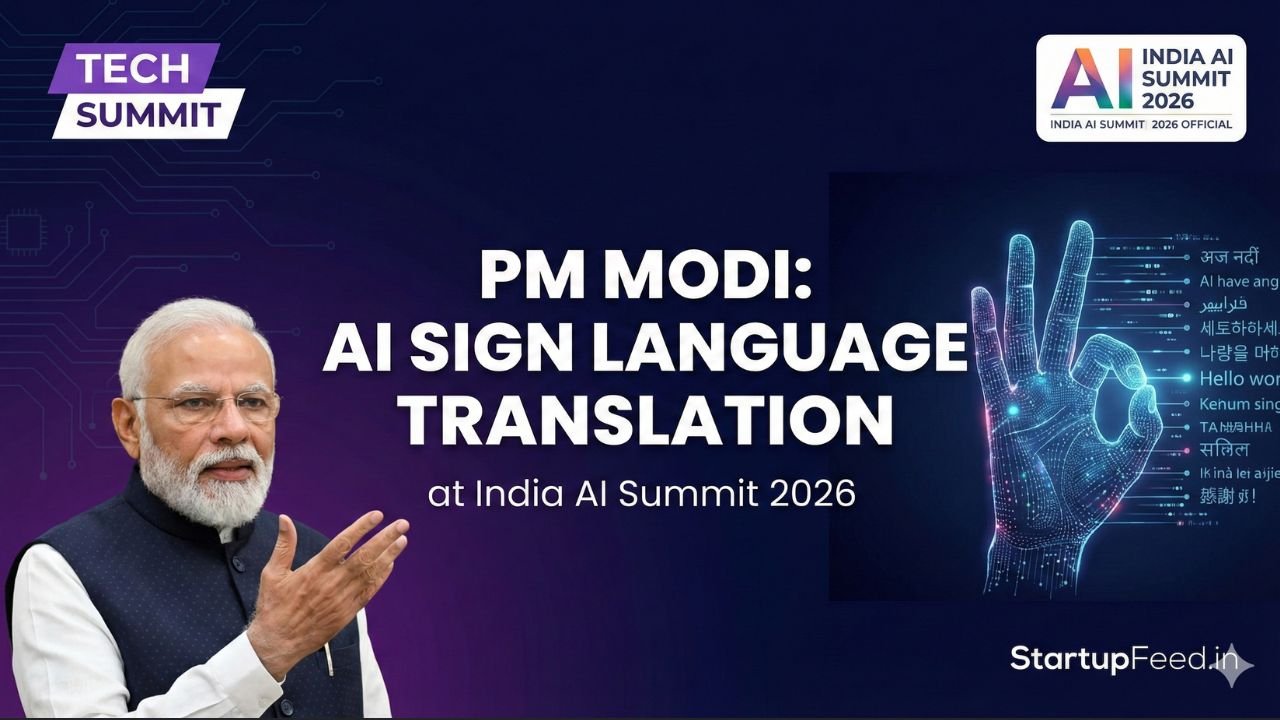
In a quiet but powerful moment at India’s most consequential technology gathering, Prime Minister Narendra Modi’s keynote address at the India AI Impact Summit 2026 became the first speech by a world leader at a global AI summit to be rendered in real-time sign language using artificial intelligence. The AI-animated sign language translation was projected on the main screen behind the Prime Minister at Bharat Mandapam, New Delhi — a live demonstration of the very principle he was articulating: that AI must be a multiplier, not a monopoly. Simultaneously, the Hindi speech was dubbed live into 11 regional Indian languages — all powered by artificial intelligence — reaching audiences across linguistic and disability divides in a single moment.
WHY THIS MATTERS
The gesture is small in scale but enormous in signal. India has approximately 18 million persons with hearing impairments—one of the largest deaf and hard-of-hearing populations in the world—and sign language accessibility in public institutions has historically been tokenistic at best. Real-time, AI-powered sign language translation at this scale and visibility reframes accessibility from a compliance checkbox to a design imperative. When the Prime Minister of a 1.4 billion-person nation chooses to include it at a global summit broadcast worldwide, it sends a message to every Indian government institution, every startup, and every enterprise CTO: accessibility is not optional; it is infrastructure.
For the Indian startup ecosystem specifically, this is a green flag of rare clarity. The sign language AI demonstration at the summit—attended by over 500 global AI leaders, including Sam Altman (OpenAI), Sundar Pichai (Google), and Dario Amodei (Anthropic)—puts AI for accessibility on the global investment agenda. Startups building in this space just received the most visible government endorsement possible.
In PM Modi’s Own Words: The PIB Statement
| PIB Delhi | February 19, 2026 | 6:14 PM
Prime Minister Shri Narendra Modi, addressing the India AI Impact Summit 2026 today, underscored India’s unwavering commitment to accessibility and inclusion in the age of artificial intelligence. During his speech, real-time translation in sign language was enabled through AI technology, ensuring that persons with disabilities could fully engage with the proceedings. Shri Modi emphasized that India will continue to champion innovation that bridges divides and empowers every citizen. PM Modi on X:
|
A First in Global AI Diplomacy: 11 Languages + Sign Language
The technical execution was impressive by any standard. PM Modi’s Hindi address was simultaneously dubbed live into 11 languages, with a separate AI-animated avatar rendering the entire speech in Indian Sign Language (ISL) on the main stage screen in real time. No human interpreter was on stage. The AI handled the entire translation stack.
| Script | Language 1 | Language 2 | Language 3 | Language 4 | Status |
|---|---|---|---|---|---|
| Indic | Assamese | Bangla | Gujarati | Kannada | ✅ Live |
| Indic | Malayalam | Marathi | Odia | Punjabi | ✅ Live |
| Indic | Tamil | Telugu | — | — | ✅ Live |
| Global | English | — | — | — | ✅ Live |
| Disability | ISL (Sign Language) | AI Avatar | Real-time | On-screen | ✅ Live |
The 11-language AI dubbing aligns with India’s Bhashini initiative — a government-backed AI language platform that supports 36+ languages, integrates over 350 AI models, and has crossed 1.2 million downloads since its 2022 launch. Bhashini represents exactly the infrastructure layer that made Thursday’s live multilingual-plus-sign-language demonstration possible at national scale.
India’s Accessibility Gap: The Problem This Solves
India’s 18 million persons with hearing impairments represent one of the largest underserved communities in the country’s digital transformation story. Sign language accessibility in Indian government, media, and public institutions has historically lagged behind global standards. The Rights of Persons with Disabilities (RPwD) Act, 2016, mandates accessibility, but real-time AI sign language translation at live national events has remained aspirational—until now.
Accessibility by Numbers: India’s Disability Inclusion Gap
|
India’s AI Accessibility Startup Ecosystem: Who’s Building the Future?
The timing of Thursday’s demonstration is a direct signal to startups building in India’s AI-for-accessibility space. Several companies are already working on solving the sign language and disability inclusion gap—and just got the most powerful government endorsement in the sector’s history.
| Startup / Initiative | Focus Area | What They Build | Summit Connection |
|---|---|---|---|
| Fifth Sense | Sign Language Hardware | AI sign language translation gloves for real-time communication | Showcased at AI Impact Expo 2026 |
| DeepVisionTech.AI | Sign Language Software | LetsTalkSign: AI two-way communication for hearing/speech impaired | Directly aligned with PM’s summit demonstration |
| Bhashini (Govt.) | Multilingual AI Platform | 36+ language translations, 350+ AI models, voice and text | Infrastructure for 11-language live dubbing at summit |
| Sarvam AI | Indic LLMs | Voice-first Indic language AI, large model for 1 billion+ users | Backed by IndiaAI Mission; selected for sovereign model development |
| Cognitive | Special Needs EdTech | AI-powered tools expanding access to special needs education | Featured at AI Impact Expo 2026 |
Connecting the Dots: Sign Language AI as the Living MANAV Principle
Thursday’s accessibility demonstration was not incidental. It was a live embodiment of the ‘A’ pillar of PM Modi’s MANAV framework—Accessible and Inclusive. MANAV, the human-centric AI governance vision unveiled at the summit, explicitly states that AI must be “a multiplier, not a monopoly.” An AI-powered sign language avatar on the main stage of a global summit, accessible to 18 million deaf Indians watching on broadcast and live stream, is that principle made tangible.
“AI is a transformative power. If directionless, it becomes a disruption; if the right direction is found, it becomes a solution. How to make AI from machine-centric to human-centric, how to make it sensitive and responsive—this is the basic objective of this Global AI Impact Summit.” — PM Narendra Modi, Keynote Address, India AI Impact Summit 2026
The sign language moment also directly supports the summit’s ‘Inclusion for Social Empowerment Chakra’—one of the seven working groups—which focuses on designing AI that accounts for diverse needs, identities, and experiences. India’s MANAV vision, if it is to mean anything, must begin here: with a government that makes public discourse accessible before it asks the world to build inclusive AI.
STARTUPFEED INSIGHT
| What the Numbers Say: “AI sign language tech is no longer a niche.” Google introduced sign language AI models in 2025. Sorenson Communications and Nagish were acquired in that same year. When a G20 PM demonstrates it live to 500+ global AI leaders and billions on broadcast, the market signal is that the accessible AI TAM just went mainstream. | |
| For Founders: | If you’re building sign language AI, multilingual accessibility tools, or disability-first interfaces, apply to the IndiaAI Mission’s startup cohort immediately. The government just gave you a 250-crore-equivalent endorsement on a world stage. |
| For Investors: | Accessibility AI is graduating from CSR to the investable category. AI sign language translation, ISL corpus datasets, and disability EdTech are the three subsectors to watch. Look at Fifth Sense, DeepVisionTech.AI, and Cognitii as early signals. |
| For Corporates: | Every large Indian enterprise running public events, investor calls, and government tenders now has a benchmark: real-time AI sign language + multilingual dubbing. If the PM’s summit can do it, your next AGM can too. |
| Our Prediction: By Q3 FY27, the IndiaAI Mission will mandate real-time ISL translation for all Union Budget speeches, Parliament broadcasts, and MeitY press conferences. Bhashini’s sign language module will become the standard API for Indian government digital services. The Indian accessibility AI startup cohort will raise its first ₹500 Cr fund by 2027. | |