


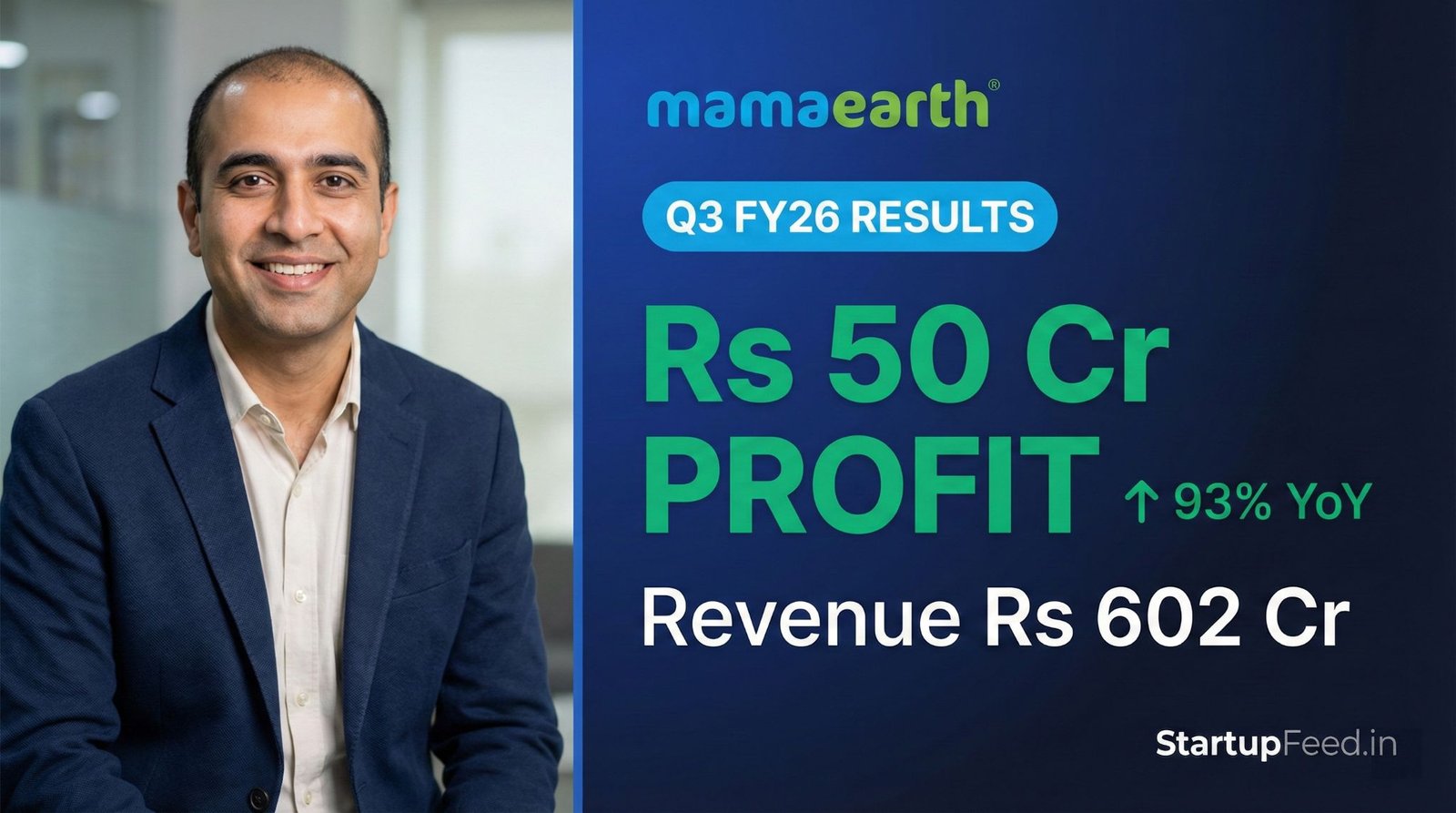

Mamaearth Q3 FY26 Results: The Lead
Honasa Consumer, the parent company of Mamaearth, reported revenue of Rs 602 Cr in Q3 FY26, up 16.2% from Rs 518 Cr a year ago. Net profit surged 93% to Rs 50.2 Cr from Rs 26 Cr — a turnaround that marks the Gurugram-based D2C giant’s strongest quarter since listing.
So What Does This Mean?
The Mamaearth Q3 FY26 results suggest Honasa has crossed its toughest operational phase. After a painful Q2 FY25 that saw a Rs 65 Cr inventory write-off and negative EBITDA margins, this quarter’s numbers position the company as the D2C sector’s defining comeback story of 2026.
StartupFeed Insight
The key number: EBITDA margin jumped from 5.0% to 10.9% — a 410 basis point expansion — while expenses grew at nearly half the rate of revenue. This is operating leverage in action.
What’s improving:
- Ad spend as a percentage of revenue dropped from 34.3% to 30.9%, saving Rs 20+ Cr in efficiency
- Like-for-like revenue hit Rs 630 Cr (+21.7% YoY), stripping out the Flipkart settlement distortion
What’s concerning:
- Gross margin compressed to 68.5% from 70.0%, indicating rising input costs or heavier discounting
- Employee costs rose 18% YoY to Rs 71 Cr, outpacing revenue growth at 11.8% of sales
Profitability math: At the current 9M trajectory (Rs 131 Cr PAT on Rs 1,735 Cr revenue), Honasa is on track to deliver Rs 170-180 Cr in full-year FY26 profit — a 130%+ jump from FY25’s Rs 73 Cr. Sustained 10%+ EBITDA margins by Q2 FY27 would put Honasa in elite FMCG territory.
Revenue Breakdown
| Metric | Q3 FY25 | Q3 FY26 | Growth |
| Revenue from Operations | Rs 518 Cr | Rs 602 Cr | +16.2% YoY |
| Like-for-Like Revenue | Rs 518 Cr | Rs 630 Cr | +21.7% YoY |
| Other Income | Rs 19 Cr | Rs 21 Cr | +10.5% YoY |
| Total Income | Rs 537 Cr | Rs 622 Cr | +15.9% YoY |
The adjusted (LFL) revenue of Rs 630 Cr tells the real story. Stripping out the one-time Flipkart settlement impact, Honasa’s underlying sales growth ran at 21.7%. Volume growth clocked 30.2%, suggesting consumers are buying more, not just paying more.
Expense Analysis
| Category | Q3 FY25 | Q3 FY26 | Change | % of Rev |
| Procurement | Rs 158 Cr | Rs 189 Cr | +19.6% | 31.4% |
| Employee Costs | Rs 60 Cr | Rs 71 Cr | +18.3% | 11.8% |
| Advertising | Rs 177 Cr | Rs 186 Cr | +5.1% | 30.9% |
| Other Expenses | Rs 107 Cr | Rs 90 Cr | -15.9% | 15.0% |
| Total Expenses | Rs 507 Cr | Rs 550 Cr | +8.5% | 91.4% |
The margin expansion story sits in two lines. Advertising costs grew just 5.1% while revenue grew 16.2% — a sign that Mamaearth’s brand is pulling consumers without heavy discounting. Other expenses dropped 15.9%, indicating the worst of the Project Neev distribution restructuring costs are behind Honasa.
Key Metrics
| Metric | Q3 FY25 | Q3 FY26 | Change |
| EBITDA | Rs 26 Cr | Rs 66 Cr | +150.7% YoY |
| EBITDA Margin | 5.0% | 10.9% | +410 bps |
| PAT Margin | 5.0% | 8.3% | +330 bps |
| Gross Margin | 70.0% | 68.5% | -150 bps |
| Offline Outlets | ~2.1 Lakh | 2.7 Lakh | +25% YoY |
Historical Trend
| Metric | Q2 FY25 | Q3 FY25 | Q2 FY26 | Q3 FY26 | ↑↓ |
| Revenue | Rs 462 Cr | Rs 518 Cr | Rs 538 Cr | Rs 602 Cr | ↑ |
| Net Profit | -Rs 19 Cr | Rs 26 Cr | Rs 39 Cr | Rs 50 Cr | ↑ |
| EBITDA Margin | -6.6% | 5.0% | 8.9% | 10.9% | ↑ |
The trajectory tells a powerful story. Just five quarters ago, Honasa was reporting negative EBITDA margins and a Rs 65 Cr inventory write-off. The swing from -6.6% to +10.9% EBITDA margin in 15 months marks one of the sharpest operational recoveries in Indian D2C history.
What the Founder Says
“Q3 FY26 marked a step-up quarter for Honasa as we delivered our highest-ever quarterly revenue of Rs 630 Cr, with profits nearly doubling year-on-year.”
— Varun Alagh, Chairman, CEO & Co-founder of Honasa Consumer
The emphasis on “highest-ever” and “step-up quarter” signals confidence that this is not a one-off beat. Alagh also noted Mamaearth is “back to double-digit growth” — a phrase that quietly acknowledges the brand had slipped below that bar during the Project Neev transition.
How It Compares
| Company | Period | Revenue | Profit | P/E | Status |
| Honasa Consumer | Q3 FY26 | Rs 602 Cr | Rs 50 Cr | ~75x | Turnaround |
| Marico | Q3 FY26 | Rs 2,700+ Cr | Rs 400+ Cr | ~55x | Mature |
| Dabur | Q3 FY26 | Rs 3,300+ Cr | Rs 500+ Cr | ~50x | Mature |
Honasa trades at a premium to established FMCG peers like Marico and Dabur. The 75x trailing P/E is expensive, but analysts are pricing in the growth inflection. Goldman Sachs raised its target to Rs 330 from Rs 300, noting that EBITDA margin beat expectations by 240 basis points.
The Bottom Line
The Mamaearth Q3 FY26 results confirm what optimists hoped and sceptics doubted — the D2C playbook can deliver both growth and profitability. With EBITDA margins doubling, record revenue, and all eight brands firing, Honasa has earned its “comeback” tag.
The next milestone to watch: Can the company hold 10%+ EBITDA margins through Q4 while absorbing the Rs 195 Cr Reginald Men acquisition? If FY26 closes with Rs 2,300+ Cr revenue and Rs 170+ Cr in profit, Honasa’s stock — still below its IPO price — could see a meaningful re-rating.
What do you think — can Mamaearth sustain this profitability run, or is this a one-cycle peak? Share your take with us on Twitter @StartupFeed_in
Honasa Consumer Ltd is India’s largest digital-first beauty and personal care company, operating eight brands including Mamaearth, The Derma Co., BBlunt, and Aqualogica. The Gurugram-headquartered company, founded in 2016 by Varun and Ghazal Alagh, reported FY25 revenue of Rs 2,067 Cr. Honasa listed on the NSE and BSE in November 2023 and currently holds a market capitalisation of approximately Rs 9,800 Cr (~$1.1 Bn). The company is debt-free and expanded into men’s grooming with the acquisition of Reginald Men in December 2025.
Quick Take:
- Revenue: Rs 602 Cr (+16.2% YoY) — highest-ever quarterly revenue
- Profit: Rs 50.2 Cr (+93% YoY) — nearly doubled from Rs 26 Cr
- EBITDA Margin: 10.9% (up from 5.0% — doubled in 12 months)
- Expense Control: Total costs grew just 8.5% vs 16.2% revenue growth
- Verdict: Turnaround confirmed — profitability over growth is delivering

