


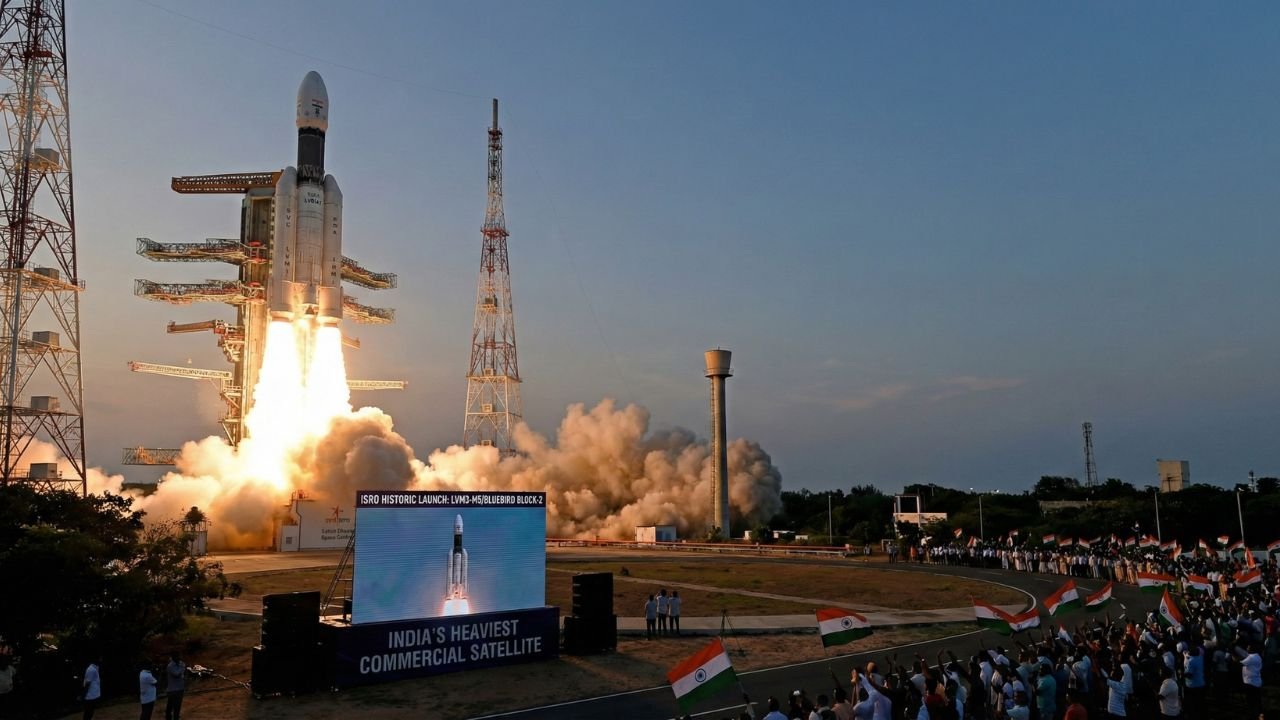

The Indian Space Research Organisation (ISRO) created history on December 24, 2024, by successfully launching the country’s heaviest-ever communication satellite from Indian soil. The LVM3-M6 mission carried the 6,100 kg BlueBird Block-2 satellite into Low Earth Orbit (LEO), marking a watershed moment in India’s commercial space ambitions and cementing ISRO’s position among the world’s elite heavy-lift launch providers.
The successful ISRO heaviest satellite launch demonstrates India’s growing capabilities in the competitive global space market, where the country now stands shoulder-to-shoulder with SpaceX’s Falcon 9 and Europe’s Ariane launchers. The mission represents not just a technical achievement but a strategic statement about India’s readiness to handle complex, high-value commercial payloads for international clients.
Mission LVM3-M6: Breaking Down the Historic Launch
The Launch Vehicle Mark-3 (LVM3), India’s most powerful operational rocket, executed its sixth commercial mission with flawless precision. Lifting off from the Satish Dhawan Space Centre in Sriharikota, the three-stage rocket carried the massive BlueBird Block-2 satellite—a technological marvel designed to revolutionize global mobile connectivity.
Key Mission Parameters:
- Launch Vehicle: LVM3 (formerly GSLV Mk-III)
- Mission Designation: LVM3-M6 / BlueBird Block-2
- Payload Mass: Approximately 6,100 kg
- Target Orbit: Low Earth Orbit (LEO)
- Client: AST SpaceMobile, United States
- Launch Date: December 24, 2024
- Launch Site: Satish Dhawan Space Centre, Sriharikota
This marks the sixth operational flight of LVM3 and establishes a new benchmark for India’s commercial launch capabilities. The previous heaviest payload launched by ISRO was the 5,805 kg GSAT-29 in 2018, making BlueBird Block-2 a significant leap forward.
BlueBird Block-2: Revolutionary Space-Based Cellular Technology
Built by AST SpaceMobile, the American satellite communications company, BlueBird Block-2 represents cutting-edge space technology designed to eliminate cellular dead zones globally. The satellite’s primary mission is to provide direct-to-cell 5G connectivity to standard, unmodified smartphones anywhere on Earth—a capability that could transform telecommunications in remote and underserved regions.
Technical Specifications of BlueBird Block-2:
Massive Phased-Array Antenna: The satellite features a 223 square meter phased-array antenna—the largest ever deployed in Low Earth Orbit. This enormous antenna enables direct communication with standard mobile phones without requiring specialized equipment or modifications.
5G Connectivity: BlueBird Block-2 will provide seamless 5G voice, data, and video services directly to existing smartphones, bridging the connectivity gap for billions of people in areas lacking traditional cellular infrastructure.
Strategic Importance: AST SpaceMobile has partnerships with major telecom operators including AT&T, Verizon, Vodafone, and Rakuten, positioning the satellite constellation as a critical component of global mobile infrastructure.
The satellite’s deployment into LEO optimizes latency for real-time communications while maintaining broad coverage footprints. Each BlueBird satellite can cover an area approximately 780,000 square kilometers—larger than Texas—providing service to multiple countries simultaneously.
Why This ISRO Launch Changes Everything
The successful ISRO heaviest satellite launch positions India as a serious contender in the lucrative global commercial launch market, which is projected to reach $28 billion by 2030. Several factors make this achievement particularly significant:
Heavy-Lift Capability Validation: LVM3’s successful deployment of a 6,100 kg payload into LEO demonstrates reliable heavy-lift capabilities comparable to international competitors. The rocket can launch payloads up to 10,000 kg to LEO and 4,000 kg to Geostationary Transfer Orbit (GTO).
Commercial Credibility: International clients like AST SpaceMobile choosing ISRO over established providers like SpaceX or Arianespace validates India’s competitive pricing, reliability, and technical expertise. This launch builds crucial commercial momentum for ISRO’s NewSpace India Limited (NSIL), the commercial arm handling such contracts.
Cost Competitiveness: ISRO’s LVM3 missions typically cost $60-70 million, significantly lower than comparable Western launches. A SpaceX Falcon 9 launch costs approximately $67 million for dedicated missions but can exceed $100 million for specialized payloads. This cost advantage positions India favorably for future contracts.
Strategic Timing: As global demand for satellite launches surges—driven by mega-constellations, 5G infrastructure, and Earth observation needs—ISRO’s proven heavy-lift capability arrives at precisely the right moment to capture market share.
India Joins Elite Heavy-Lift Launch Nations
With the LVM3-M6 success, India officially enters an exclusive club of nations capable of reliably launching heavy commercial payloads. This group includes:
- United States: SpaceX (Falcon 9, Falcon Heavy), ULA (Atlas V, Vulcan)
- Europe: Arianespace (Ariane 6)
- Russia: Roscosmos (Proton-M, though international launches limited post-2022)
- China: CASC (Long March series)
- India: ISRO (LVM3)
The geopolitical implications are substantial. As Western sanctions limit Russia’s commercial launch services and China faces trust challenges in Western markets, ISRO emerges as a politically neutral, technologically capable alternative for international clients seeking launch services.
“India has demonstrated it possesses both the technical sophistication and operational reliability that commercial customers demand,” explained Dr. Rahul Narayan, space industry analyst at Galaxy Research. “The LVM3-M6 mission isn’t just about one satellite—it’s proof that ISRO can compete globally on performance, schedule, and cost.”
AST SpaceMobile’s Strategic Bet on ISRO
AST SpaceMobile’s decision to entrust its flagship satellite to ISRO represents significant confidence in India’s launch capabilities. The Texas-based company, backed by major investors including Rakuten, Vodafone, and American Tower Corporation, had multiple launch provider options but selected ISRO for critical reasons:
Launch Schedule Certainty: With SpaceX’s manifest heavily booked and European launchers facing transition challenges (Ariane 5 retired, Ariane 6 delayed), ISRO offered predictable scheduling—crucial for AST SpaceMobile’s constellation deployment timeline.
Technical Compatibility: LVM3’s payload fairing dimensions and mass capacity perfectly matched BlueBird Block-2’s requirements without requiring satellite modifications or compromises.
Risk Diversification: By working with ISRO, AST SpaceMobile diversifies its launch provider risk, avoiding complete dependence on any single country or company—a strategic consideration for critical infrastructure deployment.
Partnership Potential: This successful launch establishes a relationship that could lead to additional contracts for AST SpaceMobile’s planned constellation of 60+ BlueBird satellites.
“We selected ISRO based on their proven track record, technical capabilities, and ability to meet our demanding mission requirements,” said Abel Avellan, Chairman and CEO of AST SpaceMobile. “Today’s successful launch validates that decision and opens pathways for future collaboration.”
Technical Triumph: How LVM3 Executed the Mission
The LVM3 rocket’s three-stage design combines solid, liquid, and cryogenic propulsion for optimal performance. Understanding the mission architecture reveals the engineering excellence behind this achievement:
Stage 1 – S200 Solid Boosters: Two massive solid rocket boosters, each containing 200 tons of propellant, provide the initial thrust to lift the 640-ton vehicle off the launch pad. These boosters burn for approximately 140 seconds, generating 5,150 kN of thrust.
Stage 2 – L110 Liquid Core: The liquid-fueled core stage, using unsymmetrical dimethylhydrazine (UDMH) and nitrogen tetroxide, takes over after booster separation. It burns for about 203 seconds, carrying the payload through the atmosphere’s dense layers.
Stage 3 – C25 Cryogenic Upper Stage: The indigenously developed cryogenic engine using liquid hydrogen and liquid oxygen provides the final push into orbit. This stage represents India’s mastery of complex cryogenic technology, which only a handful of nations possess.
The precision required to place a 6,100 kg satellite into its precise orbital parameters while managing the enormous forces during ascent demonstrates ISRO’s world-class mission planning and execution capabilities.
Economic Impact: India’s Growing Space Economy
The ISRO heaviest satellite launch contributes to India’s rapidly expanding space economy, currently valued at approximately $8.4 billion and projected to reach $44 billion by 2033, according to the Indian Space Association.
Revenue Generation: Commercial launches generate substantial foreign exchange. While ISRO doesn’t publicly disclose individual contract values, industry estimates suggest the BlueBird Block-2 launch contract was worth $50-70 million.
Job Creation: The expanding commercial space sector supports high-skilled employment across engineering, manufacturing, mission control, and satellite operations. ISRO’s vendor ecosystem includes over 500 industries employing thousands of specialized workers.
Technology Spillover: Space technology development drives innovation in materials science, propulsion systems, electronics, and communications—benefits that cascade through India’s broader industrial base.
Startup Ecosystem: Successful missions inspire and enable India’s burgeoning space startup sector, which has grown to over 190 registered space-tech companies focusing on satellite manufacturing, launch services, ground systems, and data analytics.
Global Reaction and Industry Response
International space industry observers recognized the significance of ISRO’s achievement immediately. Social media platforms buzzed with congratulatory messages from space agencies, industry leaders, and space enthusiasts worldwide.
The European Space Agency’s director tweeted congratulations, while multiple aerospace industry publications featured the launch prominently. This global recognition reflects ISRO’s growing stature in an industry historically dominated by American, European, and Russian players.
Competitors took notice as well. The successful mission demonstrates that SpaceX’s near-monopoly on commercial launches faces credible competition, particularly for clients seeking cost-effective solutions or geographic diversification.
What This Means for ISRO’s Future Missions
The LVM3-M6 success creates momentum for ISRO’s ambitious upcoming mission manifest:
Gaganyaan Human Spaceflight: The LVM3 will launch India’s first crewed mission, planned for 2025-2026. Today’s success validates the rocket’s reliability for human-rated missions.
Chandrayaan-4 Lunar Sample Return: Future lunar missions will depend on LVM3’s heavy-lift capabilities to send complex spacecraft to the Moon.
Commercial Constellation Launches: ISRO can now confidently pursue contracts for deploying multiple satellites or large constellation elements in single missions.
Interplanetary Missions: Enhanced payload capacity enables more ambitious Mars, Venus, and asteroid missions with sophisticated scientific instruments.
National Security Payloads: India’s defense and surveillance satellite programs benefit from indigenous heavy-lift capability, reducing dependence on foreign launch providers for sensitive payloads.
Challenges and Competition Ahead
Despite this success, ISRO faces significant challenges in scaling commercial operations:
Launch Cadence: SpaceX conducts 90+ launches annually. ISRO managed approximately 7 launches in 2024. Scaling infrastructure and operations to increase launch frequency remains critical for capturing greater market share.
Reusability Economics: SpaceX’s reusable Falcon 9 first stages dramatically reduce launch costs. ISRO is developing the Reusable Launch Vehicle (RLV) technology but years away from operational deployment.
Private Sector Integration: While India has opened space sector participation to private companies, the ecosystem remains nascent compared to the robust commercial space industry in the United States.
Regulatory Framework: Streamlining approval processes for commercial launches and establishing clear regulatory frameworks will determine how quickly ISRO can capitalize on growing demand.
Infrastructure Constraints: Expanding launch facilities, mission control capabilities, and satellite integration facilities requires substantial investment to handle increased commercial activity.
The Broader Strategic Picture
The ISRO heaviest satellite launch transcends pure technical achievement—it represents India’s strategic positioning in the emerging space economy. As nations recognize space infrastructure as critical to economic competitiveness, communication networks, national security, and scientific advancement, launch capability becomes a strategic asset.
India’s success with LVM3 provides:
Geopolitical Influence: Launch capability gives India leverage in international relationships, particularly with nations seeking affordable satellite deployment without depending on great power rivals.
Technology Sovereignty: Indigenous heavy-lift capability ensures India can pursue national priorities—from defense satellites to lunar exploration—without external dependencies or restrictions.
Economic Opportunities: The commercial launch market provides high-value exports, foreign exchange earnings, and opportunities for technology transfer and industrial growth.
Soft Power Projection: Successful space missions enhance India’s global reputation for technological excellence, attracting talent, investment, and partnerships.
What to Watch Next
Several developments will determine whether ISRO capitalizes on this momentum:
- Next LVM3 Missions: Launch frequency and successful mission completion will build or undermine commercial credibility
- AST SpaceMobile Constellation: Additional BlueBird satellite contracts could make ISRO a preferred provider for this critical constellation
- Gaganyaan Progress: Human spaceflight mission success would vault India into an even more exclusive club
- Reusability Development: Progress on RLV-TD program determining long-term cost competitiveness
- Commercial Partnerships: NewSpace India Limited’s success in securing international launch contracts
- Private Sector Growth: Development of India’s commercial space companies complementing ISRO’s capabilities
The December 24, 2024 launch represents more than just deploying India’s heaviest commercial satellite. It marks the moment ISRO definitively announced its arrival as a credible, competitive force in the global commercial launch market—a position earned through decades of methodical capability building, technical excellence, and unwavering commitment to pushing boundaries.
From launching a 17 kg satellite (Aryabhata) in 1975 with Soviet assistance to independently deploying 6,100 kg cutting-edge communication satellites in 2024, India’s space journey reflects the nation’s broader trajectory: patient, persistent, and ultimately unstoppable.
The world is watching. And India is delivering.

