

Quick Take:
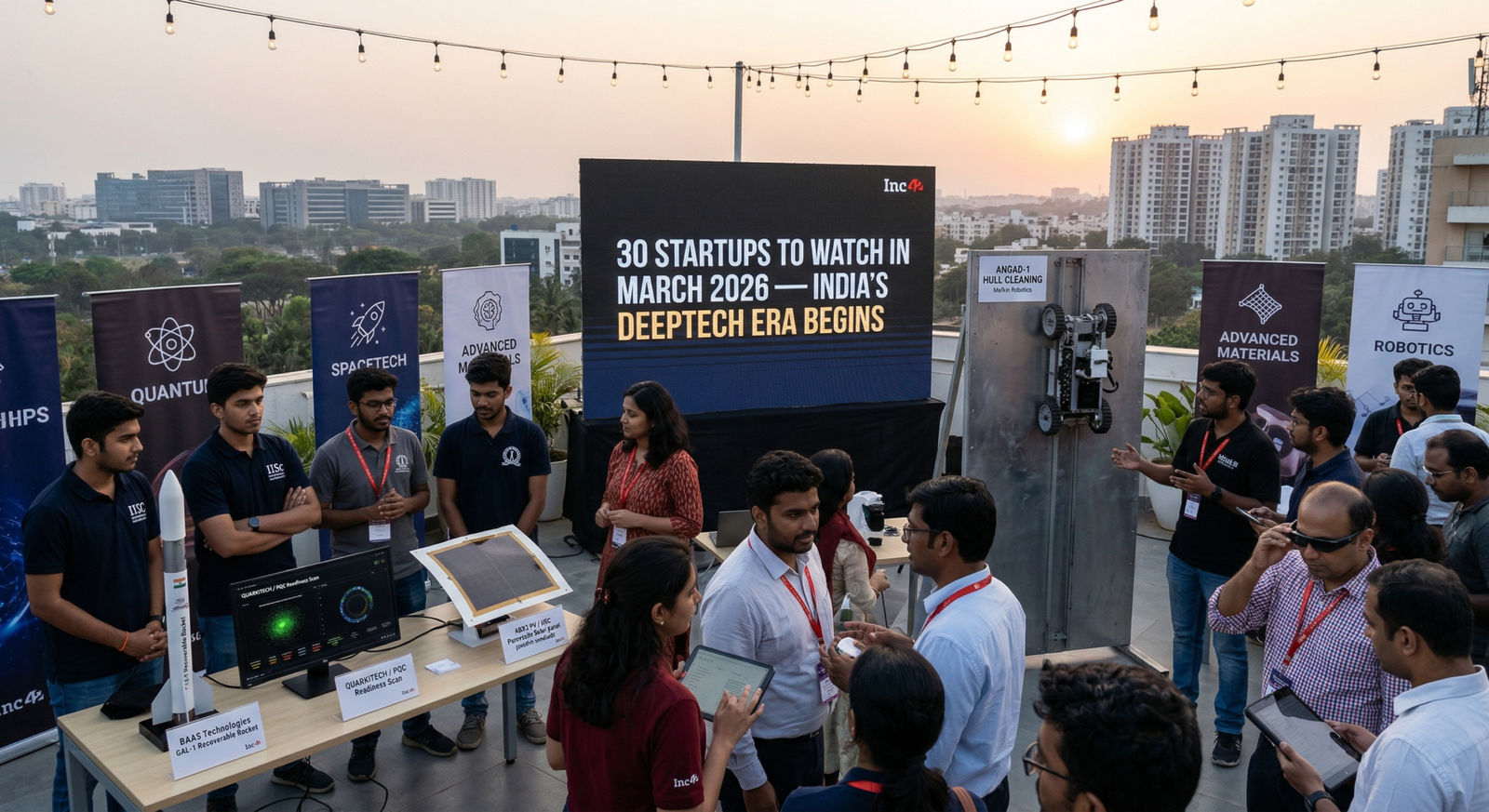
- Edition: 69th edition of Inc42’s flagship 30 Startups To Watch series
- Q1 2026 Funding: $2.3 Bn — down 26% YoY from $3.1 Bn in Q1 2025
- Deal Count: 260 deals in Q1 2026 — down 13% YoY
- Big Theme: Deeptech: spacetech, quantum computing, perovskite solar, robotics, AI hardware
- Only IPO in March: SEDEMAC — listed at 13.5% premium on NSE
- IPO Paused: PhonePe pushed to June 2026+ amid West Asia geopolitical volatility
India’s startup ecosystem navigated a difficult March 2026 — the West Asia war triggered supply chain shocks, LPG prices quadrupled on the grey market, and new-age tech stocks sold off sharply. Startups cumulatively raised $2.3 Bn in Q1 2026, down 26% YoY from $3.1 Bn in the year-ago quarter, with deal count declining 13% to 260.
Yet underneath the macro turbulence, something structural is happening. India’s startup story is quietly shifting from consumer internet toward deep technology — spacetech, quantum computing, perovskite solar, autonomous robotics, and AI hardware. The 69th edition of the ’30 Startups To Watch’ series captures this transition in real time.
StartupFeed Insight
What the numbers say: A 26% funding drop is significant — but the composition of who is raising matters more than the total. Capital is concentrating into deeptech and IP-led startups. That is a structural upgrade, not a retreat.
What this means for you —
If you’re a founder: Deeptech ventures can now qualify for startup recognition for up to 20 years under India’s revised definition. If you’re building IP-heavy tech, this is the best regulatory environment in a decade.
If you’re an investor: The 30 startups in this edition represent the early-stage end of India’s industrial future. Positions taken at seed in spacetech, quantum, or perovskite solar now are analogous to early consumer internet bets in 2012–14.
If you’re an employee: Deeptech pays differently — lower early salaries, but ESOP upside in a sector where acquisitions by defence, energy, and aerospace conglomerates are increasingly common exit paths.
Our prediction: By Q4 2027, at least 3 startups from this March 2026 cohort will have raised Series A rounds of $5 Mn+ each. Spacetech and quantum will lead. The deeptech funding cycle is 18–24 months behind consumer tech — it is just beginning.
March 2026: The Macro Picture
The quarter was defined by two forces pulling in opposite directions: geopolitical disruption pulling capital back, and India’s deeptech momentum pushing it forward.
| Event | Status | Detail |
| Q1 2026 Total Funding | $2.3 Bn | Down 26% YoY from $3.1 Bn in Q1 2025 |
| Q1 2026 Deal Count | 260 deals | Down 13% YoY |
| SEDEMAC IPO (March 2026) | Listed ✓ | 13.5% listing premium on NSE; Rs 770.66 Cr operating revenue (9M FY26) |
| PhonePe IPO | Paused | Pushed to June 2026+ amid West Asia geopolitical uncertainty |
| Zetwerk DRHP | Filed | Manufacturing unicorn moves toward public listing |
| RentoMojo DRHP | Filed | Consumer subscription rental model heads to market |
| Moneyview IPO Journey | Ongoing | Rs 2,409 Cr revenue; Rs 245 Cr profit (9M FY26) |
| Flipkart, Jio Platforms | Ongoing | Continued IPO preparation through market volatility |
The PhonePe pause is the most significant signal of the quarter. The fintech giant had filed its updated DRHP in January 2026 with Walmart, Tiger Global, Microsoft, and General Atlantic set to offload stakes via OFS. The West Asia conflict and resultant market volatility forced a delay to at least June 2026 — a reminder that even the most well-prepared IPOs cannot outrun geopolitical risk.
SEDEMAC was the lone March listing and a bright one: the deeptech company — focused on precision small engines and control systems — debuted at Rs 1,535 vs its Rs 1,352 issue price, delivering a 13.5% listing premium. With Rs 770.66 Cr in operating revenue and Rs 71.4 Cr net profit in the first nine months of FY26, it validated that deeptech can command public market premium.
The 30 Startups — March 2026 Edition
Editor’s Note: This list is not a ranking. Startups are presented alphabetically. All are early-stage ventures that caught the ecosystem’s attention in March 2026.
- ABX3 PV | Bengaluru | Cleantech / Solar
| Founded: 2023 | Founders: Laxman Gouda, Aditya Sadhanala, Praveen Chandrashekarapura Ramamurthy, Sushobhan Avasthi (IISc scientists) | Sector: Cleantech / Solar |
What It Does: Develops high-efficiency perovskite solar cells (PSCs) with power conversion efficiency exceeding 26% — cheaper to produce and more versatile than silicon. Embeds PSCs into flexible substrates, sheet substrates, and traditional modules for residential, commercial, and industrial solar installations. Currently advancing toward commercial deployment and building a 500 kW PSC production line, with target applications in satellite and drone power systems.
Traction: Incubated at IISc. 15 W panel already produced. 500 kW PSC production line under development.
Market Size: India’s perovskite solar cell market projected to reach $580 Mn by 2030, up from $20.9 Mn in 2024.
Why Watch: India receives nearly 300 days of sunshine annually yet struggles to hit its 300 GW solar target by 2030 due to import dependence on Chinese silicon modules. ABX3 PV’s indigenous PSC technology — incubated at IISc — could break that dependence. Its 15 W panel is already produced; commercial scale is the next milestone.
- AllSecureX | Gurugram | Cybersecurity / Quantum Tech
| Founded: 2025 | Founders: Himanshu Vohra | Sector: Cybersecurity / Quantum Tech |
What It Does: Builds an AI-powered platform combining cyber risk quantification with post-quantum cryptography (PQC) readiness. Its hyper-automated PQC platform scans applications and infrastructure to discover cryptographic vulnerabilities, assess quantum threat exposure, and deploy quantum-safe security layers — without requiring hardware changes or large code rewrites. Targets financial services, healthcare, FMCG, retail, and critical infrastructure where data sensitivity is highest.
Market Size: Global post-quantum cryptography market projected to grow from $302 Mn in 2024 to $1.9 Bn by 2030 (CAGR ~36%). India recorded 2.2 Mn+ cyber incidents between 2021 and mid-2025.
Why Watch: Every enterprise’s current RSA and elliptic-curve encryption is potentially vulnerable to quantum computers. AllSecureX is building the security transition layer that enterprises will urgently need in the next 3–5 years — a timing advantage that early-mover deeptech companies rarely get.
- BAAS Technologies | Pune | Aerospace / Spacetech
| Founded: 2024 | Founders: Tanmay Kanmahale, Prashant Patil, Atharva Pingale, Shriniwas Hase, Swayam Sonar | Sector: Aerospace / Spacetech |
What It Does: Develops end-to-end recoverable rocket technology for orbital and sub-orbital launches. Currently building four rocket types: Gallon (orbital, for small/micro/cubesatellites to LEO), Kelvin (small satellites, multiple fairing options based on mission profile), Fahrenheit (sub-orbital, for micro satellites and research payloads), and a fourth developmental variant. Full-stack approach covering propulsion, avionics, and recovery systems.
Market Size: India’s space economy projected to reach $44 Bn by 2033. The global small satellite launch market is growing at 15%+ CAGR driven by LEO mega-constellations.
Why Watch: ISRO’s liberalisation of India’s private space sector has opened a real commercial window. BAAS enters with a recoverable rocket architecture — the technology approach that made SpaceX economically viable — applied to India’s growing launch demand.
- Mafkin Robotics | India | Robotics / Maritime Tech
| Founded: 2023 | Founders: Sarthak Vaishnav (VIT alumnus) | Sector: Robotics / Maritime Tech |
What It Does: Builds an autonomous robotic fleet for megastructure maintenance. Its vertical crawler robot ‘Angad’ handles cleaning, inspection, analysis, report generation, and minor repairs for ship hulls, cargo holds, and oil storage tanks. Deployed through a contract-based leasing model, allowing maintenance operators to access the robots without capital expenditure. Claims to reduce operational downtime and labour costs by up to 60% while significantly improving safety.
Traction: Demoed ‘Angad’ with Larsen & Toubro (Kattupalli Shipyard) and Cochin Shipyard. Building a nationwide network of operational hubs across major maritime locations.
Market Size: Ship hull cleaning and maritime maintenance services market projected to reach $2.6 Bn by 2030.
Why Watch: Biofouling — marine growth on ship hulls — costs the global shipping industry an estimated $60 Bn annually in excess fuel consumption. Manual underwater cleaning is dangerous and expensive. Mafkin’s autonomous solution addresses a massive, structurally underserved industrial problem with real, demonstrated client interest.
- NPrep | India | Edtech / Healthcare
| Founded: 2023 | Founders: Undisclosed | Sector: Edtech / Healthcare |
What It Does: Provides AI-powered examination preparation for nurses targeting high-paying roles in government hospitals, private healthcare institutions, and international healthcare systems — particularly the Middle East, Europe, and the US — where salaries can reach Rs 1–5 Lakh per month. Bridges the preparation gap between India’s large nursing graduate pool and global nursing licensing standards.
Market Size: India’s test preparation market projected to grow from $8.5 Bn in 2024 to $14.3 Bn by 2030. Global nursing shortage creates sustained international demand for Indian-qualified nurses.
Why Watch: India produces the world’s largest pool of nursing graduates, yet a structural preparation gap prevents most from accessing premium domestic and international roles. NPrep is building the infrastructure to close that gap at scale — in a market with clear demand, low competition, and government healthcare expansion as a structural tailwind.
- Panoculon Labs | Chennai | AI Hardware / Wearable Tech
| Founded: 2023 | Founders: Rishabh Sharma and Sreeraj R (IIT Madras students) | Sector: AI Hardware / Wearable Tech |
What It Does: Builds AI-powered environmental perception systems — hardware and software that capture real-world sensory data (vision, sound, motion) and convert it into contextual intelligence. Its flagship product: smart glasses that see and hear what the wearer experiences, enabling personalised AI assistance in real time. The system is designed to close the ‘contextual awareness gap’ in current AI — most AI models are data-blind in the physical world because they rely on static datasets or fixed sensors.
Traction: IIT Madras incubated. Building for the global smart glasses market from Day 1.
Market Size: Global smart glasses market projected to become an $8.3 Bn opportunity by 2030.
Why Watch: AI agents need a sensory layer to operate in the physical world. Panoculon is building that layer — the equivalent of giving AI eyes and ears in real-world environments. As AI agents mature from chatbots to autonomous assistants, the hardware that grounds them in physical reality becomes critical infrastructure.
- QOSMIC | Bengaluru | Spacetech / Optical Communication
| Founded: 2025 | Founders: Shreyaans Jain, Rohit Ramakrishnan, Aloke Kumar | Sector: Spacetech / Optical Communication |
What It Does: Builds optical (laser-based) communication infrastructure for satellites to enable high-speed data transfer without the bottlenecks of traditional radio-frequency (RF) systems. Developing both hardware infrastructure and communication software to create a full-stack optical network for satellite operators. Also integrating quantum communication and encryption layers for secure government and commercial space networks.
Traction: Selected for Accel & Prosus’s inaugural Atoms X deeptech cohort — one of only 6 startups chosen globally.
Market Size: Global optical satellite communication market projected to grow from $2.3 Bn in 2024 to $8.1 Bn by 2030. India’s space data generation is growing exponentially with new LEO constellations.
Why Watch: As mega-constellations scale and Earth-observation satellites generate terabytes of data daily, RF bandwidth is a hard physical ceiling. Optical communication is the only viable path to the data transfer speeds space systems will require — and QOSMIC is building the pipes.
- Quarki Tech | India | Quantum Computing / Enterprise Tech
| Founded: 2025 | Founders: Rajesh Narayanan, Shashikant Singh Kunwar, Sanyam Parashar | Sector: Quantum Computing / Enterprise Tech |
What It Does: Builds a library of quantum and quantum-inspired algorithms to solve complex computational problems across industries. Developing a unified solver stack — not isolated point solutions — where each algorithmic module addresses a recurring class of computational challenges such as optimisation, simulation, and high-dimensional data analysis. Targets use cases that are difficult or computationally expensive for classical systems.
Market Size: India’s National Quantum Mission has a Rs 6,003 Cr budget. Global quantum computing market projected to reach $450 Bn by 2030.
Why Watch: Hardware quantum computers remain 5–10 years from broad commercial viability — but quantum-inspired algorithms that run on classical hardware can deliver quantum-like advantages today. Quarki is positioning as the algorithmic layer that enterprises will plug into first, and then port to quantum hardware as it matures. First-mover advantage in a virtually uncontested domestic market.
Sector Breakdown — March 2026 Cohort
The 69th edition of the series reveals a decisive shift in the type of startups attracting ecosystem attention:
| Sector | Key Startups | Market Opportunity | Theme |
| Spacetech & Aerospace | BAAS Technologies, QOSMIC | $8.1 Bn optical satellite comms by 2030 | Sovereign space infra |
| Cleantech / Solar | ABX3 PV | $580 Mn perovskite solar market by 2030 | Energy independence |
| Cybersecurity / Quantum | AllSecureX, Quarki Tech | $1.9 Bn PQC market by 2030 | Post-quantum readiness |
| Robotics / Maritime | Mafkin Robotics | $2.6 Bn ship maintenance by 2030 | Industrial automation |
| AI Hardware / Wearables | Panoculon Labs | $8.3 Bn smart glasses by 2030 | Physical AI layer |
| Edtech / Healthcare | NPrep | $14.3 Bn test prep by 2030 | Workforce mobility |
For the first time in several editions, consumer-facing apps and SaaS tools do not dominate the list. Deeptech — broadly defined as AI hardware, spacetech, quantum, robotics, and advanced materials — accounts for the majority of this month’s cohort. This reflects both a policy push (Indian Semiconductor Mission 2.0, revised deeptech startup definition, National Quantum Mission) and a genuine talent shift, as IIT and IISc graduates increasingly choose to commercialise research rather than join services companies.
3 Key Signals from This Month’s Cohort
Signal 1 — Research commercialisation is accelerating: ABX3 PV (IISc), Panoculon Labs (IIT Madras), BAAS Technologies (young founders with aerospace domain depth) — all represent founders who built expertise first and then chose to commercialise it. This is a structural shift from India’s previous startup era, where distribution insight mattered more than technical depth.
Signal 2 — India is building space infrastructure, not just apps for it: QOSMIC, BAAS Technologies, and adjacent spacetech ventures in this list are building the pipes, not the applications. India’s private space sector — enabled by ISRO liberalisation and IN-SPACe — has reached the infrastructure-building phase. The next 5 years will determine India’s competitive position in global space services.
Signal 3 — Quantum is moving from lab to product: AllSecureX and Quarki Tech are both commercialising quantum and post-quantum technologies in 2025. India’s Rs 6,003 Cr National Quantum Mission is translating into real ventures — and this cohort is the earliest evidence of that pipeline.
What’s Next
The Q2 2026 funding outlook depends heavily on two variables: the trajectory of the West Asia conflict (and its impact on global market sentiment), and whether India’s IPO pipeline can restart momentum. PhonePe’s return to the market in June 2026 — if conditions allow — would be the single biggest signal to watch.
For deeptech, the outlook is independent of near-term market cycles. The Indian Semiconductor Mission 2.0, the National Quantum Mission, and India’s Defence Production Policy are multi-year structural tailwinds that will continue funding and validating the kind of startups featured in this edition regardless of quarter-to-quarter funding fluctuations.
The 70th edition of ’30 Startups To Watch’ — to be published in May 2026 — will cover April’s cohort. Given the macro uncertainty, the next edition may feature even more capital-efficient, IP-led ventures as founders adapt to a leaner funding environment.
What do you think? Which startup from March 2026’s cohort do you think will be the breakout name? Let us know on X @StartupFeed_official