

Quick Take:
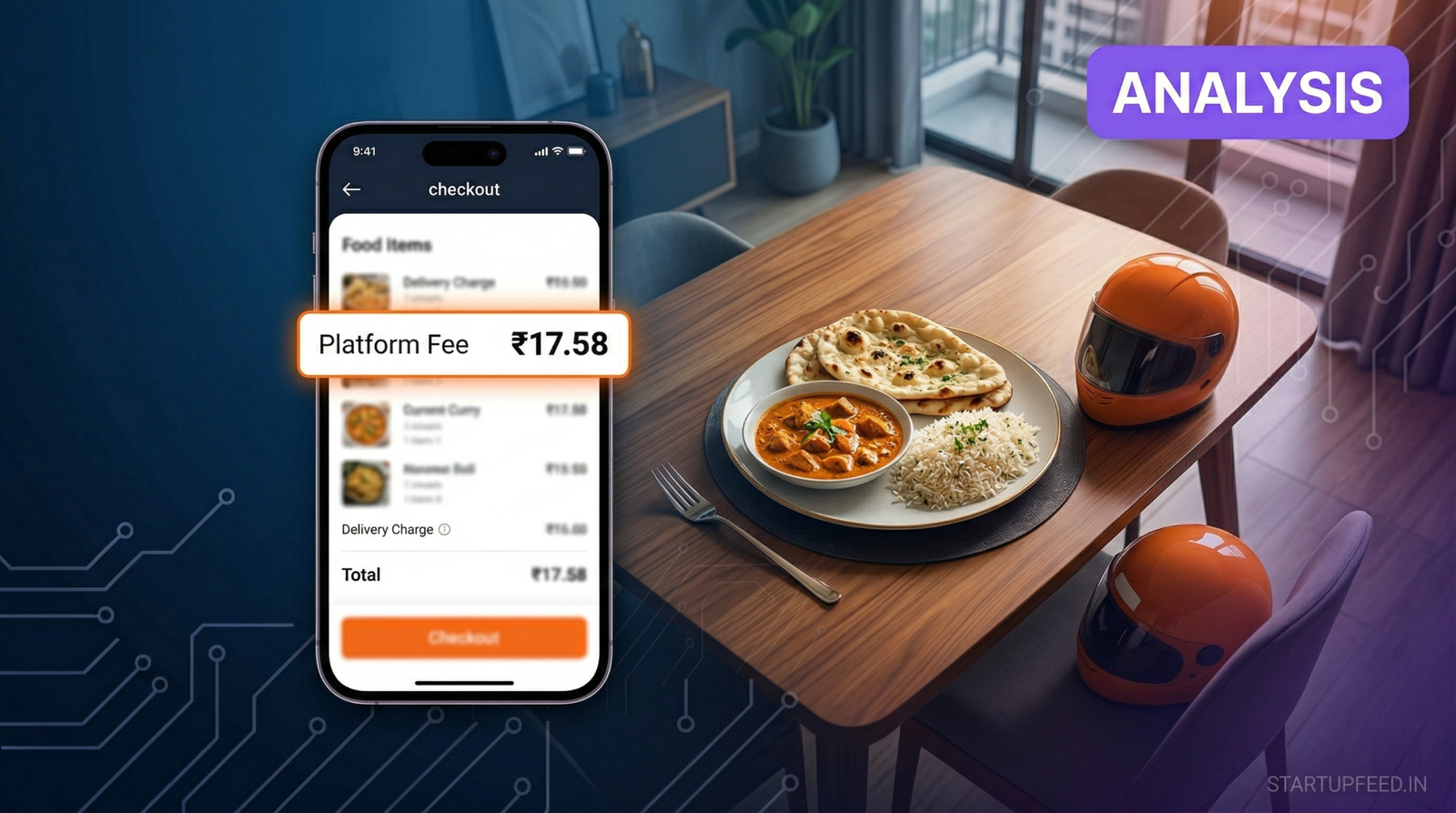
- Fee Trajectory: Zomato & Swiggy platform fees now Rs 17.58/order — up from Rs 0 in 2022 and Rs 2 at launch.
- Revenue Impact: Combined Rs 100 Cr added to Zomato + Swiggy bottom lines per quarter from the latest hike alone.
- Market Context: India’s ecommerce market hits $147 Bn in 2026, heading to $345 Bn by 2030 — fees scale with every rupee of that growth.
- The Shift: Platforms moving from subsidy-driven growth to revenue-extraction models, passing profitability pressure to consumers.
- Watch: At 4–5% of average order value today, platform fees risk triggering order-frequency decline by H2 FY27.
Three years ago, ordering food on Zomato or Swiggy carried no platform fee. Today, every order on both apps costs Rs 17.58 in platform charges alone — a figure that reached zero in 2022, Rs 2 at first introduction, and now Rs 17.58 after Swiggy’s fourth hike in seven months. This isn’t just a line item. It is the most consequential structural shift in India’s ₹1.2 lakh crore convenience economy — and consumers are absorbing it quietly.
The platform fee is the new take rate — a fixed, unavoidable charge that platforms extract from every order regardless of basket size. Unlike commissions (which scale with revenue) or delivery fees (which can be waived), platform fees are pure margin. With India’s ecommerce market projected to reach $345 Bn by 2030 and quick commerce alone expanding from $6.1 Bn today to $40 Bn by the same year, even a Rs 1 fee increase translates to hundreds of crores in annual revenue. India’s urban consumer is, in effect, funding the profitability dreams of the platforms she enabled.
StartupFeed Insight
What the numbers say: Platform fees on Zomato and Swiggy now represent 4–5% of average order value — the same range as the credit card interchange fees that disrupted retail banking. Once a fee reaches this threshold, it begins to structurally reshape consumer behavior, not just annoy them.
What this means for you:
- If you’re a founder: Platform fees prove that once user habit is formed, monetization follows — build habit first, charge later.
- If you’re an investor: Fee-layering on high-frequency platforms is a high-margin revenue stream; watch for similar moves from Flipkart Minutes, Zepto, and BigBasket.
- If you’re an employee: Profitability pressures driving fee hikes also reduce the urgency of fundraising, stabilizing employment at platforms that have reached scale.
Our prediction: By Q2 FY27, combined platform fees across Zomato, Swiggy, and Zepto will cross Rs 20/order. Order frequency among price-sensitive Tier II users will dip 8–12%, triggering a loyalty-subscription arms race — Zomato Gold vs Swiggy One — that pushes consumers toward annual contracts.
Platform Fee Trajectory: From Zero to Rs 17.58
The fee trajectory tells the story of a market that built habit on convenience and is now monetizing it systematically. What began as a Rs 2 ‘test charge’ in early 2023 has compounded at a pace that would make any fintech envious.
| Platform | Sep 2022 | Jan 2024 | Aug 2025 | Mar 2026 | % Change (2yr) |
|---|---|---|---|---|---|
| Zomato | Rs 0 | Rs 2 | Rs 12.50 | Rs 17.58* | +779% |
| Swiggy | Rs 0 | Rs 2 | Rs 14.00 | Rs 17.58 | +779% |
| Magicpin | Rs 0 | Rs 5 | Rs 12.00 | Rs 14.20 | — |
| Zepto (groceries) | Rs 0 | Rs 0 | Rs 5 (handling) | Rs 7–10 est. | — |
| Blinkit (Q-comm) | Rs 0 | Rs 0 | Rs 10 (handling) | Rs 10–15 est. | — |
* Zomato charges Rs 14.90 pre-GST + Rs 2.68 GST = Rs 17.58 effective. Magicpin CEO Anshoo Sharma has publicly stated the company will not raise its fee — a differentiation play targeting price-sensitive restaurant partners and consumers.
The Math: Rs 100 Cr Per Quarter From One Fee Line
Platform fees are now a material revenue line — not a rounding error. Based on order volumes disclosed in quarterly results, the March 2026 hike added approximately Rs 100 Cr to the combined Zomato-Swiggy bottom line per quarter — purely from this single change.
| Platform | Est. Monthly Orders | Fee per Order (Rs) | Quarterly Add (Rs Cr) | Annual Run-Rate (Rs Cr) |
|---|---|---|---|---|
| Zomato (food delivery) | ~250 Mn | Rs 17.58 | Rs 60–65 Cr | Rs 240–260 Cr |
| Swiggy (food delivery) | ~165 Mn | Rs 17.58 | Rs 40–45 Cr | Rs 160–180 Cr |
| Combined impact | ~415 Mn | — | Rs 100–110 Cr | Rs 400–440 Cr |
To put this in context: Swiggy’s Q3 FY26 net loss was Rs 1,056 Cr. At the current fee run-rate, platform fees alone could offset 15–17% of Swiggy’s annual losses — without growing orders by a single transaction. For Zomato, which turned profitable at Rs 102 Cr in Q3 FY26, every fee increase directly expands its profit pool.
The Market These Fees Are Riding: India’s $345 Bn Ecommerce Buildout
Platform fees don’t exist in isolation — they are layered on top of one of the world’s fastest-growing consumer markets. India’s ecommerce sector, valued at $147 Bn in 2026, is on a trajectory to reach $345 Bn by 2030 at a 15% CAGR. Quick commerce — the highest-frequency, highest-fee segment — is growing even faster.
| Segment | 2024 Size | 2026 Est. | 2030 Target | CAGR |
|---|---|---|---|---|
| India Ecommerce (total) | $125 Bn | $147 Bn | $345 Bn | ~15% |
| Quick Commerce (Q-comm) | $6.1 Bn | $9–10 Bn | $40 Bn | ~30% |
| Online Food Delivery | ~$7 Bn | ~$9 Bn | $18–20 Bn | ~15% |
| D2C Commerce | $12 Bn | $18 Bn | $60 Bn | ~40% |
The quick commerce sector already has over 1,200 dark stores across India’s top 20 cities, with order frequency reaching 4–5 purchases per user per month. At that frequency, a Rs 17.58 fee compounds to Rs 70–88/month per user — a meaningful annual cost that users are, for now, absorbing without visible defection.
The Invisible Bill: What a Rs 500 Order Actually Costs in 2026
The platform fee is one layer of a stacked cost structure that has grown substantially since 2021. When a consumer orders a Rs 500 meal today, the actual checkout total tells a different story.
| Charge Type | 2021 | 2023 | 2026 | Notes |
|---|---|---|---|---|
| Platform fee | Rs 0 | Rs 2 | Rs 17.58 | Fixed per order, unavoidable |
| Delivery charge | Rs 0–25 | Rs 20–40 | Rs 25–70 (surge) | Waived for Gold/One members |
| Packaging fee | Rs 0 | Rs 5–10 | Rs 10–20 | Varies by restaurant |
| GST on platform fee | — | Rs 0.36 | Rs 2.68 | 18% GST on platform fee |
| Total add-on cost | ~Rs 0–25 | ~Rs 27–52 | ~Rs 55–110 | On a Rs 500 order = +11–22% |
On a Rs 500 order, add-on charges now represent 11–22% of the food bill — a surcharge that would trigger regulatory scrutiny in most developed markets. The practical result: the ‘convenience tax’ in India is no longer hypothetical.
Who Should Be Watching?
| Player / Stakeholder | Why This Matters |
|---|---|
| Magicpin | Holding fee at Rs 14.20 — a deliberate gap that could accelerate restaurant partner migration if Zomato-Swiggy fees keep rising; CEO publicly committed to staying lower. |
| Zepto | Fee hikes on food delivery normalize consumer expectations for handling charges in quick commerce; Zepto’s per-order economics improve as a side effect. |
| Ownly (Bengaluru) | New entrant positioned 15% cheaper than Zomato-Swiggy; platform fee inflation is its primary acquisition argument — watch for Tier I city launch by Q3 FY27. |
| ONDC / Kisan Rails | Rising platform fees are the best argument for ONDC’s open-network model; 700,000+ sellers already onboarded — fee-pain could finally drive mainstream adoption. |
| Restaurant Partners | Higher consumer cost leads to lower order frequency, not lower restaurant margins directly — but basket size compression affects GMV and revenue-share payouts. |
| Retail Investors (Swiggy) | Swiggy stock is down ~33% from listing price. Fee monetization is the fastest path to loss reduction — and the market will watch Q4 FY26 EBITDA closely. |
What’s Next
The trajectory is clear: platform fees are not a temporary measure. They are a permanent structural layer in India’s digital convenience economy. The question is not whether fees will keep rising — they will — but how fast the elasticity breaks.
Our prediction: by Q3 FY27, combined food delivery platform fees will cross Rs 20/order on both Zomato and Swiggy. Zepto and Blinkit will standardize handling fees at Rs 12–15. The cumulative annual ‘platform tax’ on a regular urban consumer ordering three times per week will exceed Rs 2,700/year — roughly the cost of a mid-tier OTT annual subscription.
The real test arrives when India’s ecommerce market hits its next 100 million users — the price-sensitive Tier II and III cohort. These consumers will not absorb a Rs 17.58 fee the way Mumbai and Bengaluru have. And when they don’t, the platform fee model will face its first meaningful stress test.
What do you think? Will platform fees trigger a consumer backlash — or is convenience now too addictive to resist? Let us know on Twitter @StartupFeed_official

