

QUICK TAKE:
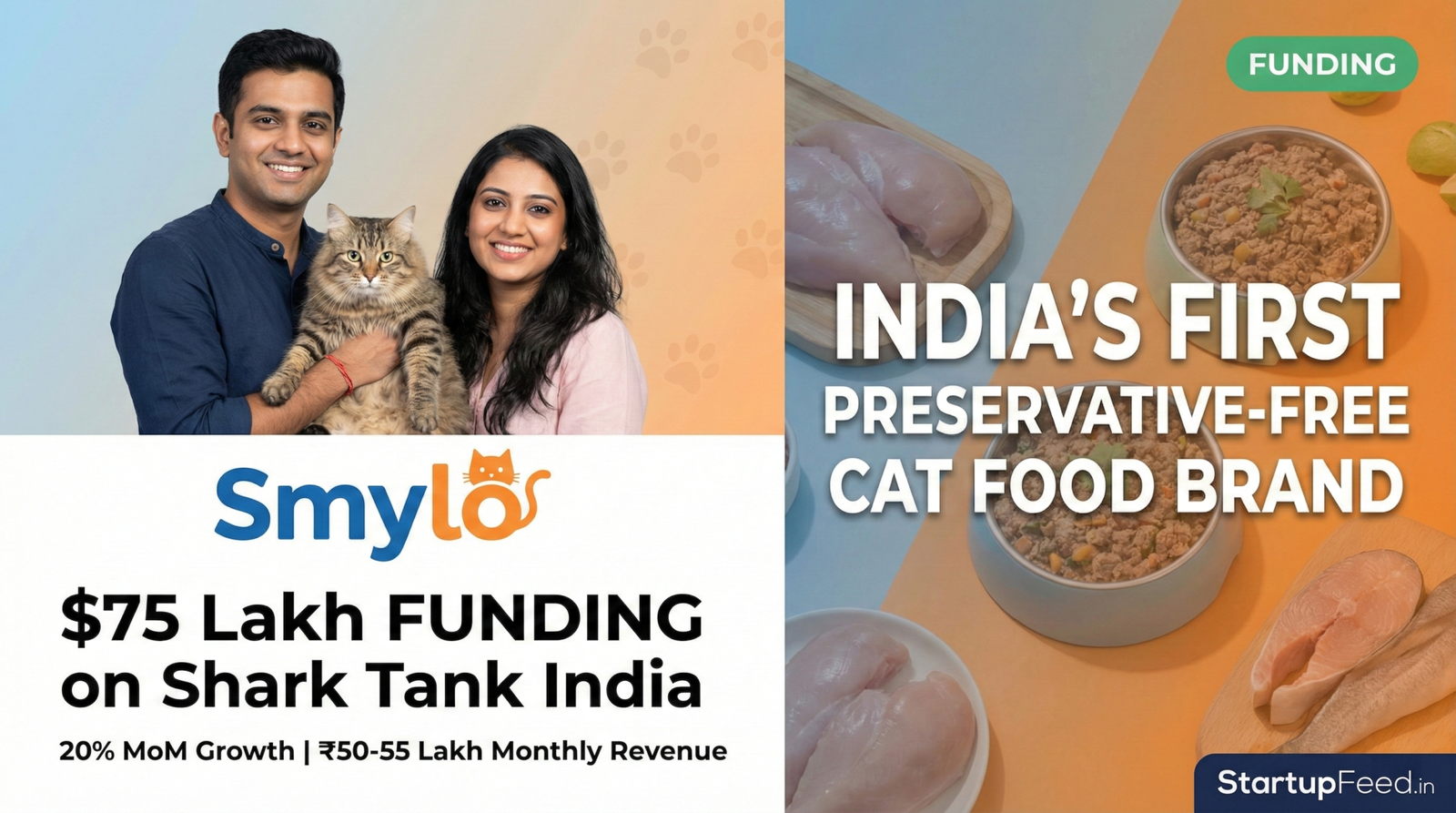
| Company: | Smylo Pet Care — Gurugram. India’s first 100% natural, preservative-free cat food brand. Website: getsmylo.com | Instagram: @smylo_in |
| Founders: | Abhishek Agrawal (IIT Delhi) + Kartikeya Gupta (BITS Pilani). Both former executives at Titan Capital (Kunal Bahl and Rohit Bansal’s VC firm — Snapdeal founders). |
| The Origin Story: | Their pet cat, Mylo, died within months of adoption. The founders realized most cat food available in India wasn’t formulated for Indian cats. Named the brand Smylo in Mylo’s memory. Launched November 2024 after ~1 year of recipe research. |
| Shark Tank India S5: | Raised ₹75 lakh from 3 Sharks: Anupam Mittal (Shaadi.com), Kunal Bahl (Titan Capital — former employer), and Varun Dua (ACKO). Original ask: ₹68 lakh for 1% equity. Additional 2% advisory stake included. |
| Revenue: | ₹50-55 lakh monthly sales. ~20% month-on-month growth over 14 months. 80% from D2C website + ecommerce; 20% quick commerce (Blinkit, Zepto, Swiggy Instamart). |
| Earlier Funding: | Seed round of $479K (~₹40 lakh) led by DSG Consumer Partners · Angel List · Skatrs Management Advisory. Angels include Kunal Bahl, Rohit Kumar Bansal, Abhishek Goyal + 80 consumer brand investors (Sula, OYO, Epigamia). |
| Product Science: | The 92/8 Rule: 92% fresh animal protein (Tuna, Salmon, Chicken) + 8% functional superfoods. Preservative-free via retort packaging + Tocopherol (Vitamin E) antioxidants. 18-month shelf life — no cold storage needed. |
| Distribution: | getsmylo.com · Amazon · Flipkart · Supertails · Blinkit · Zepto · Swiggy Instamart. Warehouses in Gurugram, Bengaluru, Mumbai, Pune. Key revenue: Maharashtra + Karnataka. Growing: Hyderabad, Kozhikode, Lucknow. |
| Market: | India: 37M pet dogs vs 4M pet cats. Cat food dominated by imported brands (Whiskas, Me-O). India pet food market: ₹10,000 crore at double-digit CAGR. Only 10% of pet owners use packaged food. |
| Post-Shark Tank: | 5-6x surge in organic followers. Meta ad spend dropped 30%. Demand surged in tier-II and III markets. Cat food growing faster than dog food on Blinkit and Zepto per founders. |
THE STORY BEHIND SMYLO
There is a startup origin story, and then there is this startup origin story.
Abhishek Agrawal (IIT Delhi) and Kartikeya Gupta (BITS Pilani) were not pet food entrepreneurs. They were investment professionals at Titan Capital — the venture capital firm co-founded by Snapdeal’s Kunal Bahl and Rohit Kumar Bansal — spending their days evaluating startups and understanding what makes consumer businesses scale. Then they adopted a cat and named him Mylo.
Within months, Mylo’s health began deteriorating. For two first-time cat parents, this was confusing and distressing. They were feeding him what was available — the products on shelves, the imported brands, the things other cat owners recommended. But something was wrong, and they could not figure out what. When they researched deeply, the answer emerged with uncomfortable clarity: the food itself.
“We had a cat named Mylo. After a couple of months, we lost him. That’s when we started asking ourselves what really went wrong. When we researched deeply, we realised it was really about the food. For pets, especially cats and dogs, what they eat matters far more than anything else.” — Kartikeya Gupta, Co-Founder, Smylo
They could not save Mylo. But the grieving founders — armed with VC-trained analytical instincts and a burning personal mission — decided to spend nearly a year researching cat nutrition from first principles: what cats actually need biologically, what Indian cats specifically require given climate and lifestyle, and why virtually every product available in India was failing to deliver it. What they found was not a market gap. It was a nutritional crisis that 4 million Indian cat owners were unknowingly putting their pets through.
In November 2024, they launched Smylo — named in Mylo’s memory, combining his name with the word ‘smile’. It would be the brand they wish had existed when Mylo was alive.
The Problem — India Has 4 Million Pet Cats, But No Good Food for Them
What’s Wrong With India’s Cat Food Market:
|
“Cats are carnivores. Scientists and researchers say that they are supposed to get a meat-based diet. But when you look at the products that exist in the market, they are harmful and carcinogenic because they do not give you any nutrition, which is imperative for cats’ overall health and wellness.” — Kartikeya Gupta, Co-Founder, Smylo
The Smylo Product — What India’s First Natural Cat Food Actually Is
After nearly a year of research — studying feline nutrition science, testing formulations, and working to identify recipes palatable for 80-85% of Indian cats — Smylo’s founders built a product architecture around three non-negotiable pillars: 100% natural ingredients, a high-protein meat-first diet, and human-grade quality standards. Every formulation is vet-developed. Every ingredient is traceable.
| Product / Feature | What It Is — and Why It Matters for Indian Cat Parents |
|---|---|
| The 92/8 Rule | 92% fresh animal protein (Tuna, Salmon, Chicken, Mackerel, Chicken Liver) + 8% functional superfoods. This ratio is not arbitrary — it mirrors the prey model diet that feline biology evolved on. The 8% superfood layer includes Pumpkin (digestion + hairball control), Pomegranate (antioxidants), Cranberry (urinary health), Rosemary (natural antioxidant). Every ingredient is visible, identifiable, and functional. |
| Zero Preservatives + 18-Month Shelf Life | Most cat parents assume preservative-free = short shelf life. Smylo broke this assumption using retort sterilization technology (the same process used for human ready-to-eat meals) combined with Tocopherol (Vitamin E) and antioxidants. The result: 18-month shelf life with zero chemical preservatives, zero cold storage needed. Commercially scalable without compromising the clean-label promise. |
| Human-Grade Standard | ‘If it’s not good enough for you, it’s not good enough for them.’ During their Shark Tank pitch, co-founder Kartikeya Gupta ate the cat food on air to demonstrate product safety and quality — one of Season 5’s most memorable moments. This is not theatre. Human-grade certification means the same standards applied to human food manufacturing (hygiene, source quality, processing) are applied to Smylo’s production. |
| Wet Food | Wet food is nutritionally superior for cats because it mirrors the moisture content of prey (roughly 70% water). This supports urinary health — critical because, as Gupta notes, ‘pathologically, cats don’t drink enough water.’ Available in gravy, flakes, and chunks formats. Each pouch ~₹84. |
| Dry Food + Broths | Dry kibble and bone broths complete the product range. Broths serve as hydration supplements for cats who resist water. Dry food supports dental health through mechanical abrasion. Together, the range enables a ‘mixed-feeding routine’ that suits different cats’ palates and different pet-parents’ schedules. |
| Taurine + Essential Nutrients | Cats cannot synthesize taurine internally — it must come from diet. Taurine deficiency causes blindness and dilated cardiomyopathy in cats. Smylo’s vet-formulated recipes include complete essential taurine, Omega fatty acids, vitamins, minerals, and prebiotics. This is the nutritional completeness that makes it a full-diet product, not a supplement. |
The Shark Tank India Season 5 Moment — From VC Analyst to National Brand
Smylo’s appearance on Shark Tank India Season 5 was a convergence of personal history and perfect timing. The founders pitched in a ‘Face-Off’ format against Nootie — a 27-year-old legacy pet care brand — in an episode that positioned India’s new-age specialist brands against established multi-category incumbents. Smylo chose to pitch first.
The pitch’s standout moment came when Kartikeya Gupta ate the cat food on air — not as a stunt, but as the ultimate proof-of-product. For a brand claiming human-grade quality and zero harmful preservatives, there is no cleaner demonstration than the founder putting it in their own mouth, on national television, in front of India’s most scrutinising investor panel. The moment became one of Shark Tank India S5’s most-shared clips.
Shark Tank India S5 Deal Summary:
|
“Abhishek has been a valued member of the Titan Capital team, and we have been thrilled to support him in his entrepreneurial pursuit with Smylo. The journey of a team member becoming an entrepreneur and then pitching in the Tank has been incredibly rewarding to watch.” — Kunal Bahl, Co-Founder Snapdeal / Titan Capital, Shark Tank India S5
“Smylo stood out to me because the founders are intentional about building more than just a product; they’re building a purpose-led brand and a community of loyal consumers. Today’s market rewards brands with clarity and focus, and Smylo’s commitment to mastering one category puts them in a strong position to lead and disrupt.” — Varun Alagh, Co-Founder Honasa Consumer (Mamaearth), Shark Tank India S5
The Market Opportunity — India’s Cat Food Category Is Structurally Underserved
| Metric | India Today | What It Means for Smylo |
|---|---|---|
| Pet Population | 37M dogs vs 4M cats (2024) | Cat ownership is growing fastest — urban India’s shift from dog-only to cat ownership is accelerating as apartment living, dual-income households, and single-professional demographics expand. The 4M figure is a 2024 estimate; the trajectory is sharply upward. |
| Pet Food Market Size | ₹10,000 crore; double-digit CAGR | India is the fastest-growing pet care market globally. Even with 10% packaged food penetration, the addressable market is enormous. The real prize is the conversion wave: as trust in quality domestic brands grows, packaged food penetration will move from 10% toward 40-50%, unlocking a market 4-5x larger than today. |
| Cat Food Dominance | Whiskas, Me-O (imported) dominate | The incumbent category leaders are not built for Indian cats, Indian price points, or Indian supply chains. They are global products adapted minimally for India. A domestic, science-led, India-first challenger like Smylo has structural advantages: local sourcing, local veterinary knowledge, local distribution speed. |
| Quick Commerce Growth | Cat food growing faster than dog food on Blinkit + Zepto | Quick commerce is the most significant distribution innovation for perishable consumer goods in India in the last 5 years. The fact that cat food is outpacing dog food on these platforms signals that cat parents are specifically seeking quality products and willing to pay for instant access — Smylo’s premium, fast-delivery model is perfectly positioned. |
| Revenue Geography | Maharashtra + Karnataka lead; Hyderabad, Kozhikode, Lucknow growing | This is not a Delhi-NCR startup with Delhi-NCR traction. Smylo’s top markets are where India’s highest density of urban cat ownership sits. The emergence of Kozhikode (Kerala) and Lucknow suggests the category is genuinely national — not just metro-limited. |
STARTUPFEED INSIGHT
| Why Smylo’s Founder-Market Fit Is Rare and Defensible: Most pet food startups are built by pet lovers who want to do better for their animals. Smylo is built by two people who experienced the worst outcome a pet parent can — the loss of their cat because of bad food — and then applied VC-trained analytical rigour to understand the market, identify the gap, and build a solution that is nutritionally validated, scientifically grounded, and commercially scalable. This combination — personal mission + analytical discipline — is rare in any consumer category. It produces brands that are authentic without being amateurish. | |
| For Cat Parents: | If you have a cat in India and have been defaulting to Whiskas or Me-O because there was nothing better available, Smylo is exactly what you’ve been waiting for. The 92/8 formulation, the retort sterilization technology, the vet-formulated recipes, the taurine completeness — these are not marketing claims but verifiable product specifications. At ₹84 per meal, it is more expensive than imported supermarket cat food but meaningfully cheaper than the vet bills that carb-heavy, preservative-laden alternatives generate over time. |
| For D2C Investors: | Smylo has the two most valuable assets in consumer D2C: a founder story that is genuinely emotional (and therefore genuinely viral), and a product that is demonstrably better than everything else in the category. The Shark Tank deal with Anupam Mittal + Kunal Bahl + Varun Dua — three investors with deep consumer brand experience — provides not just capital but strategic distribution and brand guidance. Watch for Smylo’s Series A within 12-18 months as monthly revenue crosses ₹1.5-2 crore. |
| For the Broader Pet Care Market: | Smylo’s success creates a blueprint for the 37 million dog owners who are equally underserved by India’s domestic dog food market. The founders have explicitly stated they plan to dominate cat food first before expanding — but the supply chain, the vet network, the retort manufacturing relationships, and the D2C + quick commerce distribution they are building are category-agnostic. Smylo’s Series B play is the full pet food stack. |
| Our Prediction: Within 18 months of their Shark Tank appearance, Smylo will cross ₹1.5 crore in monthly revenue, driven by: Shark Tank visibility compounding on their 5-6x follower growth; expansion into physical retail via pet specialty stores and veterinary clinic partnerships; and at least one grocery retail partnership (think Reliance Retail, D-Mart, or Natures Basket) that gives Smylo physical shelf presence alongside imported brands for the first time. Within 3 years, Smylo will either be acquired by a large pet care conglomerate (Drools, Mars Petcare, or a Marico-type FMCG player) or will raise a Series A large enough to build a dedicated cat food manufacturing facility in India. Either outcome makes the founders and the Sharks extremely well-positioned. The cat food category in India does not have a dominant domestic brand today. In 5 years, that brand will almost certainly be Smylo. | |

