

Quick Take :
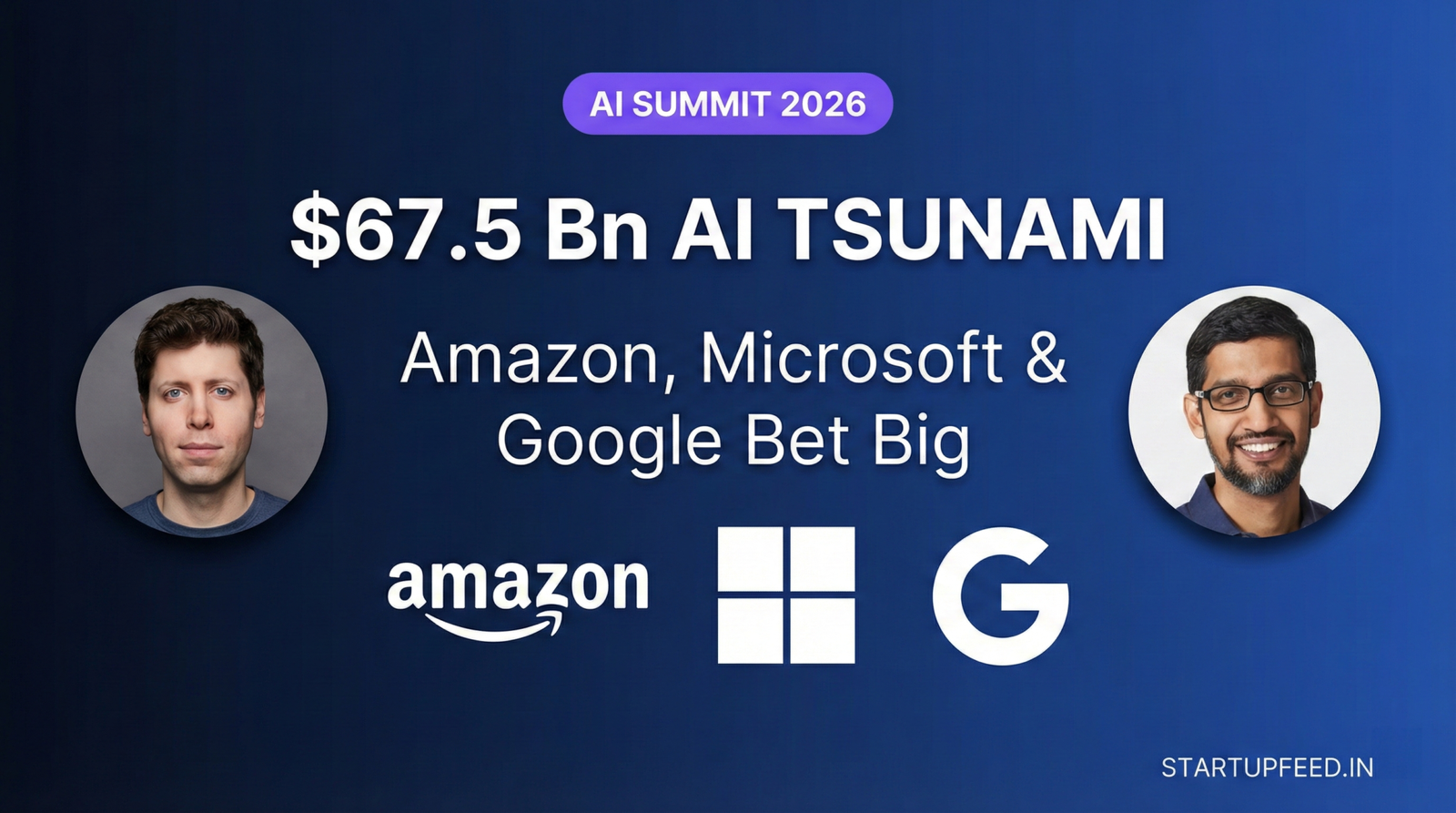
Investment: $67.5 Bn pledged by Amazon, Microsoft, Google for AI infra
Users: 100 Mn weekly ChatGPT users — India is OpenAI’s 2nd largest market
GCC Boom: 80% of new Global Capability Centers will be AI-led (ANSR data)
Government Push: Rs 10,372 Cr India AI Mission + $18 Bn in semiconductor subsidies
What’s Next: More investment deals expected during summit week (Feb 16–20)
India’s AI IPO Moment
India kicked off the AI Impact Summit 2026 in New Delhi on February 16, hosting the first global AI summit in the Global South — a five-day event at Bharat Mandapam that positions the country at the center of the global AI race. With OpenAI CEO Sam Altman, Alphabet CEO Sundar Pichai, Anthropic CEO Dario Amodei, and Google DeepMind CEO Demis Hassabis all in attendance, the summit marks India’s transition from AI consumer to AI contender.
The “So What”
This summit signals India’s formal graduation from cost center to innovation hub. The convergence of $67.5 Bn (approximately Rs 5.6 Lakh Cr) in committed tech investments, 100 million weekly ChatGPT users, and a booming GCC sector makes India impossible for global AI companies to ignore — and Indian startups stand to benefit from the capital and partnerships flowing in.
StartupFeed Insight
What the numbers say: India accounts for roughly one in nine weekly ChatGPT users globally, yet contributes a fraction of OpenAI’s revenue — the monetization gap represents both a challenge and a massive opportunity for AI companies willing to crack the price-sensitive market.
What this means for you:
If you’re a founder: Use summit-week momentum to pitch global VCs and GCC leaders actively scouting Indian AI startups
If you’re an investor: AI infra, developer tools, and Indic-language AI models are the sectors best positioned to ride the $67.5 Bn wave
If you’re an employee: Chief AI Officer roles are proliferating in India’s GCCs — upskill now for senior AI leadership positions
Our prediction: By Q4 2026, at least 3 Indian AI-native startups will raise $100 Mn+ rounds, as global investors look to back domestic alternatives to US AI platforms in India’s massive consumer market.
The $67.5 Bn Bet: Who’s Investing What
The investment pipeline into India’s AI sector has been building since late 2025. Three tech giants alone committed $67.5 Bn between October and December 2025.
| Company | Investment | Timeline | Focus |
| Amazon | $35 Bn | Through 2030 | AI digitization, logistics, data centers |
| Microsoft | $17.5 Bn | 2026–2029 | Cloud, AI infra, workforce readiness |
| $15 Bn | 2026–2030 | AI hub in Vizag, data center campus | |
| Intel | MoU with Tata Electronics | 2025 onwards | AI chip collaboration |
| India AI Mission | Rs 10,372 Cr (~$1.2 Bn) | 5-year allocation | Compute, startups, public AI |
Amazon’s $35 Bn pledge builds on $40 Bn already invested in India. Microsoft’s commitment marks its largest-ever investment in Asia. Google’s Andhra Pradesh data center campus will be powered by clean energy through a partnership with AdaniConneX and Airtel.
More deals are anticipated during the summit itself, as tech CEOs use the five-day event to announce India-specific AI initiatives.
100 Million Users: India’s AI Consumer Explosion
Altman revealed in a Times of India column on February 15 that India now has 100 million weekly active ChatGPT users — second only to the United States. With ChatGPT’s global weekly active user count nearing 900 million, India alone accounts for more than one-tenth of total usage.
| Metric | Data Point |
| Weekly ChatGPT users in India | 100 Mn |
| Global ChatGPT weekly users | ~900 Mn |
| India’s share of global usage | ~11% |
| India ranking | 2nd (after US) |
| Largest user segment in India | Students (highest globally) |
| ChatGPT Go pricing for India | Free for 1 year (originally sub-$5) |
India has the largest number of student ChatGPT users in the world. Google is competing aggressively — it offered Indian students a free one-year AI Pro subscription in September 2025. India also leads global usage of Google’s Gemini for learning.
The price war for Indian AI users is real. OpenAI launched a sub-$5 ChatGPT Go tier for India, later making it free for a year. Perplexity and other AI tools are also offering free access. The race is for users — and the data that comes with them.
The GCC Revolution: From Cost Center to AI Engine
Global Capability Centers represent perhaps the strongest structural signal of India’s AI ascent. The data from ANSR paints a clear picture.
| GCC Metric | Data |
| Total GCCs in India | 1,700+ |
| Direct employees | 1.9 Mn |
| Annual revenue | $64.6 Bn |
| GCCs focused on AI/data (last 2 years) | 60%+ |
| New GCCs projected to be AI-led (next 6–8 months) | 80%+ |
| GCC sector as % of India’s GDP | ~1.6% |
These are no longer back-office hubs doing cost arbitrage. eBay launched its first GCC in Bangalore with 300+ engineers focused on AI/ML and applied research. Zeiss Bangalore builds AI-powered diagnostic tools. Evernorth Health Services’ Hyderabad GCC powers 40+ digital health solutions globally.
ANSR CEO Lalit Ahuja put it directly: the summit “is a huge validation of the potential of the market. Everyone’s coming in because they realize that this is the place to be in and India just cannot be ignored.”
The Talent Arbitrage
The talent story goes beyond engineering headcount. India isn’t just supplying coders — it’s supplying AI leaders.
Tech Mahindra CTO Sham Arora described India as an “AI talent factory” on CNBC. The numbers support the claim: India has 500,000+ trained AI professionals, 120,000 AI engineers, and 185+ AI centers of excellence across its GCC network. An AI/ML engineer in India costs $27,000–$54,000 annually. The same role in Silicon Valley runs $150,000–$250,000.
The real shift is at the top. The Chief AI Officer role is becoming standard in Indian GCCs, per ANSR. Companies aren’t just hiring engineers in India — they’re hiring strategic AI leadership.
Microsoft plans to equip 20 million Indians with AI skills by 2030. India is projected to have 57.5 million developers by 2030 — the largest developer base globally.
Government’s Red Carpet
India’s government has rolled out a layered incentive structure that Neil Shah, partner at Counterpoint Research, calls “a red carpet for multinational companies to set up, expand and diversify their global operations.”
| Government Initiative | Scale |
| India AI Mission | Rs 10,372 Cr over 5 years |
| Semiconductor project approvals | $18 Bn worth |
| GPU procurement allocation | Rs 4,500 Cr+ |
| Foundational AI model consortium | Rs 988 Cr |
| FY26 India AI Mission budget | Rs 2,000 Cr |
The summit’s theme — People, Planet, and Progress — and its focus on “practical impact and implementation” marks a shift from previous global AI summits that emphasized safety and governance. This signals India is ready for deployment-phase investments, not just policy debates.
Who Should Be Watching?
| Player | Why This Matters |
| Indian AI startups | Global capital and partnership doors are wide open — summit week creates a window for fundraising and strategic alliances |
| Infosys, TCS, Wipro | GCCs are shifting mandates from IT services to AI-first innovation, pressuring traditional outsourcing models |
| Chinese AI companies | India’s alignment with US tech firms and data governance focus creates barriers for Chinese AI platforms |
| Tier-2 Indian cities | Google’s Vizag data center and new GCC hubs in Pune, Coimbatore signal expansion beyond Bengaluru-Hyderabad |
What’s Next
The India AI Impact Summit runs through February 20. Major investment announcements are expected throughout the week — particularly around data centers, AI compute infrastructure, and government-private partnerships.
For Indian startups, this is the moment. The global AI sector’s attention is fixed on India, and the infrastructure-users-talent trinity that CNBC identified — massive computing investments, 100 million active AI users, and a deep engineering talent pool — creates the conditions for Indian AI companies to scale.
The real question: can India build world-class AI products, not just provide world-class AI talent? The answer will determine whether the country captures value at the top of the AI chain or remains the workshop floor.

