


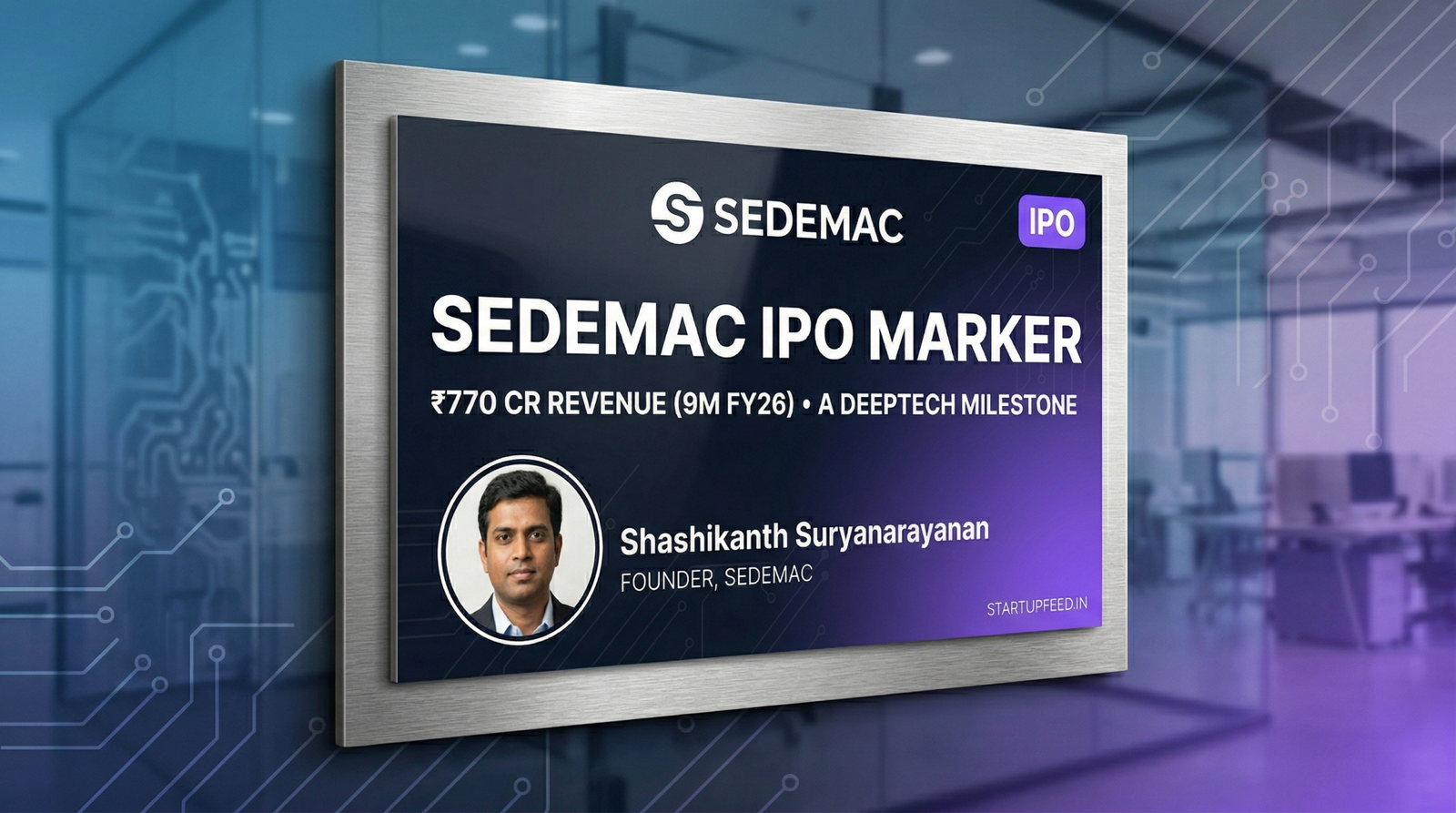

| QUICK TAKE |
|
From Pune Lab to OEM Boardroom
In 2006, when most of India’s startup conversation revolved around IT services and early-stage e-commerce, Shashikanth Suryanarayanan made a quieter bet. He co-founded SEDEMAC Mechatronics — a name derived from Systems, Electronics, Dynamics, Energy, Mechanics and Control — in Pune, with a singular focus: building the electronic brain inside petrol-powered engines.
The founders came out of IIT Bombay and had spent time in automotive research. Their insight was straightforward but uncommercialised at the time: India’s two-wheeler manufacturers were scaling rapidly, yet almost all engine management systems (EMS) and electronic control units (ECUs) were imported or licensed from Japanese and European component suppliers. There was no homegrown IP layer.
SEDEMAC set out to build exactly that. Early years were characterised by long product development cycles, frugal R&D budgets, and a deliberate resistance to the venture-capital churn that was beginning to define Indian tech startups. The company filed patents, ran engine testbeds, and quietly proved its technology in field pilots with OEM partners before going to market at scale.
That patience paid off. Within a decade, SEDEMAC’s engine controllers were embedded in vehicles rolling off lines at TVS Motor Company and Bajaj Auto — two of India’s largest two-wheeler manufacturers — along with a growing roster of three-wheeler and small engine OEMs.
SEDEMAC At A Glance
| METRIC | FIGURE | SIGNIFICANCE |
| Revenue (9M FY26) | ₹770 Cr+ | On track for record full-year revenue |
| Year Founded | 2006 | 19 years of IP accumulation before IPO |
| IPO Year | 2026 | Rare deeptech public listing in India |
| Key Customers | TVS Motor, Bajaj Auto + others | Embedded in mainstream OEM supply chains |
| Business Model | IP-led manufacturing | Higher margins than pure contract manufacturing |
| Headquarters | Pune, Maharashtra | Hub of India’s auto-component ecosystem |
The ‘Intelligence Layer’: What SEDEMAC Actually Builds
The phrase “intelligence layer” is not marketing language. It is an engineering description. In a modern two-wheeler or three-wheeler, the engine management system is the component that decides how much fuel to inject, when to fire the spark plug, how to manage the throttle response, and how to balance performance against emissions compliance — all in real time, thousands of times per second.
Unlike structural components (frames, tyres, brakes) that OEMs have long sourced domestically, the EMS has historically been a black box imported from global Tier-1 suppliers such as Bosch, Delphi or Denso. SEDEMAC cracked this open. Its proprietary control algorithms, developed over years of engine testing at its Pune facility, now govern the combustion cycle in a meaningful share of Indian-manufactured two-wheelers.
Shashikanth Suryanarayanan describes the company’s position as being “at the core of machine functionality.” This is not incidental. An OEM that has designed its engine architecture around SEDEMAC’s ECU faces a significant switching cost to move to a competitor. Every new engine variant requires fresh calibration, new embedded software, and renewed certification. That stickiness — combined with the IP moat — is what makes SEDEMAC structurally different from a typical auto-component supplier.
The company holds a portfolio of patents covering engine control strategies, diagnostic systems, and related mechatronics. This IP base is the foundation for its pricing power and, ultimately, its profitability — a quality rare among Indian hardware startups.
The IPO: A Signal For Deeptech India
SEDEMAC’s listing in 2026 carries significance beyond the company itself. India’s public markets have, for the better part of a decade, been dominated by consumer internet and SaaS IPOs. Deeptech and hardware companies — those with long gestation periods, heavy R&D requirements, and capital-intensive manufacturing — have historically struggled to attract patient capital, let alone reach the liquidity event that a public listing represents.
SEDEMAC did it the hard way: no large VC cheques in the early years, no hypergrowth narrative, no blitzscaling. Revenue scaled as product-market fit was validated with each successive OEM design win. Profitability was not sacrificed for market share. The result is a company that arrives at its IPO with a balance sheet and track record that few hardware startups in India can match.
For investors who backed SEDEMAC in its earlier stages, the listing represents a meaningful validation of the thesis that patient capital in deep engineering can generate attractive returns in India — a thesis that has struggled for evidence in a market that celebrates quick flips and high-frequency funding rounds.
The IPO is also a datapoint for policymakers and accelerators focused on building India’s manufacturing and deeptech ecosystem. Schemes such as NIDHI PRAYAS and the PLI programme for auto components are attempting to catalyse the next generation of SEDEMAC-like companies. The listing gives that push a proof point with public market pricing attached to it.
₹770 Crore in Nine Months: What the Numbers Say
Revenue of ₹770 Cr across the first nine months of FY26 puts SEDEMAC on track for an annualised run rate approaching ₹1,000 Cr — a figure that would firmly place it among India’s more substantial listed auto-component names. The number is notable for two reasons.
First, it reflects the scale of India’s two-wheeler market, which continues to recover and grow despite macroeconomic headwinds. SEDEMAC’s revenue is a direct function of vehicle volumes at its OEM customers. When TVS and Bajaj sell more motorcycles and scooters, SEDEMAC ships more ECUs. The underlying market provides a natural tailwind.
Second, and more importantly for investors, the revenue quality matters. Unlike low-margin contract manufacturers, an IP-led business such as SEDEMAC commands better unit economics on each ECU it ships. The company does not merely assemble; it licenses its control software and embedded algorithms as part of the product. That differentiation is reflected in margins.
However, the nine-month revenue figure is also a high-watermark built on an internal combustion engine installed base that the industry is beginning, slowly but irreversibly, to unwind.
The EV Question: SEDEMAC’s Most Complex Algorithm Yet
If building an engine management system for a petrol engine is a solved problem for SEDEMAC, the EV transition represents an entirely new equation. Electric two-wheelers do not use combustion. They do not need fuel injection control, ignition timing management, or exhaust gas feedback loops. The core product that SEDEMAC has spent 19 years perfecting becomes, in the EV context, largely irrelevant.
This is the challenge that defines SEDEMAC’s post-IPO chapter. India’s EV adoption in the two-wheeler segment is still in early innings — penetration remains in the single digits — but the trajectory is clear. Government mandates, FAME subsidies, and falling battery costs are accelerating a shift that will eventually reshape the entire supply chain that SEDEMAC participates in.
The company has begun working on motor control units (MCUs) and battery management systems (BMS) for electric drivetrains — the functional analogues of its petrol EMS products. The engineering challenge is substantive but not alien: SEDEMAC’s core competence in embedded control algorithms transfers, at least partially, to the EV domain. Managing an electric motor’s torque delivery and a battery pack’s charge-discharge cycle requires the same kind of real-time control engineering that the company has practised for two decades.
Whether SEDEMAC can execute this transition quickly enough, and whether its existing OEM relationships — which are calibrated for ICE programmes — translate into EV design wins, will determine whether the IPO is the peak of one chapter or the launchpad for the next.
| STARTUPFEED INSIGHT
SEDEMAC’s journey exposes a structural gap in India’s deeptech ecosystem: the absence of patient capital mechanisms for hardware and IP-intensive companies that need 10–15 years to mature. Most Indian VC funds operate on 7–10 year fund cycles, which makes them poorly suited to back companies like SEDEMAC in their earliest stages. The IPO is a proof point, but it is also a reminder that India needs more instruments — corporate venture arms from OEMs, government co-investment vehicles, and longer-duration funds — to systematically back the next generation of SEDEMAC-like bets. The EV transition will require dozens of such companies to emerge. For StartupFeed.in readers tracking the deeptech space: watch SEDEMAC’s Q4 FY26 results and any announcements around EV product lines. The motor controller and BMS segment will be the canary for whether its ICE-era IP moat can be reimagined for an electric powertrain. |
The Founder: Shashikanth Suryanarayanan
Shashikanth Suryanarayanan is the kind of founder Indian deeptech needs more of: technically credentialed, commercially patient, and resistant to the vanity metrics that often define the startup-media narrative. An IIT Bombay alumnus with a background in systems and control engineering, he has spent nearly two decades building an organisation where the competitive advantage is in the lab, not on the growth chart.
In conversations with investors and industry observers, Suryanarayanan consistently emphasises the company’s product-first approach: design wins with OEMs are the metric that matters, not gross merchandise value or user acquisition cost. That orientation — unusual in India’s founder community — has shaped SEDEMAC’s culture, its hiring, and its capital discipline.
The post-IPO phase will test a different dimension of his leadership: managing public market expectations, communicating the EV pivot to investors who bought into an ICE thesis, and simultaneously running two product-generation cycles in parallel. It is a more complex operating environment than anything the company has faced before.

