


QUICK TAKE:
| Initiative: India Chip Pvt. Ltd. OSAT facility — display driver chips for phones, cars, laptops
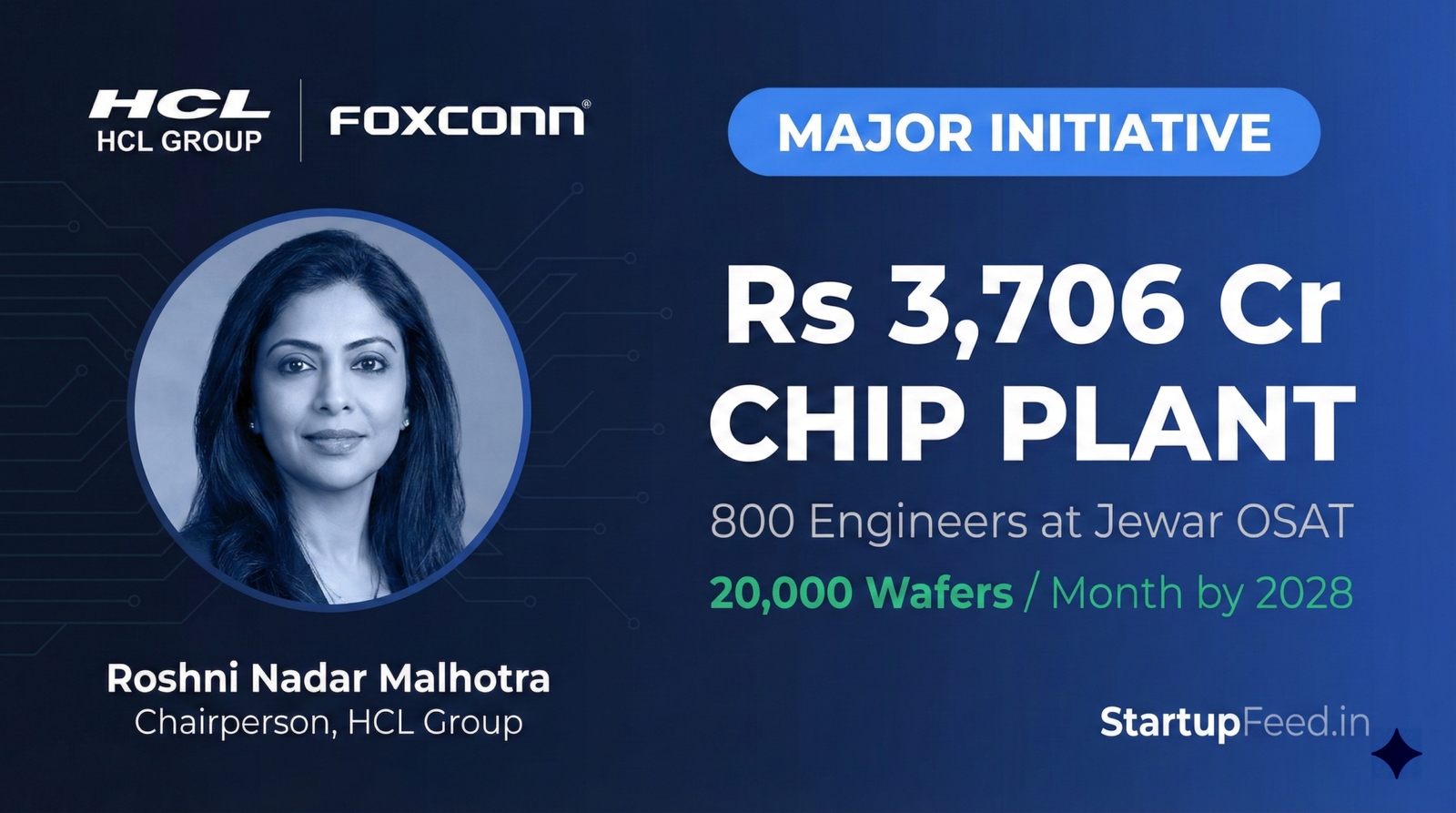
Investment: Rs 3,706 Cr (~$443 Mn) | HCL 60% + Foxconn 40% JV Talent Pipeline: 600–800 high-tech engineers; Shiv Nadar University to design semiconductor curriculum Location: YEIDA, near Jewar Airport, Uttar Pradesh—operational by 2028 Output: 20,000 wafers/month → ~3.6 crore chips/year at peak capacity What’s Next: 3,500+ direct/indirect jobs; India’s first UP-based semiconductor OSAT unit under ISM |
India Chip Private Limited—the HCL-Foxconn joint venture—has broken ground on a Rs 3,706 Cr (~$443 Mn) Outsourced Semiconductor Assembly and Test (OSAT) facility at the Yamuna Expressway Industrial Development Authority region near Jewar Airport, Uttar Pradesh, inaugurated by Prime Minister Narendra Modi on February 21, 2026. Designed to process 20,000 wafers per month and produce approximately 3.6 crore display driver chips annually, the plant will be commercially operational by 2028 — and it will need a core team of 600–800 high-tech engineers to run it.
This positions India not just as a chip assembler but as a semiconductor-capability nation. With Shiv Nadar University developing a purpose-built curriculum and HCL’s network of 55,000 employees in Uttar Pradesh providing an institutional base, the plant signals that India is finally building the human infrastructure to match its factory ambitions—something global chipmakers competing for talent in Asia-Pacific will be watching closely.
StartupFeed Insight
| The key number: India faces a shortfall of 250,000–300,000 semiconductor professionals by 2027 (TeamLease), while the HCL-Foxconn plant adds only 800 engineers—that 800 vs. 250,000 gap is why the Shiv Nadar University curriculum integration is the most strategically important element of this announcement, not the plant itself.
What this means for you: • If you’re a founder: Chip-adjacent startups near Jewar should watch for a specialized talent cluster forming by 2028–29—co-locate early to access the pipeline before it becomes competitive • If you’re an investor: The ISM’s Rs 76,000 Cr outlay means 3–4 more OSAT approvals likely in 2026; OSAT-adjacent tooling, test-equipment, and logistics startups are underpriced today • If you’re an engineer: Shiv Nadar University’s new semiconductor curriculum makes it the most strategically positioned engineering school in North India—enrollment decisions made in 2026 will compound for a decade Our prediction: India will announce at least two additional OSAT facilities by Q3 2026 under the ISM. The HCL-Foxconn plant, once operational, will catalyze a Jewar semiconductor cluster by 2030—but India’s real bottleneck will shift from investment to certified trainers. The university-industry gap, not capital, will determine whether India’s semiconductor ambition succeeds or stalls. |
The Plant at a Glance
| Parameter | Details |
| Legal Entity | India Chip Private Limited |
| JV Structure | HCL Group (60%) + Hon Hai Technology Group / Foxconn (40%) |
| Total Investment | Rs 3,706 Cr (~$443 Mn) |
| Facility Type | OSAT—Outsourced Semiconductor Assembly and Test (under ATMP Scheme) |
| Location | YEIDA, near Jewar Airport, Uttar Pradesh |
| Target Operational | 2028 |
| Wafer Capacity | 20,000 wafers/month |
| Annual Output | ~3.6 crore display driver chips/year |
| Chip Applications | Mobile phones, laptops, tablets, PCs, automobiles, consumer electronics |
| Jobs Created | 3,500+ direct and indirect; 600–800 high-tech engineers at core |
| Government Scheme | India Semiconductor Mission (ISM)—ATMP Modified Scheme; Rs 76,000 Cr outlay |
The Talent Pipeline — Why This Is the Real Story
Most coverage of this announcement has focused on the Rs 3,706 Cr investment. The more consequential detail is smaller: the facility will need 600–800 high-tech engineers when it opens in 2028. Where will they come from?
India currently employs approximately 220,000 semiconductor professionals, but the India Electronics and Semiconductor Association (IESA) projects the demand-supply gap will exceed 200,000 skilled professionals within five years. TeamLease Degree Apprenticeship estimates India faces a deficit of 250,000–300,000 semiconductor workers by 2027—across chip design, fabrication, advanced packaging, and R&D. The HCL-Foxconn plant adds to this demand.
HCL’s answer is institutional proximity. Shiv Nadar University—a STEM-focused research institution adjacent to HCL’s 55,000-employee UP base—will develop dedicated semiconductor curricula and training programs over the next few years to serve as a direct feeder for the Jewar facility. This is not a generic MoU. It is a supply-chain solution for human capital, modeled on the Taiwan-style university-fab integration that built TSMC’s talent dominance.
What the Founders Say
|
The quote reveals a careful framing—’engineering DNA’ signals HCL’s intent to position this as a capability story, not just a contract manufacturing play. By anchoring to Foxconn’s ‘semiconductor capabilities,’ Roshni Nadar Malhotra signals that knowledge transfer from Taiwan is a core part of the deal structure, not just machinery import.
|
Who Should Be Watching?
| Player | Why This Matters |
| Micron Technology | Micron’s ATMP unit in Gujarat operates in the same ISM framework—HCL-Foxconn’s talent pipeline model could be replicated, intensifying competition for the same pool of VLSI and packaging engineers in India. |
| Tata Electronics | Tata’s dual investment in chip fabrication (Dholera) and ATMP (Jagiroad, Assam) positions it as the scale player under ISM — a Jewar OSAT cluster could divert northern India’s semiconductor talent toward HCL over Tata. |
| CG Power / Renesas | CG Power’s chip assembly plant in Sanand is competing for the same display driver chip market — HCL-Foxconn’s Foxconn-backed Taiwanese process know-how gives it a yield and quality edge in the near term. |
| TSMC / Samsung | Global fabs should note India is building OSAT capacity domestically—reducing the outsourcing pipeline that currently flows to Taiwan and South Korea for packaging and test of India-designed chips. |
| IIT Madras / IISc | Shiv Nadar University’s industry-aligned semiconductor curriculum is a direct challenge to the research-only semiconductor programs at IITs—the first institution to produce fab-ready graduates at scale wins the ISM talent race. |
India’s Semiconductor Mission—Where HCL-Foxconn Fits
| Project | Location / Stage | Focus Area |
| India Chip Pvt. Ltd. (HCL-Foxconn) | Jewar, UP — 2028 | OSAT — display driver chips (auto, mobile, laptop) |
| Micron Technology | Sanand, Gujarat — Operational | ATMP—memory chips |
| Tata Electronics (PowerChip) | Dholera, Gujarat — Under Construction | Fab—28nm chips |
| CG Power / Renesas | Sanand, Gujarat—Under Construction | ATMP—power and automotive chips |
| ISM Total Outlay | Rs 76,000 Cr (~$9.1 Bn) | Fabs + ATMP + design centers + OSAT nationwide |
What’s Next
Our prediction: India Chip Private Limited will become India’s first OSAT facility to achieve profitable operations by 2029 — ahead of Micron’s ATMP unit on a per-chip revenue basis — because display driver chips for India’s booming automotive and consumer electronics market give it near-captive domestic demand. The Foxconn technology transfer is the variable that separates this from being just another government-backed industrial unit.
The more consequential milestone to watch is not 2028 operations, but 2026–2027: whether Shiv Nadar University produces a certified semiconductor curriculum that other Indian universities adopt. If it does, HCL-Foxconn will have built India’s semiconductor talent infrastructure—a moat worth more than the plant itself.
The real semiconductor race is not about land or machines. It is about the 800 engineers standing at the wafer line in 2028. Every institution, state government, and startup in the chip supply chain should be competing for that relationship right now.