Quick Take:
|
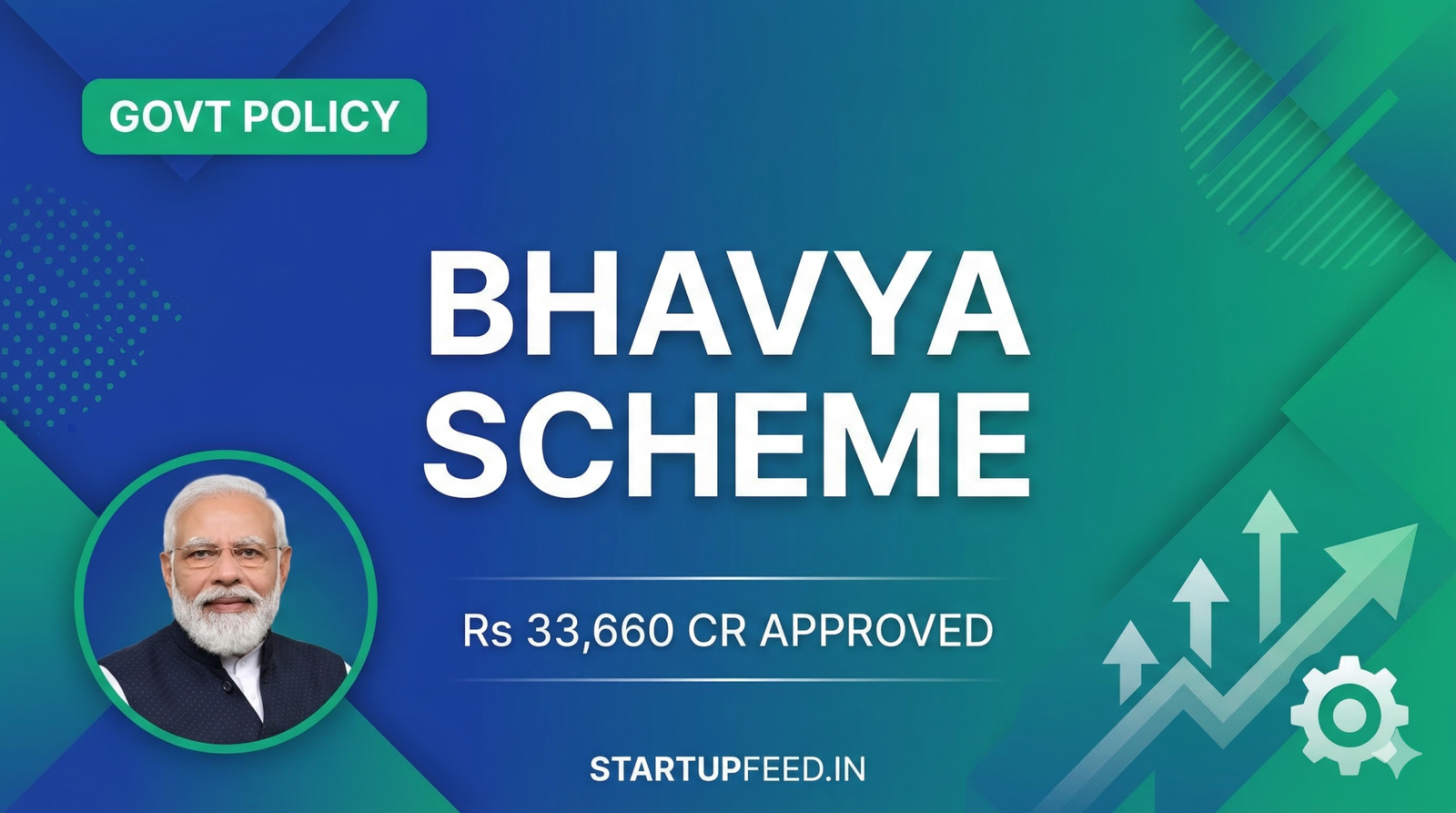
The Union Cabinet, chaired by Prime Minister Narendra Modi, on March 18, 2026 approved the Bharat Audyogik Vikas Yojna (BHAVYA) — a Rs 33,660 Cr ($4 Bn+) scheme to build 100 plug-and-play industrial parks across India, generating an estimated 15 lakh direct jobs in manufacturing, logistics, and services. The scheme provides pre-approved land, ready utilities, and single-window clearances — eliminating the three most common reasons Indian and global companies cite for delaying or abandoning manufacturing investments in India.
India’s manufacturing sector has a well-documented problem: the gap between policy intent and factory floor reality is measured in years of approvals, land acquisition battles, and infrastructure gaps. BHAVYA’s plug-and-play architecture is a direct architectural response to this problem. For founders, MSMEs, and global investors, the scheme changes one fundamental equation: instead of spending 18-36 months securing land, building internal roads, and negotiating electricity connections before producing the first unit, a company can walk into a BHAVYA park and start operations in weeks.
StartupFeed Insight
| What the numbers say: Rs 33,660 Cr divided across 100 parks and ~33,600 acres works out to approximately Rs 336 Cr per park — or Rs 1 Cr per acre for core infrastructure plus a 25% external connectivity top-up. This is a relatively lean government commitment per park, by design: the scheme’s leverage model assumes that every Rs 1 of government infrastructure catalyses Rs 4-6 of private manufacturing investment. If that multiplier holds — as it did in comparable SEZ and industrial corridor models — BHAVYA’s total investment impact is Rs 1.3-2 lakh Cr in private capex.
Winners:
Potential concerns:
Our prediction: BHAVYA will deliver 40-50 operational parks by FY29, not 100 — execution of any government infrastructure scheme of this scale in 3 years is historically unprecedented. But even 40 world-class plug-and-play parks would be transformational. The first anchor tenants to announce within BHAVYA parks will be electronics manufacturers (Apple/Foxconn supply chain), EV component makers, and semiconductor packaging units — all sectors with active PLI schemes that need ready infrastructure. |
Key Provisions Explained Simply
| Provision | What It Means | Why It Matters |
|---|---|---|
| 100 Plug-and-Play Parks | Pre-built infrastructure: roads, power, water, sewage, ICT, admin systems — all ready before tenant arrives | Eliminates 18-36 months of infrastructure setup companies previously bore themselves |
| Park Size: 100-1,000 Acres | Flexible scale — from mid-sized MSME clusters to large integrated manufacturing campuses | Allows both Gujarat-scale anchor parks and smaller Tier-2 city clusters |
| Rs 1 Cr/Acre (Core Infra) | Government funds: internal roads, underground utilities, drainage, treatment facilities, ICT, admin systems | Removes the single biggest pre-production capital burden — infrastructure setup cost |
| 25% Project Cost (External Connectivity) | Additional top-up for roads to highways, rail sidings, last-mile logistics links | Solves India’s notorious ‘last-mile logistics’ problem that makes industrial land useless without road access |
| Value-Added Infrastructure | Factory sheds, built-to-suit units, testing labs, warehousing — funded within the per-acre allocation | Startups and SMEs can lease ready-built sheds instead of constructing — 6-12 month faster start |
| Social Infrastructure | Worker housing and amenities within or adjacent to parks | Addresses India’s workforce retention problem — workers near plants = lower attrition, better productivity |
| Challenge-Mode Selection | States/private players compete for park approvals — only ‘high-quality, reform-oriented, investment-ready’ proposals win | Creates a state-level race-to-the-top on ease of doing business — only serious states with real investor pipelines get parks |
| Single-Window Clearances | Pre-approved land and integrated approvals included in BHAVYA park framework | Eliminates the 47 different approvals a manufacturing unit currently requires across state and central agencies |
| PM GatiShakti Alignment | Parks integrated with GatiShakti Master Plan for multimodal connectivity | Parks connect to highways, railways, ports, and logistics corridors from day one |
| Green Energy Mandate | Renewable power solutions and sustainable resource management within parks | Qualifies parks for ESG-conscious global manufacturers and European supply chain requirements |
| Implementing Agency | NICDC under DPIIT | Currently running 20 projects across 13 states | Government’s most experienced industrial park developer — proven execution track record |
Who Gets What: Impact by Stakeholder
| Stakeholder | Impact | Specific Benefit |
|---|---|---|
| Manufacturing MSMEs | High Positive | Ready infrastructure without Rs 5-50 Cr upfront capex; lease factory sheds from day one; 6-12 months faster time-to-production |
| Manufacturing Startups | High Positive | Access to world-class industrial parks previously only available to large corporates; plug-and-play model suits startups with limited balance sheet |
| Large Indian Manufacturers | High Positive | Pre-certified, connected parks reduce anchor plant setup risk; ready logistics corridors lower supply chain costs |
| Global Investors (China+1) | High Positive | BHAVYA parks give certified, government-backed industrial real estate — the #1 ask from global companies considering India over Vietnam/Indonesia |
| State Governments (reform leaders) | High Positive | Challenge-mode selection rewards proactive states; winners get Central funding + investor visibility + employment credit |
| Workers & Local Communities | Positive | 15 lakh direct manufacturing jobs + supply chain employment; worker housing within parks improves quality of life vs commute-heavy models |
| Logistics & Infrastructure Contractors | High Positive | 100 park developments = 100 construction contracts worth Rs 100-500 Cr each over 5 years |
| States with Weak Reform Track | Neutral/Negative | Challenge-mode selection is competitive — states without RERA-like reform momentum will not win park allocations; pressure to reform or miss out |
| Existing Industrial Real Estate Developers | Neutral | BHAVYA parks are government-subsidised competition; private industrial park developers must differentiate on services and specialisation, not price |
BHAVYA vs Existing Industrial Infrastructure: What’s Different
| Dimension | Old Approach (SEZ/DMIC) | BHAVYA |
|---|---|---|
| Scale | 10-15 large industrial cities | 100 parks across all states — geographic democratisation |
| Target Beneficiary | Primarily large anchor investors | MSMEs, startups, large manufacturers, global investors — all sizes |
| Selection | Administrative allotment | Challenge-based competitive selection — only reform-ready states win |
| Approvals | Still required post-allocation | Pre-approved land + single-window clearances integrated into park |
| Speed-to-Production | 2-4 years from allocation to operation | Weeks from park entry — plug-and-play ready |
| Infrastructure Model | Built to master plan, incremental | All core infra built before tenant arrival + value-added add-ons |
| Connectivity | Often planned, sometimes delayed | 25% project cost top-up ensures connectivity to highways/rail before tenant arrival |
| Green Mandate | Voluntary | Renewable energy and sustainable resource management built into design standards |
| Implementing Body | Multiple agencies | Single: NICDC (proven track record) |
Action Items for Founders & Manufacturers — BHAVYA Readiness Checklist
What to do RIGHT NOW:
|
What the Government Says
Analysis: Vaishnaw’s emphasis on ‘cluster-based co-location’ is the most commercially important phrase in the announcement. The history of India’s industrial parks shows that a single park without a cluster of related suppliers, tooling companies, and logistics providers fails to attract anchor tenants. BHAVYA’s cluster design — where suppliers and manufacturers are in the same park — is precisely what Sriperumbudur (Chennai) and Pune’s Chakan did for the automotive sector, naturally. BHAVYA is trying to engineer that outcome at 100 locations simultaneously. |
What’s Next
The scheme approval is the beginning, not the delivery. The implementation sequence runs: NICDC issues formal EOI → states and private developers submit proposals → challenge-mode evaluation → park selections announced → land acquisition/earmarking finalized → infrastructure construction begins → first tenants admitted. Based on comparable government infrastructure schemes, the first operational BHAVYA parks are realistically 18-24 months from today — likely Q3 FY28 at the earliest for the fastest-moving states.
The states to watch in the challenge mode: Uttar Pradesh (7 DMIC cities already in pipeline), Tamil Nadu (aggressive industrial investor pipeline, existing Sriperumbudur success), Andhra Pradesh (Amaravati-anchored knowledge economy + manufacturing), Gujarat (strongest PLI uptake nationally), and Rajasthan (new government with active investor outreach). The states that fail to submit competitive proposals by the EOI deadline will simply not get parks — and the manufacturing investment gap between BHAVYA-state and non-BHAVYA-state will compound for a decade.
BHAVYA is the policy infrastructure that India’s manufacturing PLI schemes have been waiting for. PLI gives companies money to produce. BHAVYA gives them the place to produce it. If execution matches ambition, the combination of PLI + BHAVYA + National Green Hydrogen Mission creates the manufacturing stack that makes India’s $2.47 Tn manufacturing market by 2031 target genuinely achievable — not just aspirational.
Which state do you think will win the most BHAVYA park allocations? Let us know @StartupFeed_official