


QUICK TAKE:
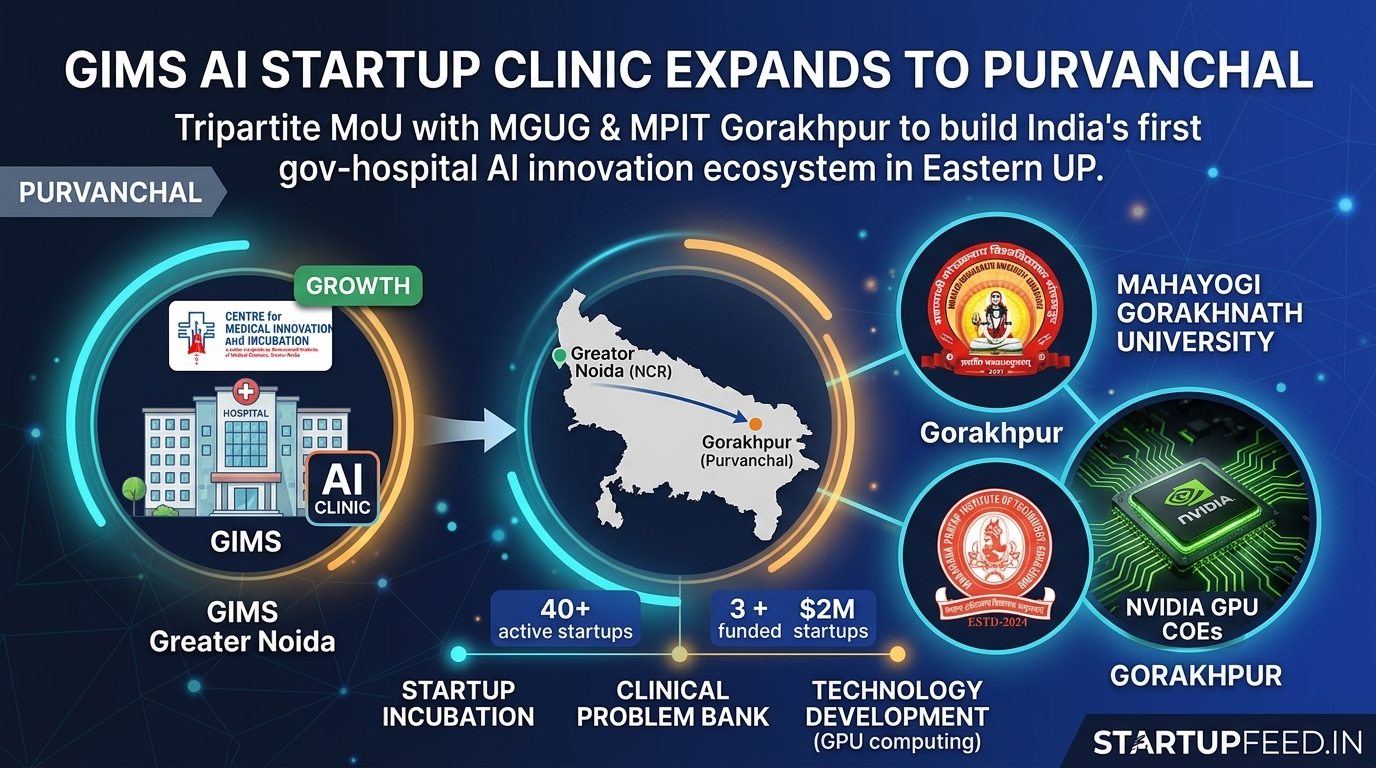
- What happened: The Centre for Medical Innovation – GIMS Foundation at Government Institute of Medical Sciences (GIMS), Greater Noida, signed a tripartite MoU with Mahayogi Gorakhnath University (MGUG), Gorakhpur, and the Centres of Excellence at Maharana Pratap Institute of Technology (MPIT)
- Date and venue: March 14, 2026; MoU formally signed at Mahayogi Gorakhnath University, Gorakhpur, Uttar Pradesh
- What it does: Expands GIMS’s AI Startup Clinic initiative to the Purvanchal region (eastern Uttar Pradesh), bringing AI-powered healthcare innovation infrastructure and startup incubation support to Gorakhpur for the first time
- NVIDIA GPU infrastructure: A key feature of the collaboration is access to NVIDIA GPU-powered AI infrastructure at MPIT’s Centre of Excellence for Artificial Intelligence – enabling training, testing, and deployment of advanced AI models for healthcare applications
- Key people present: Dr. Surendra Singh (VC, MGUG); Dr. Pradeep Kumar Rao (Registrar, MGUG); Dr. Sudhir Agarwal (Director, MPIT); Dr. Rahul (CEO, CMI-GIMS Foundation); Brig (Dr.) Rakesh Gupta (Director, GIMS)
- GIMS background: GIMS Greater Noida launched India’s first government hospital-based AI Clinic in January 2026; CMI-GIMS is India’s first public hospital-based medical incubator with 40+ active startups; partners include IIT Kanpur, AIIMS Delhi, AIIMS Deoghar, NASSCOM, NHS London
- Activities planned: Startup incubation programs; joint research projects; technology development; student-led innovation initiatives; hackathons; collaborative AI and MedTech development
- Significance: First formal institutional extension of the GIMS AI Startup Clinic model outside Greater Noida NCR; positions Gorakhpur as a node in UP’s emerging MedTech innovation corridor from NCR to Purvanchal
A tripartite Memorandum of Understanding was signed in Gorakhpur that marks a significant step in the geographic expansion of one of India’s most ambitious public-sector healthcare innovation initiatives. The Centre for Medical Innovation – GIMS Foundation at Government Institute of Medical Sciences (GIMS), Greater Noida, has partnered with Mahayogi Gorakhnath University (MGUG) and the Centres of Excellence at Maharana Pratap Institute of Technology (MPIT) to bring the GIMS AI Startup Clinic to the Purvanchal region of eastern Uttar Pradesh.
The partnership is significant for several reasons. GIMS launched India’s first government hospital-based Artificial Intelligence Clinic in January 2026 – a milestone that positioned a Uttar Pradesh public institution at the forefront of national healthcare innovation. That January launch, which brought together AIIMS Delhi, AIIMS Deoghar, IIT Kanpur, NASSCOM, and NHS London experts at a single AI Startup Townhall in Greater Noida, established a model for how public medical institutions can become active engines of startup incubation and clinical AI validation. The March 14 MoU is the first formal replication of that model – taking the GIMS AI Startup Clinic from the NCR into Purvanchal, one of India’s most densely populated and healthcare-underserved regions.
At the heart of the collaboration is NVIDIA GPU-powered AI infrastructure at MPIT’s Centre of Excellence for Artificial Intelligence. This is not a symbolic partnership – it brings real computational infrastructure to Gorakhpur that can support the training, testing, and deployment of sophisticated AI models for healthcare diagnostics and clinical decision support.
The MoU: Three Institutions, One Ecosystem
| Partner Institution | Location | Role in MoU | Key Contribution |
|---|---|---|---|
| GIMS – Centre for Medical Innovation (CMI-GIMS Foundation) | Greater Noida, Gautam Buddha Nagar, UP | Lead institution and model exporter | Brings India’s first government hospital AI Clinic model, clinical validation framework, startup incubation methodology, Stanford BIODESIGN-influenced Problem Bank and Idea Bank, and national/international partnerships (IIT Kanpur, AIIMS, NHS London, NASSCOM) |
| Mahayogi Gorakhnath University (MGUG) | Gorakhpur, Uttar Pradesh | Academic and clinical partner | Provides academic research environment, clinical faculty expertise, hospital infrastructure in the Gorakhpur region, and the institutional host for the MoU signing; led by Vice Chancellor Dr. Surendra Singh |
| Maharana Pratap Institute of Technology (MPIT) – Centres of Excellence | Gorakhpur, Uttar Pradesh | Technology and AI infrastructure partner | Contributes NVIDIA GPU-powered AI Centre of Excellence infrastructure for model training, testing and deployment; provides advanced tech labs and engineering talent pool; led by Director Dr. Sudhir Agarwal |
The tripartite structure is deliberately designed to ensure that each partner contributes a distinct and non-overlapping capability. GIMS brings the clinical validation model and national ecosystem connections. MGUG brings the academic research environment and medical education reach across Purvanchal. MPIT brings the computational infrastructure and engineering talent that makes AI model development practically possible. Together, they create a complete innovation stack: clinical problem identification (MGUG hospitals and clinics) + technology development (MPIT’s NVIDIA GPU infrastructure) + structured startup incubation and validation (GIMS CMI methodology).
“The partnership represents a major step toward integrating medicine, technology, and innovation to address real-world healthcare challenges. The GIMS AI Startup Clinic aims to empower innovators and startups by providing them with the resources and collaborative ecosystem needed to develop impactful healthcare solutions.”
— Brig (Dr.) Rakesh Gupta, Director, GIMS Greater Noida
GIMS CMI: India’s First Public Hospital Medical Incubator – The Model Being Replicated
To understand the significance of the Purvanchal expansion, it is essential to understand what GIMS CMI has built at Greater Noida – because this is the model now being exported to Gorakhpur.
The Centre for Medical Innovation at GIMS was established as India’s first medical incubator housed within a public government hospital. Under the StartinUP initiative of the Government of Uttar Pradesh, CMI-GIMS has built an innovation ecosystem that was previously thought impossible within the constraints of a government medical institution. The January 2026 AI Clinic launch was the most visible milestone, but the underlying infrastructure took years to build.
| Component | Description | National Significance |
|---|---|---|
| India’s First Government Hospital AI Clinic | Launched January 2, 2026 (online inauguration); physical launch January 6, 2026. Uses AI and genetic screening for early detection of cancer, cardiac, kidney, and liver conditions. Analyses blood tests, imaging, and genetic data for disease risk prediction. | First government medical institution in India to operationalise AI-based clinical decision support in routine patient care; inaugurated by Dr. Sujata Chaudhary, Additional DGHS, Ministry of Health and Family Welfare, Government of India |
| Clinical Startup OPD Clinics | Active startup OPD clinics where AI and MedTech startups embed directly into clinical workflows to test and validate solutions with real patients and clinicians | India’s first OPD-based Startup Clinics within a government hospital; provides real-world validation environment unavailable in typical incubators |
| 40+ Active Startups | Over 40 startups currently incubated at CMI-GIMS across AI diagnostics, medical devices, wearables, digital health, and telemedicine | Largest active startup cohort in any government hospital incubator in India |
| Stanford BIODESIGN Integration | Problem Bank and Idea Bank frameworks adopted from Stanford’s BIODESIGN programme; clinician-identified clinical problems are systematically catalogued and matched with startup solution development | International quality standard applied to public hospital innovation; brings global best practice to UP’s healthcare innovation |
| Regulatory Clinic and Startup Clinic | Dedicated regulatory readiness support for medical device approvals (CDSCO); structured Startup Clinic format for iterative product-market validation within the hospital | Bridges the regulatory gap that kills most MedTech startups between prototype and commercialisation |
| $2M Funding Milestone | Sophrosyne Technologies – a CMI-GIMS incubated startup developing indigenous medical-grade chipsets for next-generation wearables – raised $2 million, becoming the first startup from any government hospital incubator in India to achieve a significant private funding round | Proof of concept for the entire CMI-GIMS model; validates that hospital-embedded incubation produces investment-ready MedTech companies |
| STPI MedTech CoE Spoke Centre | STPI (Software Technology Parks of India) MedTech Centre of Excellence established a Spoke Centre at GIMS – the first time any national MedTech CoE has set up a spoke inside a public hospital; provides access to STPI’s advanced prototyping infrastructure in Lucknow | Creates a two-way corridor: GIMS startups access national MedTech infrastructure; STPI innovators access clinical validation within a government hospital |
| National/International Partner | Nature of Partnership | What It Provides to GIMS Ecosystem |
| IIT Kanpur – MedTech & AI Centre of Excellence | Ecosystem partner for AI Clinic; academic mentorship | Technical guidance on AI model development, validation methodology, academic research collaboration; Dr. Sarvesh Sonkar (Head, MedTech & AI CoE, IIT Kanpur) actively involved |
| AIIMS Delhi | Clinical expertise partner; keynote at AI Startup Townhall (Jan 7, 2026) | Oncology and clinical expertise; Dr. Abhishek Shankar (senior oncologist, AIIMS Delhi) delivered keynote at AI Startup Townhall |
| AIIMS Deoghar | Clinical institutional partner | Prof. (Dr.) Nitin M. Gangane (Director and CEO, AIIMS Deoghar) as Guest of Honour at AI Clinic physical launch |
| NHS London (UK) | International healthcare system partner | Cross-border healthcare AI deployment experience; international perspective on responsible AI adoption in public health systems |
| NASSCOM | Industry body partner | Technology industry mentorship, startup ecosystem connections, policy advocacy alignment |
| STPI MedTech CoE | National MedTech infrastructure partner (MoU) | First Spoke Centre inside a public hospital; access to STPI Lucknow’s advanced prototyping labs |
| MGUG + MPIT (NEW – March 2026) | Purvanchal expansion partners (tripartite MoU) | Academic research environment, hospital infrastructure, and NVIDIA GPU-powered AI compute infrastructure in Gorakhpur |
What the Purvanchal Expansion Means: Healthcare Innovation in Eastern UP
Purvanchal – the eastern region of Uttar Pradesh encompassing districts including Gorakhpur, Varanasi, Prayagraj, Azamgarh, Basti, Deoria, Kushinagar, and surrounding areas – is home to approximately 50-60 million people. It is one of India’s most populous sub-regions and one historically characterised by underinvestment in healthcare infrastructure relative to its population size. The region’s primary tertiary care hub is Gorakhpur, home to BRD Medical College (now a National Medical College) – a hospital that achieved tragic national prominence in 2017 due to the oxygen supply disruption that caused multiple child deaths, a event that galvanised state government commitment to healthcare infrastructure investment in Purvanchal.
Chief Minister Yogi Adityanath’s home constituency is Gorakhpur, and Mahayogi Gorakhnath University – the institution co-signing the MoU – is a university established in the Gorakhnath tradition with deep roots in the Gorakhpur establishment. The political will behind healthcare investment in Purvanchal is therefore strong and consistent, making the GIMS AI Startup Clinic expansion a well-timed institutional move with clear state government alignment.
| Dimension | Current Gap | What the MoU Addresses |
|---|---|---|
| AI and MedTech startup activity in Purvanchal | Near-zero – no active healthcare AI startup incubation infrastructure exists in Gorakhpur or surrounding districts; innovation activity concentrated in NCR Noida and Lucknow | First structured AI startup incubation programme for Purvanchal; GIMS CMI methodology exported to Gorakhpur; access to IIT Kanpur and AIIMS-linked mentorship network for Purvanchal-based innovators |
| Clinical AI infrastructure | No government hospital in Purvanchal currently runs structured AI-based clinical decision support programs; diagnostic AI limited to private hospitals | MPIT’s NVIDIA GPU infrastructure enables AI model training and testing; MGUG’s hospital facilities provide clinical deployment environment; pathway to AI diagnostics in Purvanchal public healthcare |
| Student innovation ecosystem | Engineering and medical students in Gorakhpur have limited access to structured healthcare innovation pathways; brain drain to NCR and Pune is consistent | Student-led innovation initiatives, hackathons, and startup incubation programmes create a local innovation track that can retain talent in eastern UP; MGUG medical students + MPIT engineering students = natural interdisciplinary founding teams |
| Joint research capacity | Limited cross-institutional medical + technology research infrastructure in Purvanchal; most clinical research is conducted through individual faculty projects without institutional ecosystem support | Joint research projects between GIMS clinicians, MGUG medical faculty, and MPIT technology researchers; potential for regional publication output and IP generation in healthcare AI |
| Healthcare access challenges specific to Purvanchal | High burden of vector-borne diseases (Japanese Encephalitis, dengue, malaria), malnutrition, maternal and neonatal health challenges, limited specialist doctor density | Healthcare AI solutions validated in Purvanchal’s clinical context will be inherently more relevant to eastern UP’s disease burden than solutions developed in urban NCR settings; geographic-specific AI model training using Purvanchal patient data |
The NVIDIA GPU Infrastructure: Why Compute Access Matters
One of the most specific and technically significant elements of the MoU is the explicit mention of NVIDIA GPU-powered AI infrastructure at MPIT’s Centre of Excellence for Artificial Intelligence. This detail deserves unpacking because it addresses a fundamental bottleneck in Indian healthcare AI development.
Training, fine-tuning, and validating AI models for medical imaging, diagnostic support, and clinical decision-making requires significant computational power. A typical medical imaging AI model – for example, a convolutional neural network trained to detect tuberculosis patterns in chest X-rays – requires hundreds of GPU-hours of training time on tens of thousands of annotated images. Most Indian healthcare AI startups either use expensive cloud compute (AWS, Azure, GCP) at per-hour rates that are prohibitive for early-stage companies, or they are constrained to smaller, simpler models that can run on CPU-based infrastructure.
MPIT’s NVIDIA GPU Centre of Excellence at Gorakhpur provides on-premises GPU compute infrastructure that can be accessed by startups, researchers, and students within the tripartite collaboration without cloud billing overhead. For early-stage MedTech AI startups, free or subsidised access to GPU infrastructure for model development is a significant competitive advantage – reducing the time from idea to validated proof-of-concept by eliminating compute cost as a barrier.
| AI Application | GPU Infrastructure Requirement | Purvanchal Clinical Relevance |
|---|---|---|
| Medical imaging AI (X-ray, CT, MRI analysis) | High – requires GPU for CNN model training on large annotated image datasets; typical training run: 8-48 GPU-hours | Gorakhpur and surrounding districts have significant TB, pneumonia, and Japanese Encephalitis burden where imaging AI has direct diagnostic value |
| Clinical decision support systems | Medium – NLP and structured data models for diagnosis prediction; can run on moderate GPU infrastructure | Rural primary health centres with limited doctor availability could benefit most from AI-assisted clinical decision support |
| Wearable health monitoring AI | Low to medium – signal processing and anomaly detection; suitable for MPIT’s GPU CoE scale | Relevant for maternal health monitoring and neonatal care in Purvanchal, where neonatal mortality rates remain above national averages |
| Drug interaction and prescription safety AI | Medium – requires NLP and knowledge graph models; beneficial for hospital pharmacy systems | Complex polypharmacy scenarios in resource-limited settings where pharmacist oversight is stretched |
| Epidemic surveillance and outbreak prediction | Medium-high – geospatial AI and time-series models; relevant for Purvanchal’s vector-borne disease patterns | Japanese Encephalitis, dengue, and malaria outbreaks in Purvanchal districts are recurring and potentially predictable through AI-based surveillance models trained on local historical data |
StartupFeed Insight – Five Non-Obvious Reads on the GIMS Purvanchal Expansion
- The GIMS CMI model is the most important government healthcare innovation infrastructure story in India – and it is almost entirely under-covered nationally.
A government hospital in Uttar Pradesh – not IIT, not IIM, not a private hospital chain – became India’s first public institution to operationalise an AI clinic, incubate 40+ startups, produce a $2M-funded MedTech company, partner with IIT Kanpur and AIIMS Delhi, and sign a MedTech CoE Spoke arrangement with STPI, all within the constraints of a public sector institution. That trajectory, achieved under Brig (Dr.) Rakesh Gupta’s leadership, is a replicable model for every state government medical college in India. The fact that it is happening in UP rather than Maharashtra or Karnataka – the states typically associated with MedTech innovation – makes it politically significant. It is evidence that the StartinUP initiative of the Yogi Adityanath government has produced a genuine, nationally-relevant institutional innovation, not just a branding exercise.
- Gorakhpur’s selection as the Purvanchal node is deliberate and strategically smart – not just politically convenient.
Gorakhpur is the largest city in Purvanchal and the natural hub for eastern UP’s educational, medical, and economic activity. It has BRD Medical College (now a National Medical College), Deen Dayal Upadhyay Gorakhpur University, MPIT, and now MGUG as anchoring institutions. The 2017 BRD hospital tragedy created a documented, urgent political will to invest in Gorakhpur’s healthcare infrastructure – a will that has translated into sustained state government investment. For a healthcare AI startup ecosystem, this combination of large medical institution (MGUG), engineering infrastructure (MPIT’s NVIDIA CoE), political backing, and genuine unmet clinical need (JE, dengue, maternal health) creates a more compelling foundation than many Tier 1 city innovation hubs where hospitals are private, patients are wealthy, and the clinical problems are less urgent.
- The MGUG-MPIT partnership creates UP’s first medical-engineering student innovation pipeline outside the NCR.
Healthcare AI startups are almost always founded by interdisciplinary teams: a doctor who understands the clinical problem + an engineer who can build the AI solution. In the NCR, this pairing happens naturally through IIT Kanpur collaborations, AIIMS proximity, and shared coworking spaces in Noida and Delhi. In Purvanchal, until now, there was no structured pathway for MBBS students at MGUG and engineering students at MPIT to co-create startups. The MoU explicitly includes student-led innovation initiatives and hackathons – which are the activation mechanism for building this pipeline. The students who participate in GIMS AI Startup Clinic hackathons in Gorakhpur over the next 3 years are the founders of the next wave of eastern UP’s MedTech startup ecosystem. This is a talent pipeline play as much as a technology play.
- This MoU signals that UP is actively building a distributed healthcare innovation corridor from NCR to Purvanchal – not a single hub model.
India’s existing MedTech and healthtech startup ecosystems are heavily concentrated in Bangalore, Hyderabad, Mumbai, and Delhi-NCR. UP’s MedTech innovation model, as GIMS CMI is building it, appears to be deliberately distributed: Greater Noida (GIMS CMI hub) + Lucknow (STPI MedTech CoE) + Kanpur (IIT Kanpur MedTech CoE) + Gorakhpur (MGUG-MPIT node). This is a corridor model, not a single-hub model. Distributed innovation corridors are more resilient and more equitable – they create local talent retention incentives in multiple cities rather than continuing the brain drain to a single metropolitan hub. For startup founders, investors, and incubator managers evaluating UP’s ecosystem potential, the Gorakhpur node is the easternmost point of what is shaping up to be India’s most geographically distributed state-level healthcare innovation network.
- Purvanchal’s disease burden is an underutilised data asset for global healthcare AI training – and the first startup to build a GCP-compliant Purvanchal clinical dataset could generate disproportionate value.
Japanese Encephalitis has killed thousands of children in Purvanchal over decades. Vector-borne disease epidemics follow predictable seasonal and geographic patterns in the region. Malnutrition and stunting data from Purvanchal is extensive and longitudinal. Maternal and neonatal health records from the region’s hospitals represent decades of clinical information on conditions common to low-resource, high-density tropical environments. This disease burden data, if properly anonymised, structured, and made available for AI model training, would be globally significant. No Indian state government hospital currently has a structured programme to build a GCP (Good Clinical Practice)-compliant clinical data asset from its patient records for AI training purposes. The startup or institution that first builds that data infrastructure at MGUG or MPIT – with IRB approvals, informed consent protocols, and structured annotation pipelines – would create a defensible, globally competitive data moat for Purvanchal-specific healthcare AI.
What Happens Next: Activity Pipeline Under the MoU
- AI Startup Clinic at MGUG/MPIT: The GIMS AI Startup Clinic format – where startups embed in clinical environments to develop and validate solutions – will now operate at Gorakhpur. Watch for an inaugural AI Startup Townhall or Roundtable in Gorakhpur, modelled on the successful January 7, 2026 event at GIMS.
- Hackathon calendar: Student-led innovation initiatives and hackathons are explicitly part of the MoU. Expect a medical AI hackathon co-organised by MGUG and MPIT targeting the interdisciplinary MBBS-BTech student population as a first public activation event.
- Joint research projects: Joint research between GIMS clinicians and MGUG/MPIT faculty is planned; likely to focus on Purvanchal-specific disease patterns (JE, dengue, maternal health) where the clinical data advantage is strongest.
- Startup applications from Purvanchal: The GIMS CMI startup application process will likely be opened to innovators from the Purvanchal region, with MGUG and MPIT as first-filter institutional partners.
- NVIDIA GPU infrastructure utilisation: MPIT’s GPU CoE will begin hosting AI model development and training sessions for healthcare applications – the first instance of NVIDIA-grade healthcare AI compute infrastructure being publicly accessible in eastern UP.