


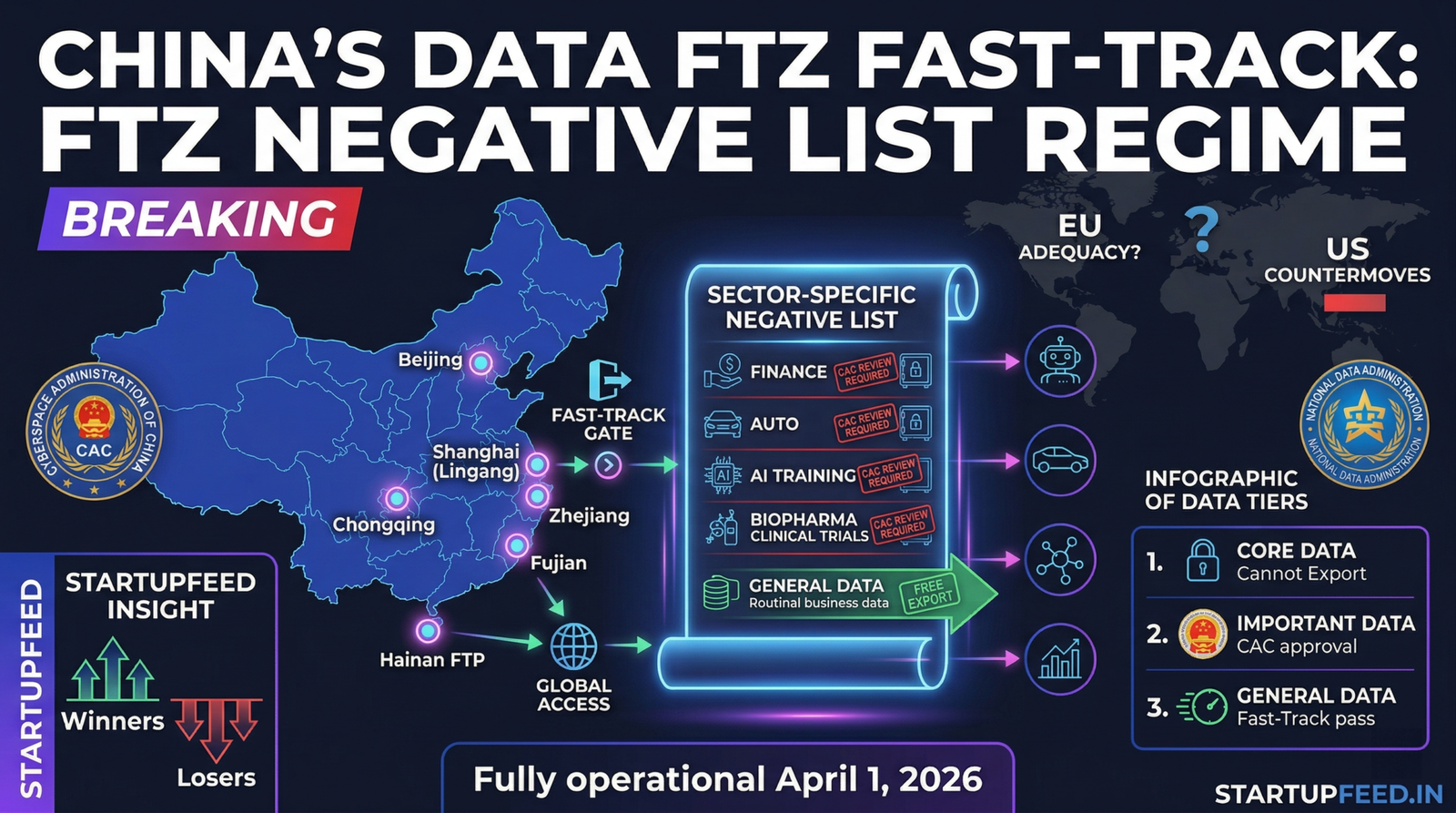

Quick Take
| Policy: | Cross-Border Data Transfer (CBDT) Fast-Track — FTZ Negative List Regime |
| Authority: | Cyberspace Administration of China (CAC) + National Data Administration |
| Affects: | Multinationals, tech firms, pharma, auto, finance in Shanghai, Beijing, Tianjin, Hainan, Zhejiang FTZs |
| Effective: | Fully operational April 1, 2026 (phased since March 2024) |
| Key Change: | Data NOT on negative lists can now be exported freely, no CAC review needed |
China has activated a data export fast-track across its key Free Trade Zones (FTZs) — Shanghai, Beijing, Tianjin, Hainan, Zhejiang, Fujian, and Chongqing — allowing companies based in these zones to transfer data overseas without CAC security assessments, standard contracts, or certification, provided the data does not appear on sector-specific “negative lists.” The move, now fully operational as of April 2026, marks the most significant liberalisation of China’s cross-border data rules since Beijing first tightened its data sovereignty framework in 2021.
StartupFeed Insight
What it means: China is threading the needle — easing data flows enough to retain multinationals, while keeping sovereignty controls intact for sensitive sectors.Winners:
Losers:
Action required: Companies in affected FTZs should immediately audit which data falls outside negative lists — this is free money on the compliance table. |
What’s New: The FTZ Negative List Regime Explained
China’s cross-border data transfer framework has historically been among the most restrictive in the world. Under the Personal Information Protection Law (PIPL), the Data Security Law, and the Cybersecurity Law, any company wanting to transfer data overseas faced one of three compliance routes: a government-led CAC Security Assessment (mandatory for critical infrastructure operators and large-volume data exporters), a Standard Contractual Clause (SCC) filing, or from January 2026, a new Certification route. Each pathway involved months of review, uncertain outcomes, and significant legal cost.
The FTZ fast-track flips this logic entirely. Under the March 2024 Provisions on Promoting and Regulating Cross-Border Data Flows, China’s FTZs were empowered to create their own “negative lists” — industry-specific catalogues of data types that cannot be freely exported. Any data not appearing on the negative list can move across the border freely, with no CAC process whatsoever. By April 2026, FTZs covering Shanghai (Lingang), Beijing, Tianjin, Fujian, Hainan, Jiangsu, Chongqing, and Zhejiang have each published sector-specific negative lists, covering 17 industries in total.
The Three Data Tiers Under the New Framework
| Data Tier | Definition | FTZ Fast-Track Status |
|---|---|---|
| General Data | Routine business data not related to national security or large personal data sets | Freely exportable from FTZs if not on negative list — no CAC process |
| Important Data | Data designated by regulators as sensitive to national interests (sector-specific) | Security assessment required even in FTZs — not fast-tracked |
| Core Data | Data critical to national security, public services, or economic operation | Cannot be exported — strict domestic storage mandate applies |
Which FTZs Are Covered and What Sectors
| FTZ | Negative List Sectors | Key Benefit |
|---|---|---|
| Shanghai (Lingang) | Auto, biopharma, mutual funds, international trade | First mover — whitelist also available for auto data export |
| Beijing | Life sciences, AI, retail, smart manufacturing | AI and cloud data flows eased for tech multinationals |
| Tianjin | Auto, pharmaceuticals, civil aviation | Important data threshold raised to 10M individuals |
| Hainan FTP | Tourism, finance, healthcare, seed industry | Special Free Trade Port rules — most liberal regime |
| Zhejiang | E-commerce, cross-border trade, logistics | Covers deep-sea industry — unique to this zone |
| Fujian & Chongqing | Manufacturing, cross-border retail | Sector-specific negative lists published 2025 |
Why “First Crack Since 2021” — The Historical Context
The year 2021 marked a watershed in China’s data sovereignty push. Between June and November of that year, Beijing enacted the Data Security Law (DSL) and the Personal Information Protection Law (PIPL) in rapid succession, creating one of the world’s most restrictive frameworks for cross-border data flows. The DSL introduced the concept of “important data” requiring government approval before export. The PIPL imposed GDPR-equivalent consent requirements and mandatory security assessments for large-scale personal data transfers.
The impact on multinationals was immediate. Companies in sectors from automotive (which relies on real-time data flows between Chinese manufacturing lines and global R&D teams) to financial services (requiring consolidated risk reporting across borders) found themselves unable to operate normally. McKinsey estimated AI initiative failure rates in China above 70% in part due to data flow friction.
Between 2021 and 2024, the CAC received thousands of data export security assessment applications, many of which faced rejection or indefinite delay. A 2024 CAC Q&A explicitly acknowledged that the strict rules had “caused significant delays” and created “concern among international companies.” The FTZ negative list regime, now fully activated, is Beijing’s answer: a structurally contained liberalisation that preserves sovereignty over sensitive data while unblocking the routine commercial flows that global companies need.
Industry Impact Analysis
| Sector | Impact | Why |
|---|---|---|
| Automotive (EV & Connected) | Positive | Tesla, BYD, Porsche in Shanghai FTZ — can now export vehicle sensor and OTA update data for global R&D |
| Biopharma / Life Sciences | Positive | Clinical trial data, genomics for global drug development now moveable from Hainan & Beijing FTZs |
| Financial Services | Positive | Fund management, reinsurance, and risk analytics data flows unlocked in Shanghai and Hainan |
| AI & Cloud | Positive | Non-sensitive training data and model outputs can now cross borders for global AI development |
| Retail & E-commerce | Positive | Cross-border consumer behavioural data (non-sensitive) freed up in Zhejiang and Fujian zones |
| Cybersecurity Vendors | Negative | Revenue from mandatory CAC assessment compliance consulting materially reduced |
| Companies Outside FTZs | Negative | Still subject to full CAC regime — creates two-tier system inside China |
| US-China Data Decoupling Advocates | Negative | Policy weakens the ‘clean network’ narrative; China looks less isolated |
What This Means for Indian Startups and IT Firms
For Indian IT services firms — Infosys, TCS, Wipro, HCL, and dozens of mid-tier players — with delivery centres in Shanghai or Hainan, the FTZ fast-track removes a major operational headache. Non-sensitive project data, client deliverables, and HR records flowing between China delivery teams and global management can now move without compliance triggers.
For Indian SaaS companies with Chinese enterprise customers — particularly in B2B software for manufacturing, logistics, and finance — this unlocks the ability to offer hosted cloud solutions where data processing happens outside China, something that was previously blocked for many data types.
For VC and PE funds with Chinese portfolio companies (including those structured through Singapore or Mauritius), the regime matters for due diligence data flows and cross-border financial reporting consolidation — both potentially fast-tracked under general data provisions.
Compliance Checklist for Companies in FTZs
- Determine if your entity is registered within an eligible FTZ boundary — Immediately — fast-track only applies to FTZ-registered entities
- Obtain the sector-specific negative list for your industry from the relevant FTZ authority — Before any data export activity
- Conduct a data audit — classify all outbound data flows against the negative list categories — Within 60 days
- For data on the negative list: proceed through standard CAC assessment, SCC, or certification routes — Per standard CAC timelines
- For data off the negative list: document the classification decision and maintain internal records — Ongoing — regulators may audit
- Assess whether ‘important data’ designations have been issued for your sector by the MIIT or other industry regulator — Before Q3 2026
- Non-FTZ companies: engage legal counsel on whether to establish an FTZ presence to access the fast-track — Strategic decision — H2 2026
Expert Reaction
China has made progress in detailing its outbound data transfer regime, most notably through the introduction of negative lists applicable to designated Free Trade Zones. This model offers a structured, if cautious, compliance framework for lawful data exports.”
— Freshfields Global Data Law Review, 2026Companies in FTZs that need to export data not included in the negative lists can do so without undergoing any of the additional compliance procedures. Going forward, more FTZs will likely implement negative lists for different industries.”
— Cyberspace Administration of China (CAC), Official Q&A, April 2025
The broader geopolitical picture: China generated 41.06 zettabytes of data in 2024 according to the National Data Administration. Even incremental regulatory shifts in how that data can move carry enormous consequences for global manufacturing analytics, AI model training, and cloud infrastructure. The FTZ fast-track is Beijing’s calculated bet that controlled openness will retain more foreign investment than blanket restriction — without ceding the data sovereignty that Xi Jinping has made a cornerstone of national policy.
What’s Next
- Expect more FTZs to publish negative lists in H2 2026 — currently 8 FTZs are covered; China has 21 total FTZs.
- The CAC has signalled it will continue refining and expanding sector-specific export scenarios — automotive and healthcare data rules are the most actively evolving.
- China’s national safety standards for cross-border personal information processing (effective March 1, 2026) will be enforced in parallel — companies must meet both the negative list and the GB/T 46068-2025 standard.
- The EU is watching: the European Data Protection Supervisor’s recent block on data transfers to India signals that the bar for data adequacy decisions globally is rising. China’s FTZ reforms may be a precursor to seeking a partial adequacy arrangement with the EU — a long shot, but no longer impossible.
- US countermoves: Executive Order 14117 and the PADFAA restrict bulk transfers of sensitive US data to China. The FTZ liberalisation makes the US-China data wall more asymmetric, not more open — expect US legislative scrutiny.