
Quick Take :
|
The Story
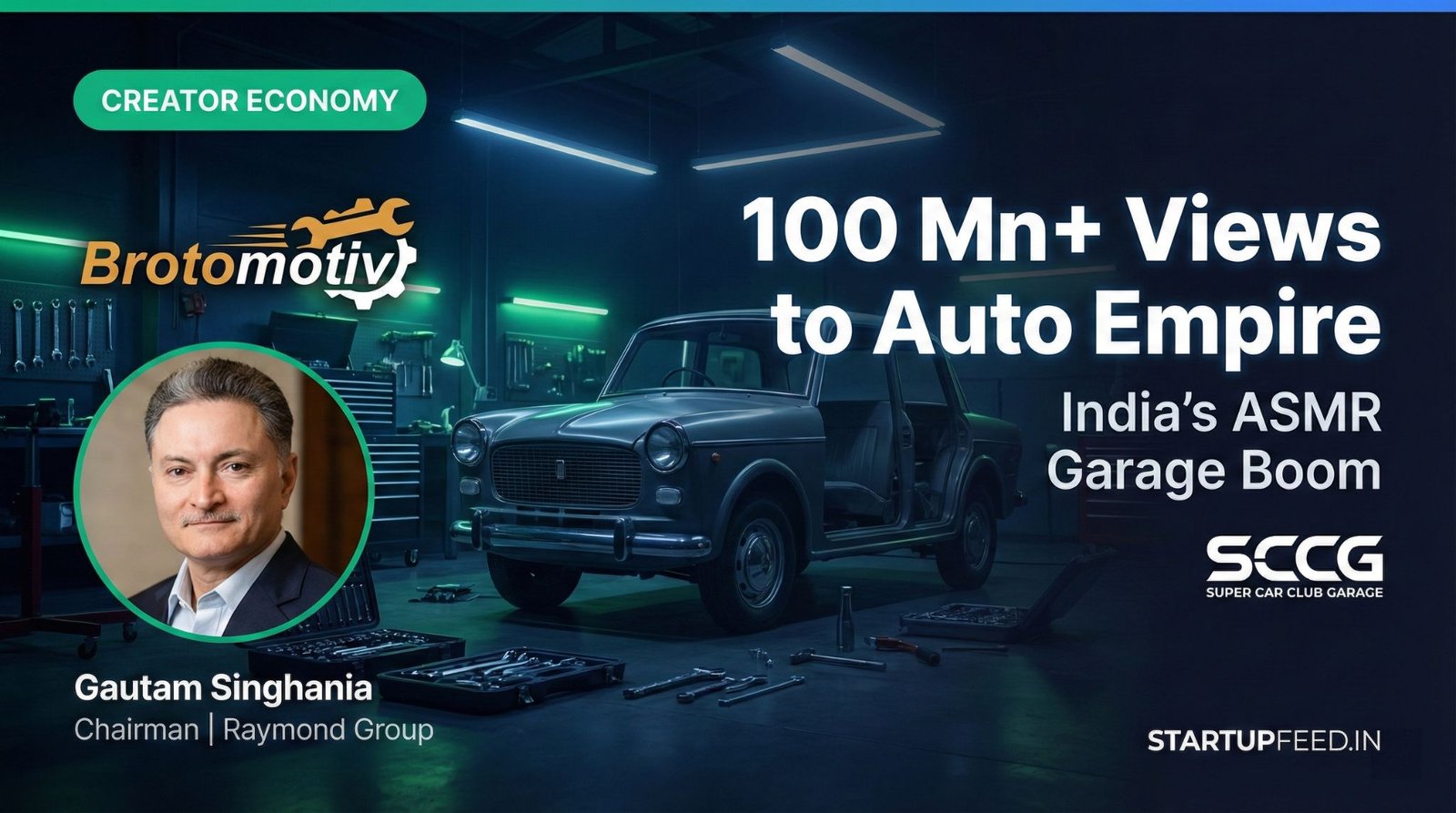
Auto-tech content startup Brotomotiv has done something almost no Indian brand has managed: it turned the sound of a rusted Ambassador getting a new lease on life into a 100 million monthly YouTube views empire — and is now launching garage franchises across India to convert that digital fandom into physical rupees. At the same time, Gautam Singhania, Raymond’s Chairman and MD, is lobbying the government to allow vintage foreign cars to be imported for restoration and re-export — positioning India as the world’s low-cost garage for classic car obsessives from London to Los Angeles. The ASMR car restoration boom is no longer just a YouTube niche; it is a startup category.
Why This Matters Now
ASMR was the single most searched term on YouTube globally in 2024. Car restoration content — with its satisfying sounds of grinding, polishing, and revving back to life — sits at the precise intersection of that ASMR wave and India’s exploding auto-enthusiasm culture. The result is a content-to-commerce flywheel that Indian founders are only beginning to monetise. With Singhania’s Super Car Club Garage (SCCG) having completed its first phase of government approvals and targeting operations by mid-2025, the policy window to build a genuine export-grade restoration industry is opening. Founders and investors who move now will own the category.
| StartupFeed Insight
What the numbers say: UK restoration labour costs £100–£200 per hour (approx. ₹10,600–₹21,200/hr). India’s garage labour averages ₹200–₹600/hr — a 30x–100x arbitrage that dwarfs even the textile industry’s cost advantage that Singhania famously references. What this means for you:
Our prediction: By Q4 2026, at least one Indian ASMR car restoration channel will surpass 10 million subscribers, and the first VC-backed garage-tech franchise chain will close a Series A round of ₹30 Cr or more. |
The YouTube Gold Rush: ASMR Meets Auto
Car restoration videos work as ASMR because they deliver exactly what the format promises — methodical, satisfying, sensory-rich content. The grind of rust removal, the hiss of a spray gun, the click of a socket wrench tightening a freshly polished bolt: every sound is a trigger. Global channels dedicated to restoring abandoned vehicles — think rusty Japanese mini-trucks rebuilt in immaculate detail — regularly pull 5–15 million views per video.
In India, Brotomotiv — founded in 2020 by brothers Parikshit Hans and Raghav Hans from Pune — has taken this global format and turbocharged it with desi context. The brand has accumulated over 5 million subscribers across platforms and crosses 100 million views per month. Their content ranges from detailed restorations of ageing Maruti Altos (already a cult segment on Indian enthusiast forums like Team-BHP) to full custom paintjobs on SUVs. Every video is both a content product and a live advertisement for their physical workshop.
The Economics: A Tale of Two Revenue Streams
This is where the story gets interesting for founders. Here is a direct comparison of the two business models being built simultaneously in India’s ASMR restoration space:
| METRIC | ASMR YOUTUBE CHANNEL | RESTORATION FRANCHISE |
| Setup Cost | ₹2–5 Lakh (camera + equipment) | ₹25–60 Lakh (workshop, tools, inventory) |
| Avg. Revenue per Video/Job | ₹40,000–₹1,50,000 (ad revenue, 15-min video) | ₹15,000–₹8,00,000 (basic to classic restoration) |
| Gross Margin | ~70–80% (content is near-zero COGS) | ~35–55% (parts, labour) |
| Scale Ceiling | Unlimited (global audience) | Limited by geography and capacity |
| Brand Trust Builder | Moderate (digital) | High (hands-on, word-of-mouth) |
| Brotomotiv’s Edge | Combines BOTH — content drives workshop leads | Workshop validates content credibility |
The Brotomotiv flywheel is the key insight: every workshop customer becomes a potential video subject, and every video drives inbound workshop inquiries from across India. Customers from as far as Karnataka are driving to Pune for a restoration because they watched Brotomotiv’s YouTube content. That is a content-led business with physical unit economics — precisely the model that VCs love.
Singhania’s Big Bet: India as the World’s Garage
Speaking at the Bharat Mobility Global Expo 2025 in January 2025, Gautam Singhania made the case that car restoration is India’s next labour arbitrage play. His Super Car Club Garage (SCCG) has sought the Centre’s approval for a licence to import foreign vintage vehicles for restoration and subsequent re-export — a currently prohibited activity. The first phase of approvals has cleared, with operations targeting mid-2025 launch and the first restoration batch expected by July-August 2025. SCCG claims it can complete restorations in under six months versus the two to three years typical of international garages.
The economics support his thesis. UK restoration labour runs £100–£200 per hour. Indian garage labour averages a fraction of that. The textile and engineering industries both followed this cost curve to India over the past four decades. If regulations clear, India could realistically capture a meaningful share of the global classic car restoration market — currently dominated by the UK, Germany, and the US — within this decade.
The Franchise Opportunity: Who Should Be Watching
Brotomotiv has already begun rolling out its franchise model, partnering with CarzSpa for studio-format outlets. For aspiring entrepreneurs, this is the most accessible entry point into India’s ASMR restoration economy. A franchise model strips out the content-creation overhead while plugging into Brotomotiv’s brand equity and its 5-million-strong subscriber base. The catchment area for a Brotomotiv franchise outlet is technically national — because the content already pre-sells the service to car enthusiasts across the country.
The nostalgic angle is a powerful demand driver. India’s automotive history — the Ambassador, the Premier Padmini, the Bajaj Chetak, the early Maruti 800 — carries deep emotional weight for the 35–55 age bracket that now has disposable income. ASMR car restoration content taps this nostalgia effectively, turning a service category (bodywork and restoration) into a culturally resonant experience product.
Competitive Landscape: India’s Restoration Ecosystem
| PLAYER | MODEL | CONTENT PLAY | FRANCHISE? | STATUS |
| Brotomotiv (Pune) | Workshop + Media | 5M+ subs, 100Mn views/mo | Yes (expanding) | Active |
| SCCG (Singhania-backed) | Export Restoration Hub | Supercar Club events (2.5L attendees) | No — B2B | Awaiting licence |
| Classic Legends / Jawa Dealers | OEM Restoration Parts | Minimal | No | Niche |
| Independent Garages (unorganised) | Local Workshop Only | None/YouTube individual | No | Fragmented |
| Emerging Creator-Garages | ASMR Content + Service | Growing rapidly | Potential | Watch this space |
What’s Next: The Triggers to Watch
- Government clears SCCG’s import-export restoration licence — expected by mid-2025; could unlock a ₹500–₹1,000 Cr annual export market within 3 years.
- Brotomotiv raises institutional funding — the media+franchise+service model is clearly VC-friendly. A Series A round would accelerate national franchise rollout.
- Creator-to-franchise template replication — expect 5–10 new ‘content-first garage’ brands to emerge in tier-1 cities over the next 18 months, targeting both ASMR audiences and classic car owners.
- Ambassador, Padmini and HM classics appreciation cycle — as supply dwindles and nostalgia deepens, restoration values for India-specific classics are set to rise sharply.