

| Quick Take: | ||||||||||||||||||||||||||||||||||||||||||||||||||||||||||||||||||||||||||||||||||||||||||||||||||
| The Platform | Bharat Taxi — India’s first cooperative ride-hailing app · Registered: Sahakar Taxi Cooperative Ltd. · Est: June 6, 2025 · Launched: February 5, 2026 at Vigyan Bhavan, New Delhi | |||||||||||||||||||||||||||||||||||||||||||||||||||||||||||||||||||||||||||||||||||||||||||||||||
| Driver Ownership | ₹500 investment = 5 cooperative shares · Sarathi becomes co-owner · 80% of profits distributed to drivers based on km driven after Year 3 | |||||||||||||||||||||||||||||||||||||||||||||||||||||||||||||||||||||||||||||||||||||||||||||||||
| Early Traction | 3 lakh+ registered Sarathis · 1 lakh+ users · 10,000+ daily rides in Delhi-NCR and Gujarat · ₹10 Crore distributed to drivers since pilot launch | |||||||||||||||||||||||||||||||||||||||||||||||||||||||||||||||||||||||||||||||||||||||||||||||||
| Key Features | Zero commission · Zero surge pricing · ₹30/day flat app fee · ₹5 lakh accident + health insurance · Delhi Metro last-mile integration · Bike Didi women driver initiative | |||||||||||||||||||||||||||||||||||||||||||||||||||||||||||||||||||||||||||||||||||||||||||||||||
| Expansion Plan | Nationwide rollout across all states within 2 years · Backed by Amul, IFFCO, NABARD · IGI Airport deal · DMRC partnership for 10 metro stations · MoU with MeitY/NeGD | |||||||||||||||||||||||||||||||||||||||||||||||||||||||||||||||||||||||||||||||||||||||||||||||||
India’s ride-hailing market has operated on a single logic since Ola launched in 2010: a private company takes the risk, writes the software, and collects 20–30% of every fare in perpetuity. Drivers are contractors. Passengers are customers. The platform is the winner. Bharat Taxi proposes a different equation entirely.
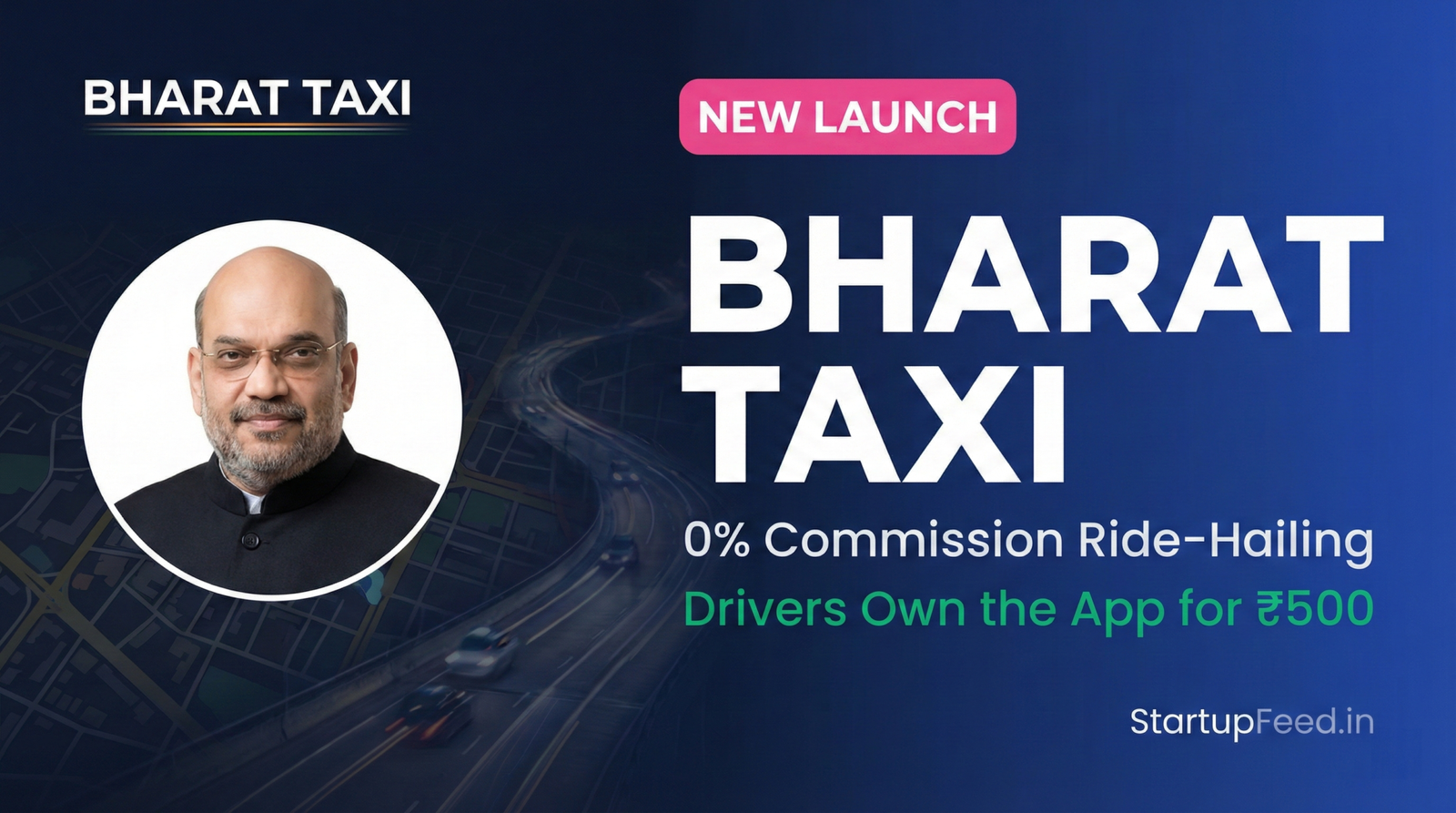
Union Home and Cooperation Minister Amit Shah stood at Vigyan Bhavan in New Delhi and formally launched India’s first — and the world’s first — cooperative-based ride-hailing platform. Registered under the Multi-State Cooperative Societies Act, 2002, and managed by Sahakar Taxi Cooperative Limited, Bharat Taxi does not extract commission. It does not surge price. And for ₹500 — less than a single Uber ride — any driver can become a co-owner of the platform they drive on.
| StartupFeed Insight | ||||||||||||||||||||||||||||||||||||||||||||||||||||||||||||||||||||||||||||||||||||||||||||||||||
| Key Angle | India’s ride-hailing market has long been a two-player duopoly (Ola + Uber) with a growing third challenger in Rapido. Bharat Taxi doesn’t just add another player — it changes the ownership architecture entirely. The platform isn’t disrupting through technology. It’s disrupting through economics. | |||||||||||||||||||||||||||||||||||||||||||||||||||||||||||||||||||||||||||||||||||||||||||||||||
| For Passengers | Fares potentially 30% cheaper than Ola/Uber on equivalent routes. Zero surge pricing. Verified ride data. Delhi Metro last-mile integration at 10 stations. If supply density scales, this is a meaningful benefit for daily commuters. | |||||||||||||||||||||||||||||||||||||||||||||||||||||||||||||||||||||||||||||||||||||||||||||||||
| For Drivers | Zero commission (vs. 20–30% on Ola/Uber). ₹5 lakh accident + health insurance. Retirement savings. No exclusivity clauses — Sarathis can still earn on Ola/Uber simultaneously. ₹10 Crore already distributed in pilot phase. | |||||||||||||||||||||||||||||||||||||||||||||||||||||||||||||||||||||||||||||||||||||||||||||||||
| For Investors | Ola’s parent ANI Technologies has been downgraded to CCC- by S&P with a 25–27% revenue decline projected for FY2026. Its 4W market share collapsed from 50%+ to 20–25%. A government-backed alternative arriving at exactly this moment is strategically significant. | |||||||||||||||||||||||||||||||||||||||||||||||||||||||||||||||||||||||||||||||||||||||||||||||||
| Prediction | By December 2026, Bharat Taxi will surpass 1 million registered Sarathis across 10+ states. The first major test: whether Delhi-NCR daily rides cross 1 lakh by year-end. If it does, a formal cooperative-sector challenge to Uber’s India business model becomes structurally credible. | |||||||||||||||||||||||||||||||||||||||||||||||||||||||||||||||||||||||||||||||||||||||||||||||||
What Is Bharat Taxi — And Why Is It Different?
Bharat Taxi was conceived under PM Narendra Modi’s ‘Sahakar Se Samriddhi’ (Prosperity through Cooperation) vision — the same cooperative philosophy that built Amul into one of India’s most successful enterprises. The Ministry of Cooperation, which Amit Shah heads, spent the first half of 2025 designing the model. The cooperative was formally established on June 6, 2025, and launched its pilot in Delhi-NCR and Gujarat in December 2025.
The structural difference from every private ride-hailing app is fundamental. On Ola or Uber, the driver is a vendor — a contractor who sells rides through a proprietary platform and pays a percentage of every fare as commission to the platform owner. On Bharat Taxi, the driver is the platform owner.
“The concept is that the one who is working hard, the one who is toiling, should get the profit, not some rich man.”
— Amit Shah, Union Home and Cooperation Minister — Vigyan Bhavan
CEO Vivek Pandya has called Bharat Taxi the world’s first mobility cooperative — a claim that appears accurate by every available comparison. Eight major cooperative organisations back the platform, including Amul, IFFCO, and NABARD, giving Bharat Taxi institutional credibility that no venture-backed startup can replicate.
How the Model Actually Works: The Economics
The Bharat Taxi financial model has three layers. Understanding all three is essential to evaluating whether the driver-ownership promise is substantive or rhetorical:
| Economics Element | The Bharat Taxi Terms | What It Means for Drivers |
|---|---|---|
| Membership cost | ₹500 one-time | Equals 5 cooperative shares; driver becomes co-owner |
| Daily platform access fee | ₹30/day | Flat fee regardless of rides completed; no per-ride deduction |
| Commission on ride earnings | Zero | Driver keeps 100% of fare income from every ride |
| Year 1–3 earnings model | Fixed fare + ₹30/day fee | Company distributes fixed returns in initial 3-year period |
| Post Year-3 profit model | 80% of profits to drivers | 20% retained as cooperative capital; 80% distributed by km driven |
| Example: ₹25 Cr earnings | ₹20 Cr → drivers | ₹5 Cr retained as cooperative capital for growth and reserves |
| Insurance coverage | ₹5 lakh per Sarathi | Personal accident + family health insurance; included in membership |
| Loan access | Cooperative bank loans | Taxis can be mortgaged through cooperative structure for financing |
| Fare transparency | 7-day advance notice | Any fare revision communicated minimum one week before effect |
| Total driver payout (pilot to date) | ₹10 Crore | Direct disbursements to Sarathis since December 2025 pilot launch |
The ₹30/day flat access fee is the clearest break from private aggregators. On Ola or Uber, a driver completing 20 rides at an average ₹150 fare pays ₹30–45 per ride — totalling ₹600–900 in daily commissions. On Bharat Taxi, the daily platform cost is fixed at ₹30, regardless of rides completed.
Shah was direct about the profit-sharing timeline: “For the first three years, you will receive fixed earnings. After that, if Bharat Taxi earns ₹25 crore, 20% will stay in the company’s account and 80% will be distributed based on kilometres driven. Apart from fare income, you will also earn profit.”
Bharat Taxi vs. Ola, Uber, Rapido: Side-by-Side
| Feature | Bharat Taxi | Ola | Uber | Rapido |
|---|---|---|---|---|
| Driver Commission | 0% (Zero) | 20–30% | 20–30% | Minimal / zero |
| Surge Pricing | None — fixed fares | Yes | Yes | Yes |
| Daily Platform Fee | ₹30 flat | Per-ride % | Per-ride % | Per-ride % |
| Driver Ownership | Yes — co-owner | No | No | No |
| Profit Sharing | 80% to drivers | N/A | N/A | N/A |
| Membership Investment | ₹500 (5 shares) | None | None | None |
| Health + Accident Cover | ₹5 lakh included | None | Partial | None |
| Exclusivity Clause | None | Yes | Yes | Yes |
| Govt Backing | Yes (MoCooperation) | No (Softbank) | No (global VC) | No |
| Daily Rides (2026) | 10,000+ (pilot) | Crores/yr | Crores/yr | Growing |
| Driver Count (2026) | 3 lakh+ | Undisclosed | Undisclosed | Undisclosed |
| Fare vs. Market | Up to 30% cheaper | Benchmark | Benchmark | Competitive |
The model’s competitive advantage is clearest in driver economics. A Bharat Taxi Sarathi completing 20 rides daily at ₹150 per ride earns ₹3,000/day gross, pays ₹30 for platform access, and keeps ₹2,970. The same driver on Ola or Uber pays 20–30% commission — ₹600 to ₹900 — keeping ₹2,100 to ₹2,400. The daily income advantage: ₹570–870 extra per day, or roughly ₹17,000–26,000 per month.
For passengers, the platform promises fares up to 30% lower on comparable routes — a direct pass-through of the zero-commission saving. The transparency pledge — no hidden charges, seven-day advance notice of any fare change — also addresses one of the most common rider frustrations with incumbent apps.
The Market: Why Now Is the Right Moment
| Market Metric | Figure | Context |
|---|---|---|
| India Taxi Market (2026) | $23.98 Bn | Growing at 7.78% CAGR to $34.87 Bn by 2031 (Mordor Intelligence) |
| India Taxi Market Alternative Est. | $20.61 Bn (2025) | Growing at 13.55% CAGR to 2033 (DataInsights); forecasts vary |
| Online ride bookings share | 70.84% (2025) | Strong platform adoption; Bharat Taxi competes directly in this segment |
| Rapido market share | ~50% of rides | Overtook Uber in monthly active users (Android) by July 2024 (Sensor Tower) |
| Ola (ANI Tech) revenue change FY2026 | -25 to -27% | S&P Global downgrade to CCC- with negative outlook; 4W share: 20–25% |
| Ola 4W market share decline | 50%+ → 20–25% | Rapid erosion over 2–3 years; Bharat Taxi arrives into this power vacuum |
| Delhi-NCR online taxi bookings | 40%+ of North India | Delhi is India’s single largest market for cab services |
| Private aggregator commission rates | 20–30% per ride | Equivalent to ₹30–50 per ride deducted; Bharat Taxi deducts zero |
| Bharat Taxi pilot daily rides | 10,000+ (Dec–Feb) | Delhi-NCR and Gujarat; target to expand nationwide within 2 years |
| Bharat Taxi registered Sarathis | 3 lakh+ (4 lakh+) | Multiple sources give 3–4 lakh; rapid growth since Dec 2025 pilot start |
The timing of Bharat Taxi’s launch is not coincidental. Ola’s parent, ANI Technologies, has been downgraded to CCC- by S&P Global Ratings with a negative outlook — projecting 25–27% revenue decline in FY2026 — while its four-wheeler market share has collapsed from above 50% to just 20–25%. Bharat Taxi is arriving into a genuine power vacuum.
BluSmart, which briefly threatened both Ola and Uber with an all-electric fleet, exited in April 2025 amid financial and governance distress, leaving a gap in the premium commuter segment. Uber rushed to fill the supply void. Bharat Taxi is now entering a market where rider loyalty has been disrupted and driver trust in private platforms is at a multi-year low.
The India taxi market is valued at $23.98 Bn in 2026, growing at 7.78% CAGR to $34.87 Bn by 2031. Delhi-NCR alone accounts for over 40% of North India’s online taxi bookings. Launching in this market first — with IGI Airport access already secured — is the right geographic prioritisation.
Partnerships That Private Startups Cannot Match
| Partner | What It Enables |
|---|---|
| Amul, IFFCO, NABARD | Founding cooperative backers — India’s most trusted cooperative brands, lending institutional credibility that no private startup can match |
| Delhi Metro Rail Corporation (DMRC) | Last-mile connectivity partnership at 10 major metro stations via bike taxi, e-auto, CNG auto and cab — passengers can plan and pay for end-to-end journeys on one platform |
| Delhi Police | Joint Command and Control Centre with real-time ride monitoring, SOS alerts, and rapid emergency response; 35 physical grievance booths across Delhi |
| Delhi Airport / DAPS / GMR | White cab services at multiple IGI Airport terminal parking locations; 20% discount on ₹245/trip pickup fee for Year 1 — opens premium airport ride corridor |
| MeitY / NeGD (Digital India) | Advisory and technical MoU enabling DigiLocker integration, UMANG access, API Setu, paperless onboarding, and cashless payment infrastructure |
| Delhi Tourism & Transport Corp. | Support for Delhi airport Kaali Peeli services — traditional taxi category brought into cooperative digital ecosystem |
| Cooperative Banks | Sarathis can mortgage their vehicles through cooperative banking system — enabling drivers who own their cab to access structured low-interest loans |
The partnership architecture is arguably Bharat Taxi’s most underappreciated advantage. A private startup launching a ride-hailing app must spend years and hundreds of crores building trust with airport authorities, metro corporations, police departments, and digital government infrastructure. Bharat Taxi arrived at launch with all of these already in place — as a government-backed cooperative, the institutional doors that remain closed to private aggregators opened immediately.
The DMRC last-mile integration is particularly significant. Metro-to-cab handoff is one of the most painful points in Indian urban commuting, and Bharat Taxi’s integration at 10 stations — covering bike taxis, e-autos, and cabs on a single payment — addresses a gap that neither Ola nor Uber has solved at an institutional level in Delhi.
Bike Didi: The Women’s Empowerment Layer
Bharat Taxi has implemented ‘Bike Didi’ — a women-driver initiative under which over 150 women have already joined the platform as two-wheeler Sarathis. For women commuters, this also addresses a long-standing safety concern: the option to specifically request a female driver for late-night or solo rides. The cooperative structure’s social security provisions — health insurance, accident coverage — are particularly meaningful for women in the informal economy who typically have zero income protection in traditional gig arrangements.
Key Risks: What Could Stop Bharat Taxi
| Risk Factor | Why It Matters |
|---|---|
| Cooperative tech execution | India’s cooperative sector has thrived in dairy (Amul), banking, and agriculture — but technology-intensive, real-time marketplace coordination is a categorically harder problem. Maintaining platform quality without private VC discipline is the central operational risk. |
| Supply density cold-start | Riders won’t switch platforms unless supply is reliable. 10,000 daily rides across Delhi-NCR is early-stage for a city of 30+ million. Until density matches Ola/Uber’s coverage reliability in every neighbourhood, convenience advantage stays with incumbents. |
| 3-year profit deferral | Sarathis receive fixed returns for Years 1–3, with profit-sharing only kicking in Year 4. For drivers in financial need, this deferred payoff may reduce the incentive to prioritise Bharat Taxi rides over competitors where earnings are immediate. |
| Political dependency risk | Launched by a sitting Union Minister, Bharat Taxi’s institutional muscle depends significantly on political continuity and ministry priority. Any change in government focus or leadership priorities could slow expansion, partnerships, or regulatory support. |
| Surge-free pricing and peak demand | Zero surge pricing sounds pro-consumer — but surge pricing is also how platforms incentivise driver availability during peak hours. Without it, supply may thin exactly when demand is highest, creating the same reliability problem that damaged BluSmart. |
| Namma Yatri precedent | Namma Yatri’s zero-commission model (backed by ONDC) showed genuine driver enthusiasm but struggled to scale beyond Bengaluru despite $11 Mn in funding. The cooperative model must solve what Namma Yatri hasn’t yet: national supply density. |
The Namma Yatri comparison deserves emphasis. Bengaluru’s zero-commission, open-network ride app proved that the driver enthusiasm for non-exploitative platforms is real — its adoption among auto drivers was rapid and genuine. But Namma Yatri, despite $11 Mn in funding and ONDC backing, has not meaningfully scaled beyond its home city. Bharat Taxi must solve what Namma Yatri hasn’t: converting institutional backing into booking density across diverse geographies simultaneously.
Who Should Be Watching
| Stakeholder | Why Bharat Taxi Changes Their Game |
|---|---|
| Ola (ANI Technologies) | Already downgraded to CCC- by S&P, losing market share from 50%+ to 20–25% in 4W. A government-backed competitor entering the exact segment it’s retreating from is a strategically dangerous timing. Ola needs a story. Bharat Taxi just complicated it. |
| Uber India | India is one of Uber’s most important global markets. It entered cooperative-adjacent territory (open platform policies, driver welfare features) but cannot replicate the ownership model. Bharat Taxi’s IGI Airport deal directly threatens Uber’s most profitable ride corridor. |
| Rapido | Controls ~50% of India’s ride-hailing market through bike taxis. Bharat Taxi’s 2W category (Bike Didi, bike taxis) is a direct overlap. Watch whether Rapido accelerates its driver welfare narrative in response. |
| Namma Yatri | India’s existing zero-commission, ONDC-backed ride platform. Bharat Taxi is philosophically similar but institutionally far better resourced. The two could collide — or could integrate — as ONDC expands mobility coordination. |
| India’s 15 million gig workers | The gig economy’s unresolved crisis: no benefits, no ownership, no voice. Bharat Taxi is the first government-backed model that structurally answers this. If it works, every other gig sector — food delivery, freelance logistics — will face pressure to follow. |
| State governments | Bharat Taxi’s Multi-State Cooperative structure means every state transport ministry is a potential institutional partner. Watch Rajasthan, UP, Maharashtra for early Bharat Taxi expansion announcements — these are the next critical growth markets. |
What’s Next: The Two-Year Road Map
- Immediate: Scale Delhi-NCR daily rides from 10,000 toward 1 lakh — the milestone that proves the cooperative model can compete on supply density, not just ideology
- Q2 2026: Expand pilot to 5+ additional cities — likely Bengaluru, Mumbai, Hyderabad, Chennai, and Jaipur — markets where Ola/Uber disruption and driver income complaints are highest
- 2026: Establish dedicated Sarathi support centres in every state; deepen DigiLocker + UMANG integration for fully paperless driver onboarding
- 2027: Begin Year-3 profit-distribution cycle for earliest Sarathis — the moment that will either validate or complicate the cooperative promise
- 2028: National expansion target — ‘Kashmir to Kanyakumari, Dwarka to Kamakhya’ — Amit Shah’s stated geographic ambition
The cooperative model as a vehicle for economic equity is not new to India. Amul showed it in dairy. IFFCO showed it in fertilisers. NABARD built a rural banking ecosystem on it. Bharat Taxi is the first attempt to apply that philosophy to the gig economy’s most visible, most contested, most urbanised sector.
Whether it succeeds will depend less on technology — the app works, the integrations are real, the institutional backing is genuine — and more on the mundane challenge that breaks every Indian mobility startup: keeping a cab available when you need one, in the neighbourhood you’re in, in less time than it takes to open a competitor’s app.
The Sarathi is now the Malik. The question is whether being the Malik is enough to win.

