
Quick Take
|
Lead
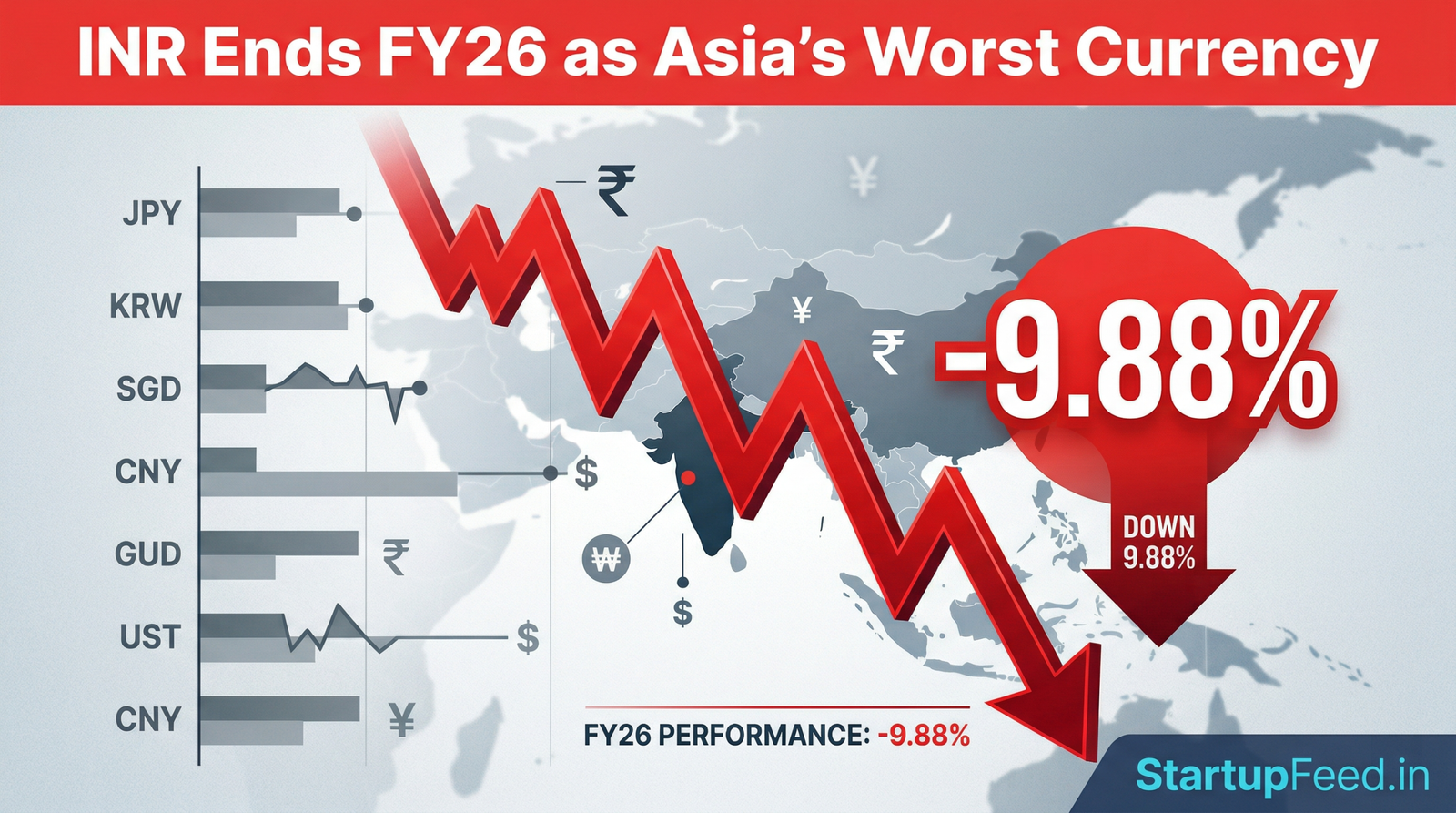
The Indian Rupee closed FY26 at 94.78 against the US Dollar — a 9.88% annual decline that marks Asia’s worst currency performance of the year and the Rupee’s steepest fall in 14 years. Driven by a ‘perfect storm’ of surging crude oil prices, persistent foreign portfolio investor outflows of Rs 96,974 crore, and the eruption of a West Asia conflict that pushed Brent crude toward $115 per barrel, the Rupee breached the psychologically significant 95-per-dollar mark intraday before closing the year at 94.78. The Reserve Bank of India sold $55 billion in spot markets trying to contain the damage — and still watched the currency shed nearly a tenth of its value.
The “So What” Paragraph
The FY26 Rupee collapse is not a one-quarter blip — it signals a structural shift in how India’s currency behaves under external shocks. With the RBI abandoning its tight-band strategy and pivoting to ‘managed depreciation’, India’s founders, CFOs, and startup investors must now price in a higher-volatility, structurally weaker Rupee as the baseline for FY27 planning. The era of the Rupee hovering around Rs 83–85 per dollar is, by most analyst accounts, over.
| StartupFeed Insight What this means: India’s currency weakness in FY26 was entirely externally driven — not a domestic growth story gone wrong. GDP grew ~7.4% even as the Rupee cratered. That divergence is the key insight for founders. Winners from Rupee weakness:
Losers from Rupee weakness:
Action required: Founders with USD cost exposure should hedge at least 3 months forward. CFOs should model scenarios at Rs 94, Rs 97, and Rs 100 per dollar for FY27 budget planning. |
What Happened — The FY26 Rupee Timeline
The Rupee began FY26 at approximately 83.50 per dollar — a level it had held within a tight band for over two years under the RBI’s active management. What followed was a year-long dismantling of that stability.
| Period | USD/INR level | Key trigger |
| Apr 2025 (FY26 start) | ~83.50 | Stable; RBI maintaining tight band |
| Jul–Aug 2025 | ~85–87 | US tariffs on India (50% rate from Aug 27); FPI outflows Rs 52,734 Cr |
| Nov–Dec 2025 | ~89–91 | Rupee breaches 91 — steepest among Asian peers at the time |
| Feb–Mar 2026 | ~92–93 | West Asia conflict escalates; crude surges toward $115/bbl |
| Mar 20, 2026 | 93.81 | Historic low; RBI issues $100M Net Open Position cap to banks |
| Mar 31, 2026 (close) | 94.78 | FY26 close; intraday breach of 95; full-year decline: 9.88% |
The Three Drivers of the Rupee’s Collapse
- Crude oil & the West Asia conflict — India imports 90% of its crude oil. When the West Asia conflict erupted in February 2026 and threatened the Strait of Hormuz, Brent crude surged toward $115 per barrel. Every $10 rise in oil adds approximately $15 billion to India’s annual import bill, directly widening the current account deficit and increasing demand for dollars — at the Rupee’s expense. The merchandise trade deficit had already hit $24.53 billion in November 2025 before the conflict escalated.
- FPI outflows — structural, not episodic — Foreign portfolio investors pulled Rs 96,974 crore out of Indian equities in FY26 — lower than FY25’s Rs 1.27 lakh crore, but still substantial. Monthly spikes were severe: Rs 34,993 crore in August 2025 and Rs 35,962 crore in January 2026 alone. Each outflow creates a surge in dollar demand as investors convert Rupee proceeds to USD — putting direct downward pressure on the exchange rate.
- US tariffs & dollar strength — The US imposed a 50% tariff on Indian goods effective August 27, 2025, triggering a risk-off selloff in Indian assets. Simultaneously, a globally strengthening US dollar — as investors sought safe-haven assets amid geopolitical uncertainty — made every emerging market currency weaker. The Rupee, given its structural oil dependence and high FPI sensitivity, bore a disproportionate share of this pressure.
Asia Currency Performance — FY26 vs USD
| Currency | Country | FY26 Change | vs INR performance |
| MYR | Malaysia | +9.69% | Best in Asia — INR underperformed by 19.57 ppts |
| CNY | China | +5.27% | 2nd best — trade surplus strength |
| THB | Thailand | +4.11% | Tourism recovery + exports |
| SGD | Singapore | +2.93% | Safe-haven, strong current account |
| TWD | Taiwan | +1.47% | Tech export resilience |
| HKD | Hong Kong | +0.12% | USD peg — near flat |
| IDR | Indonesia | -1.23% | Commodity-linked but better than INR |
| PHP | Philippines | -2.67% | Remittance-supported; better than INR |
| JPY | Japan | -4.44% | Rate differential with US |
| VND | Vietnam | -6.15% | Manufacturing base; still better than INR |
| PKR | Pakistan | -7.82% | Debt stress — but still better than INR |
| INR | India | -9.88% | WORST in Asia — 14-year low decline |
How the RBI Responded
The RBI’s FY26 forex strategy represented a significant departure from its historical approach. Rather than defend specific Rupee levels, the central bank pivoted to ‘managed depreciation’ — allowing the currency to slide in an orderly manner while deploying reserves to prevent a free-fall.
| RBI Action | Details | Outcome |
| Spot market dollar sales | $55 billion sold through January 2026 | Slowed depreciation pace; reserves held above $700B |
| Liquidity injection | Rs 2.9 lakh crore pumped since Jan 2025 | Stabilised banking system; limited currency impact |
| OMO bond purchases | Rs 50,000 Cr bond buyback auctions | Capped bond yield rises; 10-yr G-sec at 7.04% |
| Net Open Position cap | Banks limited to $100M NOP onshore (eff. Apr 10, 2026) | Short-term Rupee rally of 156 paise; gains reversed |
| Policy rate cuts | 100 bps repo rate reduction in FY26 | Boosted growth; limited FX support |
| FPI investment limit hike | Individual FPI cap raised from 5% to 10% in listed firms | Designed to attract long-term FPI flows in FY27 |



FY26 was a perfect storm of external shocks, capital outflows, and structural vulnerabilities. Unlike FY12, FY26 depreciation is externally driven — oil, geopolitics, capital flight, amplified by India’s import dependence.”
— Sunal Sodhani, Head of Treasury (India), Shinhan Bank
India’s economy is strong, our fiscal situation is strong, and the entire world is praising our fiscal deficit management.”
— Nirmala Sitharaman, Finance Minister of India
Impact on Indian Startups — Sector by Sector
| Sector | Impact | Why | Action for Founders |
| IT / SaaS (USD revenue) | Positive | Dollar earnings, INR costs = margin boost | Accelerate USD contract signings |
| Pharma / Biotech exports | Positive | Export revenues up in INR terms | Lock in forward contracts to capture gains |
| EV / Hardware startups | Negative | Component imports (chips, batteries) cost 9.88% more | Hedge USD payables; renegotiate supplier terms |
| D2C with China sourcing | Negative | USD-denominated COGS inflation | Explore India-sourced alternatives |
| Edtech (overseas) | Negative | USD fees for foreign university partnerships costlier | Reprice USD offerings or absorb margin hit |
| Fintech (lending) | Negative | External commercial borrowings in USD now costlier to repay | Prefer INR debt; avoid unhedged USD borrowing |
| Cloud-heavy SaaS | Negative | AWS, GCP, Azure bills in USD — 9.88% infra cost rise | Migrate to RBI-backed cloud or negotiate INR billing |
| Export-led B2B SaaS | Positive | INR costs, global USD revenues — natural hedge | Increase USD ARR targets aggressively in FY27 |
FY27 Action Checklist for Startup Founders & CFOs
- Audit all USD-denominated expenses (cloud, SaaS tools, imports, ECB repayments) — quantify the FY27 cost impact at Rs 95–97/USD baseline
- Hedge at least 3 months of USD payables via forward contracts — RBI’s April 10 NOP cap creates better hedging conditions
- Reprice any USD-denominated contracts with Indian clients to INR — reduce bilateral currency risk
- Model three FY27 scenarios: INR at Rs 92 (RBI stabilisation), Rs 95 (base), Rs 97 (escalation) — stress-test your P&L
- For startups raising USD funding: accelerate drawdowns before further Rupee weakness increases INR-equivalent dilution
- IT and pharma startups: lock in forward sales of USD receivables at current favourable rates to protect margin gains
- Startups with USD debt: consult treasury advisors on cross-currency swaps or refinancing to INR — priority in H1 FY27
What’s Next — FY27 Rupee Outlook
Most analysts project the USD/INR pair will trade in a broad 92–97 range in FY27, with the trajectory hinging on three variables: the pace of crude oil price normalisation (contingent on West Asia conflict resolution), the direction of FPI flows as global risk appetite recovers, and the Fed’s interest rate path.
| Variable | Bull case (INR strengthens) | Bear case (INR weakens further) |
| Crude oil | West Asia ceasefire; Brent falls to $80 | Conflict escalates; Brent sustains above $110 |
| FPI flows | Global risk-on; EMs attract capital | Fed holds rates high; EM outflows continue |
| US tariffs | India-US trade deal signed; tariffs eased | Additional tariff rounds on Indian goods |
| RBI stance | Aggressive intervention at Rs 92–93 | Managed depreciation continues to Rs 97+ |
| INR range | Rs 90–92 | Rs 95–100 |
Finance Minister Nirmala Sitharaman’s assertion that India is ‘absolutely going fine’ on the currency front reflects the government’s view that strong GDP growth (~7.4% in FY26) and resilient forex reserves ($700B+) provide a sufficient buffer. The market is less sanguine — and for startup founders navigating import costs, USD debt, and global expansion, the Rupee’s new volatility regime demands active treasury management, not passive observation.
Liked this story? Follow StartupFeed on Google so our reporting reaches you first.