
Quick Take:
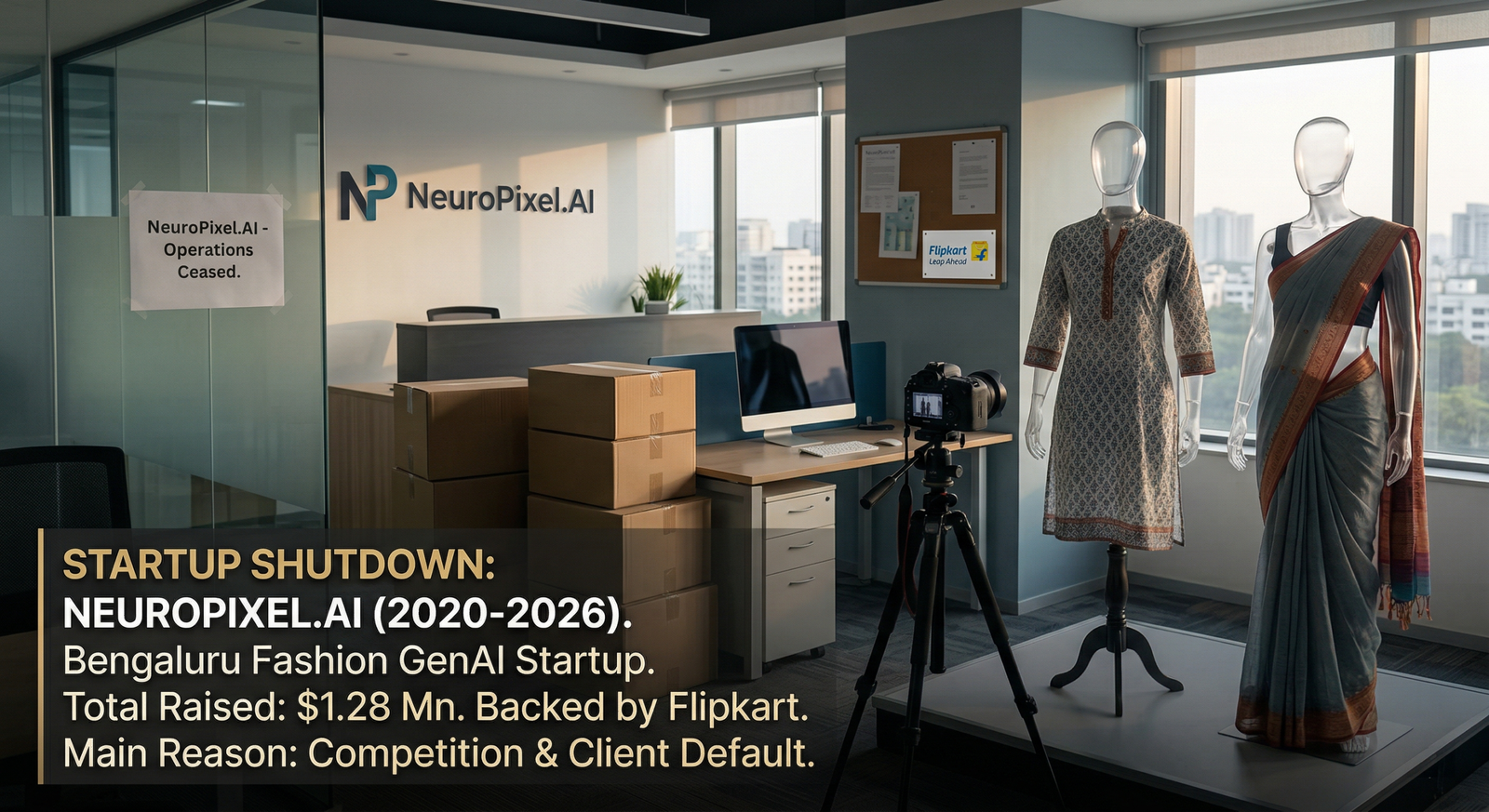
- Company: NeuroPixel.AI — AI fashion cataloguing & virtual try-on startup
- Total Raised: $1.28 Mn from Flipkart, Inflection Point Ventures, Entrepreneur First
- Peak Valuation: $5.81 Mn (Rs 46.3 Cr) — September 2022
- Employees Affected: ~17 (as of April 2025)
- Reason: Competition from Google GenAI models; major client default; no distribution scale
NeuroPixel.AI, a Bengaluru-based GenAI startup that built proprietary AI tools for fashion e-commerce cataloguing and virtual try-ons, has wound down service operations after six years of building — ending a journey backed by Flipkart, Inflection Point Ventures, and Entrepreneur First with $1.28 Mn (Rs 10.7 Cr) in total funding.
The shutdown signals a broader reckoning for India’s vertical AI application layer: proprietary models alone cannot sustain a business when Google, Adobe, and other foundation-model giants deliver comparable output quality at scale, at a fraction of the cost.
StartupFeed Insight
What went wrong: NeuroPixel.AI built world-class proprietary tech but could not survive Google commoditising the same output quality at near-zero cost.
Warning signs in hindsight:
– Revenue of just Rs 86.6 Lakh in FY24 after four years of operations — far too thin for a $5.81 Mn-valued company.
– Heavy dependence on a single major client in a B2B SaaS model with no revenue diversification buffer.
– No Series A raise beyond $1.28 Mn total — insufficient runway to withstand foundation-model disruption.
Lesson for founders: Proprietary AI models alone cannot create moat. Distribution, pricing power, and multi-client revenue diversification are non-negotiable before foundation models catch up.
The Rise
Founded in late 2020 by Arvind Venugopal Nair (Co-Founder & CEO) and Amritendu Mukherjee (Co-Founder & CTO), NeuroPixel.AI originated at Entrepreneur First’s Bengaluru cohort. The founding duo — with researchers from IISc, ISB, and IITs — built a proprietary DeepNet framework that solved a real, expensive problem: fashion cataloguing.
Their core product enabled e-commerce brands to photograph apparel on a mannequin and then generate AI-rendered catalogue images with lifelike models in varied poses and sizes. The startup claimed a 70% reduction in image production costs and up to 90% improvement in process turnaround time.

Clients including Myntra, Fabindia, Van Heusen, and Decathlon validated the product. The company raised $825K (Rs 6.8 Cr) in August 2021 in a Seed round led by Inflection Point Ventures. By September 2022, Flipkart invested Rs 2.3 Cr via its Leap Ahead accelerator, valuing NeuroPixel.AI at $5.81 Mn — a credible early-stage milestone.
At its peak, the startup was featured in Wired and showcased at Prime Venture Partners’ generative AI events. It held patents, a team of PhDs, and a pay-per-image model that made AI-powered fashion content accessible to SME brands.
The Fall
Three compounding forces ultimately ended NeuroPixel.AI’s service operations. First, Google’s launch of NanoBanana Pro — a powerful image generation model — commoditised the core capability NeuroPixel.AI had spent years building proprietary infrastructure for.
Second, the startup’s distribution never scaled. Despite comparable output quality, it could not compete on reach, pricing, or enterprise sales cycles against players with existing distribution muscle. Revenue remained at just Rs 86.6 Lakh in FY24 — inadequate for a company valued at $5.81 Mn in 2022.
Third, a major client default became the fatal blow. The startup went unpaid for over six months after losing its key account, draining the cash buffer that a company of this stage could ill afford to lose.
What Went Wrong — Analysis
- Single-Client Dependency: Revenue concentration risk: A B2B SaaS startup with a single dominant client and Rs 86.6 Lakh in annual revenue has no buffer when that client defaults. Multi-client diversification should have been a priority at Series A stage.
- Under-Capitalised Runway: Total funding of $1.28 Mn across four years was insufficient to build enterprise sales capability and withstand 6+ months of non-payment from a major client. Without a Series A, the company had no financial cushion.
- Technology-Only Moat: NeuroPixel.AI’s edge was its proprietary DeepNet framework — but this became a liability the moment Google launched a comparable model at scale. Moat must come from distribution, data network effects, or switching costs, not just model quality.
- No Follow-On Capital: The startup raised its last known round in September 2022, just before GenAI foundation models exploded globally. It did not raise a growth round to pivot strategy, expand distribution, or acquire more clients during 2023–2025.
- Pricing Model Fragility: The pay-per-image model is transactional and easy to replace. A subscription model with long-term enterprise contracts would have created stickier revenue and better client retention incentives.
Funding Journey
| Round | Date | Amount | Lead Investor | Valuation |
|---|---|---|---|---|
| Seed (EF) | March 2021 | Undisclosed | Entrepreneur First | — |
| Seed | Aug 2021 | $825K (Rs 6.8 Cr) | Inflection Point Ventures | — |
| Pre-Series A | Sep 2022 | $299K (Rs 2.3 Cr) | Flipkart | $5.81 Mn |
| Total | 2021–2022 | ~$1.28 Mn (Rs 10.7 Cr) | — | $5.81 Mn |
NeuroPixel.AI’s last funding round was in September 2022 — over three years before its closure. No Series A was raised, leaving the company operating on a thin capital base through one of the most turbulent periods in AI history.
Founder Statement
“We do still have a unique tech stack that is comparable to Google’s Nanobanana Pro in terms of output quality, and at a fraction of the cost, which we are in discussions to monetise, but for all practical purposes we are shuttering service operations.”
— Arvind Venugopal Nair, Co-Founder & CEO, NeuroPixel.AI
The quote is revealing in two ways. Nair’s assertion that the tech stack remains competitive with Google’s model — while simultaneously shutting down — underscores the core paradox: in the GenAI era, output quality parity is table stakes. Distribution and scale are the only differentiators that survive.
The company says it is exploring monetisation of its technology stack, suggesting a potential acqui-hire, IP licensing deal, or white-label arrangement. Founders should watch that space.
Employee Impact
NeuroPixel.AI had approximately 17 employees as of April 2025, per Tracxn data. The shutdown affects this team — a mix of AI/ML researchers, product engineers, and business development professionals, many of whom joined to build at the intersection of deep learning and fashion commerce.
If you are a former NeuroPixel.AI employee and wish to share your experience, reach out to StartupFeed.in at editor@startupfeed.in.
The Broader Wave: Indian GenAI Shutdowns 2025–2026
NeuroPixel.AI’s closure is part of a documented pattern. Startups building narrow, vertical solutions on top of or competing with foundational AI models are struggling as those models improve rapidly — eliminating the differentiation that once justified venture backing.
| Company | Sector | Date | Reason |
|---|---|---|---|
| NeuroPixel.AI | Fashion GenAI | April 2026 | Google NanoBanana Pro competition + client default |
| Alle | AI Fashion Stylist | Jan 2026 | No product-market fit after multiple pivots |
| subtl.ai | AI Productivity | 2025 | Funding constraints + weak differentiation |
| CodeParrot | AI Dev Tools | 2025 | Funding crunch + lack of scale |
| Astra | AI Application | 2025 | Funding pressure + distribution failure |
Lessons for the Ecosystem
- Raise before the storm: NeuroPixel.AI’s last round was in 2022. By 2023, GenAI had transformed the landscape. Founders must anticipate disruption windows and raise capital 18 months before they need it.
- Distribution is the moat, not the model: Google, Meta, and Adobe win because they have the pipes into millions of businesses — not because their models are always better. Vertical AI startups must build proprietary distribution.
- Client concentration is an existential risk: A single client default should never be fatal. Founders must cap any single client at 20-25% of revenue before raising a growth round.
- Monetise IP early: NeuroPixel.AI may yet generate value through IP licensing or an acqui-hire. Startups with strong tech stacks should explore these routes before operational shutdown — not after.
- The pay-per-use model invites churn: Subscription and enterprise-contract structures create switching costs. Transactional pricing makes replacement trivially easy for clients.
Liked this story? Follow StartupFeed on Google so our reporting reaches you first.