QUICK TAKE (30-second read)
|
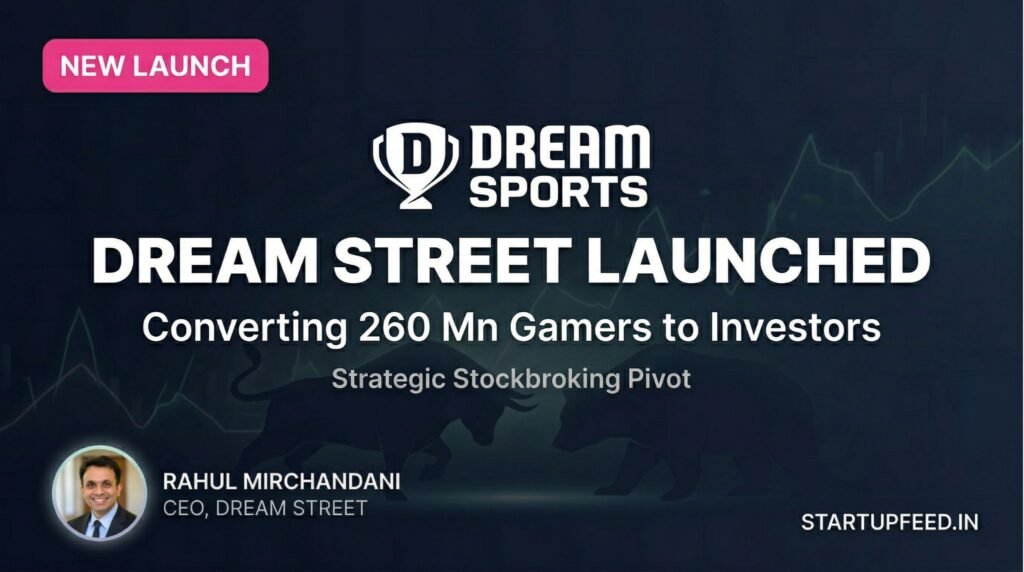
Dream Sports, the $8 Bn parent of India’s largest fantasy sports platform Dream11, is entering the stockbroking sector with a new platform called Dream Street — appointing ex-Chief Product Officer Rahul Mirchandani as its CEO. The company has secured all required SEBI licences and is currently in internal testing, with co-founder Harsh Jain confirming a public launch “soon” to Moneycontrol. The move takes Dream Sports’ financial services ambition — seeded with the Dream Money wealth management app in August 2025 — to a full-fledged direct equity trading platform.
Dream Street is not simply another discount broker. It is India’s most unusual stockbroking bet: a company bringing 260 million registered users — wired for risk, competition, and micro-money decisions through fantasy sports — into a regulated investment product. If Dream Sports can convert even 1–2% of its fantasy user base into active stock investors, Dream Street launches with 2.6–5.2 million potential investors from day one — larger than most Indian brokers’ entire user bases.
STARTUPFEED INSIGHT
|
Dream Street — What Is It?
Dream Street is Dream Sports’ dedicated stockbroking platform — a step beyond Dream Money, which was launched in August 2025 to offer gold investments, fixed deposits, and expense tracking as a first fintech foray. Dream Street specifically enters the equity trading space, targeting retail investors who want to buy and sell stocks, potentially ETFs, and derivatives.
The product logic is clear. Dream Money provided a soft entry point — low-risk, low-ticket products (Rs 10 gold SIP, Rs 1,000 FDs) that conditioned Dream11’s gaming user base to think of Dream Sports as a financial services brand. Dream Street escalates the wallet share ambition: bringing users directly into equity markets where brokerage commissions, interest on margin, and annual maintenance charges create a recurring revenue model that was impossible in the banned gaming model.
Dream Sports’ Full Fintech Stack
| Product | Launch | What It Offers |
| Dream Money | Aug 2025 | Digital gold (SIP from Rs 10, via Augmont); Fixed deposits (from Rs 1,000, via Upswing/Suryoday SFB/Shivalik SFB/Shriram Finance); expense tracking (AI-powered, via Sigfyn); mutual funds & stocks monitoring |
| Dream Street | Imminent (2026) | Full-fledged stockbroking — direct equity trading, potentially ETFs and derivatives; SEBI stockbroker licence obtained; CEO: Rahul Mirchandani; competing directly with Groww, Zerodha, Angel One |
The two-product architecture mirrors the classic fintech progression: savings products build trust and KYC, then broking converts trust into transaction volume. Dream Money seeded the financial identity; Dream Street monetises it.
The CEO — Rahul Mirchandani
| Aspect | Details |
| New Role | CEO, Dream Street (stockbroking arm of Dream Sports) |
| Previous Role | Chief Product Officer (CPO), Dream11 — July 2020 to restructuring; also led Dream Money in its initial phase |
| Education | MBA (Finance & Marketing), IE Business School; BS Finance, Drexel University |
| Prior Experience | SVP Product & Revenue, Pepperfry; VP Product & Revenue, Dream11; Head of Category Strategy roles across fintech and e-commerce |
| Domain Fit | Finance degree + fintech product leadership + 6 years building Dream11’s revenue stack — precisely the profile needed to build a SEBI-compliant, user-first broker from scratch |
“At Swiggy, our mission is to deliver unparalleled convenience to our consumers.”
— Note: No direct Mirchandani quote on Dream Street is yet available at publication.
Co-founder Harsh Jain confirmed to Moneycontrol that all required SEBI licences for Dream Street have been obtained and the platform is currently in internal testing, with a public launch imminent. The Alphabet-style restructuring of Dream Sports — where each vertical runs as a semi-autonomous startup with its own CEO — means Mirchandani has full operational independence to build Dream Street, with Dream Sports retaining majority ownership.
Why This Matters — The Strategic Logic
- The user base advantage is structural, not tactical.
Dream11’s 260–300 million registered users are not generic internet users. They are Indians who have demonstrated willingness to make micro financial decisions under uncertainty — picking players, predicting match outcomes, managing a virtual portfolio of athletes. That cognitive muscle is directly transferable to equity investing. Groww built its first 10 million users through patient acquisition campaigns. Dream Street can potentially acquire them from within an existing engaged user community.
- The gaming ban created a mandated pivot window.
PROGA 2025 — India’s Promotion & Regulation of Online Gaming Act — eliminated 95% of Dream Sports’ revenues overnight. This was not a gradual competitive threat but an existential regulatory shock. Dream Sports has a 3–4 year runway without fresh capital, per Harsh Jain’s own statements. Dream Street represents the most direct revenue-replacement path: India’s equity market generates Rs 30,000+ Cr annually in brokerage and allied income, and Dream Sports needs a large addressable market to rebuild meaningful scale.
- The stockbroking race is already crowded — but Dream Street has a differentiated entry point.
Multiple players are entering Indian stockbroking simultaneously: Jio Financial Services, CRED (via Spenny acquisition), MobiKwik, PhonePe (Share.market), and others. But none of them have 260 million users already conditioned to risk-taking in a digital environment. Dream Street’s moat is not technology — it is the psychological and behavioural compatibility of its existing user base with equity investing.
Competitive Landscape — Who Dream Street Is Taking On
| Broker | Active Investors | Dream Street’s Angle |
| Groww | ~8 Mn (est.) | Dream Street’s psychographic overlap with Groww’s young mobile-first user is highest — direct competitive threat in the 18–30 age cohort; Groww lost ~5% active users in H1 2025 amid market fatigue |
| Zerodha | ~8 Mn (est.) | Zerodha’s edge is serious traders who use kite for charting — Dream Street is unlikely to threaten this segment; Zerodha should worry more about top-of-funnel new user acquisition being intercepted |
| Angel One | ~7 Mn (est.) | Tier-2/3 city focus overlaps with Dream11’s user geography — could see direct user competition in Hindi-speaking markets |
| Upstox | ~3.5 Mn (est.) | RKSV-backed, mobile-first — similar target demographic but lacks Dream Street’s community engagement advantage |
| PhonePe Share.market | Early stage | Most direct structural competitor — large existing user base, mobile-first, UPI-integrated; will compete for same non-investing users converting to equity |
| CRED (via Spenny) | Early stage | Targets premium/affluent users — different from Dream Street’s risk-taking sports demographic; low overlap |
India’s equity market penetration is approximately 3% of the active population despite the retail investment boom. Dream Street does not need to steal users from Groww or Zerodha — it needs to convert first-time investors from within its own ecosystem. The competitive battleground is the unactivated user, not the existing investor.
How Dream Sports Got Here — The Full Pivot Story
| Timeline | What Happened |
| FY22–FY24 | Dream Sports at peak — FY24 revenue Rs 7,934 Cr, net profit Rs 1,295 Cr; 95% from real-money gaming (paid fantasy contests) |
| Aug 2025 | PROGA 2025 signed into law — bans online games that require real money deposits. Dream11 immediately suspends all paid contests; 95% revenue wiped overnight |
| Aug 2025 | Dream Money app launched — gold SIPs (Rs 10 minimum, Augmont partnership), FDs (Rs 1,000 minimum), expense tracking; 50,000+ downloads in first week |
| Dec 2025 | Dream Sports splits into 8 independent units (Alphabet model): Dream11 (second-screen fan platform), FanCode, DreamSetGo, Dream Cricket, Dream Money, Dream Sports AI, Dream Horizon, Dream Sports Foundation; 100+ senior executives exit |
| FY25 Results | Revenue falls 15% to Rs 6,759 Cr; net loss Rs 479 Cr (vs Rs 1,295 Cr profit FY24); includes one-time tax expense and director benefits charge |
| Mar 2025 | Dream Sports reverse flips domicile from Delaware to India — linked to potential future IPO |
| Mar 2026 | Dream Street (stockbroking) announced: SEBI licences secured, internal testing underway, Rahul Mirchandani as CEO, public launch imminent |
Dream Sports’ 8 Business Units — The Full Picture
| Unit | CEO/Lead | What It Does |
| Dream11 (new) | Restructured | Free-to-play second-screen fan engagement: watch-alongs, live commentary, DreamBucks in-app currency, creator-led content; onboarding Swiggy, Astrotalk, Tata Neu as advertisers |
| FanCode | Existing | Multi-sport media platform; acquired ISL exclusive broadcast rights (Feb 2026); content, commerce, community |
| DreamSetGo | Existing | Sports travel and experiences platform |
| Dream Cricket | Arpith Kanade (Head of Studio) | India’s first AAA cricket mobile game; 25 Mn users in <1 year; expanding globally |
| Dream Money | Rahul Mirchandani* | Wealth management: gold SIPs, FDs, expense tracking, mutual funds monitoring; foundation for Dream Street |
| Dream Street | Rahul Mirchandani (CEO) | NEW — Full-service stockbroking; SEBI licences secured; public launch imminent; targets Dream Sports’ 260 Mn users |
| Dream Sports AI | Amit Sharma (ex-CTO) | AI unit: Dream Play (sports analytics), RushLine (cricket predictions) |
| Dream Horizon | Amit Garde | Open-source technology division |
* Mirchandani’s role appears to have transitioned from Dream Money to Dream Street CEO as the stockbroking platform takes shape. Dream Money may now operate under separate leadership.
What’s Next
The imminent public launch is the critical event. Dream Street’s onboarding UX — whether it feels like an extension of Dream11’s gamified interface or a sterile brokerage form — will determine its user conversion rate. The hypothesis is that sports fans who pick IPL teams based on player statistics are closer to being equity investors than the general population; Dream Street’s product design must make that transition feel natural, not jarring.
The revenue model will also be scrutinised. Discount broking margins are thin — Rs 20 per trade or 0.03% brokerage, with income primarily from options trading fees, interest on margin funding, and annual maintenance charges. At 3–5 Mn users but low trading frequency (new investors tend to be SIP-first, not active traders), Dream Street’s contribution to Dream Sports’ Rs 6,759 Cr revenue base will take years to become material. The company’s stated 3–4 year capital runway provides that time.
The larger question is whether Dream Sports is building a financial services conglomerate or a collection of defensive pivots. If Dream Street, Dream Money, and Dream Sports AI can generate combined revenues of Rs 2,000–3,000 Cr within 3 years, the company has rebuilt a meaningful portion of what PROGA 2025 took away. If not, the $8 Bn valuation from 2021 may prove very difficult to reclaim — a calculation that Harsh Jain’s team knows intimately.
Liked this story? Follow StartupFeed on Google so our reporting reaches you first.