


QUICK TAKE:
| Company: Pronto | Instant home services platform | Bengaluru, India
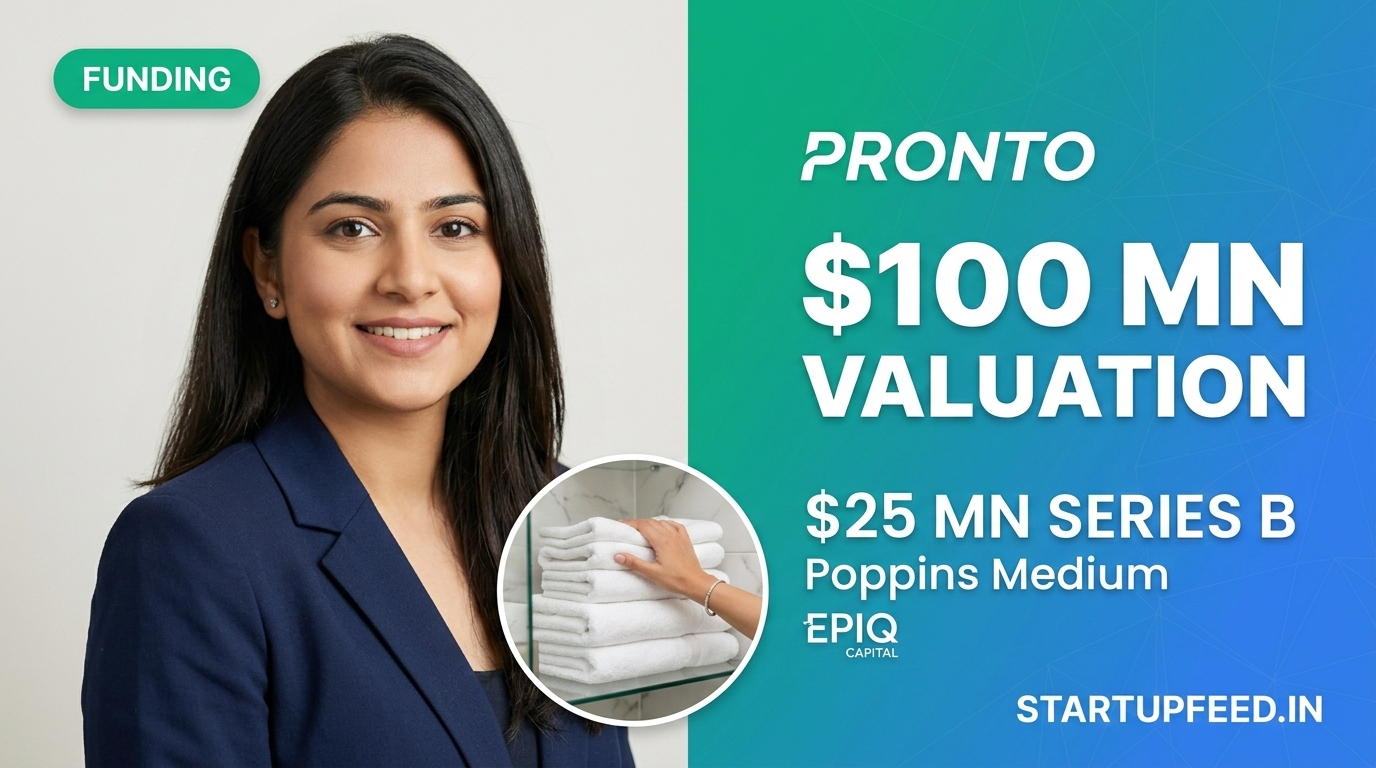
Round: Series B | $25 Mn (Rs. 228.9 Cr) Lead: Epiq Capital (Rishi Navani, Founder & Managing Partner) Co-investors: Glade Brook Capital, General Catalyst, Bain Capital Ventures (all existing) Post-money Valuation: $100 Mn Total Raised to Date: ~$40 Mn | Series A: $11 Mn (Aug 2025) | Stealth exit: $12.5 Mn (May 2025) |
Founder: Anjali Sardana, CEO (23 years old) | Founded: April 2025
Daily Bookings: 1,000 → 18,000 in 7 months (+18X) | 20%+ WoW growth North Star: 70,000 bookings/day by June 2026 Valuation Jump: $12.5 Mn (May 25) → $45 Mn (Aug 25) → $100 Mn (Mar 26) = 8X in under 1 year Professionals: 4,500 active (99% women) | Median income: Rs. 23,000-25,000/month Runway: ~2 years post-raise | Total burn to date: ~$8 Mn |
Nine months ago, Anjali Sardana was sleeping on the floor of a Gurugram apartment to make sure customers received their bookings. The startup had one hub in Sector 56, 170 bookings a day, and a founding team that had not yet worked out how to scale supply without sleeping on-site. That was April 2025. Today is March 2026. Pronto has 18,000 daily bookings, operations in 10 cities across 150+ micromarkets, 4,500 active professionals, and a $100 million valuation — achieved in less time than most startups take to close their seed round.
The Series B: $25 Mn (Rs. 228.9 Cr), led by Epiq Capital, with full participation from existing investors Glade Brook Capital, General Catalyst, and Bain Capital Ventures — all doubling down. Total funding now stands at ~$40 Mn. Capital deployment plan: hire and train more professionals, deepen existing city operations, expand into new cities and service categories over the next 12-18 months.
So what? India’s home services market is a Rs. 5,100-5,210 Bn ($56-57 Bn) sector as of FY2025 — with less than 1% online penetration. Online is growing at 18-22% CAGR through FY2030 as urbanisation, dual-income households, and rising incomes structurally formalise what has historically been an informal, referral-driven, deeply personal market. Pronto is betting that it can be the Zepto of house help — fast, reliable, predictable — and that 18,000 daily bookings in month 9 is early evidence the bet is right.
STARTUPFEED INSIGHT
|
Series B Round Details
| Parameter | Details |
| Round | Series B |
| Raise | $25 Mn (Rs. 228.9 Cr) |
| Lead Investor | Epiq Capital | Rishi Navani, Founder and Managing Partner | Mid-market growth equity focused on India consumer tech |
| Co-Investors | Glade Brook Capital | General Catalyst | Bain Capital Ventures — all existing investors doubling down from prior rounds |
| Post-money Valuation | $100 Mn (Rs. 913.5 Cr) |
| Total Funding to Date | ~$40 Mn | Seed/stealth: ~$4 Mn (May 2025) | Series A: $11 Mn (Aug 2025) | Series B: $25 Mn (Mar 2026) |
| Use of Funds | (1) Hire and train more professionals (primary focus — supply-constrained) | (2) Deepen operations across existing 10 cities | (3) Expand into new cities and service categories | (4) Pilot new offerings: cooking, car washing, dog walking, salon services | Timeline: 12-18 months |
| Revenue Multiple | Not disclosed (pre-revenue transparency stage) | Comparable: Snabbit at $180 Mn valuation (Oct 2025) suggests category multiples are demand-velocity driven, not revenue multiples at this stage |
The 8X Valuation Journey — 9 Months
| Date | Round | Valuation | Key Metric | Milestone |
| Apr 2025 | Founding | — | 1 hub, Sector 56 Gurgaon | 170 bookings/day | Sleeping on floor to fulfil orders. Supply-first launch. |
| May 2025 | Stealth Exit / Seed | $12.5 Mn | ~1,000 bookings/day | Bain Capital Ventures anchors | Emerged from stealth. First external capital validation. |
| Aug 2025 | Series A | $45 Mn | $11 Mn raised | 3.6X jump from May | Glade Brook + GC join | 3.6X valuation increase in 90 days. Multiple city expansion begins. |
| Nov 2025 | (Milestone) | — | ~3,000 bookings/day | 5 micromarkets | Gurugram oldest markets show contribution margin green shoots. |
| Mar 2026 | Series B | $100 Mn | 18,000 bookings/day | 10 cities | 150+ micromarkets | 4,500 pros | 8X valuation from stealth exit in 9 months. $25 Mn Series B. |
| Jun 2026 (Target) | North Star | — | 70,000 bookings/day target | New cities + service categories | If achieved: 3.9X from current daily bookings in ~3 months. |
Company Snapshot — Pronto
| Parameter | Details |
| Founded | April 2025 | Originally registered in Delaware | Returned to India August 2025 | HQ: Bengaluru (moved from Gurugram) | Customer ops: Gurugram retained |
| Founder | Anjali Sardana (23 years old), CEO | Origin story: sleeping on floor at Sector 56 Gurugram hub to ensure reliable service at 170 bookings/day launch |
| Business Model | On-demand + scheduled + recurring home services | 10-minute dispatch (established micromarkets) | Background-verified, trained “Pros” | Structured shifts (predictable worker income) | Booking: instant / scheduled / recurring |
| Services (Core) | Sweeping | Mopping | Utensil washing | Kitchen cleaning | Bathroom cleaning | Laundry assistance | Basic meal preparation |
| Services (Piloting) | Cooking | Car washing | Dog walking | Salon services (exploring) | Additional categories in pipeline |
| Scale (Mar 2026) | 18,000+ daily bookings | 10 cities (Delhi NCR, Bengaluru, Mumbai + others) | 150+ micromarkets | NCR ~50% of total bookings | 4,500 active Pros | 3,000 dedicated Pros |
| Worker Profile | 99% women | Median income Rs. 23,000-25,000/month (20 days/month) | Monthly retention: 70%+ | Training: in-person + background verification | Supply-constrained growth model |
| Team | ~60 core employees | 15-16 in engineering/product/design | Lean marketing: small brand + performance team | Total burn to date: ~$8 Mn |
| Engagement Metrics | Median time between 1st and 2nd booking: 2 days | Top 10% of users: 9+ orders/month | 20%+ WoW booking growth | 6X growth in 3 months (Nov 2025: 3K/day to Mar 2026: 18K/day) |
| Unit Economics | Oldest Gurugram micromarkets: contribution margins turned positive (green shoots) | Newer markets: investment mode | ~2 years runway post Series B | Contribution margin positive on matured markets = proof of concept |
| Competitor Set | Urban Company Insta Help (50,000+ daily bookings, launched ~12 months ago) | Snabbit ($30 Mn Series C Oct 2025, $180 Mn valuation, 8.3 lakh orders Feb 2026) | Traditional informal market: 99%+ of total TAM (offline) |
| Market Context | India home services market: Rs. 5,100-5,210 Bn ($56-57 Bn) FY2025 (Redseer) | Online penetration: <1% of NTV | Online CAGR: 18-22% through FY2030 | Urbanisation + dual income households + rising middle class = structural formalisation tailwind |
Anjali Sardana, Founder & CEO, Pronto:
“We were sleeping on the floor to ensure customers who had made a booking received reliable service. We were doing about 170 bookings per day. We are now at over 18,000 bookings a day with more than 3,000 dedicated and happy Pros on the platform. We know most of the work is still ahead of us.”
StartupFeed read: The “sleeping on the floor” detail is not just colour — it describes the operational philosophy that produced a 2-day median rebooking time. Founders who are physically present at the supply-demand interface in the early weeks build institutional understanding of unit economics that no dashboard can replicate. The 170-to-18,000 trajectory is credible because of that foundation.
“We ended November at around 3K bookings per day. And today we’re at 18K. Basically, we have grown 6x in three months. Therefore, we strongly believe we will hit 70,000 bookings per day, if not higher.”
StartupFeed read: The 70,000 target by June is a 3.9X jump from current levels in ~3 months. At 20% WoW growth, the mathematical output by June 2026 would be approximately 70,000-90,000 bookings/day — the target is not aspirational, it is consistent with the current growth curve. The risk is supply-side: can Pronto onboard and train 3-4X more professionals in 3 months without quality degradation?
Rishi Navani, Founder & Managing Partner, Epiq Capital:
“Customers we spoke to were unequivocal: Pronto has become part of their routine, with strong trust in Pronto professionals and the quality of service. We are excited to back Anjali and the team as they scale a trusted, high-quality standard for Indian households.”
StartupFeed read: “Part of their routine” is the most important phrase in any consumer marketplace investment thesis. It means daily active usage — not occasional, not seasonal, not one-time. The median 2-day rebooking interval Sardana disclosed to TechCrunch is arguably the strongest retention metric in India’s consumer tech landscape right now. Most consumer platforms celebrate 30-day active users. Pronto is measuring in days.
Competitive Landscape — Instant Home Services India
| Parameter | Pronto | Snabbit | Urban Company Insta Help |
| Founded | Apr 2025 | 2023 | 2014 (UC) | Insta Help ~2025 |
| Daily Bookings (Mar 2026) | ~18,000 | 27,000+ (8.3L/Feb) | 50,000+ (within 12 months) |
| Valuation (Latest) | $100 Mn (Mar 2026) | $180 Mn (Oct 2025) | Part of listed Urban Company (Rs. 5,000+ Cr market cap) |
| Latest Raise | $25 Mn Series B | $30 Mn Series C (Oct 2025) | Internally funded (UC balance sheet) |
| Cities / Markets | 10 cities | 150+ micromarkets | Multiple cities | Delhi NCR focus | 50+ cities (UC platform) |
| Worker Model | Trained, background-verified | Structured shifts | 99% women | Rs. 23-25K/month | Trained professionals | Gig model | UrbanPro verified | Mixed model |
| Differentiation | Referral-compounding supply model | 2-day median rebooking | Micromarket depth-first | Scale + speed + repeat usage density | Brand trust + Urban Company platform breadth |
| Open Question | Can supply scale as fast as demand at 70K/day target? | Maintaining quality at 8L+ monthly bookings | Insta Help cannibalising existing UC model? |
What’s Next
- The 70,000/day test (June 2026). Sardana has publicly committed to 70,000 daily bookings by June 2026. At current 20% WoW growth, this is mathematically achievable. The real constraint is supply: Pronto is explicitly supply-constrained today. To triple bookings, it needs to roughly triple its professional workforce — from ~4,500 to ~13,000+ active Pros — in 3 months. The referral-compounding thesis will be tested at this inflection point. If it holds, Pronto’s supply moat is real. If it doesn’t, capital will buy time but not fix the model.
- New service categories. Cooking, car washing, dog walking, and salon services are in pilot. Each new category extends the daily active usage frequency per household — moving Pronto from a “clean my house” app to a “run my household” super-app for urban India. The monetisation upside is significant: a household that books cleaning + cooking + laundry weekly is worth 4-5X more than a single-service user. Category expansion also creates natural cross-sell for the existing 4,500 professional base.
- New cities vs. micromarket depth. Sardana’s stated strategy is depth before breadth. The NCR-first approach (50% of bookings from one geography) reflects that philosophy. The fresh $25 Mn will be tempting to deploy into new city launches (which look good on press releases) vs. grinding out contribution margin positivity in existing markets (which builds the actual business). Watch for: how fast new city announcements come — if more than 2-3 new cities per quarter, Pronto is stretching thin.
- Series C timing. Pronto has raised $40 Mn total with ~2 years runway. At 20%+ WoW growth (even if decelerating), it will likely be back for a Series C by Q4 2026 or Q1 2027. Snabbit’s $180 Mn Series C valuation in Oct 2025 set the category comp. If Pronto hits 70,000 daily bookings by June and demonstrates contribution margin positivity across 3+ cities, a $250-350 Mn Series C valuation is defensible. The investor who leads that round — and whether it is a domestic fund or a global growth equity player — will signal whether Pronto is building a standalone category leader or a strategic acquisition target.

