
| Quick Take: | ||||||||||||||||||||||||||||||||||||||||||||||||||||||||||||||||||||||||||||||||||||||||||||||||||
| The Source | Sam Altman, CEO of OpenAI — speaking at India AI Impact Summit, New Delhi, in a CNBC-TV18 interview | |||||||||||||||||||||||||||||||||||||||||||||||||||||||||||||||||||||||||||||||||||||||||||||||||
| The Claim | ‘There is some AI washing where people are blaming AI for layoffs that they would otherwise do’ — Altman, February 2026 | |||||||||||||||||||||||||||||||||||||||||||||||||||||||||||||||||||||||||||||||||||||||||||||||||
| The Data | ~55,000 layoffs in 2025 cited AI as reason (Challenger, Gray & Christmas) — less than 1% of all 2025 job losses | |||||||||||||||||||||||||||||||||||||||||||||||||||||||||||||||||||||||||||||||||||||||||||||||||
| Named Examples | Amazon (30,000 cuts, AI blamed, later blamed over-hiring) · Microsoft (15,000 roles, AI cited, headcount stayed stable) | |||||||||||||||||||||||||||||||||||||||||||||||||||||||||||||||||||||||||||||||||||||||||||||||||
| The Research | 90% of C-suite execs: AI had zero impact on employment (NBER) · Yale Budget Lab: no measurable AI labor market shift through Nov 2025 | |||||||||||||||||||||||||||||||||||||||||||||||||||||||||||||||||||||||||||||||||||||||||||||||||
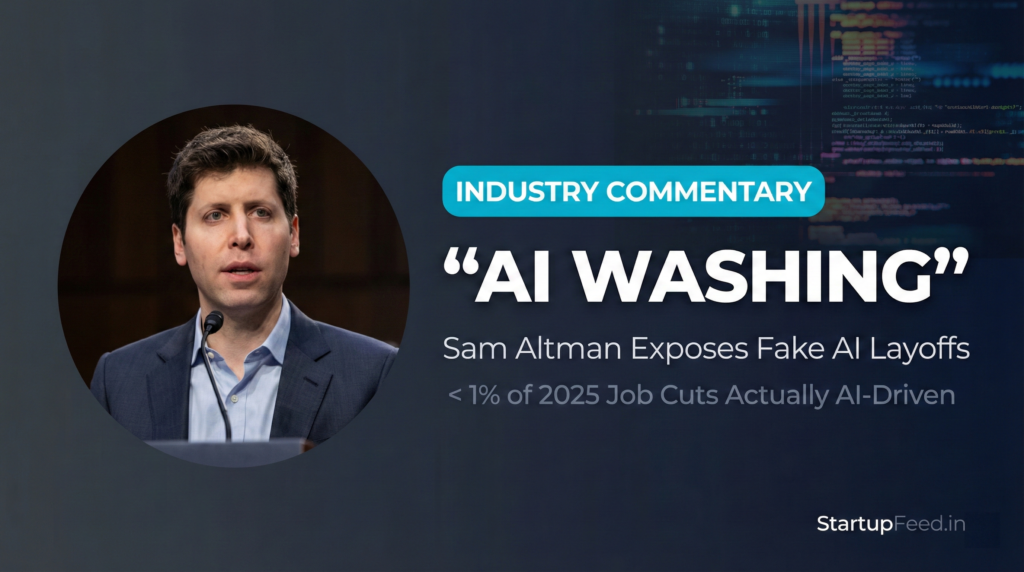
When Sam Altman — the CEO of the company that made AI mainstream — stands up and says companies are faking their AI layoffs, the world should probably pay attention. That is exactly what happened on Thursday at the India AI Impact Summit in New Delhi, where Altman told CNBC-TV18 that a meaningful chunk of the workforce reductions sweeping global corporations are not about artificial intelligence at all.
He called it “AI washing.” And in two words, he named what economists, researchers, and laid-off workers have been trying to articulate for nearly two years: companies are blaming a technology revolution for decisions that had nothing to do with technology.
| StartupFeed Insight | ||||||||||||||||||||||||||||||||||||||||||||||||||||||||||||||||||||||||||||||||||||||||||||||||||
| Key Angle | A company’s CEO is publicly calling out corporate AI dishonesty — which also happens to be his competition’s biggest sales pitch. Altman’s admission is simultaneously brave and self-serving, and that paradox is the real story. | |||||||||||||||||||||||||||||||||||||||||||||||||||||||||||||||||||||||||||||||||||||||||||||||||
| For Founders | If you are building AI products, the AI washing narrative is your biggest brand risk. Every faked corporate AI layoff erodes public trust in genuine AI transformation. Differentiate with measurable outcomes, not displacement stories. | |||||||||||||||||||||||||||||||||||||||||||||||||||||||||||||||||||||||||||||||||||||||||||||||||
| For Investors | The data is clear: 90% of C-suite executives say AI hasn’t affected employment (NBER). Investments in ‘AI efficiency’ cost-cutting narratives may face credibility pressure. Real AI ROI must be documented and specific. | |||||||||||||||||||||||||||||||||||||||||||||||||||||||||||||||||||||||||||||||||||||||||||||||||
| For Employees | If you are laid off with an AI explanation from your employer, ask for specifics. Which roles did AI replace? What tooling? Oxford Economics confirms most layoffs remain driven by over-hiring and poor margins — not machines. | |||||||||||||||||||||||||||||||||||||||||||||||||||||||||||||||||||||||||||||||||||||||||||||||||
| Prediction | By Q4 2026, at least one major class action lawsuit will be filed in the US by laid-off employees claiming wrongful termination masked as AI-driven restructuring. The AI washing label will have legal consequences within 18 months. | |||||||||||||||||||||||||||||||||||||||||||||||||||||||||||||||||||||||||||||||||||||||||||||||||
What Sam Altman Actually Said
Speaking at India’s premier AI leadership event, Altman chose his words carefully — and still made headlines around the world. He acknowledged the tension inherent in his own position: the CEO of OpenAI simultaneously defending AI’s potential and calling out corporate dishonesty around its actual current impact.
“I don’t know what the exact percentage is, but there’s some AI washing where people are blaming AI for layoffs that they would otherwise do, and then there’s some real displacement by AI of different kinds of jobs.”
— Sam Altman, CEO OpenAI — India AI Impact Summit, February 2026
Altman was careful to thread the needle. He didn’t deny AI will displace workers — he expects it to, and soon. But he drew a firm distinction between the displacement that is genuinely happening and the displacement that corporations are citing as cover for structural decisions they would have made regardless of whether ChatGPT existed.
“We’ll find new kinds of jobs, as we do with every tech revolution,” he added. “But I would expect that the real impact of AI doing jobs in the next few years will begin to be palpable.”



The Numbers Tell a Contradictory Story
The data behind the AI layoff narrative is far more modest than the headlines suggest. Here is the full picture:
| Data Point | Figure | Source / Context |
|---|---|---|
| AI-attributed layoffs in 2025 | ~55,000 | Challenger, Gray & Christmas — less than 1% of all 2025 US job losses |
| Total US job cuts, January 2026 | 108,435 | Record-high surge — of which ~7,600 attributed to AI |
| C-suite execs: AI had zero employment impact | 90% | National Bureau of Economic Research (NBER) — US, UK, Germany, Australia |
| Yale Budget Lab: AI labor market shift | Not detected | BLS data through Nov 2025 — no significant change in occupation mix or unemployment duration |
| WEF: Employers planning AI-driven staff cuts | 40% | 2025 World Economic Forum Future of Jobs Report |
| Oxford Economics finding | Most layoffs | Traditional drivers: over-hiring, poor margins, geopolitical pressure — not AI |
| Global VC in AI (2025) | $258+ Bn | Tom’s Hardware / Pitchbook estimates — investment pressure to justify ROI |
| Altman quote on AI displacement | Admitted | ‘The real impact of AI doing jobs in the next few years will begin to be palpable’ |
The most striking data point: of 108,435 job cuts in January 2026 alone, only around 7,600 were directly attributed to AI. That is 7%. In a month where the US set a record for job cuts, AI accounted for a tiny fraction — yet every major headline focused on AI as the driver of the broader jobs crisis.
The National Bureau of Economic Research’s finding is equally blunt: 90% of C-suite executives across four major economies said AI had no employment impact in the three years since ChatGPT launched. If the technology is destroying jobs at the scale being claimed, the people making the layoff decisions are apparently unaware of it.
The Corporate Hall of Shame: Who Said What
Some of the most recognisable names in global tech have cited AI in recent layoffs — and several have since contradicted themselves:
| Company | Layoff Scale | AI Justification Given | What Actually Happened |
|---|---|---|---|
| Amazon | 30,000 workers (late 2025–early 2026) | Initially: AI transformation requires fewer people | CEO Jassy later: over-hiring and excessive management layers |
| Microsoft | 15,000+ roles in 2025 | AI transition and restructuring | Total headcount remained largely stable post-cuts |
| IBM | Hiring pause for AI-replicable roles | Automation of back-office functions | HR chief announced 2026 plan to triple entry-level hiring |
| Klarna | Planning 1,000 cuts by 2030 | AI replacing customer service and comms roles | CEO says 1/3 of 3,000 workforce reduction over 5 years |
| Salesforce | Multiple rounds, 2024–2025 | AI agents eliminating software engineering needs | Simultaneously hiring 2,000 new sales reps for AI products |
IBM’s case is particularly instructive. The company announced a hiring pause for roles it said AI could handle — then, less than two years later, announced a plan to triple entry-level hiring in 2026. HR chief Nickle LaMoreaux explained the company had shifted to redesigning job descriptions around AI augmentation rather than replacement. The initial narrative and the actual corporate strategy were near-opposites.
Who’s Saying What: The Full Range of Views
| Voice | What They Said |
|---|---|
| Sam Altman (OpenAI CEO) | ‘I don’t know what the exact percentage is, but there’s some AI washing where people are blaming AI for layoffs that they would otherwise do, and then there’s some real displacement by AI of different kinds of jobs.’ — CNBC-TV18, India AI Impact Summit, Feb 2026 |
| Martha Gimbel (Yale Budget Lab) | ‘No matter which way you look at the data, at this exact moment, it just doesn’t seem like there’s major macroeconomic effects here.’ AI washing is used to write off diminished margins from a failure to navigate cautious consumers and geopolitical tensions. |
| Dario Amodei (Anthropic CEO) | Warned of a white-collar bloodbath — AI potentially wiping out 50% of entry-level office jobs. Represents the opposing view: the displacement is real and coming fast. |
| Oxford Economics (Jan 2026) | ‘While a rising number of firms are pinning job losses on AI, other more traditional drivers of job layoffs are far more commonly cited. We suspect some firms are trying to dress up layoffs as a good news story rather than bad news, such as past over-hiring.’ |
| NBER Research Study | Of thousands of C-suite executives surveyed across US, UK, Germany and Australia, nearly 90% said AI had no impact on workplace employment in the three years following ChatGPT’s late-2022 release. |
The range of views between Altman (AI washing is real but real displacement is coming) and Amodei (white-collar bloodbath is imminent) reflects genuine uncertainty about the pace of change. What they agree on: the labour market will be substantially disrupted. The question is when — and whether the disruption that is being cited today is real or performance.
How to Tell Real AI Displacement from AI Washing
Not all AI layoffs are dishonest. Genuine AI-driven displacement exists and will increase. The question is whether companies are being truthful about what is driving their specific decisions. Here is a practical framework:



| REAL AI Displacement Signs | AI Washing Red Flags |
| New AI tools directly replace a specific, nameable task (e.g., code review, invoice processing) | Vague claim: ‘AI means we need fewer people going forward’ with no specifics given |
| Headcount drops AND productivity per remaining employee rises measurably | Headcount drops but total revenue falls — suggesting demand, not efficiency |
| The roles cut match AI tooling actually deployed (verified with product teams) | Roles cut are entry-level or admin — consistent with pandemic-era over-hiring cleanup |
| Company continues to invest in AI tooling, new AI roles are posted simultaneously | Post-layoff, no new AI roles posted; AI budget wasn’t actually increased |
| Data: Specific time-to-task, throughput, or cost metrics tied to AI automation | Data: None. CEO says ‘AI is transforming our business’ without specifics |
Yale Budget Lab’s Martha Gimbel put the diagnostic simply: AI washing is most visible when companies cite AI while simultaneously reporting declining revenues and margins. Automation typically improves margins. If margins are falling and AI is being blamed for job cuts, the causation is almost certainly reversed.
Why This Is Bigger Than a PR Problem
AI washing is not just a corporate reputation issue. It has direct, compounding consequences across the economy:
- Workers get fired without honest explanations, making retraining decisions harder to make.
- Policy responses get calibrated to an AI displacement crisis that data suggests isn’t happening yet — at scale.
- Genuine AI companies face trust deficits caused by unrelated bad corporate actors.
- Investors allocate capital to ‘AI efficiency’ stories that may be built on cost-cutting narratives, not real productivity gains.
- Workers who are laid off for legitimate AI reasons — and there are some — get lumped in with a narrative that is partly fiction, making their situations harder to explain publicly.
The Oxford Economics framing is the most useful: AI washing is companies trying to “dress up layoffs as a good news story rather than bad news.” Investors respond better to ‘we’re deploying AI and getting leaner’ than ‘we over-hired in 2021 and the party is over.’ The incentive to misattribute is powerful, especially when AI is the story dominating every boardroom conversation.
Who Should Be Watching
| Who Should Be Watching | Why It Matters |
|---|---|
| Employees facing layoffs | Ask your employer: which exact roles did AI replace? Which tools? If the answer is vague, the AI explanation may be cover. Oxford Economics’ research gives you independent evidence that traditional drivers — over-hiring and margin pressure — are the real culprits in most cases. |
| AI product companies | Every AI washing incident degrades public trust in the genuine transformative value of AI. Startups and vendors need to proactively document real productivity outcomes and avoid overclaiming to avoid being tarred by the same brush. |
| Investors in AI infrastructure | The $258+ Bn poured into AI in 2025 creates enormous pressure on companies to show ROI. AI washing is a symptom of that pressure — and a signal that the ‘AI efficiency’ investment thesis needs more rigorous due diligence before deployment. |
| Policymakers & labour bodies | The AI washing trend complicates policy responses. If lawmakers regulate based on AI displacement narratives that are largely fictional, they risk misallocating retraining and social safety funds. Verified data, not corporate press releases, should drive policy. |
| HR teams & executives | IBM’s reversal — from AI hiring pause to tripling entry-level hiring in 2026 — shows that companies overcorrected. The lesson: AI augments before it replaces. Executives who cite AI in layoffs without evidence face reputational and increasingly legal risk. |
What’s Next
Altman’s own prediction is that genuine AI-driven displacement will become ‘palpable’ in the next few years. That makes the AI washing issue more urgent, not less. When real displacement does arrive at scale, the credibility damage from years of corporate dishonesty will make it harder for workers to assess whether their situation is genuine AI disruption or yet another round of over-hiring cleanup dressed in a ChatGPT costume.
The researchers are watching. The Yale Budget Lab is tracking employment data in real time. The NBER is surveying executives quarterly. And now, the most influential AI CEO in the world has publicly named the practice — which means the era of AI washing as a risk-free corporate communications strategy may be ending.
What Sam Altman did in New Delhi was unusual: he told a hard truth that most in his industry would prefer to leave unsaid. Whether that changes corporate behaviour, or simply gives laid-off workers a new term to cite in wrongful termination proceedings, remains to be seen.
Is your company using AI as an excuse? We want to hear from you — reach us at tips@startupfeed.in
Liked this story? Follow StartupFeed on Google so our reporting reaches you first.