QUICK TAKE:
| Product: Kanha AI — voice-first spiritual companion inspired by Lord Krishna Company: CoRover AI (India Chip Pvt. Ltd.) — Bengaluru, founded 2016 Pricing: Freemium — free tier + premium devotee plans (exact pricing TBA) Languages: 14+ Indian languages via BharatGPT LLM + Bhashini integration Target: 500 Mn+ Hindi-speaking Indians; devotees, wellness seekers, spiritual learners Availability: India-first launch; iOS, Android, Web—rollout February 2026 |
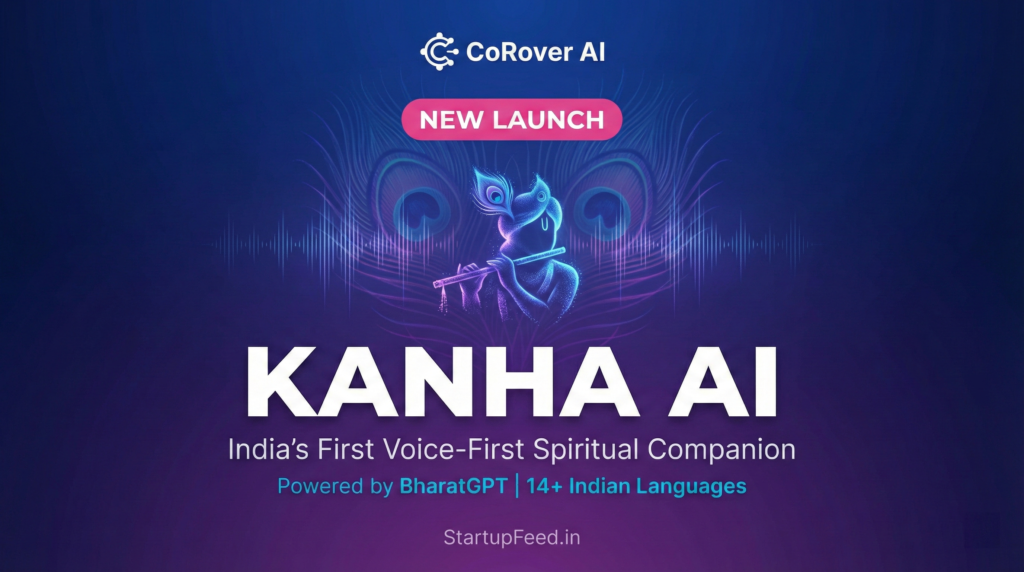
CoRover AI, the Bengaluru-based conversational AI company behind BharatGPT and IRCTC’s AskDisha, has launched Kanha AI — a voice-first digital companion designed around the personality, wisdom, and warmth of Lord Krishna. Built on CoRover’s proprietary BharatGPT large language model and integrated with Bhashini’s multilingual infrastructure, Kanha marks India’s first attempt at a culturally rooted, Sanskrit-to-vernacular AI companion—a product category that neither Siri, Alexa, nor ChatGPT has attempted in the Indian context.
This positions CoRover to define an entirely new product category: devotional AI. India’s spiritual technology market, already energized by GitaGPT, Bhagavad Gita AI, and Isha Foundation’s apps, has yet to see a voice-first, LLM-native companion built by a company with government-grade conversational AI credentials—which is precisely what Kanha AI brings. Every voice AI startup in India, and every global player eyeing the 500 Mn+ Hindi-speaking internet user base, will be watching this launch closely.
StartupFeed Insight
| The big picture: India has 950 Mn smartphone users, but the dominant AI interfaces—Siri, Google Assistant, and Alexa—were built for Western cultural contexts. Kanha AI is the first product that inverts this: it is not an AI that learned India’s languages; it is an AI built from India’s soul outward. That design philosophy, not the technology, is the true competitive moat. Bull case: • CoRover’s existing 800,000 concurrent users and IRCTC/LIC/government deployments give Kanha AI a distribution network most AI companion startups spend years building—Day 1 credibility is built in • India’s spiritual tech market is structurally underserved by text-only apps: voice is the natural interface for devotees who recite scripture orally, giving Kanha a product-market fit advantage over all existing Gita chatbots Bear case: • Religious AI faces significant backlash risk in India—even minor theological inaccuracies or perceived disrespect can trigger viral outrage, requiring an exceptionally rigorous content safety and moderation layer • Global companions like Character.ai and Replika have failed to monetize spiritual/emotional AI at scale; CoRover must prove Kanha’s freemium conversion is materially better than secular companions Our take: Kanha AI is CoRover’s most consequential product since AskDisha — and potentially its most viral. The risk is not the technology; it’s the theology. If CoRover ships a 1.0 with even one Krishna quote misattributed or a devotion query answered carelessly, the backlash could overshadow the product’s genuine innovation. Done right, Kanha could become India’s answer to Character.ai—but rooted in Dharma, not science fiction. Our prediction: Kanha AI will cross 5 million downloads within 6 months of launch—driven by Mathura, Vrindavan, and Varanasi religious tourism communities—and force at least two large devotional app companies (ISKCON digital, Art of Living tech arm) to launch competing voice companions by Q4 2026. |
What Is Kanha AI?

Kanha — named after the beloved childhood name of Lord Krishna — is a voice-first AI companion that draws its conversational personality from three pillars of Krishna’s character: wisdom (the philosophical depth of the Bhagavad Gita), warmth (the accessible, playful energy that made Krishna universally beloved), and guidance (the role of a trusted companion in the Mahabharata). The product is not a scripture lookup tool or a facts database—it is designed for conversational companionship: morning reflections, guided meditation based on Gita shlokas, and responses to life dilemmas framed through dharmic principles.
Built on CoRover’s BharatGPT LLM—which supports 14 Indian languages and is integrated with the government’s Bhashini multilingual platform—Kanha converses natively in Hindi, Braj Bhasha, Sanskrit-accented Hindi, and 12+ other Indian languages. This is not a translated experience. Users from Vrindavan can speak in Braj, users in Chennai can speak in Tamil, and Kanha adapts voice, tone, and register accordingly.
How Kanha AI Works
| Capability | Details |
| Voice Interface | Voice-first design—Kanha listens and responds in spoken Indian languages; text a secondary channel |
| Language Engine | BharatGPT LLM + Bhashini (NHLT/MeitY)—14+ Indic languages, Sanskrit phonetic support |
| Personality Core | Character trained on Bhagavad Gita, Mahabharata, Srimad Bhagavatam—wisdom with warmth tone |
| Use Cases | Morning reflections, Gita shloka interpretation, dharmic advice, meditation guidance, festival stories |
| Platform | iOS, Android, Web—also deployable on WhatsApp (CoRover’s existing channel infrastructure) |
| Pricing Model | Freemium—free daily conversations; Bhakti Premium tier for extended sessions and personalisation |
| Safety Layer | Theological accuracy guardrails do not generate content contradicting verified Vaishnava canon |
Why Kanha AI Matters—The Bigger Picture
India’s digital spiritual economy is already vast. The Bhagavad Gita AI chatbot attracted hundreds of thousands of users within weeks of launch. The Isha Foundation’s digital platforms serve millions. ISKCON streams bhajans to 10 Mn+ YouTube subscribers. But none of these are voice-first, LLM-native, or built by a company with the engineering depth to make the experience feel genuinely conversational—not just scriptural lookup.
CoRover changes that calculation. With 400 million+ unique users served across IRCTC, LIC, and government platforms, and an AI infrastructure stack proven at government scale, Kanha AI enters as arguably the most technically credible spiritual AI product India has ever seen. The real question is cultural — whether users will accept an AI voice companion in a domain traditionally governed by gurus, priests, and sants.
The timing also aligns with a major demographic shift: India’s Gen Z and millennial populations are deeply spiritual but increasingly disconnected from institutional religious structures. They seek guidance but on their own schedule, in their own language, without the friction of temple visits or guru availability. Kanha AI is built precisely for this user: the aadhyatmik native who downloads apps before lighting incense.
How Kanha Compares
| Feature | Kanha AI (CoRover) | GitaGPT | Bhagavad Gita AI |
| Voice-First Interface | Yes | Text only | Text only |
| Indian Language LLM | 14+ (BharatGPT) | English-primary | English-primary |
| Conversational Companion | Character-driven | Q&A only | Q&A only |
| Govt-Grade AI Infra | Yes (IRCTC, LIC) | No | No |
| WhatsApp Channel | Via CoRover stack | No | No |
| Sanskrit/Braj Support | Yes | No | No |
| Freemium Model | Yes | Yes | Yes |
No existing spiritual AI in India combines voice-first interaction with a genuine LLM-native multilingual foundation. Kanha AI’s nearest functional competitor is Character.ai (US-based, $1 Bn+ valuation), which allows users to create and chat with fictional characters — but has no India-specific spiritual corpus, voice infrastructure, or cultural accuracy layers. Kanha is purpose-built for a use case Character.ai could never serve.
What CoRover’s Founder Says
| “India’s AI revolution will not be complete until it speaks in the voice of Bharat — not just in its languages, but in its values, its wisdom traditions, and its cultural soul. Kanha AI is our answer to the question: what does an AI companion look, sound, and feel like when it is built for the 500 million Indians who grew up hearing Krishna’s stories before they learned to read?” — Ankush Sabharwal, Co-Founder & CEO, CoRover AI |
The statement is carefully positioned—Sabharwal frames Kanha as a cultural statement, not just a product launch. The reference to ‘500 million Indians who grew up hearing Krishna’s stories’ is a direct market sizing argument: he is telling investors and partners that the addressable audience for Kanha AI is not the niche spiritual app user but every Hindi-speaking Indian who grew up in a devotional household.
CoRover AI — Company Snapshot
| Parameter | Details |
| Founded | 2016 |
| Founders | Ankush Sabharwal (CEO/CTO), Kunal Bhakhri, Manav Gandotra, Rahul Ranjan |
| Headquarters | Bengaluru, Karnataka |
| Total Funding | $5.72 Mn across 8 rounds | Latest: Series A (June 2025) |
| Key Investors | Venture Catalysts, HDFC Bank, Lead Angels, Canbank Venture Capital |
| Flagship Product | BharatGPT—LLM supporting 14 Indian languages + 120+ foreign languages |
| Notable Deployments | AskDisha (IRCTC), AskSarkar, AskDoc, LIC AI, DigiSaathi, 100+ enterprise clients |
| User Scale | 400 Mn+ unique users | 800,000 concurrent users | 20 Bn+ interactions |
| Latest Launch | BharatGPT DeskAI Appliance (NVIDIA Blackwell, India AI Impact Summit, Feb 2026) |
| Employees | ~100 (Jan 2026, per Tracxn) |
What’s Next
Our prediction: Kanha AI will be the product that puts CoRover on the consumer AI map. Until now, CoRover has been a B2G and B2B AI infrastructure company — the engine behind IRCTC’s chatbot, not a consumer brand in its own right. Kanha changes this, and with it CoRover’s valuation narrative shifts from ‘enterprise AI vendor’ to ‘consumer AI platform’ — a multiple expansion that could make the Series A of June 2025 look like the last cheap entry point.
The milestone to watch: whether CoRover can sign a distribution partnership with Mathura-Vrindavan temple trusts, the Kashi Vishwanath Trust, or ISKCON before Janmashtami 2026 (August 16). A temple-endorsed Kanha AI would be the difference between a product and a movement.
The real question isn’t whether Indians want an AI spiritual companion. Hundreds of millions already turn to digital scripture apps daily. The question is whether they’ll trust a voice. Because in devotion, the voice matters more than the words — and if Kanha gets that right, no startup in the world will be able to replicate it.
Liked this story? Follow StartupFeed on Google so our reporting reaches you first.