

| Quick Take: | |
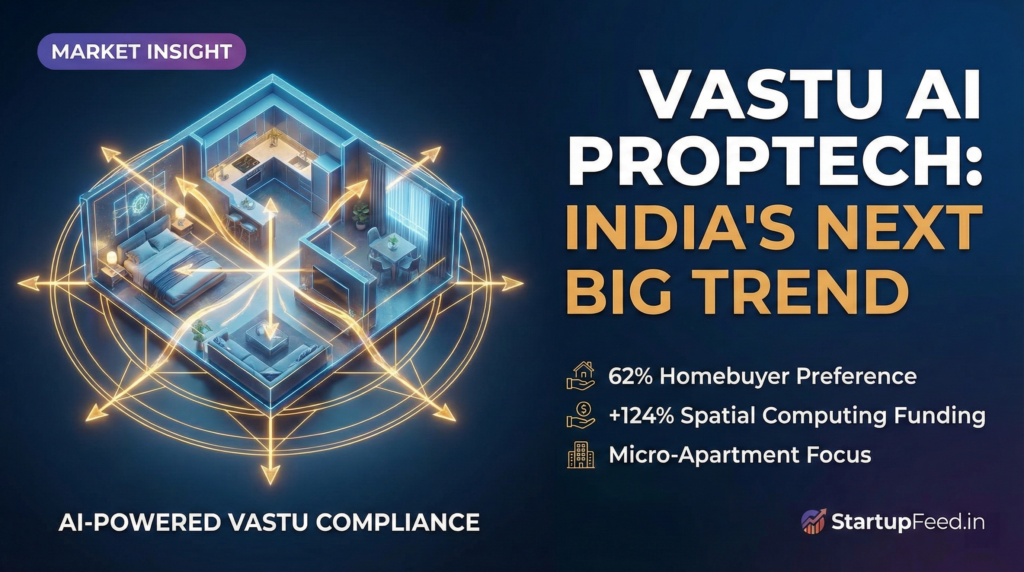
| The Trend | AI tools now embed Vastu compliance into 3D floor plans, running light and airflow simulations for spaces as small as 200–400 sq ft |
| Market Signal | 62% of Indian homebuyers prefer Vastu-compliant homes — 44% will pay a premium (99Acres, February 2025) |
| Sector Fuel | India PropTech raised $550 Mn across 32 deals in 2025; spatial computing funding surged +124% YoY to $71.4 Mn |
| The Opportunity | Mumbai’s average apartment sits at ~904 sq ft — the smallest of India’s top 7 cities, with micro-units as compact as 189 sq ft |
| What’s Next | Environmental simulation + Vastu-as-a-feature becomes a standard developer offering — not a premium add-on — by late 2027 |
India’s most space-constrained city is also its most financially pressured one. Mumbai’s average apartment size clocks in at ~904 sq ft in 2025 — the smallest among India’s top 7 metros, with micro-units selling as small as 189 sq ft in the suburbs. Into this compressed reality, a wave of AI-powered spatial computing tools is arriving with a genuinely Indian proposition: what if your 300 sq ft studio could be optimized not just for furniture layout, but for natural light angles, cross-ventilation, and the directional energy principles of Vastu Shastra — simultaneously?
That convergence is no longer theoretical. It is live, growing, and sitting at the intersection of two of India’s most powerful consumer forces: the real estate wellness premium and the AI productivity stack.
| StartupFeed Insight | |
| Key Number | 62% Vastu preference meets near-zero supply in micro-apartments — AI tools at Rs 99 are the gap-filler in a fully unserved segment. |
| For Founders | The micro-apartment segment is the highest-friction, lowest-served Vastu market in India — a Rs 99 AI floor plan report at mobile-first scale is a clear wedge into a 600M+ urban renter base. |
| For Investors | Spatial computing funding in India grew 124% YoY to $71.4 Mn in 2025 — Vastu-as-a-feature is one of the few PropTech sub-categories with a provable cultural demand signal requiring zero market education. |
| For Renters | A 3.5 ft x 5 ft balcony workstation can be meaningfully optimized for northeast light exposure and airflow — tools to do this accurately now exist at Rs 99–500 per report. |
| Prediction | By Q3 2027, at least one major Indian developer will launch a project where AI-generated Vastu compliance is a verified, marketed product feature on every unit, commanding a 5–10% price premium. |
The Problem: Space Is Shrinking, Stress Is Rising
India’s urbanization math is unforgiving. Cities like Mumbai, Bengaluru, and Delhi are expanding vertically as horizontal space becomes scarce. Micro-apartments — typically ranging from 250 to 500 sq ft — are designed to optimise every inch of space. But efficiency of square footage and quality of the lived environment are two different problems.
The second problem — how a compact space feels — is precisely where Vastu Shastra’s 5,000-year framework intersects with 21st-century computational tools. Vastu’s core directives (northeast orientation for light and clarity, southeast placement for heat elements, unobstructed central Brahmasthan, cross-ventilation from northwest) map almost exactly onto what modern environmental psychology identifies as the measurable drivers of well-being in small spaces: solar orientation, airflow, spatial organization, and visual openness.
Grihafy, an AI Vastu analysis platform, frames the practical overlap directly: the architectural and environmental psychology aspects of Vastu — solar orientation, natural light optimization, airflow principles, and spatial organization — have measurable impacts on well-being. It positions Vastu not as metaphysics but as the original user experience design for homes — 5,000 years of iteration to optimize how spaces make you feel.



The Tools: What the AI-Vastu Stack Actually Does
A new generation of tools is operationalizing this framework at consumer scale. The core product logic is consistent: upload a floor plan image or PDF, receive a Vastu compliance score, zone-by-zone analysis, and a set of remediation recommendations — without structural changes.
| Tool | Core Capability | Pricing | Target User |
|---|---|---|---|
| Grihafy | Vastu Mandala mapping + AI compliance score; airflow/light zone analysis | Free | Renters, first-time buyers |
| Vaastu-AI (vastushastras.in) | Floor plan upload → Vastu report + AI consultant chat | Rs 99/report | Homeowners, designers |
| VastuGPT (ChatGPT-4o) | Object placement + room arrangement guidance, no structural changes | Free tier | Interior designers |
| AI Vastu (Android) | Real-time AR camera analysis using Google Gemini 2.0 Flash | Free (own API key) | On-site renters, buyers |
| HuntVastuHomes.com | Algorithm-rated Vastu compliance scores on listed properties | Free to search | Buyers in 8 metro cities |
| Coohom India | 3D floor plans with Vastu-friendly layout templates; 60,000+ 3D models; 4K rendering | Freemium | Architects, developers |
| Vastu.io | ML + AI integration for Vastu spatial analysis | Not disclosed | B2B / developer segment |
The stack is not monolithic. Some tools operate at the individual object-placement level. Others operate at the architectural zoning level — analyzing whether a micro-apartment’s structural layout is fundamentally Vastu-aligned before a buyer commits.
The frontier tool type is the one that combines all three: zone compliance scoring, environmental simulation (actual light angles, airflow paths), and energy tool placement (where a Pyra Swastik or Flat Max pyramid creates maximum directional effect in a confined space). That third layer — merging computational fluid dynamics with ancient remediation logic — is where the most interesting early-stage development is happening.
The Market Context: Why NowMarket Data
| Metric | Current (2025–26) | Projection | Source |
|---|---|---|---|
| India Gaming Market | Rs 23,200 Cr | Rs 31,600 Cr by 2027 (+36%) | Indian Govt / PIB |
| India PropTech Market | $1.66 Bn | $4.29 Bn by 2031 (16.9% CAGR) | Research & Markets |
| Spatial Computing Funding (India) | $71.4 Mn in 2025 | +124% YoY vs 2024 | Tracxn |
| Vastu Preference (homebuyers) | 62% prefer Vastu homes | 44% willing to pay premium | 99Acres Survey, Feb 2025 |
| Mumbai Avg Apartment Size | ~904 sq ft | Smallest of top 7 cities | ANAROCK 2025 |
The Demand Signal is Provably Strong
A 99Acres survey (February 2025) found that 62% of Indian homebuyers prefer Vastu-compliant homes and 44% will pay more for them. A separate Magicbricks survey found that 93% of respondents from Tier 1 and Tier 2 cities prefer Vastu-compliant homes — and that Vastu-compliant properties sell 20–30% faster than non-compliant inventory.
The PropTech Funding Cycle Has Matured
Indian PropTech startups raised over $550 Mn across 32 deals in 2025, following a revival from the 2023 trough of $126.7 Mn. The India PropTech market is valued at $1.66 Bn in 2025 and is projected to reach $4.29 Bn by 2031 at a 16.9% CAGR. Within this, spatial computing companies raised $71.4 Mn in 2025 — a +124% increase over 2024, according to Tracxn data.



The Three Layers of AI-Vastu Optimization
The most sophisticated tools in this category operate across three distinct layers. The gap between Layer 1 and Layer 3 is where genuine startup differentiation lives.
| Layer | Name | Status | What It Does |
|---|---|---|---|
| 1 | Directional Compliance | Existing | Checklist-grade Vastu rule analysis — kitchen SE, bedroom SW, entrance N/NE. Most current AI tools operate here. |
| 2 | Environmental Simulation | Emerging | Computational modeling of actual light angles and airflow paths through the floor plan, cross-referenced with Vastu directional zones. |
| 3 | Micro-Space Energy Tool Placement | Frontier | AI-generated placement coordinates for Pyra Swastiks, Flat Max pyramids, and other energy tools specific to the space’s compass orientation. |
Who Should Be Watching?
| Player | Strategic Implication |
|---|---|
| Micro-apartment developers(Mumbai, Bengaluru, Gurugram) | Vastu AI compliance scoring on every unit is a documented 20–30% faster-sale driver — and now costs Rs 99 to generate, not a Rs 5,000+ consultant visit. |
| Interior design platforms(Urban Ladder, Livspace, HomeLane) | Vastu-as-a-filter for furniture placement is a zero-cost product feature that targets the 62% of buyers who actively want it — and currently get nothing. |
| Traditional Vastu consultants(Rs 5,000–50,000/visit) | AI tools are not replacing high-end advisory; they’re creating a Rs 99–500 segment that converts first-time users who then graduate to paid consultation. |
| Real estate listing platforms(99Acres, MagicBricks, Housing.com) | HuntVastuHomes.com has already built a Vastu rating layer across 8 cities — the large platforms are late to a feature 93% of their users say they want. |
| Wellness-focused co-living operators | A Vastu-optimized micro-unit is a differentiated product in a commoditized rental market — the only feature that appeals simultaneously to wellness, cultural identity, and productivity. |
The Founder’s Angle: How to Build in This Space
The most defensible position in AI-Vastu is not the app that checks directional compliance. That is already commoditized. The defensible position combines three things no single current tool offers:
- Verified environmental simulation — actual light and airflow modeling
- Vastu zone analysis overlaid on the simulation output
- Specific, purchasable remediation tools with placement coordinates accurate to the specific floor plan
That product is a full-funnel: discovery (free Vastu score) → analysis (Rs 99–500 detailed report) → commerce (affiliate or direct sale of Rs 500–5,000 energy tools placed with AI precision). It turns a knowledge product into a transaction — which is exactly the full-stack model that Indian PropTech investors rewarded in 2025.
What’s Next
The category is at inflection. The consumer demand signal — 62% preference, 44% willingness to pay, 20–30% faster sales — has been proven for over a year. The AI tooling to serve it at Rs 99 scale has arrived. The spatial computing funding environment grew 124% YoY in India in 2025. The remaining gap is a single well-executed product that bridges Layer 1 (directional compliance) through Layer 3 (precision energy tool placement) in a mobile-first, vernacular-friendly interface.
The broader question this category raises is structural: as India’s real estate market pushes toward its $1 trillion target by 2030, and as micro-apartments become the dominant first-home format for 440 million millennials in tier-1 cities, will the industry treat Vastu compliance as a marketing claim or an engineered, verifiable product feature? The tools to make it verifiable already exist. What’s missing is a founder willing to own the category before a listings platform annexes it.
Is AI-Vastu a genuine product category or a features-on-features chase? Tell us your take on Twitter
About This Article
India’s PropTech sector raised $550 Mn in 2025 and is valued at $1.66 Bn, projected to reach $4.29 Bn by 2031 at a 16.9% CAGR. Spatial computing funding in India grew 124% YoY to $71.4 Mn in 2025. A 99Acres survey (February 2025) confirmed 62% of Indian homebuyers prefer Vastu-compliant homes and 44% will pay a premium. AI tools including Grihafy, Vaastu-AI, Coohom India, and VastuGPT are now enabling floor plan Vastu analysis at Rs 99–500 per report, without on-site consultation.
Liked this story? Follow StartupFeed on Google so our reporting reaches you first.