QUICK TAKE:
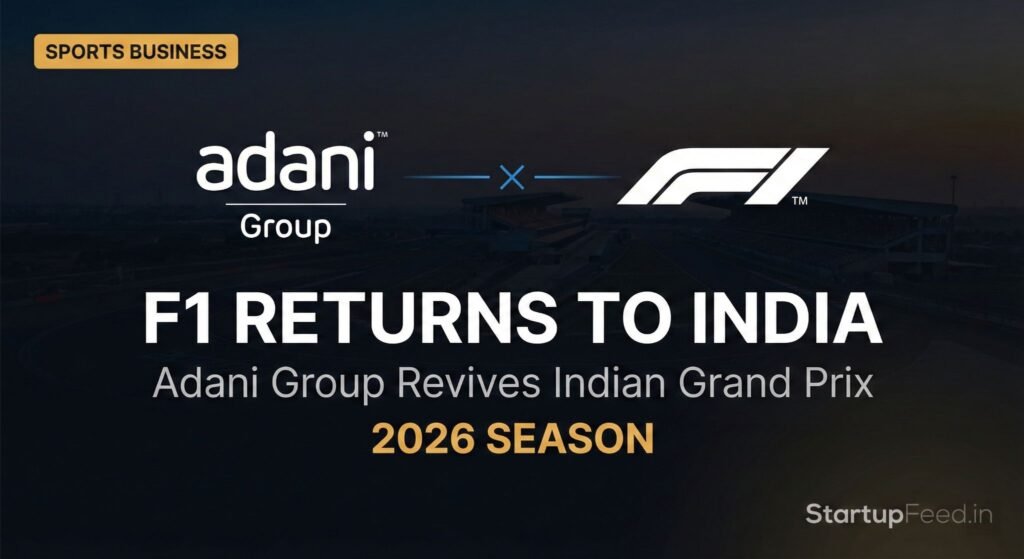
- The Big News: Karan Adani confirmed the Adani Group is actively working to bring Formula 1 back to the Buddh International Circuit in Greater Noida.
- The Asset: The 120,000-capacity track is now under Adani’s control following their ₹14,535 crore takeover of Jaypee Group (JAL) in late 2025.
- Why It Stopped: F1 abandoned India after the 2013 season due to a massive tax dispute with the UP government, which heavily taxed the event by classifying it as “entertainment” rather than a “sport.”
- The Roadblocks: Reviving the race won’t be cheap or easy. Hosting costs up to ₹1,250 crore per weekend, the 13-year-old track needs massive upgrades, the old tax disputes must be permanently resolved, and they need to win a slot on the highly competitive FOM calendar.
- The Momentum: F1 is currently in a commercial renaissance, boasting 827 million global fans. With recent track visits from India’s Sports Minister signaling government support, Karan Adani stated he is “personally engaged” in making the comeback a reality.
THE STORY — WHY THIS ANNOUNCEMENT IS DIFFERENT FROM PAST F1 INDIA RUMOURS
Every few years, a rumour circulates that Formula 1 is returning to India. Track upgrades are discussed. FOM meetings are held. Feasibility studies are commissioned. And then nothing happens. February 21, 2026 is different — not because the ambition is bigger, but because for the first time, the corporate mechanism that makes it structurally possible is already in motion.
Speaking at the 70th Foundation Day of the All India Management Association (AIMA) in New Delhi, Karan Adani — Managing Director of both Adani Cement and Adani Ports & Special Economic Zone — made a statement that was not speculative or aspirational. It was operational: “I’m very personally engaged in terms of bringing Formula 1 back into India.” The key phrase in that sentence is ‘personally engaged.’ This is not a company’s PR department floating a trial balloon. This is the son of Gautam Adani, MD of two of the group’s flagship companies, publicly committing to the project at a major institutional forum.
The reason Karan Adani can credibly say this is directly connected to the Adani Group’s ₹14,535 crore acquisition bid for Jaiprakash Associates Limited (JAL) — the debt-laden parent company of the Jaypee Group, which built the Buddh International Circuit in 2011. Adani won the majority of creditor votes for this acquisition in November 2025. The deal includes JAL’s assets — and the Buddh circuit is one of them. As Karan Adani put it directly: “obviously the Buddh circuit comes (as) part of the deal.” The circuit, which has sat largely dormant for over a decade, is about to change hands. The question is what Adani does with it next.

“I believe that India can really showcase Formula 1… and can be a benchmark for a global event. The reputation of India and Indians has improved very, very significantly.” — Karan Adani, MD, Adani Cement & Adani Ports and SEZ, at AIMA 70th Foundation Day, Feb 21, 2026
“Bringing global events and global sports to India, giving them an exposure to India and also giving an exposure to our people to these kinds of sports — because, unfortunately, the exposure is limited to very few people right now. Most of the time, people end up going to Abu Dhabi or Singapore or Doha to experience a sport.” — Karan Adani, AIMA 70th Foundation Day, Feb 21, 2026
India’s Formula 1 History — Three Races, One Champion, One Tax Dispute
| Year | Race Name | Winner | Key Context |
|---|---|---|---|
| 2011 | Indian Grand Prix (inaugural) | Sebastian VettelRed Bull Racing | October 30, 2011. 17th round of the 2011 F1 season. 95,000+ spectators attended the inaugural race. The circuit was praised by drivers as technically demanding and one of the best new venues on the calendar. Vettel clinched his second World Championship at this race. |
| 2012 | Indian Grand Prix | Sebastian VettelRed Bull Racing | Attendance dipped from 2011 as ticket prices (starting at ₹5,000 for general admission) were cited as a barrier for mass attendance. The event was commercially challenging despite global TV viewership. Vettel won again, extending his championship dominance. |
| 2013 | Indian Grand Prix (final) | Sebastian VettelRed Bull Racing | October 27, 2013. The last F1 race ever held on Indian soil. Vettel won his fourth consecutive World Championship at this race, cementing Buddh’s place in F1 history as the track where Vettel’s dynasty was confirmed. The event was pulled from the 2014 calendar shortly after. |
| 2023 | MotoGP (return event) | Multiple class winners | India’s return to FIM-sanctioned motorsport. MotoGP’s Bharat Grand Prix was held at Buddh International Circuit in September 2023 — the first international motorsport event there in a decade. It was not commercially renewed for 2024, signalling the continuing challenge of monetising Indian motorsport events. |
| Post-2013 | F1 absent for 13 years | No Indian GP | Root cause: UP government classified the event as ‘entertainment’ (liable to entertainment tax) rather than ‘sport’ (tax-exempt). Formula One World Championship Ltd.’s appeal was rejected by the Supreme Court, which confirmed FOWC had a Permanent Establishment in India. The resulting tax liability made the economics unworkable. |
The JAL Acquisition — The Deal That Makes F1 Strategically Possible
Understanding why Karan Adani’s statement is not a daydream requires understanding the mechanics of the Jaiprakash Associates (JAL) acquisition. JAL — the flagship of Jaypee Group, one of India’s largest infrastructure conglomerates — accumulated debt exceeding ₹57,000 crore over years of aggressive infrastructure expansion. Its collapse triggered one of India’s most complex insolvency proceedings. Adani Group won the resolution race with a ₹14,535 crore proposal that offered a higher upfront payment than rival bidders — securing majority lender votes in November 2025 and clearing the Competition Commission of India (CCI) by late 2025.
| JAL Asset / Issue | What It Means for the F1 Ambition |
|---|---|
| Buddh International Circuit(BIC) | The circuit is an asset of JAL. Adani’s acquisition of JAL transfers ownership of BIC to the Adani Group. For the first time since 2013, the circuit has an owner with both the financial capacity and declared ambition to revive F1. Previous JAL management was unable to resolve the tax dispute or fund circuit operations effectively. |
| JAL’s Total Debt(₹57,000+ crore) | Adani’s ₹14,535 crore bid is a fraction of JAL’s total liabilities — but that’s how IBC (Insolvency and Bankruptcy Code) resolution works. Creditors take a haircut. Adani gets a distressed-asset portfolio at below-replacement cost. The Buddh circuit alone has an estimated reconstruction cost of ₹2,000–3,000 crore. |
| CCI Clearance(Late 2025) | Competition Commission of India clearance removes the regulatory barrier to the deal. This is a critical milestone — without CCI approval, no transfer of JAL assets (including the circuit) could legally occur. With CCI cleared, the asset transfer process can proceed. |
| Government EngagementSports Minister Mandaviya’s Visit | Union Sports Minister Mansukh Mandaviya personally visited the Buddh International Circuit and held talks with YEIDA (Yamuna Expressway Industrial Development Authority) officials. Ministerial-level engagement signals that the UP government — the same entity whose tax classification killed the 2013 event — is now supportive of revival. |
| The Tax Dispute(The Unresolved Obstacle) | The Supreme Court’s ruling that FOWC has a Permanent Establishment in India making its income taxable is still law. Any F1 revival must either secure a new tax exemption (UP government or Central government route) or restructure the commercial arrangement so the taxable PE nexus does not apply. This is the most complex unresolved element. |
Why 2026 Is the Right Moment for This Ambition
The Confluence of Factors That Makes India’s F1 Return Commercially Viable in 2026:
|
STARTUPFEED INSIGHT
| The Startup Ecosystem Angle That Most Coverage Is Missing: An F1 Grand Prix weekend does not just bring race cars to a city. It brings 100,000+ high-income domestic and international visitors over 3–4 days. It brings global media (the Indian GP typically generates 1.5–2 billion TV impressions). It creates a concentrated demand event for hospitality, food & beverage, transport, accommodation, security, and entertainment. Greater Noida is already the NCR’s fastest-growing startup hub. An annual F1 race would make it a recurring international destination — with implications for every startup in the logistics, SaaS, hospitality-tech, fintech, and event-tech ecosystems that serves the NCR region. | |
| For Greater Noida Startups: | You are potentially sitting in the future host city of India’s largest annual sporting event. Greater Noida already has YEIDA’s infrastructure investment, the Yamuna Expressway, proximity to Jewar International Airport (under construction), and a growing startup ecosystem. An F1 Grand Prix would be the single most powerful anchor event that could catalyse hotel construction, premium F&B investment, corporate office expansion, and tourism infrastructure in the region. Startups building in hospitality-tech, event management, premium transport, and ticketing should begin building relationships with YEIDA and the Adani Group’s BIC management team now. |
| For Startups in Sports & Entertainment Tech: | India’s last F1 race was in 2013 — before smartphones became ubiquitous, before UPI existed, before live streaming was mainstream. A 2026+ Indian GP would be a completely different commercial environment. Fan experience apps, AR/VR trackside experiences, F1-licensed merchandise platforms, live betting tech (where legally permitted), corporate hospitality SaaS, dynamic ticket pricing, and multilingual content platforms are all legitimate startup opportunities that did not exist in 2013’s India. Get in early. |
| For Investors & LPs: | Adani’s JAL acquisition at ₹14,535 crore includes distressed assets at a fraction of their replacement cost. The Buddh International Circuit alone — a Hermann Tilke-designed Grade 1 FIA circuit with 120,000 spectator capacity — cost over ₹2,000 crore to build in 2011. Adani is acquiring it as part of a debt resolution at a fraction of that. If F1 returns, the annual hosting fee to FOM (Formula One Management) combined with TV rights, hospitality revenue, and real estate uplift around the circuit creates an asset that could generate ₹800–1,500 crore in annual economic activity. The investment thesis for sports infrastructure in India just became significantly more credible. |
| StartupFeed’s Prediction: The Indian Grand Prix will return to the F1 calendar by 2028 — not 2026 or 2027. The timeline is driven by three parallel processes that must complete before FOM will add India to the calendar: (1) Adani’s JAL acquisition formally closes and BIC management is transferred; (2) A new tax framework or exemption is negotiated with the UP government to resolve the 2013 PE ruling’s commercial implications; and (3) The circuit undergoes FIA Grade 1 recertification after years of limited maintenance. The 2028 timeline also aligns with Jewar International Airport’s expected opening, which transforms logistics for international F1 visitors from Delhi to Greater Noida. When India returns to the F1 calendar, it will not leave again. The market, the infrastructure, and the political will are all finally aligned. | |
Liked this story? Follow StartupFeed on Google so our reporting reaches you first.