
Key Highlights:
- Skills Over Credentials: Indian startups are increasingly prioritizing demonstrable hustle, speed, and execution over traditional academic degrees, challenging the dominance of elite credentials.
- The Dropout Hall of Fame: Success stories from Zerodha, Zepto (Stanford dropouts), and Bobble AI (IIT-Delhi dropouts) prove that deep domain focus and agility trump academic pedigree.
- A Culture of Risk: Startups favor those who are risk-tolerant and value “learning by doing” in chaotic, fast-moving environments, making them a natural launchpad for non-traditional talent.
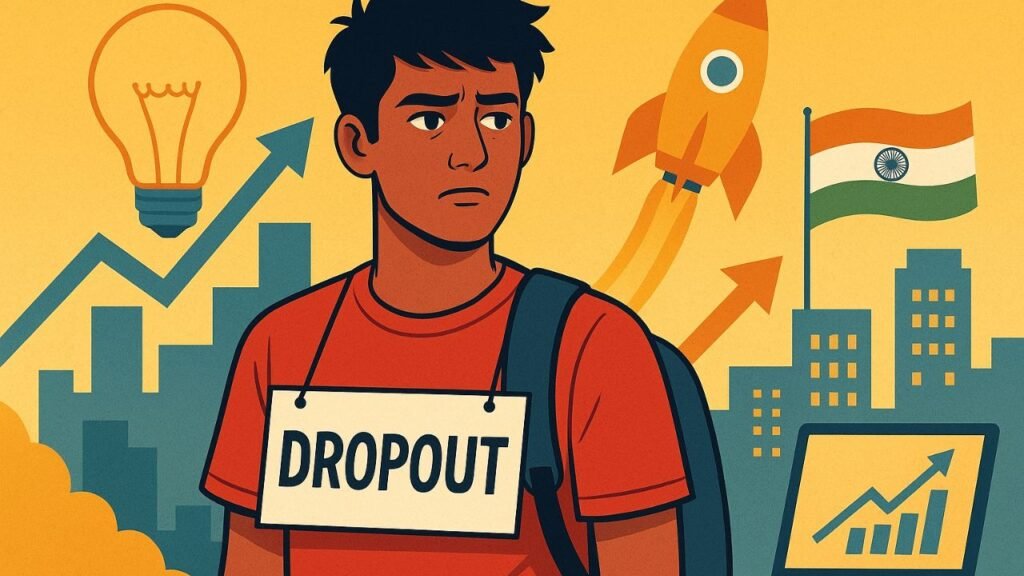
Imagine standing at a crossroads where the path marked “IIT/IIM Degree” is no longer the guaranteed route to success. For many founders, hiring managers, and innovators in India today, the chaotic, risk-filled path of the dropout is becoming the more valuable credential.
The new thesis is clear: execution beats education. The Indian startup ecosystem is undergoing a profound cultural shift that increasingly values real-world output, speed, and grit over the polished resume. For those who have left academia—or are considering it—startups are proving to be not just a refuge, but the ultimate launchpad.
I. The Startup Culture Shift: Why Execution Trumps Pedigree
The core reason startups are becoming a haven for dropouts is the fundamental difference in cultural priorities compared to established corporate firms:
- Speed Beats Perfection: In the chaotic, often messy environment of an early-stage company, someone who can build a Minimum Viable Product (MVP) imperfectly in a week is far more valuable than someone who requires a quarter to perfect a feature. Dropouts are perceived as being highly adaptable to fast pivots and unknowns.
- The Risk Premium: Dropouts, by their very nature, have already demonstrated a high tolerance for risk by challenging societal and familial expectations. This innate risk tolerance is highly valued in an industry where pivots and failure are mandatory steps toward success.
- Grit and Ownership: Startups seek builders, not collectors of degrees. The dropout’s track record, usually involving side-projects, early ventures, or open-source contributions, demonstrates initiative and a mindset of ownership that aligns perfectly with a startup’s need for employees who will roll up their sleeves and solve problems without waiting for instructions.
II. The Indian Proof Points: Dropouts Redefining Market Value
India’s own startup landscape is littered with powerful examples that validate this trend, providing clear proof that the hiring narrative is changing:
III. The Balanced View: What Dropouts Gain and Risk
For those considering the non-traditional route, the specialist analysis requires a balanced look at the trade-offs:


What You Gain:
- Time and Network: You gain several years of valuable time to build skills, launch products, and accumulate a high-value network far earlier than your university peers.
- Resilience and Resourcefulness: Surviving the uncertainty of the dropout path builds an ownership mindset that traditional education often cannot teach.
- Equity Upside: Success in a startup offers greater equity upside than traditional corporate entry points.
The Risks and Trade-Offs:
- Social and Family Pressure: The weight of societal expectations and potential family disappointment can be immense.
- Missing Depth: Certain highly specialized roles (e.g., core ML research or regulatory domains) may still require the foundational theoretical depth offered by an advanced degree.
- Safety Net: Without a degree, the “safety net” for failure is reduced, making future corporate jobs or specific visas potentially harder to acquire.
The time for operating on the boundary of education is now. If your work speaks louder than your academic transcript, the startup world is actively waiting to launch you.
Exclusive: The Dropout’s Playbook
Ready to let your output speak louder than your degree? Get the practical guide used by successful dropouts to build a portfolio that VCs and hiring managers cannot ignore.
Liked this story? Follow StartupFeed on Google so our reporting reaches you first.