

QUICK TAKE:
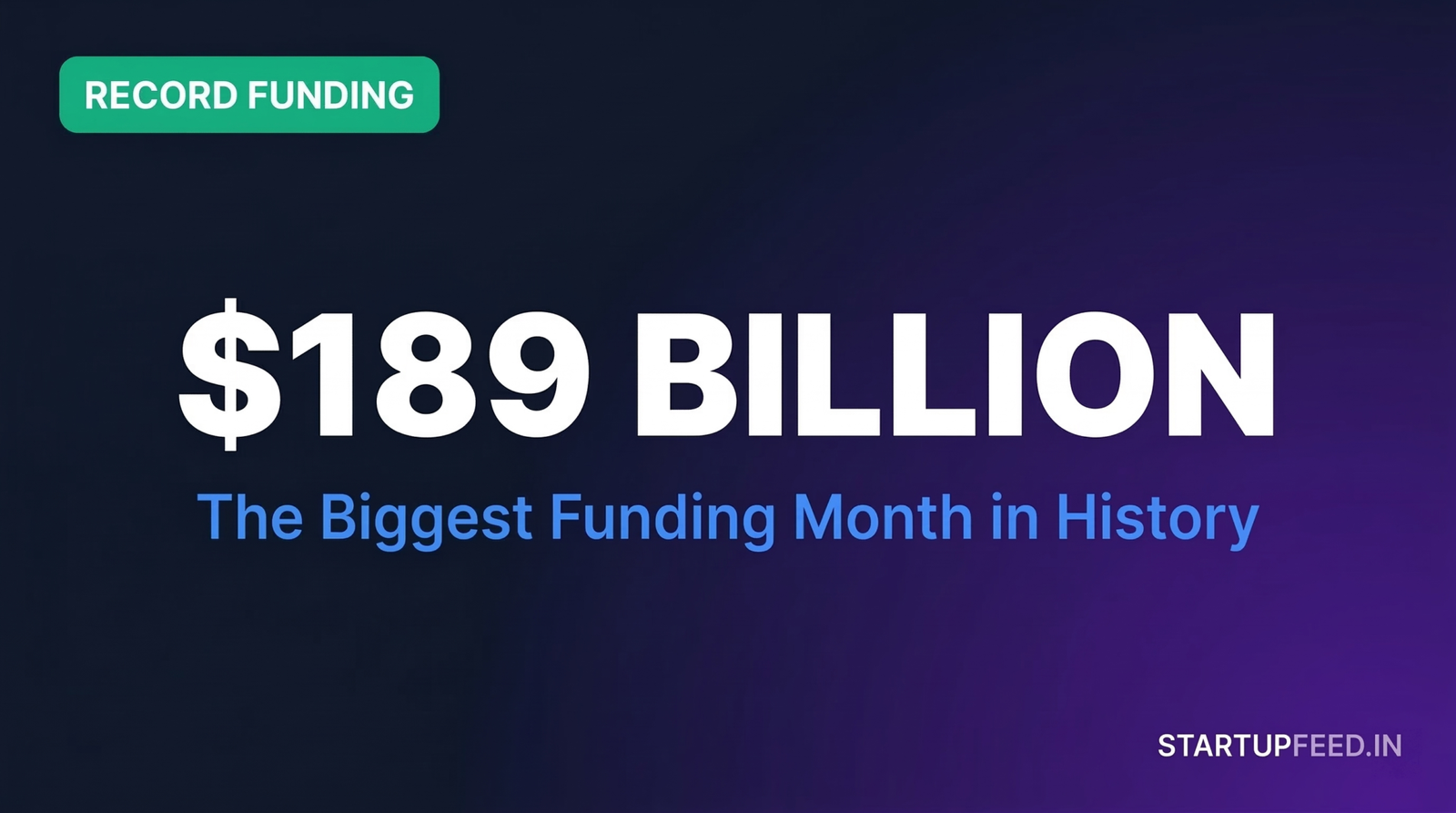
- Record month: February 2026 became the largest startup funding month in recorded history at $189 billion globally – up 780% year-over-year from $21.5 billion in February 2025 (Crunchbase)
- Concentration: 83% of February’s $189 Bn went to just three companies: OpenAI ($110 Bn), Anthropic ($30 Bn), and Waymo ($16 Bn) – the most extreme capital concentration ever recorded in a single month
- AI dominance: AI-related startups raised $171 Bn in February alone – 90% of all global venture capital deployed that month
- Q1 2026 trajectory: Just two months into 2026, global venture funding has already surpassed 50% of all capital deployed in the entirety of 2025
- #1 OpenAI: $110 Bn raised on February 27, 2026 – the largest private venture round in history; Amazon committed $50 Bn as exclusive third-party cloud partner; Nvidia and SoftBank each committed $30 Bn; post-money valuation: $840 Bn
- #2 Anthropic: $30 Bn Series G (Feb 2026) led by Coatue and GIC; post-money valuation $380 Bn – the second-largest private tech fundraise in history; Nvidia committed up to $10 Bn, Microsoft up to $5 Bn as part of round
- #3 xAI: $20 Bn Series E (January 2026) from Nvidia, Cisco, Fidelity, and others; post-money valuation ~$230 Bn; Elon Musk’s AI company has now raised $42.7 Bn total including debt and equity
- #4 Waymo: $16 Bn (Feb 2026) led by Dragoneer, DST Global, Sequoia; valuation $126 Bn – largest AV funding round in history; expanding to 20+ cities including Tokyo and London
- India angle: Amazon’s $50 Bn commitment to OpenAI uses AWS infrastructure; Nvidia’s investments in OpenAI, Anthropic, and xAI are backed by GPU revenues partly driven by Indian AI cloud deployments; xAI-SpaceX merger and OpenAI IPO (targeting Q4) will reshape global tech valuations
Something structurally unprecedented happened to global venture capital in the first two months of 2026. The rules changed.
In February 2026, global startup funding reached $189 billion in a single month – a figure so large it is difficult to contextualise. For reference, total global venture capital deployed in all of 2020 was approximately $300 billion. February 2026’s $189 billion – in a single month – represents roughly two-thirds of that. The year 2025, itself a record year for AI funding with $425 billion deployed, would be surpassed at the current Q1 2026 run rate before the end of April.
Three companies – OpenAI, Anthropic, and Waymo – absorbed 83% of February’s capital. Add xAI’s $20 billion from January and four companies have raised $176 billion in the first ten weeks of 2026. That is more than the entire venture capital deployed in the US in a typical year as recently as 2019.
What is happening is not a bubble in the traditional sense. Institutional investors – sovereign wealth funds, pension funds, corporate strategic arms, and private equity – are treating frontier AI infrastructure not as venture capital bets but as infrastructure allocation comparable to sovereign bond or blue-chip equity positions. The investment thesis is not ‘this startup might work.’ It is: ‘AI will be the operating system of the global economy for the next 30 years, and these four companies are the most probable infrastructure providers.’
This article ranks and explains the 10 biggest startup funding rounds of 2026 to date (January-March), with full investor breakdowns, valuation analysis, use-of-funds detail, and a StartupFeed Insight on what this mega-round era means for Indian founders, startups, and the global venture ecosystem.
The Master Ranking: 10 Biggest Startup Rounds of 2026 (Jan-Mar)
| Rank | Company | Amount Raised | Valuation (Post-Money) | Round | Sector | Date | Lead Investors |
|---|---|---|---|---|---|---|---|
| #1 | OpenAI | $110 Bn | $840 Bn | N/A (Growth) | Foundation AI / AGI | Feb 27, 2026 | Amazon ($50 Bn), Nvidia ($30 Bn), SoftBank ($30 Bn) |
| #2 | Anthropic | $30 Bn | $380 Bn | Series G | Foundation AI / AI Safety | February 2026 | Coatue, GIC (Singapore SWF); Nvidia (up to $10 Bn), Microsoft (up to $5 Bn) included |
| #3 | xAI | $20 Bn | ~$230 Bn | Series E | Generative AI / AGI | January 2026 | Nvidia, Cisco, Fidelity; Sequoia Capital, a16z, Valor Equity Partners |
| #4 | Waymo | $16 Bn | $126 Bn | Growth | Autonomous Vehicles / AV AI | February 2026 | Dragoneer Investment Group, DST Global, Sequoia Capital; a16z, Mubadala Capital, Silver Lake, Tiger Global, Fidelity, T. Rowe Price, Temasek |
| #5 | Wayve | $1.2 Bn | $8.6 Bn | Series D | Autonomous Driving / ADAS | February 2026 | Eclipse, Balderton Capital, SoftBank Vision Fund 2; Microsoft, Nvidia, Uber (strategic) |
| #6 | World Labs | $1 Bn | $5 Bn | Growth | AI for Robotics / Spatial AI | February 2026 | AMD, Autodesk, Emerson Collective, Fidelity, Nvidia, Sea; founded by Fei-Fei Li |
| #7 | Cerebras Systems | $1 Bn | $23 Bn | Series H | AI Chips / Wafer-Scale Compute | February 2026 | Tiger Global; Benchmark, Fidelity, AMD, Coatue, Altimeter, Alpha Wave Global, 1789 Capital |
| #8 | Rapidus | $1 Bn+ | Undisclosed | Strategic | Semiconductors (2nm fab) | February 2026 | Japanese government agency; strategic corporate investors; building Japan’s first 2nm chip fab |
| #9 | ElevenLabs | $500 Mn | $11 Bn | Series D | Voice AI / Audio AI | Feb 4, 2026 | Sequoia Capital (lead); a16z (4x follow-on), ICONIQ (3x), Lightspeed, Evantic, Bond; Nvidia previously invested |
| #10 | MatX | $500 Mn | Undisclosed | Series B | AI Chips / Training Accelerators | Q1 2026 | Jane Street, Situational Awareness; Marvell (strategic), Stripe co-founders |
Note: Databricks closed a $5 Bn Series L in late 2025 at $134 Bn valuation and is not included in this 2026 ranking. Apptronik ($520 Mn) narrowly missed the top 10. Rounds listed are confirmed closed in January-March 2026 per Crunchbase, TechCrunch, and company disclosures.
#1 OpenAI | $110 Billion
Foundation AI | AGI | ChatGPT | Valuation: $840 Bn post-money | February 27, 2026
OpenAI’s $110 billion raise on February 27, 2026 shattered every record in the history of private company financing. The previous record was OpenAI’s own $40 billion Series from March 2025. Before that, the record was Ant Group’s $14 billion in 2018. OpenAI’s February 2026 round is nearly three times its 2025 mega-round and nearly eight times the prior all-time record.
The round was not structured as conventional venture capital. Amazon committed $50 billion and was simultaneously named OpenAI’s exclusive third-party cloud partner – making this as much a commercial infrastructure deal as a financial investment. Nvidia committed $30 billion, building on its $100 million October 2024 entry and subsequent deepening relationship tied to a massive GPU deployment commitment. SoftBank committed $30 billion, extending its prior $15 billion commitment from the 2025 round. The combined $110 billion came largely from corporate and institutional strategics, not traditional VC funds.
| Investor | Commitment | Type | Strategic Angle |
|---|---|---|---|
| Amazon (AWS) | $50 Bn | Corporate strategic | Named exclusive third-party cloud partner; AWS-OpenAI commercial partnership worth hundreds of billions in cloud revenue over the deployment horizon |
| Nvidia | $30 Bn | Corporate strategic | Jensen Huang signalled this may be Nvidia’s last OpenAI increase; tied to GPU deployment commitment (10+ gigawatts of Nvidia compute for OpenAI training) |
| SoftBank | $30 Bn | Corporate strategic / PE | Extension of Masayoshi Son’s prior $15 Bn commitment from 2025 round; Vision Fund 3 vehicle |
| Other investors | ~$0 Bn remaining open | Round open for additional investors | OpenAI said the round remains open with additional investors expected to be announced |
What the money is for: OpenAI is carrying $1.4 trillion worth of infrastructure commitments (data centres, compute clusters, talent) made following its 2025 fundraising. The $110 billion primarily serves as working capital to execute against those commitments, fund the development of GPT-5 and beyond, and fuel the subscriber and enterprise revenue growth needed to support a Q4 2026 IPO targeting a near-$1 trillion public market valuation. OpenAI’s annualised revenue exceeded $20 billion at the time of the raise. It serves 810 million+ monthly active users and over 1 million enterprise customers.
#2 Anthropic | $30 Billion
Foundation AI | AI Safety | Claude | Valuation: $380 Bn post-money | February 2026
Anthropic’s $30 billion Series G makes it the second-largest private tech financing in history, following only OpenAI’s February 2026 raise. The round more than doubles Anthropic’s valuation from $183 billion (September 2025 Series F) to $380 billion – representing an extraordinary 108% valuation jump in approximately five months. The round was led by Coatue and GIC, Singapore’s sovereign wealth fund – a pairing of a growth equity specialist and a sovereign wealth allocator that signals the institutional treatment of Anthropic as infrastructure, not startup.
| Investor | Commitment/Participation | Type | Note |
|---|---|---|---|
| Coatue Management | Lead investor | Growth equity | Led the round; Coatue has been building a concentrated AI infrastructure portfolio |
| GIC (Singapore SWF) | Co-lead | Sovereign wealth fund | Singapore’s sovereign fund deepening AI infrastructure exposure alongside its earlier Anthropic position |
| Nvidia | Up to $10 Bn (as part of round) | Corporate strategic | Nvidia committed up to $10 Bn in November 2025; included in this round’s close; Jensen Huang indicated this would be Nvidia’s last Anthropic increase |
| Microsoft | Up to $5 Bn (as part of round) | Corporate strategic | Microsoft committed up to $5 Bn in November 2025; included; Anthropic committed $30 Bn in Azure cloud spending |
| D.E. Shaw Ventures, Dragoneer, Founders Fund, ICONIQ, MGX, DE Shaw | Participating | PE / VC / SWF mix | Broad institutional participation signalling cross-sector conviction |
What the money is for: Anthropic gets approximately 80% of its revenue from enterprises – a product-market fit profile that differs significantly from OpenAI’s mixed consumer-enterprise model. Claude Code (AI coding tool) and Claude Cowork (productivity) have been key enterprise growth drivers. The $30 billion goes toward infrastructure expansion (compute, data centres), safety research (Anthropic’s Constitutional AI and interpretability work), and continued international enterprise expansion. Anthropic’s IPO timeline is under evaluation but not yet committed. The company was founded by former OpenAI executives Dario Amodei and Daniela Amodei in 2021.
#3 xAI | $20 Billion
Generative AI | AGI | Grok | Valuation: ~$230 Bn post-money | January 2026
Elon Musk’s xAI opened 2026 with a $20 billion Series E in the first week of January – a single round larger than most countries’ entire annual venture investment totals. The raise brings xAI’s total reported debt and equity funding to $42.7 billion since its founding in 2023, a pace of capital accumulation that has no precedent in startup history outside of OpenAI and Anthropic.
Unlike OpenAI and Anthropic, xAI has a unique strategic advantage: vertical integration with Elon Musk’s other assets. xAI’s Grok model is integrated into X (formerly Twitter, with 500+ million registered users) – providing a distribution channel that no other foundation model company has. xAI completed a merger with SpaceX in February 2026 creating a combined entity valued at approximately $1.25 trillion – described by analysts as the largest merger in history – spanning frontier AI (Grok models), orbital launch infrastructure (SpaceX rockets and Starlink), and social media (X platform).
| Aspect | xAI (January 2026 Round) | Details |
|---|---|---|
| Amount raised | $20 Bn Series E | Closing the year’s largest single round, by any company, in January 2026 – before OpenAI’s February raise |
| Post-money valuation | ~$230 Bn | Up from $200 Bn after its prior $10 Bn round in 2025 coinciding with the launch of Grok 4 |
| Total funding to date | $42.7 Bn | Debt and equity combined since 2023 founding; one of the fastest capital accumulations in startup history |
| Key investors | Nvidia, Cisco, Fidelity, Sequoia Capital, a16z, Valor Equity Partners | Mix of compute infrastructure strategics (Nvidia, Cisco) and tier-1 VC |
| Use of funds | Expand compute advantage via large-scale data centre build-out in Memphis; infrastructure needed to train increasingly complex Grok models | Doubling down on what xAI calls its ‘decisive compute advantage’ |
| AGI timeline | Musk told employees xAI could achieve AGI as early as 2026; assigned Grok 5 a ‘10% chance of reaching AGI’ | Aggressive public AGI timeline differentiated from OpenAI and Anthropic’s more cautious public positioning |
| xAI-SpaceX merger (Feb 2026) | Combined entity valued at ~$1.25 trillion | Described as the largest merger in history; spans AI, orbital launch, Starlink, and social media; targeting June 2026 IPO at up to $1.5 trillion |
#4 Waymo | $16 Billion
Autonomous Vehicles | Robotaxi | AV AI | Valuation: $126 Bn post-money | February 2026
Waymo’s $16 billion raise is the largest autonomous vehicle funding round in history – and it values the Alphabet subsidiary at $126 billion, nearly triple its $45 billion valuation from 15 months prior (Series C, 2024). This compresses what might normally take 5-7 years of value creation into a single fundraising cycle, driven by Waymo’s unique status as the only company operating paid, fully driverless ridehail services at commercial scale in the United States.
Waymo currently operates 2,500+ robotaxis across six US markets (San Francisco, Phoenix, Los Angeles, Austin, Miami, and Atlanta), completing 400,000+ weekly driverless rides. The $16 billion will fund aggressive expansion to 20+ new cities in 2026, including Tokyo and London – the company’s first international deployments. Parent company Alphabet contributed more than three-quarters of the total raise and maintained its majority investor position.
#5 Wayve | $1.2 Billion
Autonomous Driving | ADAS | AV Software | Valuation: $8.6 Bn post-money | February 2026
London-based Wayve’s $1.2 billion Series D – led by Eclipse, Balderton Capital, and SoftBank Vision Fund 2 – reflects the market’s conviction in the AI-native approach to autonomous driving that differs from Waymo’s sensor-heavy, HD-mapping model. Wayve builds AI-first ADAS (Advanced Driver Assistance Systems) that learn from human driving behaviour using cameras and neural networks, rather than expensive lidar arrays. Key strategic investors Microsoft, Nvidia, and Uber participated – Wayve’s software is planned for integration into Uber’s robotaxi fleet across multiple cities in 2026. Automakers Mercedes-Benz, Stellantis, and Nissan invested in a subsequent round, providing OEM validation of Wayve’s go-to-market strategy of embedding its AI driving platform into existing vehicle production.
#6 World Labs | $1 Billion
AI for Robotics | Spatial AI | Embodied AI | Valuation: $5 Bn post-money | February 2026
World Labs, founded by Fei-Fei Li – the Stanford computer scientist widely credited with co-creating the ImageNet dataset that sparked the modern deep learning revolution – raised $1 billion to build what it calls ‘world models’: AI systems that understand three-dimensional space and physical interactions, enabling the next generation of robotics and spatial computing. The company was valued at $1 billion at its September 2024 emergence from stealth with $230 million in seed funding. Its February 2026 $1 billion raise at a $5 billion valuation represents a 5x valuation jump in 18 months. Investors include AMD, Autodesk, Emerson Collective, Fidelity, Nvidia, and Sea.
#7 Cerebras Systems | $1 Billion
AI Chips | Wafer-Scale Engine | GPU Alternative | Valuation: $23 Bn post-money | February 2026
Cerebras Systems builds the world’s largest AI processors – wafer-scale engines (WSE) that are literally the size of an entire silicon wafer rather than the chip-sized units that Nvidia’s GPUs use. This architecture delivers extraordinary performance for AI model inference and training at scales that challenge Nvidia’s dominance in the compute market. The $1 billion Series H round, led by Tiger Global, tripled Cerebras’s valuation from $8.1 billion (October 2025 Series G) to $23 billion in just five months. This valuation trajectory reflects the market’s view that enterprise AI workloads are generating genuine demand for GPU alternatives beyond Nvidia. Cerebras is planning an IPO in Q2 2026, following resolution of a CFIUS national security review related to its ties with Abu Dhabi-based G42.
#8 Rapidus | $1 Billion+
Semiconductors | 2nm Chip Fabrication | Japan | Valuation: Undisclosed | February 2026
Tokyo-based Rapidus is Japan’s national bet on semiconductor independence – a government-backed consortium attempting to build Japan’s first cutting-edge 2-nanometer chip fabrication facility by 2027, competing with TSMC and Samsung at the leading edge of chip manufacturing. The February 2026 raise, which includes Japanese government agency participation alongside strategic corporate investors, reflects the geopolitical imperative of AI chip supply chain diversification. As the US, EU, Japan, and India all pursue semiconductor sovereignty strategies in the post-Hormuz supply disruption environment, Rapidus represents the most capital-intensive attempt to break TSMC’s near-monopoly on advanced chip production. Rapidus has partnerships with IBM (for 2nm process technology) and has received over $3 billion in Japanese government subsidies.
#9 ElevenLabs | $500 Million
Voice AI | Audio AI | Conversational AI | Valuation: $11 Bn post-money | February 4, 2026
ElevenLabs’ $500 million Series D – led by Sequoia Capital – is the largest funding round in voice AI history and more than triples the company’s valuation from $3.3 billion (Series C, January 2025) to $11 billion in just one year. Founded in 2022 by Polish entrepreneurs Mati Staniszewski and Piotr Dabkowski, ElevenLabs began as a text-to-speech company and has evolved into a full-stack audio AI platform spanning voice synthesis, transcription, sound effects, music, dubbing, and conversational AI agents.
The company closed 2025 with $330 million+ in annual recurring revenue (ARR), reaching that level in just five months according to CEO Staniszewski. Enterprise adoption is the primary driver: Deutsche Telekom, Square, Revolut, the Ukrainian government, Duolingo, Salesforce, Meta, and Epic Games are among its customers. Andreessen Horowitz quadrupled its investment in this round; ICONIQ tripled. Sequoia partner Andrew Reed joins the board. ElevenLabs is building toward an IPO and plans global expansion across 14 cities including Tokyo, Seoul, Bengaluru, and Sao Paulo.
#10 MatX | $500 Million
AI Chips | Training Accelerators | GPU Challenger | Valuation: Undisclosed | Q1 2026
MatX builds AI training accelerators that promise approximately 10x the performance of current GPUs for large language model training – positioning it as a serious challenger to Nvidia’s dominance in the AI training chip market. The $500 million Series B was led by Jane Street – the quantitative trading firm – and Situational Awareness, with strategic participation from chip manufacturer Marvell and the Stripe co-founders. MatX’s approach involves custom silicon optimised specifically for the attention mechanisms that dominate modern AI model architecture, rather than general-purpose GPU compute. TSMC-fabricated sample shipments are planned for 2027.
StartupFeed Insight – Five Things the 2026 Mega-Round Era Reveals
- The $189 Bn February is not a bubble signal – it is a reclassification event.
The capital flowing into OpenAI, Anthropic, xAI, and Waymo is not coming from traditional venture capital. Amazon’s $50 Bn OpenAI commitment is a cloud partnership deal. Nvidia’s $30 Bn is a GPU sales-enablement strategy. SoftBank’s $30 Bn is a Vision Fund mega-bet. GIC (Singapore) and Mubadala (Abu Dhabi) are sovereign wealth allocations. The characterisation of these as ‘startup funding rounds’ is technically accurate but conceptually misleading. What is happening is that nation-states, corporate infrastructure providers, and institutional capital are treating frontier AI model companies as critical infrastructure – comparable to how they would invest in telecommunications networks, satellite systems, or cloud computing platforms in earlier eras. This is a reclassification of what these companies are, not a market overvaluation event in the traditional venture sense.
- The four frontier model companies (OpenAI, Anthropic, xAI, Google DeepMind) are now competing like nation-states, not startups.
OpenAI is targeting a $1 trillion public market valuation at its Q4 2026 IPO. xAI-SpaceX is targeting $1.5 trillion at a June 2026 IPO. Google (via DeepMind and Gemini) announced $185 billion in capex for 2026. These numbers place the frontier AI competition in a category previously occupied only by sovereign governments and the largest multinational corporations in history. The competitive dynamics are no longer about product-market fit or customer acquisition. They are about compute advantage (who has the most GPUs), distribution moat (who has the most users and enterprise contracts), and safety credibility (who can operate at scale without catastrophic failure). Traditional startup competitive analysis frameworks do not apply.
- The concentration of capital is simultaneously the biggest opportunity and the biggest risk for the global startup ecosystem.
83% of February’s $189 billion went to three companies. The remaining 17% ($33 billion) was distributed across thousands of other startups globally. This concentration has two effects. First, seed and early-stage funding is being compressed – seed was down 11% year-over-year in February per Crunchbase, as institutional LPs allocate capital toward mega-rounds rather than diversified early-stage portfolios. Second, the mega-rounds are creating massive downstream markets: OpenAI, Anthropic, and xAI spend billions with chip makers (Nvidia, Cerebras, MatX), cloud providers (AWS, Azure, GCP), data infrastructure companies, and developer tooling startups. The ‘trickle-down economy’ of frontier AI spending is real, but it disproportionately benefits companies already in the AI supply chain rather than creating new startup opportunities.
- For Indian startups and founders, the 2026 mega-round era creates both a capital disadvantage and a market expansion opportunity.
Indian AI startups are competing for the global attention of the same institutional investors who are committing $30-110 billion to single US-based AI companies. The capital disadvantage is real and structural: an Indian AI startup raising a $50 million Series B is working against investor portfolios where OpenAI alone is absorbing more than 2,000 equivalent rounds simultaneously. However, the market expansion opportunity is equally real. OpenAI’s 810 million monthly users, Anthropic’s enterprise deployments, and xAI’s integration into X all require Indian language models, India-specific fine-tuning, and India-market distribution partnerships. The companies most likely to benefit from the 2026 mega-round era in India are those building in the application and distribution layer on top of OpenAI/Anthropic APIs, not competing at the foundation model layer where capital requirements are prohibitive.
- The IPO pipeline from these mega-rounds will be the defining financial event of 2026-2027 – and it will reshape global equity markets.
xAI-SpaceX is targeting a June 2026 IPO at up to $1.5 trillion – potentially the largest public offering in history. OpenAI is targeting Q4 2026 at near $1 trillion. Databricks filed confidentially for Q2 2026. Cerebras Systems is targeting Q2 2026. CoreWeave is targeting Q2 2026. If even two of these listings proceed at their targeted valuations, they would add approximately $2 trillion to global public market capitalisation in a single year. For comparison, Apple – the most valuable public company in the world – has a market cap of approximately $3 trillion. The absorption capacity of public markets for $2 trillion+ of new tech equity at AI-era growth multiples remains the critical unknown. Public market volatility already caused Liftoff and Clear Street to withdraw 2026 listings in February. The IPO wave, if it materialises, will determine whether private AI valuations were prescient or excessive.

