
QUICK TAKE :
| Company: | Superhealth — Full-stack hospital builder + operator + technology company, Bengaluru, India |
| Founder/CEO: | Varun Dubey — Founder & CEO, Superhealth |
| Product: | SuperOS — World’s first agentic AI operating system for healthcare, built entirely in-house |
| What It Does: | Runs an entire hospital end-to-end: OPD scheduling, ambient AI consultations, radiology/pathology AI, surgical OT coordination, ICU monitoring, pharmacy + inventory, Magic Discharge |
| Key Feature: | 15 Indian languages · 100% clinical audit · Zero-wait · Zero-paper · Zero-commission model |
| Deployed: | Live and operational at flagship hospital, Salapuria Towers, Koramangala, Bengaluru — NOT a demo |
| Key Stats: | 30% faster radiology reporting · 3x specialist capacity · 100% of clinical interactions audited in real time |
| Expansion Plan: | 100 hospitals · 5,000 beds · 50,000 healthcare jobs by 2030 |
| Data Sovereignty: | All patient data stored in India · HIPAA-compliant · Indian clinical data training |
THE PROBLEM SUPEROS IS SOLVING — INDIA’S HEALTHCARE CRISIS IN NUMBERS
|
THE STORY
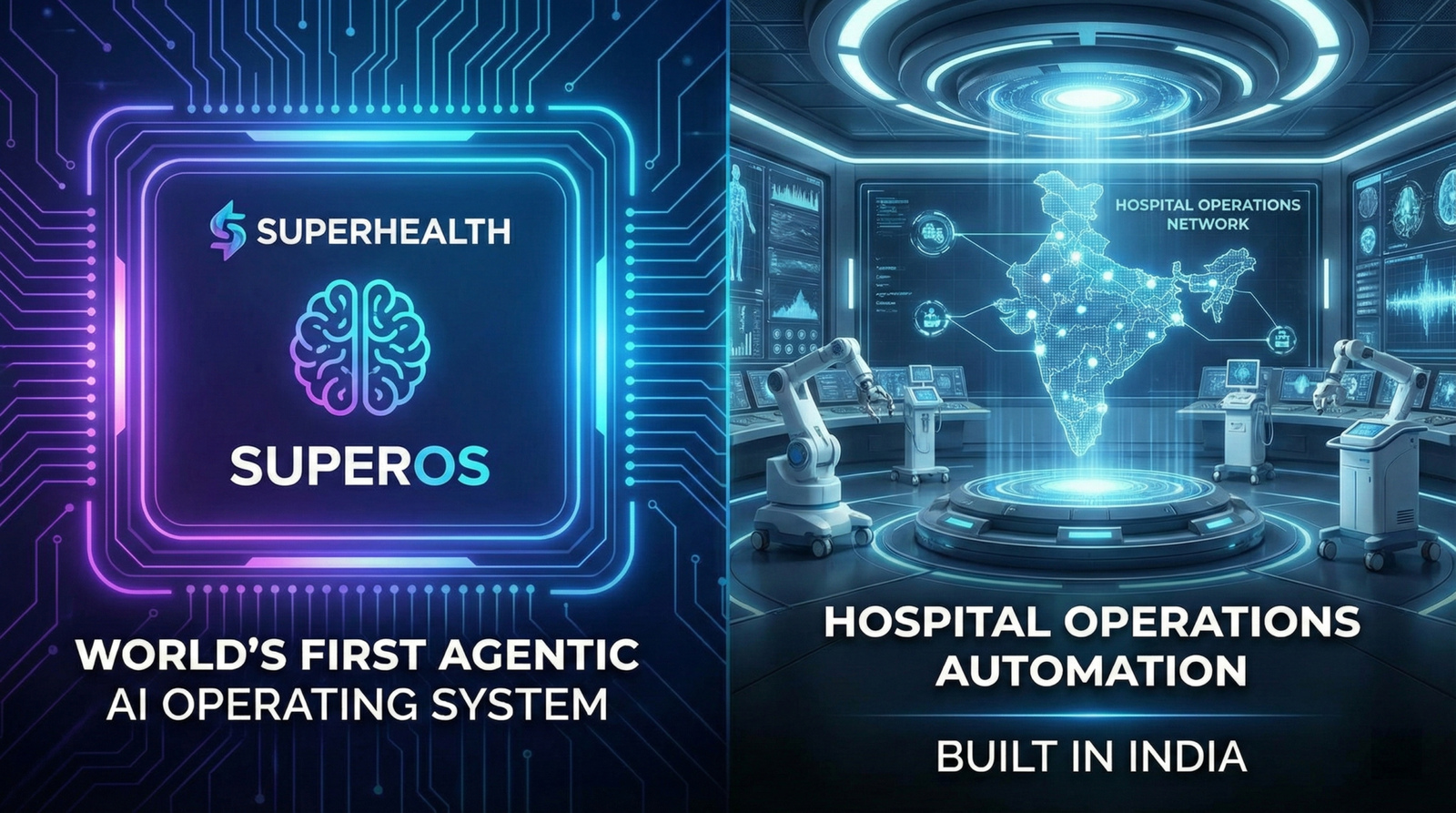
On February 11, 2026, Bengaluru-based healthcare company Superhealth introduced SuperOS — claiming the title of the world’s first agentic AI operating system built to run an entire hospital. Not to assist a hospital. Not to add a feature to an existing hospital management system. To operate one. The distinction matters enormously. Superhealth builds, operates, and owns its hospitals — giving it a uniquely closed-loop environment to embed AI not as a layer on top of existing systems, but as the foundational intelligence that the entire hospital runs on. SuperOS is currently live and operational at Superhealth’s flagship hospital in Koramangala, Bengaluru — running day-to-day, at production scale, for real patients. Founder and CEO Varun Dubey framed the ambition plainly:
“SuperOS is the world’s first agentic AI operating system built to actually run a hospital — from clinical decisions to operations, from labs to discharge, from OT assignments to auto prescriptions, it does it all. It understands doctors, nurses, patients, and 15 Indian languages, and it orchestrates outcomes with humans and AI agents in real time. This is not software that merely assists healthcare. This is technology that operates healthcare.” — Varun Dubey, Founder & CEO, Superhealth
WHAT ‘AGENTIC AI’ MEANS IN A HOSPITAL CONTEXT (PLAIN ENGLISH)
| Most AI tools are reactive: you give them an input, they give you an output. An AI that helps a doctor write a discharge note is reactive. An AI radiology tool that flags a tumour is reactive.
Agentic AI is proactive: it takes actions, coordinates other systems, assigns tasks, makes decisions, and loops back on results — without being told to do each step. It has goals, not just instructions. In a hospital context, agentic AI means: when a patient books surgery, SuperOS doesn’t just log it. It immediately begins coordinating the surgeon’s schedule, anaesthesia team, OT room assignment, equipment availability, pre-op labs, recovery room, and post-op care — simultaneously, without a human coordinator managing each thread. It assigns tasks to both AI agents and human staff in real time, monitors the patient throughout, and adjusts when things change. This is the difference between a hospital management software (reactive, passive, human-driven) and a hospital operating system (proactive, agentic, AI-driven). Superhealth is claiming the latter. |
SuperOS: 7 Modules That Run the Entire Hospital
| # | Module | What It Actually Does |
| OPD AI Co-Pilot | Ambient AI listens to doctor + patient consultations in 15 Indian languages. Surfaces past prescriptions, scans, tests. Suggests clinical considerations. Auto-drafts prescriptions for doctor approval. Optimises appointment slot durations by visit type (first consult vs. follow-up vs. post-surgery). Zero queues at pharmacy — medicines sent directly to consultation room. | |
| Diagnostic AI (Radiology + Pathology) | Traditional PACS server eliminated. Fibre-optic image transfer to Superhealth Cloud. AI performs instant 3D volumetric analysis across CT, MRI, X-ray. Detects: intracranial haemorrhage, fractures, implant positioning, pneumothorax, oncology markers. Result: 30% faster radiology reporting. Radiologist reviews annotated AI output rather than raw scans — effectively tripling specialist capacity. | |
| OT & Surgical Coordination | When surgery is booked, SuperOS immediately coordinates surgeon availability, anaesthesia team, OT room assignment, equipment allocation, recovery room readiness. Dynamic real-time adjustments if any variable changes. Eliminates manual OT scheduling via whiteboard or phone calls. | |
| ICU & Inpatient Monitoring | Continuous real-time monitoring of all admitted and ICU patients with personalised alert thresholds. A marathon runner’s resting heart rate of 48 bpm does NOT trigger a false alarm — SuperOS learns individual baselines and detects meaningful deviations within ‘normal’ ranges. Reduces alert fatigue while improving patient safety. Doctors retain full override control. | |
| Pharmacy & Inventory Management | Medicines, phlebotomists, and blood draw kits coordinated and sent directly to the consultation room — patient never queues at pharmacy. Zero-paper prescription system with automatic drug-drug interaction checks and clinician alerts before adverse events. Inventory tracked and restocked predictively. | |
| Magic Discharge | Automated discharge summaries generated in real time from the entire patient journey — consultation notes, surgery records, medications, lab results, follow-up instructions. Zero manual paperwork. Discharge that previously took hours reduced to minutes. Post-discharge care protocols monitored remotely. | |
| 100% Clinical Audit Layer | Every clinical interaction — every consultation, every prescription, every diagnostic decision — is audited in real time by SuperOS. This is not a compliance checkbox. It is a continuous quality-improvement loop where corrections by specialists feed back into the system, improving accuracy over time. India’s first hospital-wide 100% clinical audit at production scale. |
SuperOS by the Numbers — What the Data Shows
| 30%
Faster Radiology Reporting |
AI flags anomalies in seconds rather than requiring manual scan-by-scan review. Radiologist reviews an annotated, pre-analysed image rather than a blank scan. Each radiologist effectively handles 3x the patient volume at the same quality bar. |
| 3x
Specialist Capacity Multiplier |
India’s 6,000 radiologists now serve the equivalent workload of 18,000 — without hiring a single additional specialist. For a country with a structural specialist shortage, this is not an incremental improvement. It is a category shift. |
| 100%
Clinical Interactions Audited |
Every consultation. Every prescription. Every diagnostic decision. Zero sampling. This is the first time any Indian hospital has achieved full-coverage clinical auditing at production scale — a standard that most hospitals in developed markets do not meet. |
| 15
Indian Languages Supported |
Hindi, Tamil, Telugu, Kannada, Malayalam, Bengali, Gujarati, Marathi, Punjabi, Odia + more. The ambient AI understands both the doctor and the patient — even when they switch languages mid-consultation, as they routinely do in Indian clinical settings. |
| 100
Hospitals by 2030 |
5,000 beds. 50,000 healthcare jobs. SuperOS is not a single-hospital proof of concept. It is infrastructure for a national hospital network, with Bengaluru as the live template. |
Why Only Superhealth Could Build This — The Full-Stack Advantage
Every other healthcare AI company in India builds software and tries to sell it to hospitals that were not designed for it. They end up with an AI layer bolted onto a legacy HIS (Hospital Information System) that runs on Oracle databases from 2003, paper forms, and siloed departments that do not talk to each other. The AI becomes another tool that doctors ignore after week two.
Superhealth’s structural advantage is that it designs, builds, and operates its own hospitals — while simultaneously building the technology that runs them. This means SuperOS was not written to interface with a hospital. It is the hospital’s intelligence layer, architected from day one to be the operating system rather than an add-on. As Dubey put it:
“We design, build and operate hospitals while also building all the technology that runs them. This allows us to create AI that is deeply embedded in real clinical environments, rather than layered on top as an add-on.” — Varun Dubey, Founder & CEO, Superhealth
Superhealth vs. Traditional Health-Tech
|
India’s AI Moment — Why SuperOS Lands Right Now
The launch of SuperOS is timed, intentionally or not, to land in the middle of India’s biggest AI week ever. The India AI Impact Summit 2026 (February 16–21, Bharat Mandapam) saw $200+ billion in AI investment commitments, three sovereign Indian LLMs launched (Sarvam 30B/105B, BharatGen Param 2, Gnani Vachana), and PM Modi articulating India’s AI vision as ‘Sarvajana Hitaya, Sarvajana Sukhaya’ — Welfare for All, Happiness for All. Within that context, SuperOS is the most tangible proof point that Indian AI is not just being built for enterprise SaaS or government infrastructure — it is being built for life and death decisions, at hospital scale, in Indian languages, for Indian patients.
The Global Context: India vs. the World’s AI Health Ambitions
|
DATA SOVEREIGNTY — BUILT IN INDIA, STORED IN INDIA
At a moment when data sovereignty is the defining theme of India’s AI policy agenda — from ISM 2.0 to the IndiaAI Mission to Budget 2026’s data centre tax holiday — SuperOS makes three concrete commitments:
This is not just a regulatory compliance checkbox. For a country that watched its UPI data generate economic value for global platforms, and whose patients are now asking why their medical records are stored in AWS servers in Singapore, Superhealth’s data sovereignty architecture is a genuine differentiator. |
STARTUPFEED INSIGHT
| The Big Picture: The global race for the ‘AI hospital OS’ was assumed to be won by either an American EHR giant (Epic, Oracle Health) or a Chinese national AI programme. Superhealth’s launch positions India as a surprise contender — not through government mandate, but through a private startup that took the hardest possible approach: owning the hospital first, then building the OS for it. If SuperOS delivers what it claims at scale, the playbook becomes exportable. Every hospital system in Southeast Asia, the Middle East, and Africa faces the same structural problems India does: specialist shortages, language diversity, paper-heavy workflows, and limited budgets. A frugal, multilingual, agentic hospital OS built in India is not just an Indian product. It could be global healthcare infrastructure. | |
| For Founders: | The full-stack vertical integration model — own the end market, build the technology, capture the data loop — is the only defensible architecture for deep healthcare AI. Half-measures (selling software to hospitals that aren’t designed for it) will always lose to the company that designed the hospital for the software. |
| For Investors: | SuperOS is currently pre-funding news. Watch for a Series A announcement in Q2 2026. The natural investor profile: a healthcare-focused PE (Manipal Health, Columbia Asia vintage), a deep tech fund (Chiratae, Blume, Eight Roads), or a strategic like Siemens Healthineers or Philips Healthcare. The 100-hospital / 5,000-bed expansion plan is the fundraising narrative. |
| For Policy Makers: | SuperOS validates the IndiaAI Mission’s sovereign AI vision in the most high-stakes domain possible. The government’s next move: earmark a share of the $1.1 billion AI VC Fund specifically for healthtech AI startups building in Indian languages with Indian clinical data. The DLI Scheme works for chips — a Healthcare AI Linked Incentive (HALI) Scheme could do the same for clinical AI. |
| Our Prediction: Superhealth will announce its Series A funding (estimated ₹150–250 crore) before Diwali 2026, with at least one international strategic investor on the cap table. SuperOS will be licensed to its first non-Superhealth hospital by Q4 2026 — proving the model can extend beyond the closed-loop system. By 2028, SuperOS will be the operating system of choice for greenfield hospital builds across Tier 2 India. And by 2030, when Superhealth’s 100-hospital network is operational, it will be the world’s largest agentic AI-native hospital chain — a global first that originated in Koramangala. | |