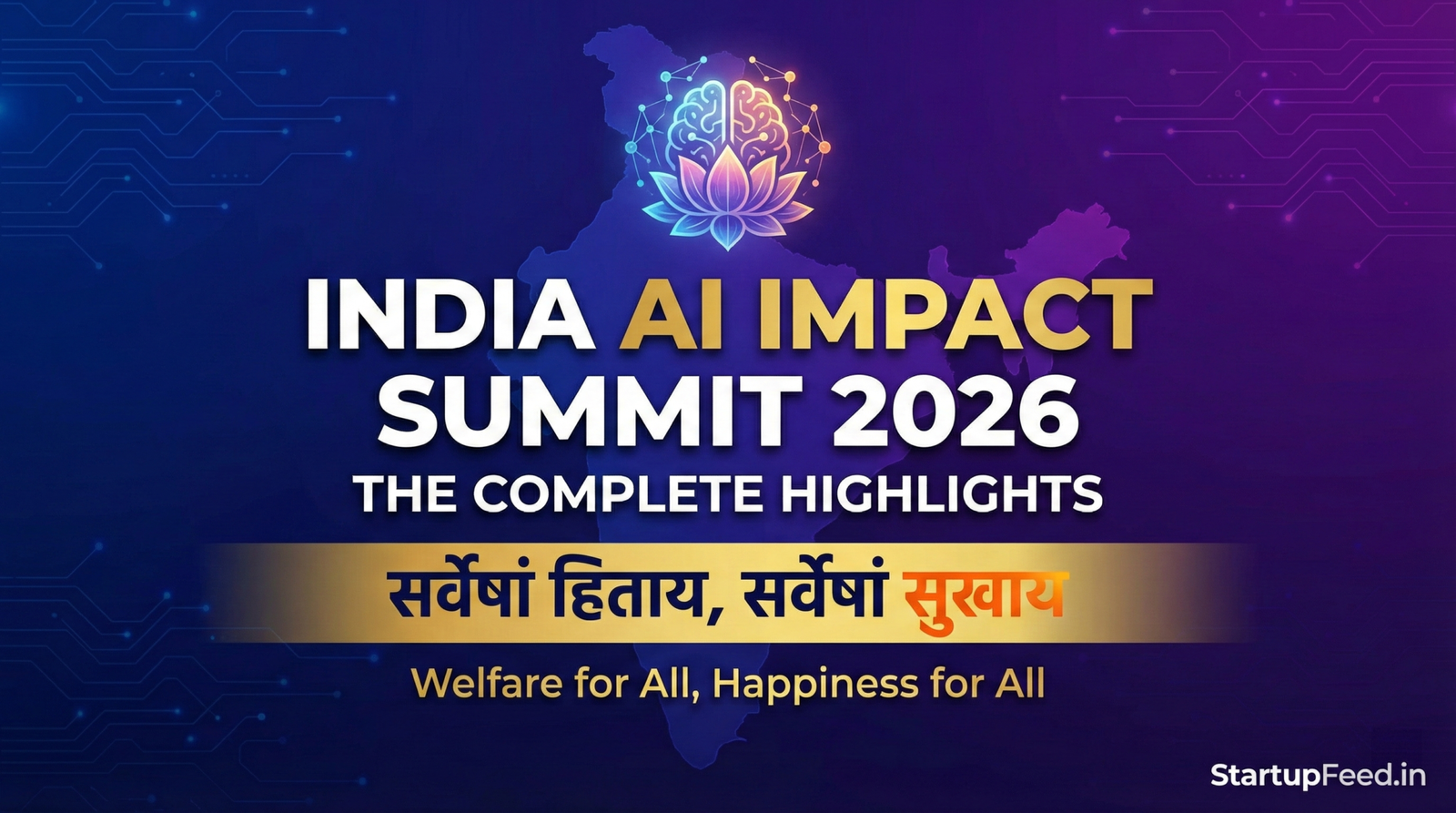

This was the fourth in the global AI summit series—after Bletchley Park (2023), Seoul (2024), and Paris (2025)—and the first ever hosted by a Global South nation. India’s pivot was intentional: while the earlier summits were framed around AI “Safety” and “Action,” India rebranded this one as AI ““Impact”—shifting the conversation from governance and guardrails to deployment, democratization, and measurable outcomes for the 6 billion people outside the Western AI bubble.
PM Modi’s tagline: “Sarvajana Hitaya, Sarvajana “Sukhaya”—Welfare for All, Happiness for All.
The Star-Studded Room
The who’s who of global AI and geopolitics descended on New Delhi:
Tech CEOs: Sam Altman (OpenAI), Sundar Pichai (Google), Dario Amodei (Anthropic), Demis Hassabis (Google DeepMind), Brad Smith (Microsoft), Yann LeCun (Meta), Cristiano Amon (Qualcomm), Mukesh Ambani (Reliance), Nandan Nilekani, Vinod Khosla
Heads of State: PM Narendra Modi (India), President Emmanuel Macron (France—whose visit elevated India-France ties to a “Special Partnership”), President Luiz Lula da Silva (Brazil), UN Secretary-General António Guterres, UK Deputy PM David Lammy, former UK PM Rishi Sunak (who quipped: “AI can do many things, but can’t fix Delhi’s traffic”)
Notable absence: Jensen Huang (Nvidia CEO) pulled out last minute, citing “unforeseen circumstances”—Nvidia sent EVP Jay Puri instead. Bill Gates also canceled his keynote session.
Luxury/Lifestyle angle—Chanel: Yes, Chanel had representation at the Summit’s Finance and Philanthropy Plenary at The Oberoi New Delhi on February 18, as part of the broader engagement of European luxury and fashion houses exploring AI in design, supply chain sustainability, and customer experience. The luxury sector’s presence underscored that this was not just a tech summit—it was a geopolitical and economic convening.
The $200+ Billion Investment Avalanche
This is where the summit will be remembered. The combined investment commitments announced during the five days exceeded $200 billion—the largest single-event AI investment clustering ever seen in the Global South.
Adani Group announced $100 billion for AI data centers powered by renewable energy across India by 2035, with an additional $150 billion expected in server manufacturing, advanced electrical infrastructure, and sovereign cloud platforms.
Microsoft committed $50 billion by the end of the decade for AI infrastructure across the Global South, covering data centers, skilling initiatives, and language-focused AI systems. Microsoft’s Brad Smith also outlined an “unbundling” framework for enterprise AI deployment.
Google announced the America-India Connect initiative—new strategic fiber-optic cables connecting the US, India, and multiple locations across the Southern Hemisphere. Sundar Pichai also confirmed partnerships with Reliance Jio for cloud clusters in India and a 50 MW renewable energy project in Rajasthan to power AI data centers. Separately, Google pledged a $30 million Google.org AI for Government Innovation Challenge and another $30 million for AI for Science, plus the Google Center for Climate Technology in partnership with India’s Principal Scientific Advisor.
Blackstone led the $600 million equity round in Neysa (as covered in our earlier articles) — the single most significant foreign PE commitment to Indian AI cloud infrastructure.
NVIDIA had the most operationally dense announcement slate despite Huang’s absence. The NVIDIA-L&T joint venture to build gigawatt-scale AI factory infrastructure (30 MW in Chennai, 40 MW in Mumbai) was announced. NVIDIA also signed a $2 billion partnership with Yotta Data Services to deploy 20,000+ Blackwell Ultra GPUs for Yotta’s Shakti Cloud. NVIDIA additionally tied up with Peak XV Partners and Accel India for co-investment in AI startups.
Qualcomm announced its $150 million Strategic AI Venture Fund (covered in our earlier article).
TCS-AMD: AMD expanded its partnership with TCS to deploy up to 200 megawatts of AI infrastructure capacity in India.
The Indian government earmarked $1.1 billion (₹10,000 crore) for a state-backed venture capital fund of funds under the IndiaAI Mission, specifically targeting AI and advanced manufacturing startups.
Anthropic confirmed India as its second-largest market for Claude AI globally (revenue doubling since October 2025), opened its first India office in Bengaluru (second Asian office after Tokyo), and announced partnerships with Karya, the Collective Intelligence Project, and Indian nonprofits Digital Green and Adalat AI to build locally relevant AI evaluations.
OpenAI announced 100 million weekly active ChatGPT users in India — its second-largest market after the US. Sam Altman announced the OpenAI for India initiative, partnerships with TCS (ChatGPT Enterprise + Codex), Pine Labs (agentic payments), Eternal/Zomato group (Blinkit, District, Hyperpure), ixigo (500M+ travel consumers), and 100,000+ ChatGPT Edu licenses for IIMs, AIIMS, Manipal, UPES, and Pearl Academy. JioHotstar’s ChatGPT voice search integration was also announced here (our earlier article).
India’s Sovereign AI Moment — 3 Homegrown Models Launched
The most strategically significant domestic announcements came from India’s own AI builders:
Sarvam AI unveiled two open-source LLMs trained entirely in India from scratch: Sarvam-30B (named Vikram, after Vikram Sarabhai) trained on 16 trillion tokens, designed for real-time conversation and agentic workflows; and Sarvam-105B, a Mixture-of-Experts architecture for complex reasoning. Both support all 22 scheduled Indian languages. Benchmarks showed the models competing with Gemma 27B, Mistral-32-24B, and Qwen-30B. Sarvam also launched Kaze smart glasses—India’s first made-in-India AI wearable—which PM Modi tried at the expo. Total spend to build the models: ~$25–30 million—a fraction of what US counterparts spent. Sarvam co-founder Vivek Raghavan pointedly called out Big Tech’s free model strategy as “dumping” and called on the government to become the first domestic buyer of Indian AI.
Gnani.ai launched Vachana TTS — a zero-shot voice cloning text-to-speech system that clones any voice in 12 Indian languages using fewer than 10 seconds of audio, preserving pitch, timbre, and speaking style across every language. The company already processes 10 million calls per day.
BharatGen (a government-backed consortium) released Param 2—a 17-billion parameter multimodal model supporting 22 Indian languages, designed for governance, education, healthcare, and offline deployment in low-connectivity areas.
Pax Silica — India Joins the US-Led Semiconductor Alliance
On February 20, India formally joined Pax Silicona—a US-led coalition for semiconductor supply chain resilience and chip manufacturing cooperation. The move, timed to coincide with the summit’s closing day, has significant implications for India’s electronics and semiconductor industry. It deepens the US-India technology partnership, accelerates semiconductor policy execution under ISM 2.0, and sends a geopolitical signal to China about India’s alignment in the global chip supply chain.
The Government’s “Whole-of-Nation” AI Stack
Union Minister Ashwini Vaishnaw outlined India’s frugal, sovereign, scalable AI strategy:
The government announced 20,000+ additional GPUs on top of the existing 38,000-GPU cluster under the IndiaAI Compute Portal—available to startups and researchers at ₹65/hour (one-third the global average). The DLI Scheme now supports 24 semiconductor design startups with ₹430 crore in VC attracted. The IndiaAI Mission’s MANAV framework (covered in our earlier PM Modi CEO Roundtable article) was formally presented as India’s governance framework for responsible AI. India also set a Guinness World Record—250,946 AI responsibility pledges in 24 hours—in partnership with Intel India.
The Controversies That Couldn’t Be Ignored
No event of this scale escapes without some chaos. Galgotias University caused a national embarrassment when a representative presented the Unitree Go2 — a commercially available Chinese robot dog—as an indigenous Indian development. IT Secretary S. Krishnan had to publicly state that exhibitors were not supposed to showcase products that weren’t their own. The university was ejected from the expo. Bloomberg reported that delegates were left stranded without food or water during a security lockdown ahead of PM Modi’s arrival on February 19. A Bengaluru entrepreneur alleged his wearable products were stolen from the venue (later recovered by Delhi Police). Critics noted the Summit was used heavily for government PR and questioned whether the focus had shifted too far from AI safety to AI optics.
What This Means for India’s AI Future
The summit was, at its core, a geopolitical declaration as much as a technology event. India’s message to the world: We are not just a market for your AI—we are building our own. The $200 billion+ in commitments, three sovereign models, Pax Silica membership, ISM 2.0, and the global convening power India demonstrated all point to one trajectory.
By 2030, India is targeting a $100–110 billion semiconductor market, sovereign AI deployed in hospitals and courts running offline on Indian infrastructure, GPU compute accessible to every startup at one-third global cost, and at least one Indian AI company competing on the global LLM leaderboard. The summit didn’t solve any of those ambitions—but it made them undeniably, publicly, and irreversibly official in front of 100+ countries and the entire global AI power structure. That, in itself, is how national AI destinies are shaped.
India hosted the world’s most consequential AI gathering of 2026, extracted $200 billion in commitments, launched its own sovereign LLMs, joined Pax Silica, and served notice that the Global South is no longer just consuming AI — it’s building it.